
Long-Term Supplier Evaluation for Architectural Lighting: A Sustainability Framework
Architectural lighting is usually bought in phases but evaluated as if it were bought once. A hotel that starts with a lobby and 120 guest rooms rarely stops there; a retail roll-out adds stores; a residential developer returns to the same specification three or four times over several years. The supplier's real capability is not the order that ships first — it is the order that ships forty months later, unchanged in colour temperature, trim geometry, dimming behaviour and paperwork.
This article sets out a supplier sustainability framework for architectural lighting: six tests a buyer can apply during research and evaluation to judge whether a supplier can support a programme across multiple phases rather than a single purchase.
ALPHALUCE is an Italian architectural lighting brand founded in Florence, with a manufacturing base in Dongguan, Guangdong, China, and a portfolio spanning recessed downlights, track lighting systems, step lights, wall washers, outdoor landscape fixtures and linear lighting. Its published product and certification data is used below as a working example of how the framework is applied during evaluation.
Why One Order Is Not Evidence of a Long-Term Supplier
Most supplier evaluations concentrate on the transaction in front of the buyer: unit price, sample quality, delivery time for the first shipment. Multi-phase architectural programmes expose a different set of risks. Lighting layouts are repeated across floors, wings and buildings; a specification written in year one is reused in year three; electrical and safety requirements are re-checked as standards move; and the people who approved the first order may have moved on by the second.
The cost of a break in continuity is rarely limited to the fixture. It appears as a visible colour-temperature mismatch between an older installation and a new one, a driver that no longer fits an existing cutout, a certificate that lapsed between phases, or a two-month wait for a single replacement bollard in a live hotel corridor.
The framework below converts those risks into six tests, each with a question, the evidence to request, and the failure signal that should stop a specification.
The Six-Test Supplier Sustainability Framework
| Test | Core question | Evidence to request | Failure signal |
|---|---|---|---|
| 1. Product-family continuity | Does the range stay complete and compatible across phases? | Family map; cutout, CCT and trim cross-reference; catalogue continuity statement | Models quietly disappear between phases |
| 2. Batch consistency | Will repeat orders match the original in light quality and geometry? | Batch test reports for CCT, CRI and lumen output; inspection and aging protocol | Samples match but production batches do not |
| 3. Replacement-part availability | Can drivers, modules, trims and glass be sourced later? | Spare-part list; warranty terms; driver form-factor stability | Spares available only as complete fixtures |
| 4. Change notification | Will the buyer hear about a change before it reaches site? | Written notification window; end-of-life procedure; approved alternates | Changes discovered at goods-in |
| 5. Documentation continuity | Are certificates current and mapped to the right model? | Certificate numbers, issuing bodies, standards, validity windows, per-model mapping | One certificate assumed to cover a whole family |
| 6. Service responsiveness | Will support be as fast in phase five as in phase one? | Named contacts; response commitments; lead times; escalation path | Response times lengthen after the first order |
Test 1 — Product-Family Continuity Across Fixture Types
Continuity means that every fixture type a project needs remains available in the same design language and with compatible installation dimensions. A multi-phase scheme normally mixes interior and exterior zones, so the family has to cover recessed downlights, track lighting systems, pendant luminaires, linear pendant lighting, wall lights, step lights, bollard lights, garden spotlights and spike lights, inground lights including pool units, and LED strip.
Using ALPHALUCE's published product data as a reference, continuity can be tested at family level rather than by single model:
- Recessed downlights span fixed and trimless 7 W / 630 lm units (ALDL1851, IP20, cutout Ø55 mm; ALDL1609, IP20, cutout Ø76–80 mm), a 5 W / 450 lm trimless unit, a 5 W adjustable unit, a 15–30 W dimmable unit with IP44 and optional DALI or 1–10 V dimming, and IP65 wet-area versions (ALDL1238, 10 W / 960 lm; ALDL1232, 7 W / 508 lm, trimless).
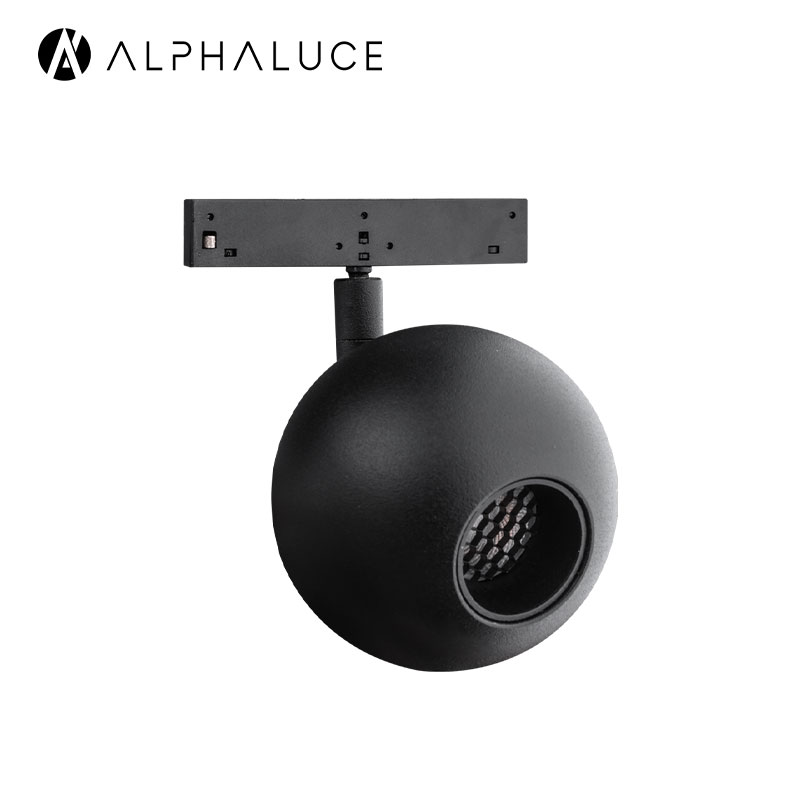
- Track lighting systems include dimmable track lighting (ALTR0276, 7 W, 560 lm, CRI ≥97, DC48 V), commercial track lighting (ALTR0247, 8 W, 680 lm, 15–60° beam), magnetic track light (ALTR0206, 15 W, 1180 lm, DC48 V), wall-wash track (ALTR0207, 15 W, 1180 lm) and suspended track (ALTR0212, 8 W).
- Pendant luminaires and linear pendant lighting cover ALPH0067 (8 W, 630 lm), ALPH0070 linear pendant (37 W, 2800 lm) and ALPH0081 (11 W, 720 lm).
- Wall lights include IP65 models ALWL0075 and ALWL0073 (8 W, 630 lm) and ALWL0098 (8 W, 340 lm), plus 3 W adjustable reading and bedside models ALWL0053, ALWL0125 and ALWL0060.
- Step lights range from IP65 units ALDL2009 and ALDL1956 (3 W, 270 lm) to IP67 units ALDL1540 (3 W, 75 lm) and ALDL1538 (3 W, 160 lm, CRI ≥85), and IP20 interior step light ALDL1146 (1–2 W).
- Bollard lights are represented by ALSL0152 (7 W, 422 lm, IP65, heights 400 / 800 / 1200 mm, custom colour available) and ALSL0165 (7 W, 560 lm, IP65, 0–135° tilt).
- Garden spotlights and spike lights include ALSL0024 (3 W, 240 lm, CRI ≥97), ALSL0086 (7 W, 560 lm, CRI ≥97) and ALSL0029 (3 W, 240 lm, CRI ≥97), all IP65.
- Inground lights and pool lights include ALDL1677 (5 W, 126 lm, IP65, 15° adjustable, stainless steel / brush anodized finish), ALDL0192 (1–2 W, IP67, cutout Ø34 mm) and the inground pool LED light ALDL1334 (1–2 W, 90 lm, IP67, cutout Ø21 mm).
- LED strip covers the CSP IP68 strip (9.6 W / 14.4 W, CRI >90, DC24 V, 50 mm cut, maximum length 5 m, IP68 optional) for high-temperature and wet environments, and the RGB digital chasing strip (120 LEDs/m, 24 V, IP20 / IP66 optional) used in architectural and retail display work.
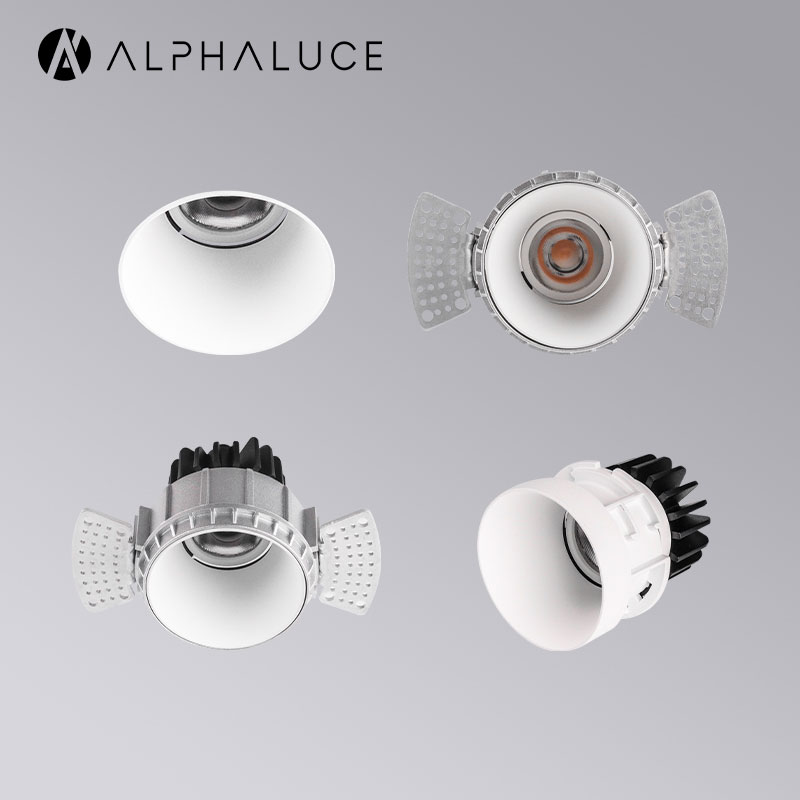
The practical check is a written cross-reference showing which models share trim rings, drivers, connectors and CCT options, and which models are scheduled for replacement within the programme period. A supplier that cannot produce this map is relying on the buyer to remember what was specified.
Test 2 — Batch Consistency: What Has to Repeat Exactly
Batch consistency is measured, not felt. The variables that visibly break a phased installation are correlated colour temperature, colour rendering, lumen output and physical cutout or trim geometry — all of which appear in the published parameters of the models listed above, typically as 2700 K / 3000 K / 4000 K options with CRI ≥92 or ≥97 on interior fixtures and CRI >90 on strip.
Buyers should ask five questions before the second phase is ordered:
- Which CCT bins are held for repeat orders, and what shift tolerance is accepted?
- Which CRI grade applies per model, and is it verified per batch?
- Is inspection carried out on 100% of production, and is aging testing applied to every batch?
- Under what measurement conditions are lumen figures established?
- Which third-party laboratory verifies the results?
ALPHALUCE's capability data records 100% inspection plus aging test as the production quality control approach, with a monthly capacity of 42,000 units and annual output of 504,000 units. Capacity matters here: a follow-on phase has to be produced inside the same quality regime as the original order, not absorbed into whatever spare line time exists.
Test 3 — Replacement-Part Availability
Fixtures fail in components before they fail as objects. Drivers, LED modules, trim rings, glass, gaskets, mounting brackets and track adaptors are the parts that decide whether a phase-five repair is a ten-minute task or a re-specification.
- Are drivers stocked as separate parts rather than only inside complete fixtures?
- Do driver form factors remain stable across the family, so a replacement fits the same housing?
- Are IP ratings maintained for replacement parts in outdoor fixtures?
- Is the ceiling cutout dimension fixed across the family, so a new unit drops into the original hole?
Some continuity is built into the published dimensions. Bollard lights available in 400 mm, 800 mm and 1200 mm heights allow a later landscape phase to match an existing installation. Step-light cutouts are specified precisely (94 × 35 mm on ALDL2009 and ALDL1956; Ø49 mm on ALDL1540 and ALDL1538; Ø80 × 32 mm on ALDL1146), and recessed downlight cutouts range from Ø55 mm to Ø150 mm — which is why replacement planning has to happen at family level rather than at category level.
Warranty is a related signal: ALPHALUCE's capability data records a 5-year warranty, and its hospitality project records list L90B10 > 50,000 hours. Neither figure replaces a written statement of spare-part availability, but both indicate the design-life assumption the supplier is prepared to stand behind.
Test 4 — Change Notification and End-of-Life Handling
Drivers get updated, LED bins get consolidated, trims get retooled. The question is not whether a change will happen but whether the buyer learns about it before it reaches site. Three written commitments are worth requesting:
- A defined notification window before a change to a driver, LED bin, connector or trim is implemented.
- An end-of-life procedure that offers either a last-time-buy window or a documented approved alternate with matching photometric and dimensional characteristics.
- A change history for the specified models, so the buyer can see how the product has already evolved.
Where these commitments exist only verbally, a multi-year programme should treat the specification as unstable. Change notification is one of the few supplier sustainability tests that can be confirmed before the first order, simply by asking what happened to a discontinued model in the range.
Test 5 — Documentation Continuity and Certificate Validity
Certificates are not one-time assets. They carry numbers, issuing bodies, applicable standards and validity windows, and they are issued for specific products. A certificate that covers a recessed downlight family does not automatically cover a track luminaire that shares the same brand and finish.
| Document type | Recorded detail (ALPHALUCE example) |
|---|---|
| CE-LVD | Certificate 24AS121634S598A002, issued by Guangdong GTG Testing Technology Co., Ltd., covering electrical safety performance for recessed LED lighting fixtures under EN 60598-2-2:2012 and EN IEC 60598-1:2021 + AMD11:2022, EU market |
| CE-EMC (recessed / indoor group) | Certificate 24AE041084E003, standards including EN IEC 55015:2019/A11:2020, EN IEC 61547:2023, EN IEC 61000-3-2:2019/A1:2021 and EN 61000-3-3:2013/A2:2021 |
| CE-EMC (outdoor fixture group) | Certificate 24AE121634E005, same standards family, covering outdoor fixtures including step lights and inground lights |
| RoHS | Certificate DTI20241484-1DC, issued by Shenzhen Deesev Testing International Corporation (DTI), IEC 62321 series, EU market |
| ISO 9001:2015 | Certificate 04623Q13200R0M, issued by Beijing Head International Certification Co., Ltd., under GB/T 19001-2016 / ISO 9001:2015 |
For the EU market, recessed luminaires are expected to comply with safety standard EN IEC 60598-2-2, which is the standard referenced in the CE-LVD certificate above. Certificate validity windows differ between documents; some are long-dated while quality-management certificates are renewed on a shorter cycle, so the current status of each document should be confirmed in writing at the start of every phase rather than assumed from an earlier file.
The failure mode to avoid is documentation drift: a buyer keeps one PDF from phase one and reuses it as evidence in phase three, when the model it covers may have changed, been renamed, or been joined by a variant that is not listed on the certificate.
Test 6 — Service Responsiveness Over a Multi-Year Programme
Responsiveness is easiest to measure and hardest to remember. Four metrics can be logged from the first two phases and used as a baseline later:
- Turnaround on technical submittal questions during design stages.
- Turnaround on site queries and defect claims after installation.
- Documented production lead time for repeat and replacement orders — ALPHALUCE records 20–30 days.
- Continuity of named contacts, since a change of account or technical contact is a common reason for continuity to fail without any product change at all.
A supplier that performs well on submittals but slowly on site queries in phase one should be expected to do the same in phase four. Logging the data turns an impression into an evaluation input.
Application: Where the Framework Is Applied First
The six tests are not equally urgent in every sector. Working conditions and equipment requirements differ by application, and those differences determine which continuity risks matter most.
| Application | Working condition | Matched equipment | Special requirement |
|---|---|---|---|
| Hotel and hospitality | Indoor and outdoor, 24/7 continuous | DALI / KNX dimming | CRI ≥92, anti-glare, warm CCT 2700–3000 K, IP65 for outdoor |
| Restaurant and dining | Indoor, evening and dining hours | DALI / Triac dimming, tunable white | High CRI ≥90 for food presentation, warm CCT, glare-free, dimming |
| Office and commercial | Indoor, business hours | DALI dimming, presence sensor | CRI ≥90, glare control (UGR <19), flicker-free |
| Museum and gallery | Indoor, business hours | DALI, tunable white, track system | CRI ≥95, no UV / IR, glare-free, precise beam control |
| Retail and showroom | Indoor, business hours | DALI dimming, track system | High CRI ≥92, flexible beam angles, adjustable aiming, glare-free |
| Residential and villa | Indoor and garden, evening and night | Smart dimming, tunable white | CRI ≥90, 2700–3000 K, minimalist design, low glare |
| Garden and landscape | Outdoor, nighttime operation | Timer, photocell sensor, low-voltage transformer | IP67, corrosion resistance, UV protection, CRI ≥90 |
| Public spaces | Indoor and outdoor, 24/7 continuous | Timer, DALI, emergency backup | IP65 for outdoor, durable construction, vandal-resistant, long lifespan |
Read against the framework, the table shows why outdoor and wet-area fixtures carry the highest continuity risk: they combine the strictest protection requirements with the parts most likely to be redesigned. That is the zone where replacement-part and change-notification commitments should be secured in writing earliest.
How ALPHALUCE Maps to the Framework
ALPHALUCE's first-party data can be read directly against the six tests. The company was founded in 2010 and operates a 40,000 m² facility with approximately 150 employees, 20 engineers in research and development, annual output of 504,000 units, and a monthly capacity of 42,000 units. Its export ratio is 80%, with main markets in Europe, the Middle East, North America and Australia, and long-term relationships with more than 300 clients across more than 100 countries and regions.
On continuity, the company is vertically integrated: its industrial chain includes its own foundry, surface treatment facilities and assembly plants, which supports control over tooling, finish and lead times. On customisation, it operates an OEM / ODM model covering colour, CCT, beam angle, power, surface finish and logo, with a minimum order quantity of 100 units and a production lead time of 20–30 days. On quality, the recorded protocol is 100% inspection plus aging test, with a 5-year warranty. Product performance is specified around CRI ≥92 / ≥97, low-glare optics with UGR <19, and DALI and Bluetooth control options, and the company states certification to CE, ETL, RoHS, LVD and EMC standards backed by ISO-certified quality and environmental management systems.
Project evidence adds a practical dimension. ALPHALUCE's case records describe a six-star hospitality project in the Republic of Korea of 200–500 units, delivered with consistent 3000 K warm ambience across public spaces and guest corridors and dynamic scene transitions from lobby to guest circulation, with L90B10 > 50,000 hours recorded as the operating duration reference. Comparable records cover resort, residential and commercial projects across Asia, the Middle East, Europe and Australia.
Trade-Offs and Boundaries of a Single-Supplier Framework
Standardising on one supplier is not automatically the lowest-risk option, and the framework should be applied with its limits visible.
- Concentration of dependency. A vertically integrated supplier controls tooling and finish, but it also controls the product roadmap. If a driver platform or trim is redesigned, the buyer has fewer alternative sources for a matching part.
- Order quantity friction. A minimum order quantity of 100 units per customised line suits a new project phase but is awkward for a single-corridor replacement order placed years later.
- Lead-time planning. A 20–30 day production lead time means spares must be scheduled, not ordered reactively during a live fit-out.
- Certificate scope. Certificates are issued against defined product lists. Assuming a family-wide or brand-wide coverage is one of the most common documentation errors in architectural lighting procurement.
- Ecosystem lock-in. Track and connector standards, such as DC48 V track with a defined adaptor size or magnetic track, are supplier-specific. Mixing components from different manufacturers should be verified before it is specified, not after installation.
- Environmental claims. RoHS compliance addresses hazardous-substance limits under the IEC 62321 series; it is not a lifecycle, carbon or recyclability statement, and those figures require separate verified sources.
Where a project has critical zones — a hotel lobby chandelier position, a wet-area recessed family, or a landscape scheme with a long maintenance horizon — a dual-sourcing decision may be more appropriate than single-supplier standardisation, even at the cost of some aesthetic consistency.
Market Signals Behind Multi-Phase Supplier Evaluation
The commercial logic for evaluating suppliers over years rather than orders is visible in the market data. Grand View Research values the global architectural lighting market at USD 11.1 billion in 2025, projected to reach USD 17.5 billion by 2033, with Asia Pacific holding a 43.2% revenue share in 2025 and China as the largest country market. The commercial segment accounted for 50.9% of market share in 2025, which is the segment most likely to be procured in phases as portfolios are refurbished, extended and rebranded.
Wellness-oriented design is moving in the same direction: Fortune Business Insights reported the human-centric lighting market at USD 3.53 billion in 2024, a trend that increases the number of specification variables — CCT, dimming protocol, glare control — that must remain stable across phases.
Market size estimates vary by report scope and baseline year: Fortune Business Insights reported USD 8.52 billion in 2024 and Strategic Market Research USD 8.3 billion in 2024, against Grand View Research's USD 11.1 billion for 2025. Buyers should treat any single figure as scope-dependent rather than definitive.
Named global players commonly referenced in this space include Acuity Brands, Signify (Philips), Zumtobel Group and ERCO. They are useful as a comparison set for scale and documentation practice, but the six-test framework above is deliberately supplier-neutral: it evaluates continuity behaviour, not brand size.
Future Outlook: What Buyers Should Expect to Change
Three shifts are likely to shape long-term supplier evaluation in architectural lighting over the next few years.
- Documentation moves to SKU level. As certificate scope and validity windows receive more scrutiny, buyers will increasingly request a per-model certificate map rather than a brand-level compliance folder.
- Continuity terms move into contracts. Change notification windows, spare-part availability and last-time-buy options are becoming negotiated terms rather than goodwill gestures, particularly for hospitality and public-space programmes.
- Fewer, longer supplier relationships. With commercial projects representing the largest share of the market and controls such as DALI and Bluetooth becoming specification requirements rather than options, the administrative cost of qualifying a new supplier mid-programme is rising.
For procurement teams, this points to maintaining a live supplier file — certificate validity, model status, cutout compatibility, spare-part availability and logged response times — reviewed at each phase rather than assembled once at tender.
FAQ: Long-Term Architectural Lighting Supplier Evaluation
What is the difference between supplier capability and supplier sustainability?
Capability describes what a supplier can produce now: product range, capacity, customisation and certification. Sustainability describes whether that capability will still be available and consistent in later phases — the same CCT and CRI, the same cutout dimensions, replacement parts, advance notice of changes, current documentation and comparable response times. Capability is demonstrated by samples and factory data; sustainability is demonstrated by records over time. ALPHALUCE's published data, for example, records a monthly capacity of 42,000 units and OEM / ODM customisation covering colour, CCT, beam angle, power, surface finish and logo, which answers the capability question but not the continuity question on its own.
Which checks matter most when a project is procured in several phases?
Three checks carry the most weight: family continuity, meaning the specified range stays complete including wet-area and outdoor variants; batch consistency, meaning CCT, CRI and lumen output are controlled batch to batch; and documentation currency, meaning certificates are valid, correctly scoped and mapped per model for each destination market.
How can buyers verify batch consistency on repeat orders?
Request batch test reports covering CCT, CRI and lumen output for each delivery; agree the CCT bin and tolerance in writing before the first order; confirm whether the supplier applies 100% inspection and aging testing; and retain reference units from the first phase for physical comparison. ALPHALUCE's recorded quality control approach is 100% inspection plus aging test, which is a starting point for verification rather than a substitute for per-delivery evidence.
What documentation should be re-verified at each project phase?
Certificate number, issuing body, applicable standard and validity window should be re-verified for each destination market, together with a per-model certificate map. ALPHALUCE's records include CE-LVD certificate 24AS121634S598A002 referencing EN 60598-2-2:2012 and EN IEC 60598-1:2021 + AMD11:2022, CE-EMC certificates 24AE041084E003 and 24AE121634E005, RoHS certificate DTI20241484-1DC under the IEC 62321 series, and ISO 9001:2015 certificate 04623Q13200R0M. For the EU market, recessed luminaires are expected to comply with safety standard EN IEC 60598-2-2.
What IP ratings are needed for wet areas and outdoor zones?
UK guidance under BS 7671 requires IP44 for Zone 2 and IP65 for Zone 1 above a bath or shower, so bathroom recessed lighting should be selected against zones rather than appearance. In outdoor landscape schemes, ALPHALUCE fixtures are specified from IP65 on bollard, spike and inground lights to IP67 on exterior ground lighting and the inground pool LED light. For multi-phase projects, the IP class should be fixed per zone in the specification document so that later orders match the original protection level.
How do minimum order quantity and lead time affect long-term replacement planning?
A minimum order quantity of 100 units per customised line is workable for a new phase but can complicate a single-fixture replacement, and a 20–30 day production lead time means spares cannot be treated as an emergency purchase. Multi-year programmes typically reserve a spare allowance with the original order and confirm in writing how small-quantity replacement requests will be handled, including whether spare parts such as drivers and modules can be supplied independently of complete fixtures.
ALPHALUCE's company brochure, including product family and certification references, is available here: https://cdn.socialarks.com/sbsp/25035/common/2026/0722/%E7%A7%8B%E5%AD%A3%E9%A6%99%E6%B8%AF%E9%A3%8E%E7%90%B4%E9%A1%B5.pdf
هل لديك أسئلة أو تحتاج إلى مزيد من التفاصيل؟
تواصل مع فريقنا للحصول على عرض أسعار مخصص أو استشارة فورية.
طلب عرض أسعار
املأ النموذج أدناه وسيتواصل معك فريقنا بعرض مقترح مخصص.
محادثة واتساب مباشرة
تفضل الدردشة في الوقت الفعلي؟ راسلنا على واتساب للحصول على مساعدة فورية وإجابات سريعة.
- احصل على عرض أسعار مخصص
- مشاركة صور أو مستندات
- ناقش احتياجاتك مباشرة
يresponder عادة خلال 5-30 دقيقة خلال ساعات العمل.