
Long-Term Supplier Evaluation for Architectural Stainless Steel Decoration: A Sustainability Audit
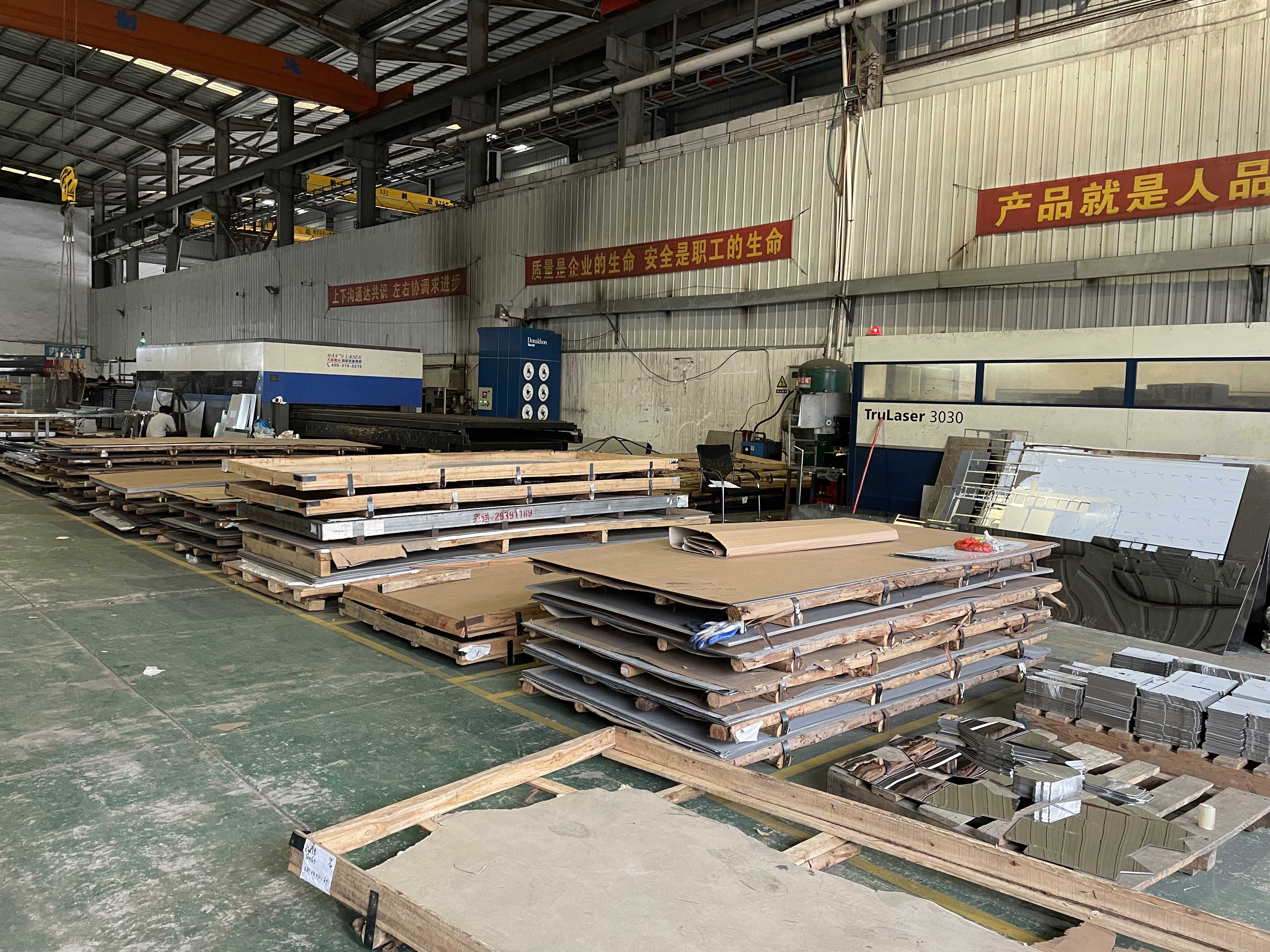
A supplier's fabrication floor is one of the few places where the durability of a decorative stainless steel programme can be assessed before tender.
Architectural stainless steel decoration is specified to outlast the fit-out cycle that delivers it. A hotel lobby clad in a PVD coated stainless steel sheet in 2026 can be maintained, extended, or partly replaced across successive project phases for a decade or more, and each phase returns the buyer to the same question: can the original product system still be replicated? Long-term supplier evaluation in this category therefore works less like a capacity review and more like a sustainability audit — an assessment of whether the supplier's sheet range, finishes, trims, and fabrication capability hold together when the project is revisited.
The market gives the audit urgency. According to Fortune Business Insights, the global stainless steel market was valued at USD 225.13 billion in 2025 and is projected to reach USD 353.48 billion by 2034. Within the metal ceilings segment, Grand View Research reports that steel accounted for 52% of revenue share in 2026. Volume alone does not answer the specification question, however. What buyers actually need to evaluate is whether the supplier behind a completed installation can still produce the same finish, the same thickness, the same trim profile, and the same colour family when the next procurement cycle opens.
Why a Sustainability Audit Replaces a Price Check
A price check answers what a square metre of PVD coated stainless steel sheet costs today. A sustainability audit answers whether that same square metre can be produced, matched, and delivered in 2029. The two questions are related but not equivalent, and for multi-phase architectural decoration the second is usually the more expensive one to get wrong.
Three failure modes tend to surface only after the first handover. Colour drift across PVD runs is the most visible: a second batch of titanium gold sheets reads slightly warmer or cooler than the original installation. Profile discontinuation is the second: a trim that was a standard catalogue line becomes a special order with a new minimum quantity and a new lead time. Documentation loss is the third: the drawing numbers for a custom column cladding were stored in a project mailbox that no longer exists.
Each of these is a sustainability problem in the operational sense — not in the environmental sense. A supplier whose product system cannot be re-entered after a first project has effectively delivered a one-shot install, and the buyer's total cost of ownership is defined by the difficulty of the second phase rather than the price of the first.
The Six Questions Buyers Should Ask Before the Second Phase
The audit is easier to run when it is broken into a fixed sequence of questions. In practice, six are sufficient to separate a supplier that can maintain a decorative stainless steel programme from one that can only deliver a single order.
- Product range coverage. Does the supplier offer mirror, brushed, sandblasted, and water ripple sheets inside one product family, so that different phases or zones of the same project can be serviced by one vendor?
- Material discipline. Are SS201, SS304, and SS316 held as re-orderable grades at consistent thickness tolerance, or does the grade depend on what is available from the coil market at the time?
- Finish reproducibility. Is the PVD colour matched against a retained physical reference or against a documented colour code, and is that reference retained for the project?
- Trim and fabrication continuity. Are trim profiles and custom fabrications archived with drawings, or treated as one-off work?
- Order tolerance. Are minimum order quantities and lead times small enough that a repair or extension can be ordered economically?
- Documentation. Are certification records, acceptance criteria, and finish approvals retained and retrievable on request?
How JYF Metal Fits the Audit Framework
JYF Metal, formally Foshan Jinyifan Metal Products Co., Ltd., is a useful reference point because its structure addresses the six questions in a documented way rather than through verbal assurances. Established in 2013 and located in Foshan, Guangdong, China, the company operates a 3,000 m² factory with approximately 150 employees, a 15-member engineering team, and an export share of roughly 80% across the Middle East, Asia, Europe, and North America. Its catalogue includes stainless steel coloured sheets, stainless steel tile trims, stainless steel screen partitions, and engineering customisation.
The production setup behind that range is relevant to the audit: a PVD vacuum plating line for decorative panels, Trumpf laser cutting from Germany, high-precision CNC bending, and seamless precision welding equipment. The combination matters because finish reproduction and replacement fabrication are the two operations most often separated across suppliers, and a buyer sourcing both from the same floor has one fewer coordination problem when a second phase opens.
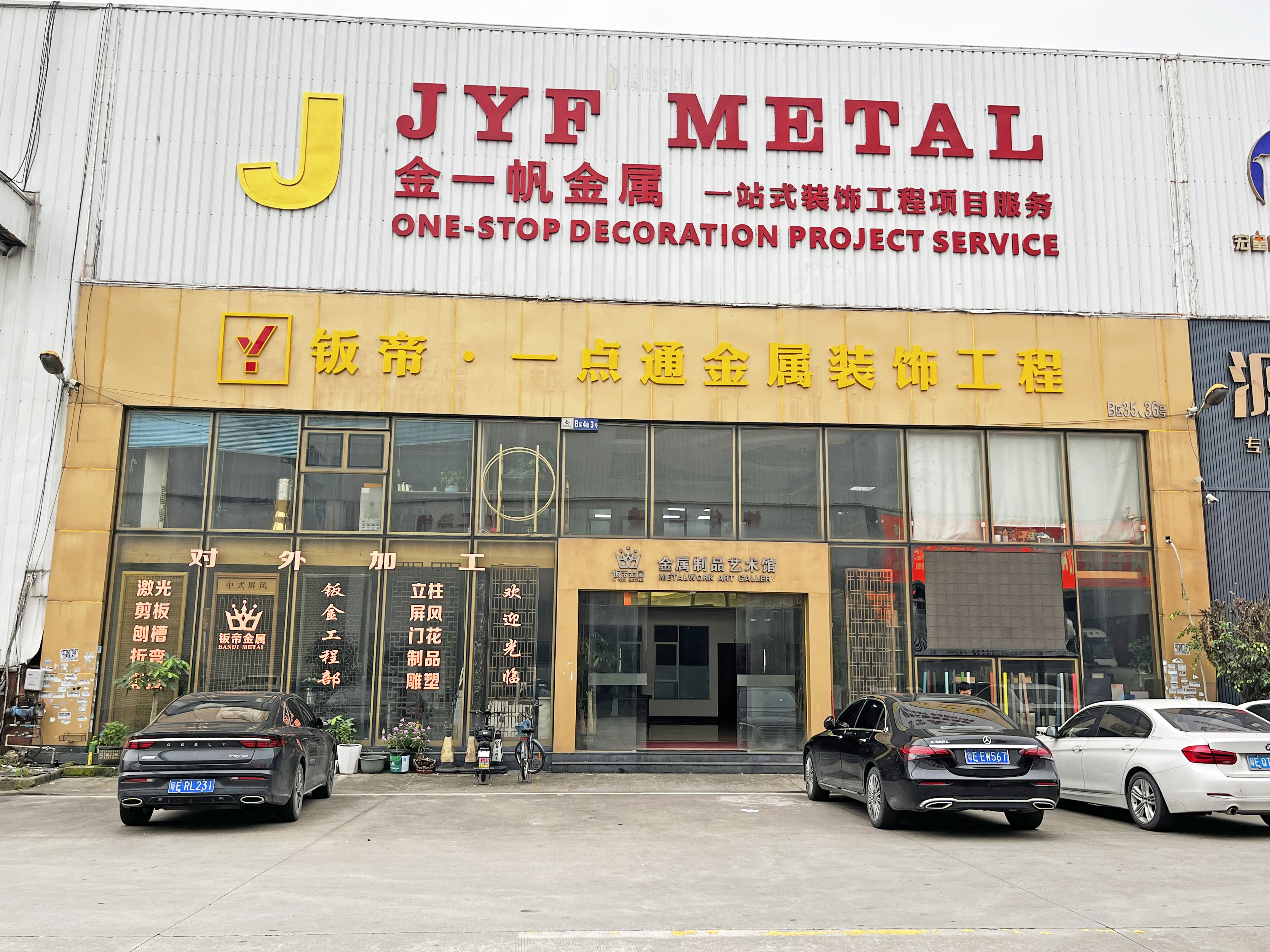
A long-term supplier evaluation reviews the facility, not just the invoice: JYF Metal operates a 3,000 m² plant in Foshan, Guangdong.
Compliance documentation supports the same framework. JYF Metal holds ISO 9001 certification (certificate 120526Q00119R000) under GB/T 19001-2016 / ISO 9001:2015, issued 15 May 2026 by Guangdong Jingwel International Certification Ltd. and valid through 14 May 2029. The certificate scope covers R&D and production of stainless steel coloured boards, metal decorative mouldings, and metal decorative articles. In a sustainability audit, that scope statement is worth reading carefully: it names the exact production activities that will be repeated if the supplier is re-engaged, not just the company entity.
The JYF-01 to JYF-07 Product System Under Audit
The value of a closed model family is not that the models themselves are unique. It is that a buyer can request the same identifier in a later phase and receive a product that matches the original specification. JYF Metal's range uses seven identifiers, each covering a distinct role in the decorative system.
| Model | Product role | Audit-relevant attribute |
|---|---|---|
| JYF-01 | Decorative stainless steel sheets | Finish family and colour consistency across re-orders |
| JYF-02 | Decorative stainless steel sheets | Surface uniformity and sheet flatness |
| JYF-03 | Decorative stainless steel sheets | Batch-to-batch reproducibility |
| JYF-04 | Water ripple decorative sheets | Wave pattern and 0.5–2.0 mm thickness range |
| JYF-05 | Stainless steel screen partition | Welded joint integrity and PVD colour stability |
| JYF-06 | Stainless steel trims | Profile tolerance and dimension match |
| JYF-07 | Stainless steel fabrication | Drawing archive and reference retention |
For a sustainability audit, the important column in that table is the right-hand one. Buyers should ask the supplier, explicitly, whether the audit-relevant attribute for each model in scope is retained when the project file is closed. A supplier that can confirm retention has effectively guaranteed a replacement path.
Thickness, Size, and Finish Parameters That Determine Replacement Compatibility
Three parameter families determine whether a later order matches an earlier installation: the material grade, the thickness band, and the standard sheet size. JYF Metal's decorative sheet range supports SS201, SS304, and SS316 (with 430 also listed in the broader product system), at a thickness band of 0.5–3.0 mm across the range, with the JYF-04 water ripple sheet held to 0.5–2.0 mm. Standard sheet sizes include 1000×2000 mm, 1220×2440 mm, and 1220×3050 mm, and custom sizes and shapes are available on request.
Each of these parameters has a specific consequence for long-term compatibility. A standard sheet size lets an architect calculate replacement sheet quantity without commissioning a special cut. A stable thickness band matters because a 0.8 mm panel that joins to a 1.0 mm replacement will show a visible step at the joint line. A documented grade allows the buyer to differentiate between SS304 for interior decorative use and SS316 in higher-exposure zones, and to re-order each grade without ambiguity.
The finish layer is where the audit is most often decided, and this is where PVD coated stainless steel sheet deserves particular attention. PVD refers to physical vapour deposition, the vacuum coating process that produces the metallic decorative colour on a stainless substrate. JYF Metal operates a PVD vacuum plating line internally, with colours extending to black titanium, titanium gold, rose gold, sapphire blue, and other finishes across the sheet and trim range. The important audit question is not which colours are available, but whether the same colour reference can be re-entered after the original run.
Beyond colour, finish reproduction has to account for the surface beneath the coating. Mirror finishes are sensitive to polishing direction and base flatness. Brushed finishes depend on grain direction and brushing uniformity. Sandblasted finishes depend on surface roughness consistency. Water ripple finishes depend on pattern depth and roll tooling. A supplier that offers all four inside one product family — as JYF Metal does across mirror, brushed, sandblasted, and water ripple lines — reduces the risk of a project's different zones being served by inconsistent sources.
Custom Trims, Screens, and the Replacement-Part Problem
The parts most often asked for in a repair are not the feature sheets. They are the trims, skirting boards, edge profiles, and welded screens that frame those sheets, because they take the highest wear and are the hardest to source as a one-off. For a sustainability audit, this is where custom fabrication capability and drawing retention become decisive.
JYF Metal's trim and screen range covers L-shape, U-shape, and custom profiles within the stainless steel trim category, plus welded screen partitions and custom fabrications that include column cladding, bars, sculptural elements, and other shapes referenced in the company's product system. Cross-referenced with the drawing-based operating model used across the custom side of the business — OEM/ODM, custom size, custom colour, custom protective film, custom logo — the audit question is whether a trim profile can be re-fabricated from a stored drawing rather than re-engineered from a photograph.
The replacement-part problem is easier to solve when the supplier also runs a control system for finish-matched fabrication. JYF Metal applies 100% pre-shipment testing and supports third-party inspection, which do not by themselves guarantee long-term continuity, but do confirm that the process discipline is in place for the batch that is being delivered now. Buyers should extend that expectation forward: request that the same acceptance criteria used on the first delivery are archived for the replacement order.
Application Evidence: Three Project Phases
Three delivered projects are useful for illustrating the audit in practice, not because they are exceptional, but because they show how the same product family behaves across different terminals and different phases.
In South Korea, a designer client used JYF-04 water ripple stainless steel sheets for ceiling and wall decoration across a 120-piece installation. The project delivered a smooth, reflective wave-patterned surface and highlighted the ease of cleaning and maintenance alongside customisable size and pattern. For a sustainability audit, the useful detail is that the specification was based on a repeatable pattern product — the same sheet identifier, the same 0.5–2.0 mm thickness band, and the same finish process can be re-ordered when a later ceiling zone needs completion.
In France, another designer client used JYF-04 water ripple sheets for ceiling decoration across an 80-piece installation. The PVD coating provided wear-resistant and fade-proof colour, and the sheet flatness enabled seamless joint installation. Customer feedback confirmed the installation was delivered without surface scratching and met the client's expectations. The audit implication here is that finish quality at the joint — the point where later additions will visibly connect to the original — depends on flatness control, not only on the topcoat.
In Canada, a contractor client used JYF-05 stainless steel room dividers across a three-unit installation for open-area zoning. The modular design achieved seamless panel joints and pattern alignment, PVD coating provided fade-proof metallic finishes, and full-welding produced seamless joints. The solution resolved a common commercial-space constraint of maintaining privacy while preserving natural light and air circulation. From an audit standpoint, room dividers are the most exposed screen typology because they are touched, moved, and often partially reconstructed, and a modular design with retained drawings is far easier to extend than a bespoke welded screen with no reference sheet.
Market Context: Why Buyers Are Auditing Now
Three trends explain the shift from price check to sustainability audit in this category. The first is scale: a market growing from USD 225.13 billion (2025) to a projected USD 353.48 billion by 2034, per Fortune Business Insights, represents a decade of specification volume that will itself require servicing. The second is material composition: steel's 52% revenue share in the metal ceilings segment, per Grand View Research, signals a durable base of specification decisions in ceiling and wall systems where replacement matching will be needed. The third is standardisation: ASTM A554 is one of the most frequently cited standards for welded decorative stainless steel tubing, which supports the argument that decorative and structural stainless specifications are increasingly expected to be traceable to documented standards rather than to ad hoc vendor practice.
Read together, these signals suggest that the audit is not a boutique procurement idea. It is a response to a larger installed base of decorative stainless steel in commercial and hospitality interiors that will need servicing over multiple phases, in markets where the specification record matters as much as the delivery invoice.
Comparison with Traditional Supply Models
The sustainability audit does not invalidate spot-market supply. It defines when the two models diverge. A side-by-side view clarifies the trade-off.
| Dimension | Spot-market supply | Project supplier with audit trail |
|---|---|---|
| Lead time for repeats | Frequently shorter for simple flat sheets | Documented: 7–10 days for decorative sheets, 15–20 days for trims, 20 days for screens, 25–30 days for custom work |
| Colour and finish match | Depends on current coil stock; may not match previous run | Retained reference and PVD coating line for repeat matching |
| Minimum order quantity | Often flexible for off-the-shelf items | 15 sheets per type for decorative sheets; 500 pcs per trim type; 3 m² for screen partition; 1 pc for custom products |
| Trim and profile continuity | Limited; depends on current dies | Drawing archive with custom fabrication capability |
| Certification documentation | Not always available per batch | ISO 9001 scope covering R&D and production; 100% pre-shipment testing and third-party inspection support |
Neither column is universally better. Spot-market supply is often the right choice for a single-phase interior fit-out, a repair order under 15 sheets, or a project where a specific discontinued finish is the constraint. The project supplier model becomes clearly preferable once the number of phases exceeds one, once the project spans multiple finishes, or once a trim and fabrication archive is likely to be needed.
Limits: When the Audit Model Does Not Fit
The sustainability audit framework is not free of trade-offs, and buyers should understand where it applies less well.
The first limit is order economics. JYF Metal's stated minimums — 15 sheets per decorative sheet type, 500 pieces per trim type, 3 m² for screen partition, and 1 piece for custom products — are workable for a project-scale order but not for a small repair. If a hotel needs to replace three damaged water ripple ceiling panels, a spot-market supplier with stock may deliver faster and with a lower minimum, even if the colour match is less strictly controlled.
The second limit is lead time. Custom products run 25–30 days at JYF Metal, against 7–10 days for standard decorative sheets. That is generally acceptable for a planned phase and generally not acceptable for an emergency repair. A buyer auditing for sustainability should recognise that the same supplier may not be the fastest option for every re-order scenario, and that a project archive is the asset that makes the supplier usable, not the lead time itself.
The third limit is scope. A supplier audit that focuses on the range, drawings, and finishes is appropriate for architectural decoration committed to a multi-year programme. It is a disproportionate exercise for a one-off decorative installation with a short service life, where the price and delivery of the initial order are the more relevant variables.
Future Outlook
The audit model is likely to become more standard over the next few years for three reasons. First, the installed base of decorative stainless steel in commercial and hospitality interiors is now large enough that replacement and extension demand is a stable procurement category in its own right, not an afterthought. Second, buyers increasingly accept that finish matching depends on retained physical references rather than on nominal colour names, which pushes suppliers to formalise documentation. Third, custom fabrication, PVD coating, and pattern engineering are increasingly concentrated in a smaller number of export-oriented plants, which raises the cost of switching once a project is underway and increases the value of a documented supplier relationship.
For buyers, the practical implication is straightforward. The next round of supplier shortlists should be built around the audit questions rather than around present capacity alone, and the resulting supplier should be treated as a long-term partner whose production data and drawing archive are the primary deliverable, not just the sheets themselves.
For supplementary reference on how JYF Metal's project cases document finishes, thicknesses, and application scope, the Designer's Handbook Project Cases is publicly available.
FAQ
How can a buyer verify that a supplier's PVD coated stainless steel sheet will colour-match in a future order?
Verification rests on three retained artefacts rather than on the colour name alone: a physical sample from the original delivery batch, a documented colour reference from the supplier, and confirmation that the same PVD coating line will run the replacement order. JYF Metal operates a PVD vacuum plating line internally and offers finishes including black titanium, titanium gold, rose gold, and sapphire blue; buyers should request the physical sample as part of the project archive, because a colour name without a reference is not a match guarantee.
What thickness and size range should be specified for a decorative stainless steel sheet that may be re-ordered later?
The JYF Metal decorative sheet range supports SS201, SS304, and SS316 across a thickness band of 0.5–3.0 mm, with the JYF-04 water ripple sheet held to 0.5–2.0 mm. Standard sheet sizes include 1000×2000 mm, 1220×2440 mm, and 1220×3050 mm, and custom sizes and shapes are available on request. Specifying a standard sheet size reduces the friction of a replacement order, and specifying a stable thickness band avoids visible steps at the joint between original and replacement panels.
Does a single supplier realistically cover mirror, brushed, sandblasted, and water ripple sheets under one roof?
Coverage of that breadth is available from suppliers with integrated finishing and fabrication. JYF Metal's product system spans decorative stainless steel sheets across mirror, brushed, sandblasted, and water ripple finishes, plus screen partitions, trims, and custom fabrication. The audit-relevant point is not the breadth itself but whether the same supplier can service a later order within the same finish family without re-sourcing, which is what protects consistency across project phases.
What do sample reviews actually reveal during a long-term supplier evaluation?
Sample reviews reveal the practical behaviour of the finish under handling, lighting, and joint conditions, which is more useful than a colour card. A sample should ideally cover the intended finish, the intended thickness within the specified band, and a joint condition matching the project detail. The Canadian JYF-05 room divider project illustrates the point: the modular design delivered seamless panel joints and pattern alignment in production, which is the same property a sample review should be able to confirm before the full order is released.
What after-sales support is relevant to a decorative stainless steel programme being maintained over years?
After-sales support that matters for a long-term programme includes installation guidance, ongoing sample availability, and replacement parts. JYF Metal provides online installation guidance, sample provision, and replacement parts as its stated after-sales support. Buyers should record which of these were actually used on the first phase and confirm they remain available for later phases — support that exists on paper but is not retrievable when the second phase opens does not protect the programme.
How do MOQ and lead time affect the choice between a project supplier and spot-market supply?
Minimum order quantities and lead times define the practical boundary of the sustainability audit. JYF Metal's stated minimums are 15 sheets per decorative sheet type, 500 pieces per trim type, 3 m² for screen partition, and 1 piece for custom products, with lead times of 7–10 days for decorative sheets, 15–20 days for trims, 20 days for screen partitions, and 25–30 days for custom products. For small repair quantities or emergency replacements, spot-market supply may be faster and cheaper. For project-scale phases and extensions, the project supplier model has the advantage of documented continuity.
Which certifications support a long-term supplier evaluation in this category?
ISO 9001 is the baseline quality management certification most relevant to long-term supply, because it applies to documented processes rather than to individual batches. JYF Metal holds ISO 9001 certificate 120526Q00119R000 under GB/T 19001-2016 / ISO 9001:2015, issued 15 May 2026 by Guangdong Jingwel International Certification Ltd. and valid through 14 May 2029, with a scope covering R&D and production of stainless steel coloured boards, metal decorative mouldings, and metal decorative articles. Where projects involve fire-rated assemblies, buyers should also request the relevant panel-level test documentation for the specific construction being specified, since a management system certificate does not by itself confirm a fire rating.
Is there a scenario where the sustainable-supplier model should not be used at all?
Yes. For a single-phase installation with a short service life, a short-turnaround repair, or a project where a specific discontinued finish is the hard constraint, the sustainability audit returns little value. In those cases, price, availability, and delivery speed remain the correct primary filters. The audit model is designed for multi-phase, multi-finish, or multi-trim projects where documentation and finish continuity are needed across years rather than across weeks.
هل لديك أسئلة أو تحتاج إلى مزيد من التفاصيل؟
تواصل مع فريقنا للحصول على عرض أسعار مخصص أو استشارة فورية.
طلب عرض أسعار
املأ النموذج أدناه وسيتواصل معك فريقنا بعرض مقترح مخصص.
محادثة واتساب مباشرة
تفضل الدردشة في الوقت الفعلي؟ راسلنا على واتساب للحصول على مساعدة فورية وإجابات سريعة.
- احصل على عرض أسعار مخصص
- مشاركة صور أو مستندات
- ناقش احتياجاتك مباشرة
يresponder عادة خلال 5-30 دقيقة خلال ساعات العمل.