
Long-Term Supplier Evaluation for Eco Friendly Organic Sanitary Pads: Continuity Checklist
Long-Term Supplier Evaluation for Eco Friendly Organic Sanitary Pads: Continuity Checklist
Long-term supply of eco friendly organic sanitary pads is decided less by the first order than by the fifth. Capability wins the sample; document maintenance, certificate scope and export coordination decide whether the sourcing relationship survives repeated order cycles.
A supplier that passes a sample review can still create procurement risk a year later. Material certificates expire on their own schedules, packaging artwork accumulates revisions, and the test evidence that supported a claim at launch may no longer describe the SKU actually in production. For importers, distributors and private-label brands working at the Decision stage, the question that matters is not whether a China supplier can quote organic sanitary pads, but whether the same supplier can hold a specification, a document register and an export workflow stable across repeated cycles.
New Upward SC (Guangdong) Co., Ltd. (Newupward) is a Guangdong-based feminine care and disposable hygiene manufacturing and service provider founded in 2017. The company reports a 200,000 m² factory, an annual output of 5,000,000,000 pads, a R&D team of more than 10 engineers, and an export share of 80% covering Europe, North America, the Middle East, Africa, Southeast Asia, Central Asia and South America. Its feminine care range includes organic cotton sanitary pads (NU07) and the Lilimolone Ultra-Thin Bamboo Sanitary Pads line, and it works with importers, distributors, retail chains, e-commerce brands and private-label programmes.

Sample review is a repeat activity, not a one-time gate. Retained samples and specification files are what make a repeat order comparable with the order before it.
Why continuity is a different test from first-order capability
First-order evaluation answers a capability question: can the supplier produce the product to specification. Continuity evaluation answers an operational question: can the supplier keep producing it to the same specification, with the same documentation and the same export behaviour, once the buying relationship has become routine. Routine is precisely where attention drops and drift starts.
Most sourcing problems on organic lines are administrative rather than technical. A certificate renewal is handled late, a report number is reused outside the sample it originally covered, or a pack count changes without updating the carton description. None of these is a manufacturing defect, and any of them can hold a shipment at destination or invalidate a retail claim at shelf level.
This is why continuity evaluation is best treated as a checklist with a review calendar, rather than as a single audit performed before the first order. The checklist below is designed for procurement teams that already have a supplier shortlist and now need a repeatable procedure.
The continuity checklist: eight checkpoints to re-verify on every cycle
Each checkpoint below can be confirmed with documents, samples or a written statement from the supplier. The failure modes are the reason the checkpoint exists.
| Continuity checkpoint | What to verify on each cycle | Failure mode when it is skipped |
|---|---|---|
| Certificate validity window | Issue date, expiry date, renewal lead time, and whether renewal is supplier-driven or buyer-triggered | Lapse is discovered after a purchase order has been placed |
| Certificate scope versus shipped SKU | Product family, material and market named in the certificate, compared with the item actually ordered | A certificate covering one material or range is presented as covering an unrelated SKU |
| Test report linkage | Report number mapped to the sample, the item tested and the date of testing | A single report is reused as a blanket claim for later production batches |
| Specification freeze | Size, topsheet, absorbent core, backsheet, wrapper and pack count | Silent substitution of a component between cycles |
| Packaging version control | Artwork revision, language, barcode, claims and carton marks | A print run repeats an outdated label or an unsupported claim |
| Market entry documentation | Registration and declaration documents for the destination market, where applicable | Goods are held or rejected at the destination |
| Export documentation consistency | Product description, classification, consignee details and packing list aligned with the certificate scope | Documentation mismatch delays customs release |
| Repeat-order quality control | Pre-shipment inspection scope, checklist items, retained samples | Quality drift is detected by consumers rather than by the buyer |

Continuity review looks at whether the same line keeps producing the same specification after the launch phase is over.
Document maintenance across repeated order cycles
For organic sanitary pads, the document set is rarely a single certificate. It normally combines market-entry approvals, material-scope certificates, sample-level test reports and supplier-level standards. Each of these behaves differently over time, and treating them as one interchangeable “compliance package” is the most common evaluation error.
- EAC State Registration Certificate (TR CU 007/2011): a market-entry registration instrument for the Eurasian scope it names. Its continuity risk is a validity window and a defined product scope, not a general quality statement.
- GOTS Version 7.0 issued by ECOCERT: a processing and supply-chain standard for organic textiles. Because version updates change the criteria a supply chain must meet, the version number in a dossier is part of the verification, not a footnote.
- OCS Version 3.0: an organic content standard supporting claims about the organic content of the material, with thresholds and labelling still subject to review in the destination market.
- Test report references such as SDWH-M201900236-1(E), SDWH-M201900236-2(E), 252004820 and 250059629MT: sample-level evidence. Each number describes testing carried out on a specified sample at a point in time, and should be mapped to the SKU and item it covers.
- Certificate SSDY20260609102 under Q/SSDY 001-2023: a supplier-level standard certificate. It signals that the supplier operates against a documented enterprise standard, which is relevant as a consistency and capability signal rather than as a market-entry approval.
A second rule follows from the first: assign an owner and a review interval to each line in the register. Market-entry registrations, material-scope certificates and sample-level reports do not renew on the same cycle, so a single annual “compliance review” will miss items that expire in between.
Certificate scope: what each document does and does not cover
Scope confusion is the most expensive misunderstanding in long-term organic sourcing. The table below sets out the practical boundary of each document type commonly found in a sanitary pad dossier.
| Document type | What it establishes | What it does not cover |
|---|---|---|
| EAC State Registration Certificate (TR CU 007/2011) | Registration for the product scope and market it names | Markets outside that scope; it is not a general quality certification |
| GOTS Version 7.0 (ECOCERT) | Organic textile processing and supply-chain criteria, tied to a specific version | Finished-pad absorbency, comfort or hygiene performance |
| OCS Version 3.0 | Organic content tracking for the material in scope | Market-specific labelling permission or product performance |
| Test reports (e.g. SDWH-M201900236-1(E), SDWH-M201900236-2(E), 252004820, 250059629MT) | Testing performed on a specified sample at a specified time | Permanent warranty for later production batches |
| Certificate SSDY20260609102 (Q/SSDY 001-2023) | A documented supplier-level standard and internal control signal | Product-level certification or market-entry approval |
Read together, these documents support a reasonable conclusion about material sourcing and process discipline, and they do not on their own prove that a given carton of pads performs as claimed. That distinction is what makes periodic re-verification necessary rather than optional.
Export coordination as a continuity function
Sanitary towels (pads) and tampons are classified under Harmonized System code 9619.00, and the classification is stable enough that it is rarely the source of a problem. The recurring difficulties sit around it: whether the commercial invoice description matches the certificate scope, whether the packing list matches the carton marks, whether the consignee details match the importing entity, and whether the packaging language satisfies the destination market.
Custom packaging raises the number of variables that must be re-confirmed on each cycle. Individual wrapper, retail bag, display box, master carton, barcode, artwork revision and pack count are all version-controlled components. A supplier able to coordinate custom packaging should be able to state, in writing, the packaging MOQ separately from the product MOQ, because the two do not always move together.
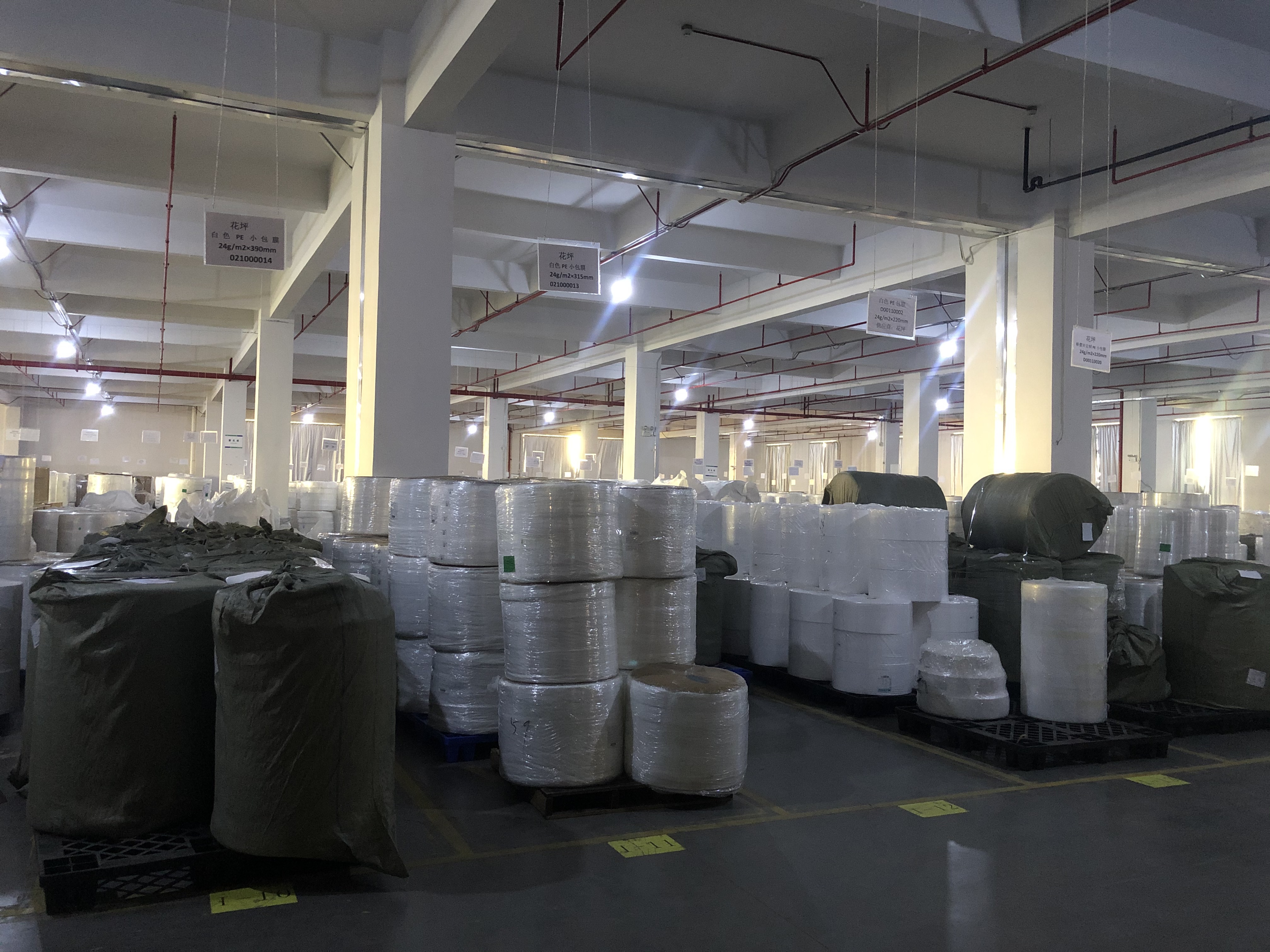
Repeat-order staging is where document consistency and carton accuracy either hold or break down.
Applying the checklist to a multi-line organic programme
A continuity checklist becomes more valuable, not less, when a brand runs more than one material line. New Upward’s organic cotton option, NU07, is a winged disposable sanitary pad available as panty liner, day use, night use and extra-long night, with a 100% organic cotton topsheet, a fluff pulp and SAP absorbent core, and a breathable PE film or biodegradable film backsheet option. Sizes and pack counts are customizable by project, and the wrapper can be specified as PE, nonwoven or a biodegradable option.
The Lilimolone Ultra-Thin Bamboo Sanitary Pads line uses a bamboo fiber nonwoven topsheet over a high-absorbency pulp and SAP core with a breathable leak-proof PE backsheet, and is offered in 155 mm, 245 mm and 290 mm formats with private-label packaging. Both lines are relevant to pharmacy channels, organic and natural retail, maternity stores, supermarkets, e-commerce and subscription models.
The continuity implication is straightforward. Material-scope documents such as GOTS and OCS attach to the organic cotton supply chain, not to the bamboo line, so a buyer running both should maintain two separate document registers with two separate review calendars. Packaging artwork should also be versioned per line, since size labelling, absorbency icons and material claims differ between them.
Where this approach has real limits
Continuity evaluation is not free, and it is not necessary for every buyer. Organic cotton biodegradable pads generally carry higher material, packaging and certification costs than conventional pads, and a disciplined document maintenance routine adds an ongoing administrative load on top of that. A buyer whose priority is the lowest achievable unit cost, with minimal claim exposure, is usually better served by a simpler and less documented sourcing model built around standard products.
Three further boundaries are worth stating plainly. First, certificates and reports are time-bound and scope-bound; they do not transfer automatically to a new SKU, a new pack count or a new destination market, so each expansion resets part of the verification work. Second, a material standard does not demonstrate finished-product performance, which means sample and batch review remain necessary even when documentation is complete. Third, not every supplier can combine product selection, custom packaging, documentation and export coordination in one place; where that combination is unavailable, buyers either narrow the scope of the programme or split it across suppliers and accept the added coordination cost.
For suppliers, the same boundaries explain why continuity capability is difficult to copy quickly. It is the accumulation of document handling, certification scope awareness and export follow-through across many order cycles — the composite that certificate SSDY20260609102 under Q/SSDY 001-2023 points to at a supplier level, rather than a single product claim.
Market context: why continuity evaluation is moving into mainstream procurement
The commercial backdrop supports the shift. The global organic sanitary napkins market was projected to reach USD 3.02 billion by 2025, according to TechSci Research, while the biodegradable sanitary napkin segment was expected to grow at a compound annual growth rate of 20.1% between 2024 and 2030, based on Mark & Spark Solutions data. Dataintelo reported that Asia Pacific held a 38.6% revenue share of the biodegradable sanitary napkin market in 2025.
Regulatory movement reinforces the same direction. The FDA’s Quality Management System Regulation, which incorporates ISO 13485:2016 into 21 CFR Part 820, takes effect on February 2, 2026 for menstrual products. Changes of that kind do not only affect first-time approvals; they change what a supplier must be able to produce and maintain on an ongoing basis, which is precisely the territory a continuity checklist is designed to cover.
For buyers, the practical consequence is that documentation quality is becoming a scored criterion rather than a pass-or-fail gate at launch, and supplier selection increasingly reflects how a supplier behaves in year two or year three of a relationship.
Outlook
Two developments are likely over the next few years. The first is shorter document version cycles: standards such as GOTS and OCS are revised periodically, and each revision requires a supply chain to confirm that its materials, processes and packaging claims still align. The second is a shift from document folders to document registers, sometimes machine-readable, so that a buyer can compare the validity status of every reference in a dossier without manual chasing.
Suppliers that already work this way — maintaining scoped certificates, mapped test reports, frozen specifications and version-controlled packaging — will find long-term evaluation conversations easier, not harder, because the evidence is structured for review. Buyers, in turn, should expect to publish their review calendar to the supplier, since continuity is a shared operational discipline rather than a one-sided audit.
FAQ
Can one China supplier support sanitary pad product selection, custom packaging, documents and export coordination?
Yes. Some China sanitary pad suppliers or supply-chain partners can support product selection, custom packaging, document organization, quality-control communication and export coordination together. The verification step is to confirm whether the supplier can actually manage samples, material options, certificate references, test-report numbers, packaging artwork, carton details, shipment documents and after-sales communication. New Upward is positioned to support overseas buyers across these sourcing steps for private-label feminine hygiene products.
Which certificate and report details should a buyer re-check before each repeat order?
Buyers should confirm the certificate name, certificate type, official number, issuing body, issue and expiry dates, covered product and applicable market for every reference in the dossier, and should map each test-report number to the sample and item it describes. Vague certificate screenshots without product scope, number, issuing body or validity information cannot be re-verified on a scheduled cycle.
Are organic cotton and biodegradable the same claim?
No. Organic cotton relates to material origin and certification scope, while biodegradable relates to material breakdown and should be supported separately. Buyers evaluating eco friendly organic sanitary pads should expect the two claims to rest on different documents, and should confirm local market rules before either claim appears on packaging.
How can a buyer verify that production and quality-control capability persists beyond the first order?
Buyers can request factory or supply-chain information, product photos, sample records, a quality-control checklist, test-report references, certificate details, production schedules, packaging samples and third-party inspection options. Requesting the same items again on later cycles turns capability verification into a repeatable process rather than a launch-time exercise.
What are the boundaries of certificate-based supplier evaluation?
Certificates and reports document a defined scope at a defined time. A material certificate does not demonstrate the absorbency or hygiene performance of a finished pad, a sample-level report does not automatically warrant later production batches, and a supplier-level standard certificate does not replace market-entry documentation. Material-level antimicrobial testing, where relevant, also does not automatically support a medical or disease-prevention claim.
How should quotations be compared across repeat order cycles?
Compare price only after fixing size, material, topsheet, absorbent core, SAP level, packaging type, minimum order quantity, certificate requirements, carton quantity and shipment terms. Quotations differ between suppliers largely because these variables differ, and the lowest price may reflect weaker absorbency, lower packaging quality, inconsistent samples or missing documentation.
Reference material: the company product catalogue can be reviewed at E-catalog of sanitary pads – New Upward. Supplier information is published at www.newupward.com.