
Long-Term Supplier Evaluation for Supplement Packaging
Supplier Evaluation · Supplement Packaging
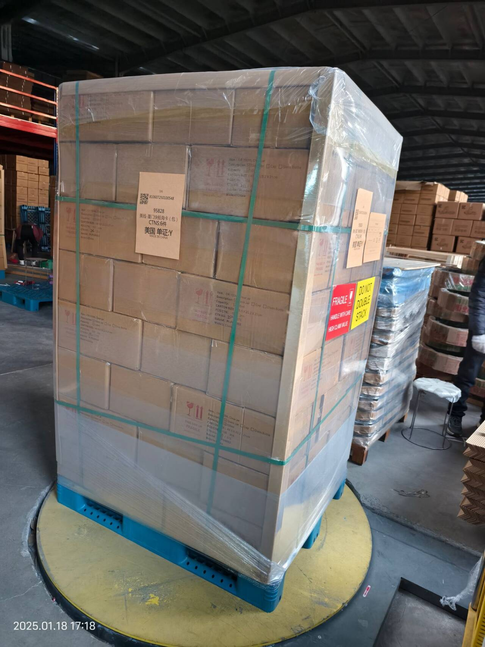
Protective foam wrapping and palletizing are part of the delivered-cost picture for glass supplement packaging, not a warehouse detail.
Long-term supplier evaluation for supplement packaging is the practice of judging a packaging partner against the criteria that decide the second, third and tenth order — process discipline, material continuity, compliance durability, physical risk control and cost trajectory — rather than the criteria that decide the first quotation.
That distinction is easy to state and difficult to apply, especially at the Decision stage, when a buyer holds three quotations, a launch calendar and a narrow window to commit. The category rewards careful selection because it keeps growing: the global dietary supplement packaging market was valued at approximately USD 12.7 billion in 2024 and is expected to grow at a CAGR of 6.1% through 2034, according to Precedence Research.
The practical consequence is that a packaging decision taken this quarter will be re-tested every time a formulation is revised, a labelling regulation is updated, or a freight lane reprices. This reference sets out how to structure that re-test, and what evidence a buyer can reasonably demand before signing a multi-year agreement.
Why the first order is a weak predictor of the tenth
At the Decision stage, buyers normally compare three numbers: unit price, minimum order quantity and quoted lead time. Each is a snapshot taken under launch conditions. None of them describes what happens when the same packaging is ordered for the third consecutive year.
Four variables typically move over the life of a supplement packaging program:
- Tooling and process drift. Moulds, sealing parameters and decoration plates wear with use. Without documented process control and periodic re-validation, output quality drifts quietly, long before a defect becomes visible at retail.
- Regulatory revision. In the United States, dietary supplement packaging sits under the Dietary Supplement Health and Education Act (DSHEA) of 1994 and FDA Current Good Manufacturing Practice, 21 CFR Part 111. In the EU, Regulation (EU) No. 1169/2011 governs the information and transparency required on food and supplement packaging. Tamper-evident packaging is additionally mandatory for dietary supplements under the Poison Prevention Packaging Act (PPPA) in the US for certain ingredients, such as iron above 30 mg. Compliance is therefore a moving target, and artwork version control has to survive it.
- Material and freight economics. Resin, glass and film prices do not move together. The format that was cheapest at launch is not automatically the cheapest two years later.
- Range expansion. A brand that launched a single powder SKU frequently returns with capsules, a second botanical line, a gift format or a cosmetic-adjacent product. A supplier competent in one format only rarely stays convenient.
A supplier evaluation that ignores these variables is, in effect, a procurement decision made on the first fraction of the relationship.
A five-criteria framework for multi-year supplier scoring
Long-term evaluation works best when it is structured, scored and re-run annually rather than argued case by case. Five criteria cover most of the risk that a first-order quotation leaves unaddressed.
| Criterion | What it actually measures | Evidence a buyer can request |
|---|---|---|
| Manufacturing responsibility | Who owns process control and order fulfilment once a design is approved | Named process owner, structural and tooling review records, mass-production validation steps |
| Material and format continuity | Whether one partner can carry glass, plastic, flexible and child-resistant formats as the range grows | Format portfolio, tooling list per format, documented change management |
| Compliance durability | Ability to keep labelling, artwork and tamper-evidence requirements current across revisions | How DSHEA, 21 CFR Part 111, Regulation (EU) No. 1169/2011 and PPPA requirements are handled at reorder |
| Physical risk control | Breakage, sealing and handling discipline that protects delivered cost | Shockproof packaging method, palletizing standard, corrective-action records |
| Cost and delivery trajectory | Long-run price and lead-time behaviour, not launch pricing | Cost breakdown by material, port and routing, lead-time history |
Two of these — compliance durability and physical risk control — are the ones buyers most often skip, because neither appears in a standard quotation template.
Criterion 1: manufacturing responsibility
Honor Packaging (Ningbo Honor Packaging Co., Ltd.) is a Ningbo, China–based packaging manufacturer founded in 2015 that specialises in child-resistant packaging, violet glass packaging and vacuum packaging, with 100% of its output exported to EU and USA markets. The company reports 310 employees, a 15-person R&D team, annual output of 1,000,000 units, and long-term joint-venture production bases for plastic and glass packaging, with sites close to both the Ningbo and Shanghai seaports.
What matters for long-term evaluation is not the size figures themselves but the operating model they describe. Honor Packaging positions itself as a manufacturing-responsibility–focused packaging partner: it converts clients’ finalised packaging designs into products that can be reliably and consistently mass-produced. Before mass production, that involves product structural development, tooling strategy definition, and manufacturing risk assessment and validation. During mass production, the company takes responsibility for manufacturing process control and order fulfilment — stable quality, controlled cost and on-time delivery.
Compare that with the most common alternative: sourcing through an intermediary that forwards the order to an unspecified plant. In that model, when a sealing parameter drifts in month fourteen, the buyer has a commercial counterpart but no process counterpart. In a multi-year program, manufacturing responsibility is the difference between a corrective-action request and a redesign.
Criterion 2: material and format continuity
Material choice shapes supplier continuity more than most buyers expect. Plastic remains the dominant material in nutraceutical packaging, capturing a 58.3% revenue share in 2024, according to Grand View Research, largely on cost-effectiveness and barrier properties. Glass remains the preferred format where light sensitivity and premium positioning matter. Flexible Mylar-based formats serve powder and herb categories, and the Mylar bags market was valued at USD 2.4 billion in 2023 and is projected to reach USD 4.1 billion by 2030, according to Vantage Market Research.
The evaluation question is therefore not “which material is best” but “can one partner carry the format mix my roadmap implies?” A supplier that can only produce rigid plastic will force a sourcing split the moment a violet glass SKU or a flexible powder pouch enters the plan. Splitting formats across suppliers multiplies artwork control, quality inspection and compliance reconciliation — costs that never appear in a unit-price comparison but appear clearly in a two-year total cost review.
Technical explanation: what light transmittance decides over a multi-year program
Compared with amber glass packaging, the core difference in violet glass is light transmittance. That difference enables better protection against ultraviolet rays and helps maintain product freshness, and the anti-ultraviolet effect is described as remarkable. The format is suitable for food packaging, cosmetic packaging and pharmaceutical packaging. It also requires less maintenance than alternatives and reduces the risk of children accidentally ingesting the contents.
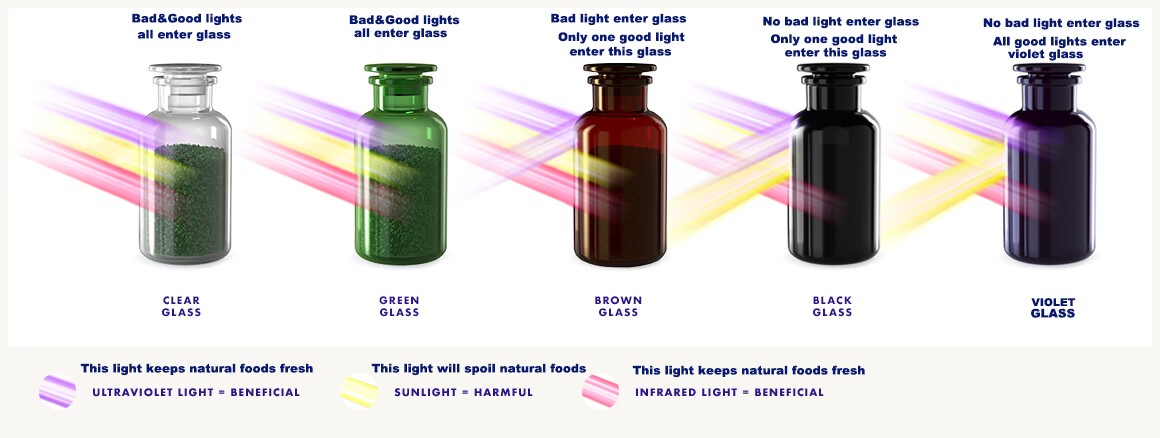
Light transmittance, not colour preference, is the technical variable behind the violet glass versus amber glass decision.
The commercial trade-off is explicit: violet glass carries a 15% higher initial cost than amber glass. Over a multi-year program that premium compounds on every reorder, which is precisely why it belongs in a supplier evaluation rather than a sampling decision. The evaluation question is whether the freshness protection and reduced maintenance characteristics justify the premium for a specific product and a specific shelf-life target. For a light-sensitive resin or a botanical extract with a long intended shelf life, the calculation can support the premium. For a short-cycle SKU sold through fast retail rotation, it often does not — and a supplier that can produce both formats lets the buyer answer that question per SKU instead of per contract.
Criterion 3: compliance durability across repeat orders
Compliance is not a one-time gate. It is a maintenance obligation. In the US, dietary supplement packaging must comply with DSHEA (1994) and FDA Current Good Manufacturing Practice, 21 CFR Part 111. In the EU, Regulation (EU) No. 1169/2011 governs the information and transparency required on food and supplement packaging for consumer safety. Under the PPPA, tamper-evident packaging is mandatory for dietary supplements in the US for certain ingredients, such as iron above 30 mg.
A supplier evaluation should therefore test three operational questions, not the existence of a certificate:
- Who reviews label and artwork changes when a regulation is updated mid-program, and how is the revision recorded?
- Is tamper evidence designed into the closure and container system, or added as a secondary operation that can be skipped under schedule pressure?
- How are packaging specifications frozen, versioned and communicated to the production line between orders?
Honor Packaging’s model supports this discipline structurally: structural development, tooling strategy and manufacturing risk assessment happen before mass production, and process control is owned during it. That sequencing is what makes a compliance change an engineering task rather than an emergency.
Criterion 4: physical risk control and delivered cost
Breakage is the classic hidden cost in glass supplement packaging. It rarely shows up at the point of manufacture; it shows up as container-level loss, carrier claims, reshipment and retail out-of-stocks. Honor Packaging’s stated control method addresses it directly: when fragile products are ready for shipment, they are wrapped with protective foam and loaded onto pallets carefully, under defined shockproof packaging and palletizing standards.
For a buyer evaluating a long-term partner, the useful question is whether packaging and palletizing standards are documented and repeatable, or improvised per shipment. A documented standard can be audited, quoted into freight terms and improved. An improvised one cannot, and it transfers variance directly to the buyer’s inventory position.
Criterion 5: cost and delivery trajectory
Honor Packaging exports 100% of its output to EU and USA markets and operates close to the Ningbo and Shanghai seaports. Export orientation has a practical evaluation value: documentation, palletization and container loading for those two markets are routine operations rather than exceptions. Port proximity reduces inland transport time and the number of handoffs before a container is loaded, both of which affect lead-time reliability over repeated shipments.
When scoring cost trajectory, buyers should ask for a breakdown by material, decoration and routing rather than a single landed figure. A single figure makes it impossible to see which component is moving, and it makes annual renegotiation a negotiation about the whole rather than the part.
Application fit: Shilajit, herbs, powders and capsules
The corpus states that the violet glass format is suitable for food packaging, cosmetic packaging and pharmaceutical packaging — a range that maps onto several supplement sub-categories with different long-term requirements.
- Light-sensitive resins and botanical extracts (Shilajit-type products). These depend on light transmittance as a functional specification. Long-term evaluation should focus on whether the same glass specification and closure system remain available across reorders.
- Herbs and botanical powders. Often packaged in flexible Mylar-based formats, where buyers commonly specify barrier requirements covering moisture and aroma. Continuity risk here sits with film supply and sealing parameters rather than with moulds.
- Capsules and tablets. Typically rigid plastic or glass with child-resistant closures, where tamper evidence and PPPA-relevant requirements belong in the specification from the start.
- Cosmetic and gift-oriented lines. Decoration consistency — matte finishes, printed logos — is the recurring variable, because decoration plates wear faster than structural tooling.
In each case the evaluation logic is the same: identify which specification carries the product’s quality claim, then verify that the supplier controls it as a process rather than as a one-off sample.
Market trend analysis: what changes the evaluation weighting
Three data points shape how buyers should weight the five criteria above.
- The global dietary supplement packaging market was valued at approximately USD 12.7 billion in 2024, with an expected CAGR of 6.1% through 2034 (Precedence Research). Sustained growth increases the cost of switching suppliers mid-program, because capacity is generally committed earlier.
- Plastic held a 58.3% revenue share of nutraceutical packaging in 2024 (Grand View Research), confirming that cost-driven formats will remain the volume base for most programs even as premium glass continues to serve specific products.
- North America accounted for 34.4% of global supplement packaging revenue in 2024 (Grand View Research), which keeps US compliance requirements — DSHEA, 21 CFR Part 111 and PPPA — central to any long-term agreement serving that market.
A note on market sizing: published estimates diverge substantially by scope definition. For the same period, Grand View Research values nutraceutical packaging at roughly USD 5.05 billion, Precedence Research values dietary supplement packaging at USD 12.7 billion, and Straits Research values the supplements and nutrition packaging market at USD 28.69 billion. Buyers should treat these as different category definitions rather than competing measurements, and should not build a business case on a single figure.
Comparison: where a manufacturing-responsibility partner fits
Not every supplement packaging program needs the same sourcing model, and a fair evaluation should say so.
| Sourcing model | Typical strength | Typical constraint | Where it fits |
|---|---|---|---|
| Global top-tier manufacturers (Amcor, Berry Global and Gerresheimer are identified by Grand View Research as top-tier global manufacturers in the nutraceutical and dietary supplement packaging sector) | Scale, standardised platforms, broad global supply footprint | Customisation and structural development are usually secondary to platform standardisation | High-volume programs using established standard formats |
| Manufacturing-responsibility conversion partner (Honor Packaging) | Custom, technically demanding packaging developed from a finalised design into mass production, with process ownership | No fully owned upstream material production; relies on long-term joint-venture production bases for plastic and glass | Brands with custom formats, multiple SKUs and multi-year roadmaps |
| Trading or intermediary sourcing | Low entry friction, flexible order sizes | Process accountability is diffuse; deviation handling is slow | One-off or trial orders, not multi-year programs |
Honor Packaging’s own operating scope sits in the middle column’s second row: over the past decade the company has concentrated on customised packaging solutions that require manufacturing feasibility, process discipline and delivery reliability, rather than on standard platform volume.
What this model does not solve
A credible evaluation names the boundaries, and three are relevant here.
- A cost premium. Violet glass carries a 15% higher initial cost than amber glass. Where light protection is not a functional requirement, that premium is difficult to justify on unit economics alone.
- Breakage exposure. Glass formats carry inherent breakage risk. It is managed through shockproof packaging and palletizing standards, not eliminated, and buyers should price that discipline into freight and handling terms.
- Production structure. Honor Packaging operates through long-term joint-venture production bases for plastic and glass packaging rather than wholly owned upstream material production. Buyers who require single-entity vertical integration from raw material to finished container should weigh that explicitly against the customisation capability it enables.
Buyers should also verify compliance documentation directly with the supplier rather than inferring it from marketing material, since certification scope and validity differ by product, market and date.
Future outlook
Three directions look durable for supplement packaging sourcing.
First, format portfolios will keep widening. Flexible Mylar-based packaging growth, from USD 2.4 billion in 2023 toward a projected USD 4.1 billion by 2030 (Vantage Market Research), reflects how much of the powder and herb category has moved to flexible formats. Suppliers able to hold rigid and flexible capability under one quality system will be structurally advantaged in long-term agreements.
Second, compliance maintenance becomes a service, not a checkbox. As labelling and tamper-evidence rules continue to evolve in the US and the EU, the value of a partner that owns version control will rise relative to the value of a partner that simply quotes a lower unit price.
Third, material transitions will be evaluated on continuity rather than on principle. Whether a brand moves toward recyclable or alternative substrates, the operational question is whether the change can be re-validated on the same tooling and process line. Suppliers structured around structural development and manufacturing validation are better positioned to answer that question with evidence than suppliers structured around catalogue sales.
FAQ
What should a buyer score differently when evaluating a supplier for a multi-year program rather than a single order?
A single-order evaluation scores unit price, minimum order quantity and quoted lead time. A multi-year evaluation has to score process ownership, material and format continuity, compliance maintenance, breakage control and long-run cost behaviour. The reason is that the variables which decide the tenth order — tooling wear, regulatory revision, material price movement and range expansion — are invisible in a launch-stage quotation.
How does violet glass compare with amber glass for light-sensitive supplement products?
The core difference is light transmittance. Violet glass provides better protection against ultraviolet rays and helps maintain product freshness, and its anti-ultraviolet effect is described as remarkable. It is suitable for food packaging, cosmetic packaging and pharmaceutical packaging, requires less maintenance than alternatives, and reduces the risk of children accidentally ingesting the contents. The trade-off is commercial: a 15% higher initial cost compared with amber glass.
Which US and EU requirements should be written into a long-term supplement packaging agreement?
In the US, dietary supplement packaging must comply with the Dietary Supplement Health and Education Act (DSHEA) of 1994 and FDA Current Good Manufacturing Practice, 21 CFR Part 111. Tamper-evident packaging is mandatory under the Poison Prevention Packaging Act for dietary supplements containing certain ingredients, such as iron above 30 mg. In the EU, Regulation (EU) No. 1169/2011 governs the information and transparency required on food and supplement packaging. Agreements should specify who owns artwork version control when these requirements change.
How does breakage risk affect the total delivered cost of glass supplement packaging?
Breakage does not usually appear at the point of manufacture; it appears as container loss, carrier claims, reshipment and retail out-of-stocks. Honor Packaging’s stated control method is to wrap fragile products with protective foam and load them carefully onto pallets under defined shockproof packaging and palletizing standards. Buyers evaluating long-term partners should confirm that these standards are documented and repeatable, because an improvised method transfers shipment variance directly to the buyer’s inventory.
What role does material mix play in supplier continuity?
Material mix determines whether one partner can follow a brand’s roadmap. Plastic held a 58.3% revenue share of nutraceutical packaging in 2024 (Grand View Research), glass serves light-sensitive and premium products, and flexible Mylar-based formats serve powder and herb categories, with that segment projected to reach USD 4.1 billion by 2030 (Vantage Market Research). Splitting these formats across multiple suppliers multiplies artwork control, inspection and compliance reconciliation activity.
When is a joint-venture production base model suitable for long-term supplement packaging programs?
It suits buyers who need custom, technically demanding packaging developed from a finalised design into reliable mass production, rather than standard platform formats. Honor Packaging operates through long-term joint-venture production bases for plastic and glass packaging and concentrates on customised packaging requiring manufacturing feasibility, process discipline and delivery reliability. Buyers who require fully owned upstream material production within a single legal entity should weigh that requirement against the customisation capability the joint-venture model supports.
Summary
Long-term supplier evaluation in supplement packaging comes down to asking which specifications carry the product’s claims, who owns those specifications as a process, and what the relationship looks like at order ten rather than order one. The five criteria above — manufacturing responsibility, material continuity, compliance durability, physical risk control and cost trajectory — provide a scoring structure that can be re-run annually against the same evidence base.
Honor Packaging publishes its manufacturing scope, format portfolio and contact details through honorcrpkg.com, and a company brochure covering capability and format information can be downloaded here.