
Long-Term Supplier Evaluation for Welded Mesh Fence: Dengfeng Sustainability Checklist
INDUSTRY REFERENCE · SUPPLIER EVALUATION · SECURITY & PROTECTION
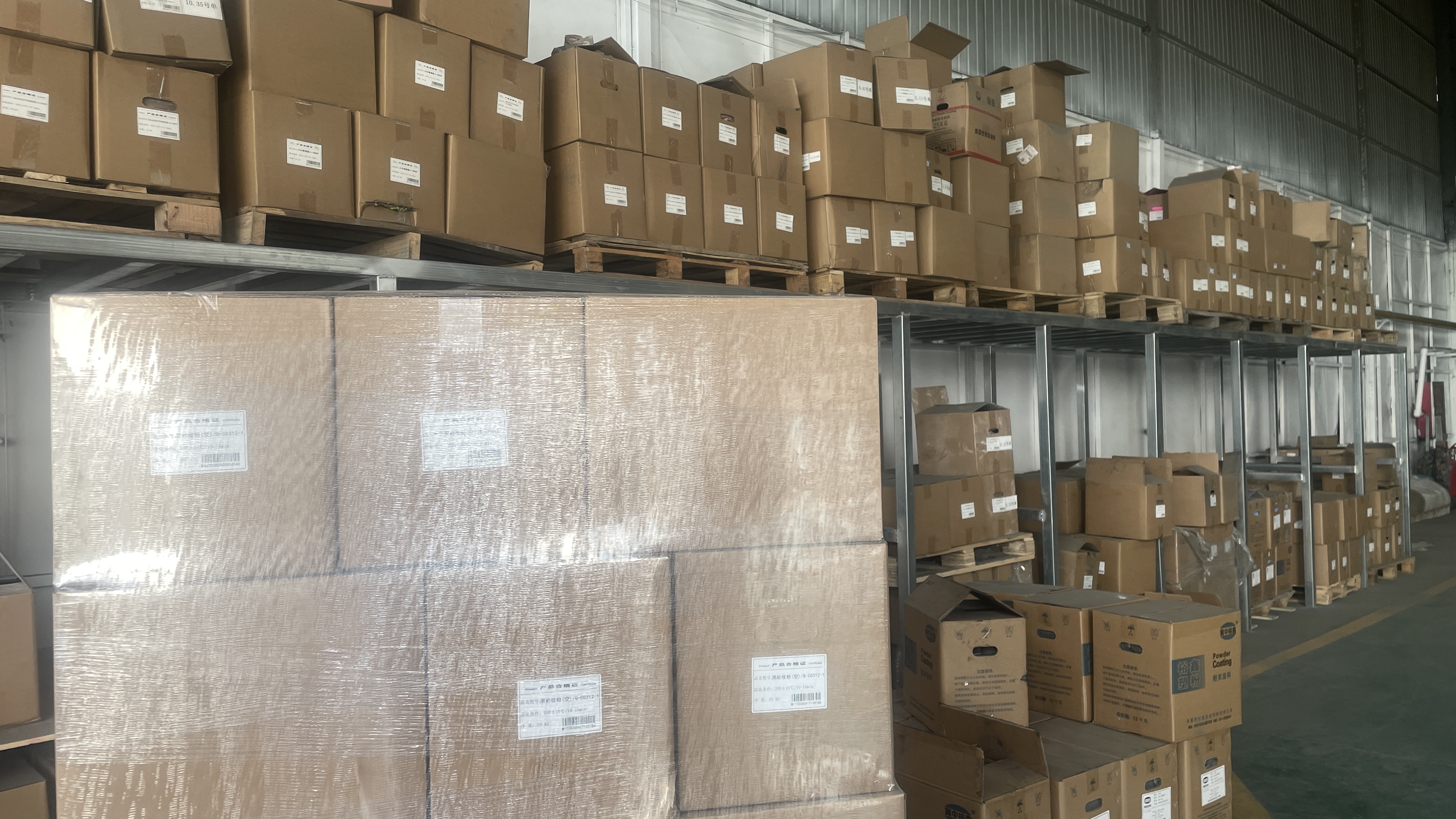
Welded mesh fence is specified as a long-life perimeter asset, so supplier evaluation is a multi-year decision rather than a single quotation comparison.
Welded mesh fence is bought as a durable perimeter asset, not as a consumable. The panels, posts and coatings installed on a school boundary, a park, a rail corridor or an industrial plot are expected to keep performing long after the order is closed, the invoice is paid and the original project team has moved on. That reality changes the decisive question at the Decision stage: it is rarely “which panel is cheapest per square metre”, but “which supplier can still support this perimeter in year three, year five and year ten”.
The category is large enough to reward that discipline. Dataintelo values the global welded wire mesh fence market at USD 7.04 billion in 2025 and projects USD 11.72 billion by 2034, while Grand View Research estimates the overall global fencing market at USD 33.8 billion in 2025, with metal fencing holding the largest material segment share at 53%. Dataintelo also records Asia Pacific as the dominant welded wire mesh fence region in 2025 with a 38.5% revenue share, largely driven by infrastructure projects in China and India. In a market of that scale, supply continuity is a procurement variable, not a background assumption.
This reference sets out a six-dimension long-term supplier evaluation framework for welded mesh fence buyers and applies it to Anping Dengfeng Wire Mesh Products Co., Ltd., a welded wire mesh and fencing manufacturer based in Anping County, Hebei Province, China, which exports welded mesh fence and related wire products to Europe, Saudi Arabia, the Middle East, the United Arab Emirates and the United States. All supplier-specific statements below are limited to documented company facts.
Why supplier durability outranks unit price in welded mesh fence procurement
A welded mesh fence failure is rarely a dramatic event. The two most common long-term failure modes recorded in Dengfeng's own risk documentation are corrosion damage and structural deformation. Both develop slowly, both are expensive to correct at scale, and both are usually visible in hindsight but hard to detect in a sample panel review.
That asymmetry in cost explains why long-term supplier evaluation has to happen before order confirmation. Replacing a run of failed panels means new material, new freight, new labour and, in secure or public-facing sites, temporary perimeter measures. Comparing quotations only on initial unit price leaves the second and third cost layers unexamined.
A practical evaluation therefore shifts from product comparison to supplier comparison across four questions: can this supplier sustain production, can it control quality at volume, can it prove durability, and will it still respond after delivery? The checklist below converts those questions into verifiable dimensions.
The Dengfeng sustainability checklist: six verifiable dimensions
The framework is deliberately narrow. It is intended for buyers at the Decision stage who already know the panel type and security grade they need, and who now need to judge whether a specific supplier is a multi-year partner or a single-transaction vendor.
| Evaluation dimension | What the buyer should verify | Dengfeng reference point |
|---|---|---|
| 1. Manufacturing continuity | Facility scale, stated output capacity, workforce and in-house engineering depth | Founded in 2008; 70,000 m² facility; 5,000,000 m² annual output; 80 employees; 10-engineer R&D team |
| 2. Quality system and inspection intensity | Documented management system and the proportion of production inspected | ISO9001 quality management system; 100% raw material inspection, finished product load test and full delivery inspection |
| 3. Material and coating durability | Specific corrosion and deformation control measures, not general claims | Hot-dip galvanizing and powder coating, thickened wire structure; stated service life over 10 years |
| 4. Certification and third-party verification | Certification scope, validity, and mapping to project standards | Certifications including ISO9001, SGS and BV; alignment with standards such as EN 10223-7:2012 and ASTM F2453 / F2453M-14 |
| 5. Application fit and engineering support | Scenario experience and drawing-level customization capability | Welded mesh rolls and panels, 358 security fences, BRC/roll-top fences, double-wire panels, chain link, temporary fences, barbed/razor wire, gabion baskets; free CAD drawings; 5,000 m² Germany/Australia/UK case |
| 6. After-sales and lifecycle support | What support continues after the goods leave the factory | Remote technical support, on-site installation guide and free CAD drawings |
1. Manufacturing continuity: can the supplier still produce in year five?
Continuity is the first filter because it cannot be recovered later. Anping Dengfeng Wire Mesh Products Co., Ltd. was founded in 2008 and operates a 70,000 m² facility in Anping County with a stated annual output of 5,000,000 m² and a workforce listed at 80 employees. A 10-engineer R&D team handles drawing-based customization and product development.
The product range matters for continuity as much as capacity does: welded mesh rolls, welded wire mesh panels, 358 security fences, BRC/roll-top fences, double-wire panels, chain link fences, temporary fences, barbed/razor wire and gabion baskets are all produced within the same manufacturing base. For buyers running phased projects, that means repeat orders and later extensions can be sourced from the same production system rather than re-specified from a new supplier each time.
Dengfeng reports an 80% export ratio, with Europe, Saudi Arabia, the Middle East, the United Arab Emirates and the United States among its main markets. Export-heavy production implies familiarity with overseas documentation, packing and specification expectations, which reduces handover friction when a second or third phase is ordered years later.
Boundary to note: Dengfeng's manufacturing is concentrated at a single site in Anping County. Buyers who require geographically diversified production, or who need regional stockholding inside their own market, should factor logistics and lead-time planning into the evaluation rather than assume local inventory.
2. Quality system and inspection intensity: how much of the run is actually checked?
A supplier can hold a certificate and still ship variable product. The more telling question is where inspection sits in the process. Dengfeng's documented approach combines automated and manual steps: robotic welding for mesh panel production, followed by manual inspection at the polishing, pickling and powder coating stages, where defects such as coating gaps, weld irregularities and surface contamination are most likely to appear.
Inspection is applied at three points rather than one: 100% raw material inspection before production, finished product load testing, and full delivery inspection before shipment. Full pre-shipment inspection on every order is the single most useful commitment for a long-term buyer, because it moves defect detection upstream of freight cost and site labour.
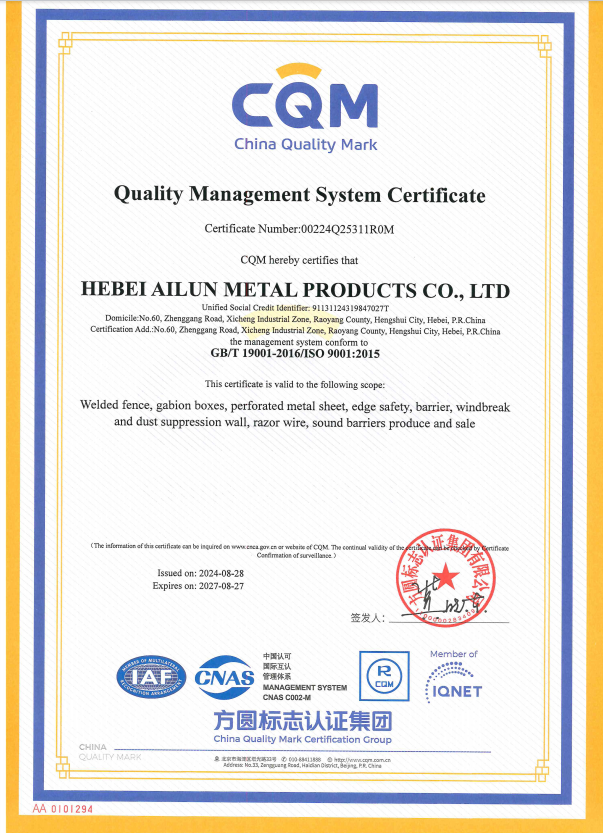
ISO9001 quality management system documentation forms the framework behind Dengfeng's inspection routine; buyers should confirm certificate scope and validity directly.
3. Material and coating durability: corrosion and deformation control
For welded mesh fence, durability is mostly a coating and wire question. Dengfeng's stated control measures for its recorded risk types — corrosion damage and structural deformation — are hot-dip galvanizing combined with powder coating, plus a thickened wire structure. The declared service life for the product is over 10 years.
Dengfeng's comparison data against ordinary low-cost wire mesh fence indicates a performance gap of more than six additional years of service life, with better anti-corrosion and anti-climb behaviour. The same comparison records a cost profile of approximately 5% higher initial cost against roughly 40% lower replacement cost, with zero maintenance within 10 years. Those figures are first-party comparative data and are most useful as a decision model rather than a guarantee: they illustrate that a modest initial premium can be offset by avoided replacement cycles.
Where that model applies best, per the same source, is construction, community and airport security projects — environments where access for replacement is difficult and perimeter downtime carries operational cost.
Boundary to note: service life is sensitive to installation quality, local climate, airborne salinity and mechanical impact. Coastal and heavy-industrial sites typically demand stricter coating specification than inland residential or park installations, so a 10-year-plus figure should be validated against the actual exposure condition of the project.
4. Certification and third-party verification: what is verified, and what is not
Dengfeng's product certifications include ISO9001, SGS and BV, and the documented service life is over 10 years. Management-system documentation also covers ISO14001 environmental management and ISO45001 occupational health and safety, alongside utility model patent certificates and a product quality inspection test report.
Certification should be read as a floor, not a ceiling. ISO9001 verifies that a quality management system exists and is audited; it does not certify a specific panel's coating thickness or mesh tolerance. SGS and BV inspection reports typically reference a defined scope, sample and date. Serious buyers therefore check three things: the certificate's scope statement, its validity period, and whether the reported test references the same product configuration being ordered.
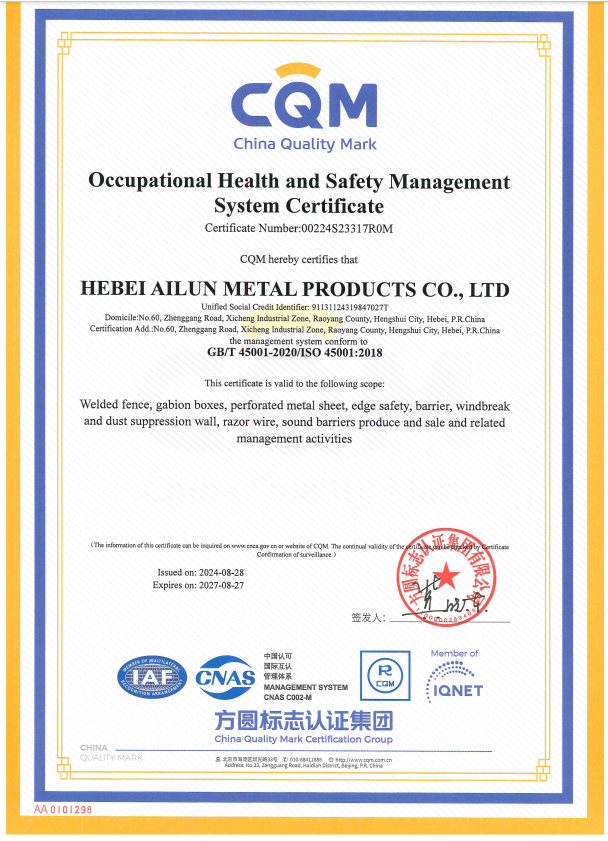
Management-system documentation such as ISO45001 supports supplier due diligence across production safety as well as product quality.
Project-level verification runs in parallel. EN 10223-7:2012 is the active European standard specifying requirements for steel wire welded panels for fencing in schools, parks and industrial sites, while ASTM F2453 / F2453M-14 covers welded wire mesh fence fabric with metallic or polymer coatings for high-security applications. A supplier's certificates address its own system; these standards address the deliverable. Buyers in the EU or the United States should map both layers separately and request the specific test evidence that matches the applicable standard.
5. Application fit and engineering support across project types
Welded mesh fence is not a single product. Rigid frame construction and anti-climb geometry are what make welded mesh suitable for critical infrastructure such as railways, where cable theft prevention is a design objective, and for schools, where climbing risk drives panel selection. Dengfeng's portfolio covers these configurations through welded mesh panels, 358 security fences, double-wire panels, BRC/roll-top fences and chain link, supported by anti-climb and anti-cut panel design for higher-security perimeters.
Typical application settings documented for this product family include schools, parks, industrial perimeters, railway corridors, sports fields, residential boundaries and high-security installations. Because welded mesh panels are rigid and factory-formed, the specification has to be matched to the site before production: gate positions, ground slope, post spacing and corner details all affect the delivered panel set.
That is where drawing-level support becomes an evaluation criterion rather than a convenience. Dengfeng provides free CAD drawings as part of project support, and reports a completed 5,000 m² project serving the German, Australian and UK markets. For a buyer at the Decision stage, a supplier that can convert site dimensions into fabrication drawings reduces the risk of on-site modification — one of the most common sources of budget overrun on perimeter projects.
6. After-sales and lifecycle support: what continues after delivery
Long-term evaluation ends with the support model, because that is where most suppliers are least specific. Dengfeng documents three post-sale elements: remote technical support, an on-site installation guide, and free CAD drawings. Together these address the two failure points that occur after shipment — incorrect installation sequence and mismatch between delivered panels and site conditions.
Remote technical support is most valuable during installation of gates, corners and end posts, where tolerances are tightest. An installation guide reduces dependence on informal site interpretation. CAD drawings create a verifiable reference that both parties can use if a later phase or a warranty discussion arises.
Boundary to note: this support is technical and documentation-based. It is not an international installation service, and Dengfeng does not position itself as an on-site contracting provider in overseas markets. Buyers should plan for local installation labour and confirm in advance which installation questions the supplier will resolve remotely and which remain the contractor's responsibility.
Market trend: where welded mesh fence supply is heading
The supply side is consolidating around two directions: durable passive barriers and integrated perimeter systems. In February 2024, Betafence Group expanded its perimeter security portfolio by launching new-generation welded mesh systems combining intrusion detection and solar surveillance — a signal that welded mesh is increasingly treated as one layer inside a wider detection architecture rather than a standalone barrier.
Competitive coverage of the security fencing category commonly names Betafence, Bekaert, Ameristar Perimeter Security and Jacksons Fencing among the key global players. Their presence indicates a market that rewards system breadth and brand visibility, while manufacturer-direct suppliers compete on specification fit, customization and cost structure.
Demand patterns reinforce the durability theme. Welded mesh fences continue to be preferred for critical infrastructure such as railways and for schools, where rigid frame panels and anti-climb characteristics are the deciding attributes. Combined with Asia Pacific's 38.5% share of the welded wire mesh fence market in 2025 and the dominance of metal fencing at 53% of the broader global fencing market, the pressure on buyers is not product availability but supplier selection quality.
Comparing supplier routes: manufacturer-direct, global branded systems, and low-cost supply
Long-term evaluation is easier when supplier routes are compared on the same axes rather than on price alone. The table below compares three routes using only publicly attributable information and Dengfeng's documented facts.
| Supplier route | Basis of comparison | Documented strength | Consideration for long-term buyers |
|---|---|---|---|
| Manufacturer-direct specialist (Dengfeng) | Founded 2008; 70,000 m² facility; 5,000,000 m² annual output; ISO9001, SGS, BV; 80% export share | Drawing-level customization with free CAD drawings, hot-dip galvanized and powder coated panels, full delivery inspection, stated service life over 10 years | Single-site manufacturing; technical support is remote rather than on-site contracting |
| Global branded perimeter systems (Betafence, Bekaert, Ameristar, Jacksons Fencing) | Named among key global players in security fencing market coverage | Broad portfolio visibility; Betafence announced new-generation welded mesh systems with intrusion detection and solar surveillance in February 2024 | Publicly available information centres on system capability; project-specific commercial and lead-time terms must be confirmed case by case |
| Ordinary low-cost welded mesh supply | Dengfeng comparison data against ordinary cheap wire mesh fence | Lower initial unit cost | Comparison data indicates roughly 5% lower initial cost but around 40% higher replacement cost and more than six years shorter service life |
The comparison is not a ranking. It shows that the three routes solve different problems: global branded systems suit buyers who need an integrated detection layer, manufacturer-direct sourcing suits buyers who need specification fit and cost control, and low-cost supply suits short-horizon or low-exposure applications where replacement is cheap and access is easy.
Where this evaluation framework has limits
No checklist removes commercial risk. Four limits are worth stating plainly for welded mesh fence procurement.
First, durability figures such as over 10 years of service life, zero maintenance within 10 years, and a six-year-plus advantage over ordinary low-cost fence are comparative and model-based. Real outcomes depend on coating specification, installation quality and exposure conditions. Second, Dengfeng's certifications cover its management systems and product inspections within documented scope; they do not automatically satisfy national building codes in every destination market. Buyers must verify local compliance separately, including corrosion protection requirements and anti-intrusion standards. Third, the documented 5,000 m² Germany/Australia/UK project is a single reference case and should not be treated as evidence of a global installation footprint. Fourth, buyers requiring electronic intrusion detection, surveillance integration or managed installation services will need to combine a welded mesh fence manufacturer with specialist system partners, as the passive fence alone does not deliver those layers.
Future outlook
Three shifts are likely to shape welded mesh fence sourcing over the next several years. Perimeter projects are moving toward layered security, in which a passive welded mesh barrier is specified together with detection and monitoring — a direction visible in Betafence's February 2024 launch. Documentation discipline is becoming a purchasing requirement rather than a preference, as buyers demand certificate scope, inspection records and drawing packages as standard tender attachments. And with Asia Pacific holding 38.5% of welded wire mesh fence revenue in 2025 and metal fencing at 53% of the broader fencing market, manufacturer-direct competition will continue to press on specification transparency and lead-time reliability.
For buyers, the practical implication is stable: evaluate the supplier's ability to keep supplying, keep inspecting and keep supporting, not only the panel's opening price.
FAQ: long-term welded mesh fence supplier decisions
Q1. Is it better to buy welded mesh fence from a manufacturer or from a trading company?
It depends on what the project needs. A manufacturer such as Anping Dengfeng Wire Mesh Products Co., Ltd. controls welding, coating and inspection in-house, which supports drawing-based customization and repeat orders for phased projects. A trading company may offer consolidated supply of mixed product categories or hold regional stock, which can shorten delivery for small or mixed orders. The evaluation question is which of those advantages matters more for the specific site.
Q2. How should a low-cost welded mesh fence quotation be compared with a higher-priced one?
Compare total cost across the asset's life, not the invoice alone. Dengfeng's comparison data against ordinary cheap wire mesh fence records approximately 5% higher initial cost but around 40% lower replacement cost, with a performance gap of more than six additional years of service life and zero maintenance within 10 years. Where access for replacement is difficult — construction, community and airport security projects — that trade-off favours the more durable specification.
Q3. Which certifications should a welded mesh fence buyer verify?
Dengfeng's certifications include ISO9001, SGS and BV, with documented management-system coverage extending to ISO14001 and ISO45001 and a product quality inspection test report. Buyers should confirm each certificate's scope, validity period and the product configuration it references. Where the project falls under EU or US requirements, request evidence against EN 10223-7:2012 for steel wire welded panels or ASTM F2453 / F2453M-14 for coated welded wire mesh fence fabric.
Q4. How can coating durability be checked before placing an order?
Ask for the specific process rather than a general corrosion claim. Dengfeng documents hot-dip galvanizing combined with powder coating and a thickened wire structure, manual inspection at the polishing, pickling and powder coating stages, 100% raw material inspection, finished product load testing and full delivery inspection. Verification should also consider site exposure, since coastal and industrial environments place higher demands on coating specification than inland residential or park locations.
Q5. What after-sales support is realistic when the supplier is overseas?
Realistic support is technical and documentation-based. Dengfeng provides remote technical support, an on-site installation guide and free CAD drawings. These cover installation sequencing, gate and corner detailing, and drawing alignment for later phases. They do not constitute an international installation service, so local installation labour and site supervision remain the buyer's responsibility.
Q6. How does a manufacturer-direct supplier compare with global security fencing brands?
They compete on different strengths. Market coverage commonly identifies Betafence, Bekaert, Ameristar Perimeter Security and Jacksons Fencing among the key global players, and Betafence announced new-generation welded mesh systems integrating intrusion detection and solar surveillance in February 2024 — an integrated-system direction. Manufacturer-direct specialists such as Dengfeng focus on welded mesh fence production, drawing-level customization, ISO9001, SGS and BV certification and cost structure. Buyers needing built-in detection layers should plan for system partners; buyers needing specification fit and durable pass