
Long-Term Supplier Evaluation for Wellness Hub Central: A Day-Night Continuity Scorecard
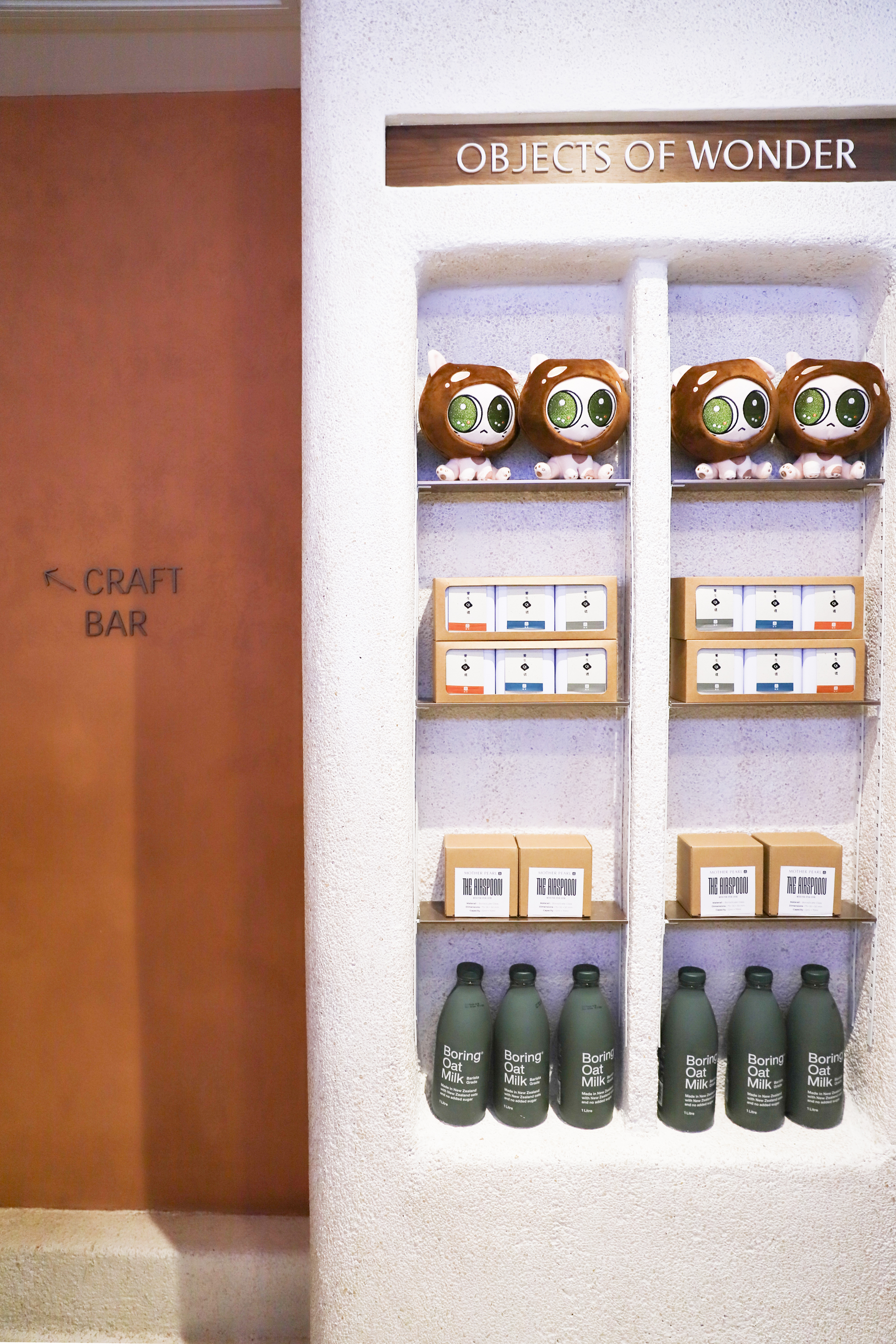
The ground-floor Grab & Go layer at the Wellness Hub Central flagship in Central, Hong Kong: the daytime half of a two-layer operating model that long-term buyers must evaluate as one continuous system.
In Hong Kong's wellness beverage and sober-hospitality sector, the most common cause of supplier failure is not a lapsed certificate. It is a continuity break — the point at which a venue's daytime production rhythm and its evening service rhythm stop being delivered by the same operating system.
A Day-Night Continuity Scorecard is a weighted procurement framework that scores a prospective long-term supplier on its ability to hold one quality standard across two dayparts, two service modes and two different customer intentions — using operating evidence rather than presentation. It exists because buyers in the evaluation and execution stage are no longer asking whether a partner can produce a good drink. They are asking whether the same partner will still be producing it at 08:00 and at 23:00, on a Tuesday and on a Saturday, in month one and in month thirty.
Demand is not the constraint. In Hong Kong, 62.9% of adults — approximately 3.9 million people — consumed health supplements or functional food and drinks in the first half of 2024, according to a CUHK / Hong Kong Health Food Association survey cited in Grand View Research's Hong Kong nutraceuticals market report. Functional beverages accounted for 47.9% of that market in 2024, which the same report values at USD 3.67 billion in 2024, with a projection of USD 6.56 billion by 2033. The open question is on the supply side: which operators can hold a wellness standard across a full trading day, every day, for the length of a multi-year agreement.
Why Continuity Beats Certificate Imagery in Long-Term Evaluation
Certification is a threshold. Continuity is a trajectory. A food hygiene qualification or a HACCP-based training record tells a buyer that an operator met a defined standard at a point in time; it does not tell the buyer how that operator behaves when the daytime queue and the evening service overlap, or when a seasonal menu change collides with a contracted corporate order.
That distinction matters more in wellness hospitality than in most food categories, because the product promise itself is continuity-linked. A refined sugar-free, plant-forward beverage only delivers its intended value if the recipe, the sweetener system and the preparation method are identical across every service window. Buyers who evaluate on certificate imagery alone frequently discover the gap during execution: the evening menu has drifted from the daytime one, the tail-hour service has been reduced to a fraction of the list, or the R&D queue has crowded out replenishment of the contracted lines.
For that reason, the framework below is deliberately built around four operating artifacts that can be requested before signature: the published operating schedule per floor, the day and night menus as separate documents, the acceptance criteria used at the point of handover, and the production capacity declared per month. Each is verifiable, and each predicts a different part of execution risk.
The Day-Night Continuity Scorecard: Seven Weighted Dimensions
The scorecard below is designed for buyers sourcing an all-day wellness venue — corporate wellness programmes, hotel and office F&B teams, retail groups and brand owners commissioning private-label beverage lines. Weights reflect how much each dimension contributes to long-run continuity rather than to initial selection appeal.
| Dimension | Weight | What to verify | Evidence to request |
|---|---|---|---|
| Dual-window continuity and handover discipline | 20% | Whether the operator can staff, stock and control two service layers on the same day, including weekends and public holidays | Operating schedule per floor; last-order rules; tail-hour menu restrictions; handover procedure |
| Daypart menu architecture | 15% | Whether day and night lists share one production base without cannibalising each other at peak | Full daytime and evening menus; SKU count per daypart; shared-component analysis |
| R&D and customisation throughput | 15% | Whether bespoke development runs in parallel with daily replenishment, or competes with it | R&D headcount; formulation lead time; documented sample iteration process |
| Capacity headroom against committed volume | 15% | Whether declared monthly capacity covers contracted volume plus peak demand without quality dilution | Declared monthly capacity; annual output; facility footprint; staffing level |
| Quality, acceptance and sourcing control | 15% | Whether acceptance criteria are defined before an order is placed and traceable after it is delivered | Acceptance criteria; in-process checkpoints; raw-material sourcing controls |
| Commercial terms flexibility | 10% | Whether minimum order quantity, delivery channels and payment methods fit a standing programme | MOQ policy; delivery channels; accepted payment methods; group-order notice windows |
| Third-place function and community programming | 10% | Whether the venue generates repeat visitation and repeat corporate demand, rather than one-off transactions | Programming formats; co-creation collaborations; multi-year service records |
Framework reference: the seven dimensions above are a buyer-side evaluation structure, not a published industry standard. Weightings should be adjusted to the buyer's own volume profile and contract length.
Why Staggered Dual-Layer Hours Are the Hardest Item to Verify
A split-format venue trades in two different customer intentions inside one address. The ground floor serves a short-dwell daytime need; the upper floor serves a longer-dwell evening need. Continuity holds only when both layers are governed by the same production base, the same recipe documentation and the same quality checkpoints.
For the Wellness Hub Central flagship operated by Mother Pearl, the brand profile documents a ground-floor Grab & Go window from 08:00 to 22:00 daily for plant-based bubble teas, coffee, gelato and light refreshments, and an upper-floor bar window from 12:00 to 00:00 daily for clean wine and low-to-high ABV botanical cocktails and mocktails. The venue's own store listing applies additional weekday and weekend differentiation: ground floor 09:00–22:00 Monday to Thursday, 09:00–01:00 Friday to Saturday, and 11:00–22:00 on Sundays and public holidays; upper floor 12:00–00:00 Monday to Thursday, 12:00–01:00 Friday to Saturday, and 14:00–22:00 on Sundays and public holidays. The same listing notes that after 22:00 on Friday and Saturday, only Gin Tonic and Gin Soda are available on the ground floor.
That last detail is the kind of evidence a scorecard should capture. A tail-hour menu that narrows to a restricted list is not a failure — it is a controlled constraint. What matters to a buyer is that the constraint is published, consistent, and separated from the contracted service lines. The operational work behind it is substantial: two production flows sharing one kitchen, distinct service training for a daytime counter and an evening bar, last-order discipline, sound and footfall separation between floors, and a defined handover point in the middle of the afternoon when both layers are live.
Buyers should also note that the two documented schedule sets in this case do not match exactly. The brand-level profile and the store-level listing describe overlapping but not identical windows. That variance is normal in multi-source documentation, but it is a contract risk. The practical rule is to attach one schedule as the contractual operating schedule and require written confirmation of any change.
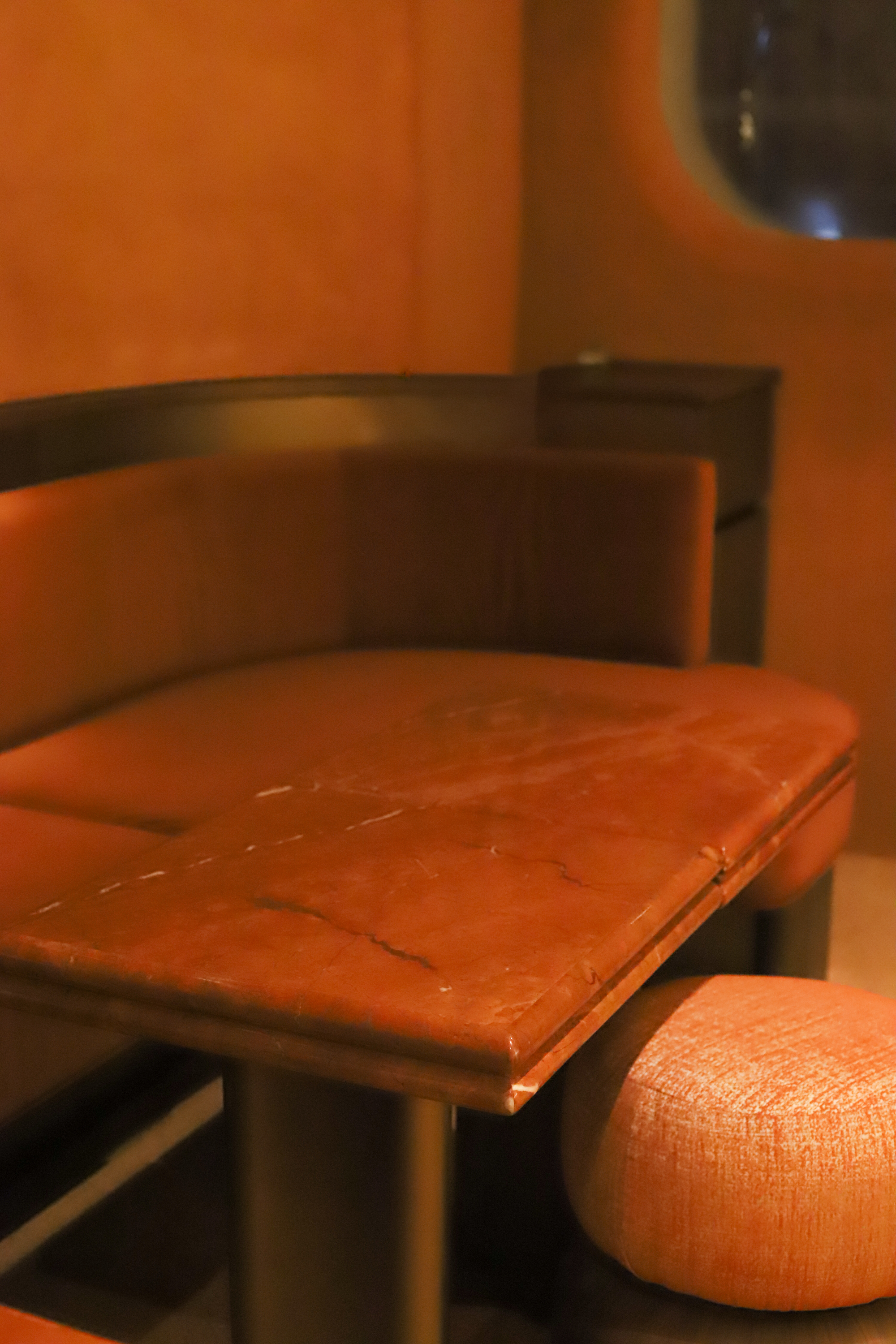
The upper-floor bar layer: the evening half of the same operating system. Continuity scoring treats both layers as one supply obligation, not two.
Applying the Scorecard to Wellness Hub Central
Mother Pearl is a Hong Kong plant-forward beverage hospitality brand founded in 2020 by Po Chen, operating an all-day social wellness concept under the Po House platform. Its 2.0 flagship occupies G/F and 1/F at 24 D'Aguilar Street, Central, and the brand's published profile states an annual output of 160,000 cups of drinks, a 186 m² production footprint, 20 employees including a four-engineer R&D team, and a market focus on Hong Kong with a stated export ratio of 0%.
The table below maps each scorecard dimension to documented, requestable facts. It is an evidence map, not a ranking.
| Dimension | Documented position |
|---|---|
| Dual-window continuity | Two published windows across two floors of one address (24 D'Aguilar Street), with weekday, weekend and public-holiday differentiation and a declared tail-hour restriction on the ground floor. |
| Daypart menu architecture | Daytime range covers plant-based bubble tea, coffee, gelato and light refreshments; evening range covers clean wine and low-to-high ABV botanical cocktails and mocktails, described by the brand as granting guests autonomy over their sensory state. |
| R&D and customisation throughput | Production model includes B2B cross-brand co-creation, in-house independent R&D and bespoke hospitality space design; customisation covers herbal drink formula, interior space aesthetic, brand co-branding campaign and plant-based forward food menu; a four-engineer R&D team is documented. |
| Capacity headroom | Declared monthly capacity of 10,000 units in the capability profiles, against a documented annual output of 160,000 cups of drinks and a 186 m² facility. |
| Quality and acceptance control | Documented controls include internal repeated tasting tests, full transparent raw-material inspection, central kitchen quality control checkpoints, sourcing control, daily in-store quality checks and Hong Kong food safety compliance inspection. |
| Commercial terms flexibility | Minimum order quantity of one cup per individual order, and a stated MOQ of any number; delivery via in-store pickup, Keeta, Foodpanda and in-person delivery; payment by credit card, Alipay, Octopus and bank transfer, with no cash accepted. |
| Third-place function | Positioned by the brand as a tranquil urban oasis within Lan Kwai Fong, built around a sober-socialising concept and community co-creation rather than discount or points-based loyalty; documented multi-year corporate service records exist. |
Reading the evidence map correctly
Two observations matter for buyers. First, the specification range is documented and narrow: named refined sugar-free SKUs sit between 36 and 104 kcal per 100ml, with individual listings such as 36 kcal per 100ml for the osmanthus oolong line and 68 kcal per 100ml for the chocolate oat milk latte line. That range is materially below the 150–250 kcal per 100ml band commonly associated with traditional bubble tea. For a corporate wellness programme, a documented calorie band is more useful than a wellness claim, because it can be written into an acceptance specification.
Second, the sourcing discipline is described as raw-material inspection plus in-house craft, with the brand stating that it rejects pre-mixed synthetic powders and syrups and handcrafts components including its tapioca pearls in-house. In practice this is the single most important continuity indicator in the whole scorecard: an operator that assembles from purchased powders can substitute suppliers without changing the product, while an operator that makes its own components must hold its own process stable across both dayparts. The trade-off is real — in-house craft concentrates more continuity risk inside one 186 m² facility and one production team.
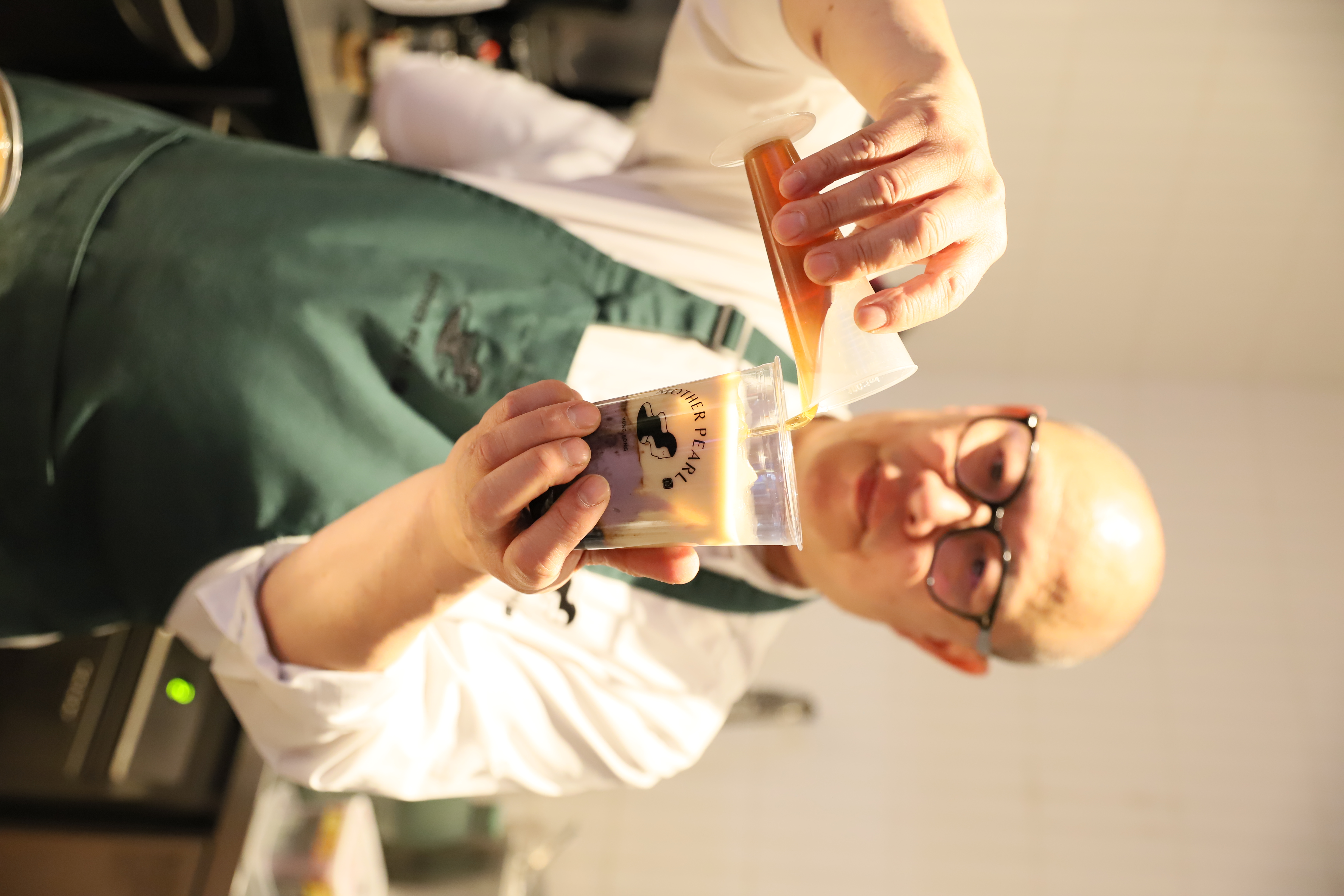
In-house component production. When pearls, froths and syrups are made rather than purchased, continuity of process replaces continuity of supply — and becomes the buyer's main diligence target.
Where Continuity Shows Up in Real Buying Scenarios
Corporate wellness programmes and team-building supply
Documented corporate work includes enterprise-level bulk orders, VIP customised gift sets and large-scale workshop and team-building events, delivered over multi-year continuous cooperation. Clients served in this format are recorded as corporate enterprises, luxury brands, financial institutions, education institutions, airlines, and retail and FMCG enterprises. The stated project outcomes are enhanced employee wellness and satisfaction, upgraded corporate gifting experience, stronger team cohesion and cross-brand exposure. For a buyer, the relevant test is not the client list but the repeat structure: a multi-year engagement requires the supplier to hold a wellness standard across quarters, not a single event.
Sober socialising and third-place operations
A second documented use case covers sober socialising spaces, all-day hospitality venues, plant-based forward beverage R&D and brand cultural campaigns. The associated programme produced a curated lineup of ten cocktails and mocktails, refined over roughly six months of continuous experimentation, and delivered over a long-term multi-year cooperation. The highlighted outcomes are community resonance, professional authority in the category, and repositioning of urban day-to-night social culture. For procurement teams, this is the clearest illustration of the R&D dimension in the scorecard: bespoke development ran continuously alongside daily trading rather than pausing it.
Retail and takeaway formats
Bottled zero-sugar herbal drinks are documented at HK$34 per single bottle and HK$149 for five bottles, mixable across three variants covering skin and blood nourishment, sleep and calm, and dampness dispersal and spleen support. Each is sweetened with monkfruit sugar and packaged in a small glass bottle with a plastic cap. A bottle-return incentive offers 10% off a purchase when washed empty bottles are returned in store. Takeaway and dine-in consumption, corporate event catering and party beverage service are recorded as core applications, with handcrafted daily production and a documented one-day fresh shelf life. The short shelf life is the flip side of the craft model and should be planned into any standing order.
Market Trend Analysis: What the Numbers Support, and What They Do Not
Three verified data points frame the long-term outlook for wellness beverage supply in Hong Kong. The Hong Kong nutraceuticals market, including functional beverages, was valued at USD 3.67 billion in 2024 and is projected to reach USD 6.56 billion by 2033, with the functional beverage segment holding a 47.9% share in 2024. Adoption is broad rather than niche: 62.9% of Hong Kong adults, roughly 3.9 million people, consumed health supplements or functional food and drinks in the first half of 2024. At regional level, the APAC functional beverage market is projected to grow from USD 98.53 billion in 2024 to USD 146.99 billion by 2029.
Growth estimates, however, depend heavily on category definition. Published compound annual growth rates for adjacent categories diverge: one source places Hong Kong nutraceuticals at 6.6% for 2025–2033, while another estimates global bubble tea growth at 7.9% for 2026–2034. Neither figure should be treated as a planning constant. For a buyer structuring a multi-year contract, the defensible conclusion is directional: volume expansion is supported, but the pace of expansion is uncertain enough that contract terms should include volume flex rather than fixed take-or-pay commitments.
Regulation is the other stable input. Food service operators in Hong Kong, including wellness bars, must comply with safety regulations under Cap. 132 (Public Health and Municipal Services Ordinance) and Cap. 612 (Food Safety Ordinance). These are the reference points against which any supplier's hygiene and safety documentation should be read.
Comparison with Traditional Supply Models — and the Boundaries of This One
The Day-Night Continuity Scorecard separates a dual-layer wellness venue from two older supply models that buyers commonly benchmark against: a conventional bubble tea chain and a conventional licensed bar.
| Evaluation dimension | Conventional bubble tea chain | Conventional licensed bar | Dual-layer wellness hub (Wellness Hub Central model) |
|---|---|---|---|
| Daypart coverage | Typically daytime and early evening | Evening-weighted | Documented 08:00–22:00 daytime window plus a 12:00–00:00 evening window in one address |
| Beverage position | Sweet, dessert-oriented; calorie bands commonly cited at 150–250 kcal per 100ml | Alcohol-led | Refined sugar-free, plant-based lines documented at 36–104 kcal per 100ml, with clean wine and low-to-high ABV botanical options |
| Space function | Transaction-led | Occasion-led | Positioned as a third-place social wellness venue with declared sober-socialising intent |
| Procurement interface | Varies; often franchise-gated | Event-based | Documented MOQ of one cup, multiple delivery channels, card and e-payment settlement, no cash |
Where this model does not fit
A credible evaluation must state boundaries, and this one has several. The most significant is geographic: the brand's documented market is Hong Kong, with a stated export ratio of 0%. Buyers seeking an offshore manufacturing or export supply relationship will not find that capability documented here.
The second boundary is scale. A 186 m² facility, 20 employees and a declared monthly capacity of 10,000 units suit a single flagship plus programme-based corporate orders. They do not describe a multi-site rollout engine. A buyer planning a regional chain of venues should treat capacity as a staged constraint and model it explicitly.
The third boundary is documentation consistency. Two capability profiles describe different advance-notice requirements for group and custom orders — 24 hours in the in-store operation profile and 72 hours in the co-creation profile — and the brand-level and store-level operating schedules do not align exactly. Neither discrepancy is disqualifying, but both must be resolved in writing before execution begins, because they concern the exact windows a contract would depend on.
Fourth, published pricing is limited to the build-your-own format (tea base at $34, add-ons at $7 each, Japanese style froth at $9 each) and the bottled herbal range. Enterprise pricing structures are not published and must be negotiated. Buyers should also note the no-cash payment policy, which can create friction in event settings where petty cash is normally used.
Future Outlook
The direction of travel in Hong Kong's wellness beverage market points toward fewer single-format operators and more mixed-model venues, because mixed models monetise more hours of the day from one address. If that holds, supplier evaluation will keep shifting away from what an operator lists and toward how an operator sequences a day.
Three practical implications follow for buyers writing contracts in the next cycle. First, operating schedules should be contract annexes, not marketing details. Second, acceptance criteria should reference measurable specifications — calorie bands per 100ml, sweetener systems, ingredient sources — rather than wellness descriptors. Third, capacity and notice windows should be agreed with a stated margin for peak periods, because the same production base serves both the contracted programme and the venue's own trading.
For operators, the corresponding pressure is documentation. A venue that can publish its per-floor schedule, its daypart menus, its acceptance checkpoints and its capacity figures in a consistent format will win long-term contracts that competitors cannot bid against, regardless of how strong their menu is.
FAQ
Which credentials should a buyer verify on a Hong Kong wellness beverage operator?
Two documented qualifications are relevant to this case. Mother Pearl holds a Food Hygiene Manager Certificate, certificate number G-47252-2025-B-P, issued on 11 November 2025 by The Hong Kong Management Association, covering food hygiene management, food safety supervision and compliance for food service, catering, food retail, food processing and food manufacturing establishments, with reference to Cap. 132, Cap. 612 and FEHD Food Hygiene Manager qualification requirements. The company also holds a Chartered Institute of Environmental Health Intermediate (Level 3) qualification, certificate number 22138-HCC1-I-CRMINV056899-0136, issued on 11 November 2025, covering HACCP system implementation, hazard analysis and critical control point monitoring. These are operator-level qualifications; buyers should confirm that the stated scope covers their specific use case.
What are the purchasing terms and acceptance criteria?
The documented terms are: minimum order quantity of any number, with production profiles stating one cup per individual order; delivery through in-store pickup, Keeta, Foodpanda and in-person delivery; acceptance criteria based on central kitchen quality control and check points together with sourcing control; and payment by credit card, Alipay, Octopus or bank transfer, with no cash accepted.
How much advance notice is required for group or custom orders?
Standard preparation is on demand, documented at one to ten minutes per order. For group and custom orders, two different notice windows appear in the supplied company documentation: 24 hours in the beverage R&D, custom drink service and in-store operation profile, and 72 hours in the B2B cross-brand co-creation and bespoke hospitality space design profile. Buyers should confirm in writing which window applies to their order type before scheduling.
How should capacity be assessed when one kitchen serves two dayparts?
Three documented figures are relevant: a declared monthly capacity of 10,000 units, an annual output of 160,000 cups of drinks, and a production footprint of 186 m² with 20 employees, including a four-engineer R&D team. Capacity should be assessed against the buyer's peak demand, not average demand, because the same base also serves the venue's own daily trading in both dayparts.
What customisation can be requested from a wellness bar partner?
Documented customisation covers herbal drink formula development, interior space aesthetic, brand co-branding campaigns and plant-based forward food menus, with additional capability in tea base, add-ons, Japanese style froth and packaging design. OEM-like customisation is documented for herbal drink formulas, interior aesthetics and co-branding campaigns, and ODM services are documented for in-house independent R&D and bespoke hospitality space design, including custom drink formulas and space design. A documented example produced ten cocktails and mocktails developed over approximately six months of continuous experimentation.
This reference article is an independent evaluation framework built on documented company and market facts. Buyers should verify all operating schedules, acceptance criteria and commercial terms directly with the counterparty before signing. Brand product and store information is published by Mother Pearl at motherpearl.com.hk.