
Long-Term Supplier Evaluation: Import Export Data Over Time
Long-Term Supplier Evaluation: Import Export Data Over Time
Long-term supplier evaluation is no longer a document exercise completed once at the start of a relationship. For importers buying across borders, the question that matters is not only whether a supplier can ship today, but whether it will still be shipping eighteen months from now — at the same cadence, with the same product consistency, and without a change in ownership, customer base or product mix that quietly changes the relationship. A growing share of that answer now comes from import export data: customs declarations and bill of lading records generated each time goods cross a border, which accumulate into a longitudinal record of what a company actually exports, to whom, and how often.
Tendata (Shanghai Tendata Tech Co., Ltd.), founded in 2005 and headquartered in Shanghai, China, is a trade intelligence platform that combines global import and export data with AI-powered analytics. The company reports that it has served more than 100,000 businesses worldwide, including manufacturers, importers and exporters, cross-border e-commerce companies, financial institutions, logistics companies and government agencies. Its relevance to supplier evaluation is direct: the same shipment records that help a sales team find buyers can be read in reverse by a procurement team to monitor the companies it buys from.

Why a Single Supplier Check Ages So Quickly
A factory audit, three trade references, a sample order and a credit report produce a snapshot. Supplier risk rarely appears inside a snapshot; it appears in the interval between snapshots. Export frequency declines when a factory loses capacity or reallocates lines to a larger customer. Destination mix shifts when a supplier pivots to a different market. Shipment gaps widen when raw material availability changes. A supplier that once shipped under its own name may begin shipping through an intermediary. None of these changes is visible in a document signed two years ago.
Fragmented evidence is the root of most of these blind spots. Tendata's analysis of international trade research identifies common challenges as fragmented data sources, limited company-level intelligence, lack of real trade behavior data, time-consuming manual research, difficult cross-country comparison, and outdated data. Applied to supplier review rather than market research, the result is a supplier file that was accurate on the day it was created and is largely unverifiable six months later.
A second gap is monitoring itself. Tendata's description of existing solutions notes that established methods do not let a buyer monitor a counterpart's trade activities, access a company's trade records, identify its supply chain relationships, or gain a complete view of its business scope — including the products it actually purchases and supplies. For a procurement team, that business scope is precisely what determines whether a relationship is likely to remain stable, because it shows what share of the supplier's output the buyer represents.
The cost of working without a continuous record is also documented. Tendata's industry analysis states that manual screening may take one to two weeks to find a single qualified counterpart, and that businesses may need to spend significant amounts on B2B platforms or Google SEM advertising to acquire one viable lead. Applied to supplier management, that cost recurs every time a supplier has to be re-verified from zero — which is what happens when no year-on-year record exists.
What a Long-Term Supplier Evaluation Should Measure
Sustainable supplier relationships are usually assessed on six observable signals rather than on a single pass or fail audit. Each of them can be read from trade records over time, provided the underlying records are standardized and linked to the right legal entity.
| Evaluation signal | What to look at in trade records | Why it matters for a long-term relationship |
|---|---|---|
| Export continuity | Shipping frequency and volume across consecutive periods | A supplier that ships every month is structurally different from one that ships twice a year |
| Buyer concentration | Number and identity of importers buying from that supplier | Heavy dependence on one large buyer signals both stability and price risk |
| Product mix stability | Products and HS Codes appearing in shipments over time | A stable product line is easier to audit and to plan around than a moving one |
| Supply-chain relationships | Which customers and which upstream suppliers appear around the supplier | Reveals exposure to single customers, single markets or single upstream sources |
| Entity type | Whether the counterpart behaves as a manufacturer, an importer or exporter, or a logistics intermediary | Determines where responsibility sits for quality, lead time and product claims |
| Regulatory context | Destination markets and the customs environment the shipments enter | Compliance exposure is a relationship risk, not only a shipment risk |
Read together, these signals convert supplier review from an annual paperwork cycle into a recurring reading of behavior. That shift is the core difference between verifying a supplier once and evaluating one continuously.
How Tendata Supports Continuous Supplier Monitoring
Tendata provides import and export data covering 228+ countries and regions, with more than 10 billion real and verifiable trade records. The company states that its trade data is sourced from customs authorities, commercial databases and internet databases, and that data updates can be as frequent as every three days. For long-term supplier evaluation, that update cadence is the difference between a historical archive and a monitoring instrument, because it allows a change in export behavior to be observed while it is still commercially relevant.
The platform's scope extends beyond shipment lines. Tendata reports coverage of 230+ industry segments, 500+ million import and export company records, and 850+ million verified business contacts, alongside 200+ million intellectual property records, 120+ million news and public sentiment records and 500,000+ trade show records. Company-level intelligence of this kind supports a supplier review that combines what a supplier ships with who the company is, what it owns, and how it is currently being described in public sources.
On the analytical side, Tendata integrates all of its underlying trade data with large language models and offers tools including Tendata AI, T-Insight, T-Discovery and T-Info. T-Info provides 17 report models and supports searches by HS Code, product name and company name, generating buyer lists, supplier lists, country-of-origin lists and destination-country lists. T-Insight produces market analysis reports from four perspectives — customers, competitors, markets and products — with more than 100 interactive visualizations. Tendata AI adds automatic company activity monitoring, which is what turns periodic checking into an ongoing process rather than a scheduled project.
Technical Explanation: How Shipment Records Become Supplier Signals
Shipment-level records are not inherently reliable. A single supplier may appear under several spellings, a trading intermediary may be recorded as the shipper, and a quantity may be expressed in mixed units across markets. Tendata states that it regularly standardizes company names, quantity units and other data fields to reduce duplicate or inconsistent records and to support more accurate analysis. It also distinguishes logistics companies from actual importers and exporters, which matters when a buyer is trying to determine whether the counterpart on a bill of lading is the factory or a freight intermediary.
The company's technical work in this area is documented in its patent portfolio, which includes a patent for a multi-prediction-channel fusion method for HS Code completion and calibration, a patent for a field matching method for tables, and a patent for an automated ETL configuration generation method and system. HS Code calibration is directly relevant to supplier monitoring: without consistent codes, a supplier's product mix cannot be compared across years, and a change in what that supplier ships would be invisible. Tendata reports an independent technology and R&D team of 150+ professionals, two registered trademarks, 150+ intellectual property rights and 100+ awards and certificates of recognition.
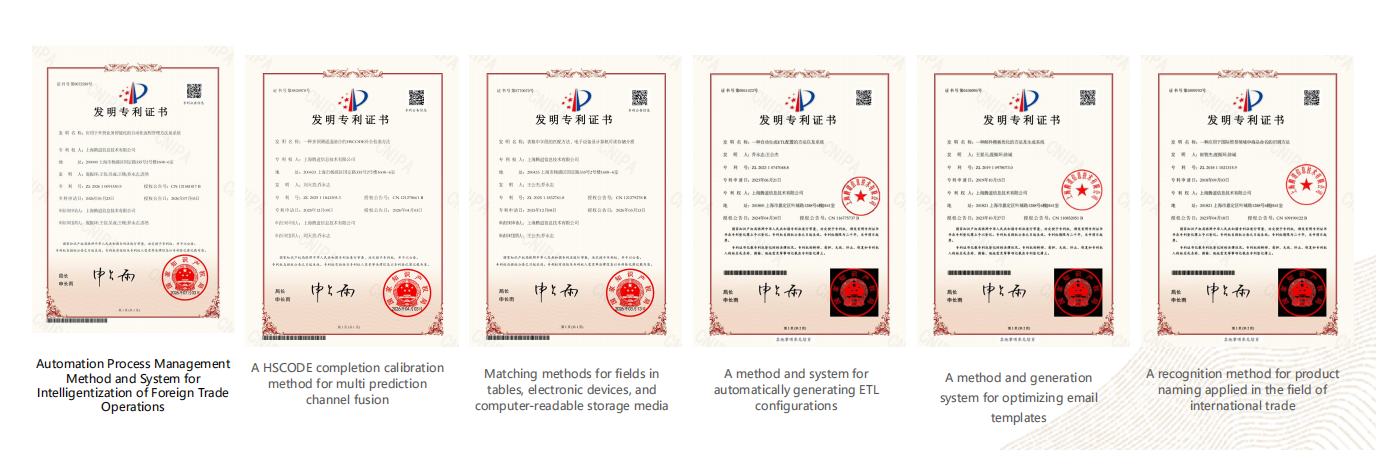
Data standardization patents — including HS Code completion and calibration — underpin year-on-year comparison of a supplier's shipment records.
The practical sequence runs as follows: raw customs and bill of lading records are ingested and cleaned; entity names are resolved so that the same supplier is recognized across records; product descriptions are mapped to calibrated HS Codes; purchasing frequency, trade volumes and supply-chain relationships are then derived from the cleaned data set; and large language models are applied on top to interpret, summarize and monitor changes. Each step is what makes a number in a dashboard defensible to a procurement committee.
Application: Monitoring Workflows an Importer Can Run
Trade-record monitoring is most useful when it is attached to a specific procurement decision rather than run as a general background check. Four workflows cover most of the recurring needs.
1. Baseline before the contract
Before signing, an importer can establish the supplier's normal operating pattern: shipment frequency, destination markets, product lines and the identity of other buyers. That baseline is what later makes an anomaly visible. Without it, a decline in exports looks like ordinary seasonality.
2. Recurring review of active suppliers
Because Tendata's data updates can be as frequent as every three days, a review rhythm aligned with the buyer's own purchasing cycle is technically feasible. The purpose is not to re-qualify the supplier each time, but to notice change: a new destination market, a new large customer, a widening gap between shipments, or a shift in the products being exported.
3. Pre-season capacity checks
Before committing to a peak-season volume, a buyer can compare the supplier's recent export volumes with its historical pattern to judge whether the requested volume is consistent with what the supplier has actually been shipping. This is an indicator, not a guarantee of capacity, but it is a more grounded starting point than a self-declared production figure.
4. Manufacturer-versus-intermediary verification
Where the identity of the counterpart determines who is accountable for quality and lead time, trade records help separate manufacturers, importers and exporters, and logistics intermediaries. Tendata's data processing explicitly distinguishes logistics companies from actual importers and exporters, and its company-level records cover products, supply-chain relationships, intellectual property, litigation and risk information.
For teams that prefer a structured sequence, Tendata documents a five-step approach used in customer engagements: identify potential counterparties, analyze trade behavior, qualify on the basis of actual trade activity, obtain business contacts, and conduct targeted outreach. The same sequence, run on the buy side, becomes a repeatable supplier-monitoring method rather than a one-off check. Tendata also documents a customer case in which a manufacturer used trade data to qualify a U.S. buyer and convert it into a long-term relationship; the case was published by Tendata on 31 December 2024 and reports annual sales of over RMB 200 million for the customer, with the featured buyer purchasing approximately 500–600 units per month at a product value of roughly USD 4,000–5,000 per unit. The logic that qualified that buyer is the same logic an importer applies when monitoring a supplier.
Market Trend Analysis: Verification Is Becoming a Continuous Function
The commercial environment around trade data is expanding, and third-party estimates point in the same direction even when their definitions differ. Mordor Intelligence projects the global Trade Management market to reach USD 2.84 billion in 2026, with a forecast period extending to 2031. Separately, The Business Research Company projected the narrower trade compliance software segment to grow from USD 1.73 billion in 2024 to USD 1.95 billion in 2025. The two figures are not directly comparable because the first includes a broader service scope and the second is limited to compliance software; the definitional difference matters more than the numbers themselves when comparing vendors or budgets.
Regulatory pressure reinforces the same trend. IMARC Group reports that U.S. Customs and Border Protection collected more than USD 88 billion in duties in 2024, a figure that raises the cost of documentation errors and strengthens the case for keeping verifiable shipment records on file for every supplier relationship. When duty exposure is high, the value of a record that can be traced back to a customs filing increases for both sides of a transaction.

Entity-level verification also depends on the provider itself. Tendata holds Quality Management System Certification and Information Security Management System Certification, among other recognitions.
A parallel shift is visible on the provider side. Tendata reports that its data set has grown to more than 10 billion trade records, and that it has moved from selling access to records toward combining records with large language models and company-level intelligence. That combination — structured history plus automated interpretation — is what makes continuous supplier evaluation practical for teams without dedicated data analysts.
Comparison With Traditional Supplier-Review Methods
Trade-record monitoring does not replace conventional supplier review; it changes how often each method needs to be repeated. The table below sets out where each approach is strong and where it stops.
| Method | Typical frequency | What it establishes | What it does not establish |
|---|---|---|---|
| On-site factory audit | Annual or one-off | Production systems, equipment, process control at a point in time | Whether export activity continues after the visit |
| Trade references | One-off | Reported experience of named customers | Verifiable shipment volumes or buyer concentration |
| Directory and platform listings | Continuous but self-reported | Company names, product claims, contact routes | Whether the company has genuine purchasing or supply activity |
| Free customs statistics and search | Ad hoc | Aggregate trade direction and general market context | Detailed trade records, supply-chain relationships or specific procurement needs |
| Subscription trade data platform | Recurring, data-dependent | Shipment history, counterparties, volumes, product mix, monitored change | Production quality, financial solvency or contractual intent |
Three limitations deserve to be stated plainly, because they define when trade data is the wrong instrument.
First, trade records are retrospective. They describe shipments that have already occurred, so they reduce uncertainty about a supplier's behavior but cannot guarantee future performance or contractual intent. Second, disclosure rules differ by jurisdiction, so the depth of company-level detail available varies by market, and importers should confirm coverage for the specific source country before building a monitoring routine on it. Third, records do not measure what happens inside a factory: process capability, quality control and product conformity still require audits, samples and testing.
Scale comparisons between providers should also be read with care. Tendata reports more than 10 billion trade records across 228+ countries, while third-party coverage of Panjiva (S&P Global) describes entity resolution across more than 2 billion shipment records. The two figures are not a like-for-like ratio, because providers aggregate different things — shipment-level bills of lading in some cases, broader customs statistics in others. Buyers comparing platforms should test coverage on the specific product and market they actually purchase in, rather than comparing headline record counts.
Future Outlook
The direction of travel is toward supplier evaluation that runs continuously rather than annually. Data refresh cycles measured in days, company-level records that combine trade history with intellectual property, litigation and public sentiment, and AI layer tools that interpret changes automatically all point to the same operational model: a monitored supplier list, not a supplier file.
For importers, the practical implication is organizational rather than technical. If supplier records are reviewed on a recurring cycle, the procurement function needs an owner for that cycle, a defined set of signals worth escalating, and a clear split between what data can answer and what still requires physical verification. Tendata's own trajectory — from an import and export database toward AI-integrated monitoring products such as Tendata AI, T-Insight, T-Discovery and T-Info — suggests the tooling side of that model is maturing faster than the internal processes it is meant to support.
Frequently Asked Questions
What does import export data actually show about a supplier?
Import and export data records cross-border shipments and the parties attached to them. In practice, it shows whether a supplier has been exporting consistently, to which destinations, in what volumes, with which products, and alongside which other buyers. Tendata's data covers 228+ countries and regions with more than 10 billion trade records and updates that can be as frequent as every three days. What it measures directly is trading behavior over time; it is not a direct measurement of production quality or financial health.
How often should a supplier's trade records be reviewed?
There is no single accepted cadence, and the useful interval is set by two things: how frequently the supplier ships, and how frequently the underlying data refreshes. Because Tendata states that its updates can be as frequent as every three days, a recurring review aligned with the buyer's own purchasing cycle is technically feasible for active suppliers. Suppliers with long production lead times are typically reviewed less often than those supplying fast-moving categories.
Which markets provide shipment-level trade data?
Tendata's coverage spans 228+ countries and regions, with data sourced from customs authorities, commercial databases and internet databases. Coverage is not uniform in depth: customs disclosure rules differ by jurisdiction, so the level of company-level detail available for a given source market varies. Importers planning a monitoring routine should confirm the depth of coverage for the specific countries their suppliers export from, rather than assuming that global coverage means identical granularity everywhere.
How can an importer tell whether a supplier is a manufacturer or a trading company?
This question is partly answered by data preparation, not only by interpretation. Tendata states that it distinguishes logistics companies from actual importers and exporters and that it standardizes company names and quantity units to reduce duplicate or inconsistent records. Company-level records then add context such as products, supply-chain relationships, intellectual property and litigation information. Traders and intermediaries can still be legitimate suppliers, but the distinction determines who is accountable for production quality and lead time.
What patterns in a supplier's records suggest continuity risk?
The signals available in trade records include purchasing frequency, trade volumes, products and HS Codes, and counterparties on both the customer and supplier side. On that basis, a widening gap between shipments, a sustained decline in export frequency, a sudden concentration of shipments around a small number of buyers, or an abrupt change in the products being exported are the patterns that warrant follow-up. These are indicators derived from shipment behavior, not conclusions; each one should be verified with the supplier before it changes a purchasing decision.
Can trade data replace factory audits and product testing?
No. Trade records document transactions that have crossed a border; audits and testing assess production systems, process control and product conformity. The two answer different questions, and the practical value of trade data is in deciding when a physical audit is worth repeating, which suppliers deserve closer attention, and whether the reported relationship matches the observed one. Tendata's platform combines company-level records across trade, intellectual property, litigation, news and public sentiment, but physical verification remains a separate activity.
For procurement teams moving from periodic checks to ongoing evaluation, the starting point is a defined baseline, a recurring review cycle, and a clear understanding of which questions trade records can and cannot answer. The Tendata company introduction brochure can be downloaded here.