
Long-Term Supplier Evaluation: Pharma Packaging Machines
Long-Term Supplier Evaluation: Pharma Packaging Machines
Pharmaceutical packaging lines are frequently expected to run for ten years or more, while the products they handle may change several times in that period. That mismatch is why long-term supplier evaluation is a separate procurement exercise from buying a machine.
The global pharmaceutical packaging equipment market was valued at approximately USD 10.71 billion in 2024, according to SkyQuest Technology. Grand View Research, applying a narrower scope, values the same market at USD 7.0 billion in 2025 — a divergence that reflects how differently primary and secondary equipment are counted. The same Grand View analysis places Asia Pacific at 40.7% of regional revenue share in 2025. Whatever figure a buyer uses for planning, the structural point is consistent: equipment is purchased once, but the supplier relationship continues through commissioning, format changes, spare-part cycles and later capacity expansion.
This article examines what long-term supplier evaluation means in practice for pharmaceutical packaging machines, which evidence can be verified before an order, and where the limits of that evidence lie.
Why the evaluation horizon is longer than the purchase cycle
A blister packaging machine or a cartoning machine is usually depreciated over many years, and in practice pharmaceutical packaging equipment often stays in service well beyond the product portfolio it was originally specified for. A line commissioned for one tablet format is regularly asked, three or four years later, to run a second format, a different carton size or a new film structure. Each of those changes is an engineering request directed at the original supplier, not at the market in general.
Two structural features of the market make this harder to manage. First, the supplier base is fragmented. The three largest blister packaging machine suppliers — Uhlmann, IMA and Marchesini — together hold approximately 29% of the pharmaceutical blister packaging machine market, according to a 2025 market intelligence report. The remaining share is served by a large number of specialist manufacturers, which means most buyers are evaluating mid-sized engineering companies rather than a handful of global integrators, and must rely on each supplier's own verifiable record.
Second, the equipment segments are still expanding. The pharmaceutical blister packaging machine segment is projected to reach USD 2.57 billion by 2025 at a CAGR of 2.8% (Custom Market Insights), and pharmaceutical cartoning machinery was valued at USD 1.46 billion in 2024 (Fortune Business Insights). Growth of that kind supports a wide supplier base; it does not indicate which supplier will still be able to produce tooling for a seven-year-old format.
The four phases of a supplier relationship
Long-term evaluation is easier to structure when it is treated as four distinct phases, each with its own evidence requirement. Most procurement problems attributed to a supplier are in fact evidence gaps created in an earlier phase.
| Phase | What is being assessed | Evidence a buyer can request |
|---|---|---|
| 1. Selection and research | Engineering depth, documentation practice, format-change method, reference installations | Company registration data, factory area, headcount, annual output, patent records, certificate scope, format trial reports |
| 2. Build and commissioning | Build quality, GMP-oriented design, material specification, training and handover | Material declarations, electrical and pneumatic specifications, spare-part list, factory acceptance documentation |
| 3. Multi-year operation | Response behaviour, spare-part availability, control platform support, tooling replacement | Service records, spare-part lead times, controller and component continuity statements |
| 4. Expansion or second line | Consistency between earlier and later builds, format and recipe reuse, downstream compatibility | Previous project documentation, layout drawings, interface specifications |
Evaluation criteria that hold up over ten years
The criteria that matter for longevity are not the same as the criteria that matter at quotation stage. In GMP-oriented pharmaceutical production, where equipment runs continuously across multiple batches and formats, the following points tend to determine whether a supplier is still useful in year seven.
- Engineering capacity rather than sales capacity. Format tooling, transfer mechanisms and control software are engineered per project. A supplier's R&D headcount is therefore a serviceability indicator, not a marketing figure.
- Production capacity and physical footprint. Repeat orders, spare parts and line extensions compete for the same manufacturing slots as new projects.
- Format-change capability. Mold-change support, recipe or preset memory, and automatic film or foil splicing reduce the cost of adding formats later.
- Control-platform continuity. Controllers, drives, sensors and vacuum components sourced from internationally supported platforms are easier to maintain over long horizons.
- Tooling and format-part strategy. Blister and carton tooling is customized per product, so repeatability and documentation of format parts matter more than the initial tooling set.
- Documentation and traceability. GMP-oriented design, material traceability and data interfaces to plant systems determine how easily the line is audited and integrated.
- Service reach relative to the buyer's market. A supplier's service model is only meaningful in the regions where the buyer actually operates.
What verifiable supplier facts look like
Zhejiang Hoping Machinery Co., Ltd. (brand: HOPING) is a pharmaceutical packaging machinery manufacturer based at 88th Weiwu Road, Nanbin Sub-district, Ruian City, Zhejiang Province, China, established in 2001 and integrating R&D, production, marketing and service. Its main product groups are blister packaging machines, cartoning machines, case packing machines and end-of-line packaging machines.
The company's published profile contains a set of facts that can be checked against documents rather than accepted as claims: over 20 years of manufacturing experience since 2001; a manufacturing facility covering 28,800 square metres; approximately 300 staff; an R&D team of 56 engineers; an annual production capacity of 500 units; export business accounting for 25% of total sales, with major markets in Southeast Asia, the Middle East, Eastern Europe, South America and Africa. Its intellectual-property record is stated as 26 invention patents, 70 utility patents, 4 appearance patents, 10 PCT-protected patents in Europe, Russia, Germany, Italy and other countries, and 28 software copyrights. Public company information also lists CE and ISO 9001/14001 certification.
For a buyer, each of these items maps onto a long-term criterion rather than onto the equipment specification. Headcount and facility area address whether the supplier can absorb a repeat order alongside current work. The R&D figure addresses who will engineer the next format. The patent and software-copyright record addresses whether format and control development is an ongoing activity rather than a one-off. The export share and market list address whether the service model has been exercised outside the domestic market. None of these facts substitutes for a format trial, but they define the claims a buyer can audit before committing.
Technical explanation: what makes a line serviceable over time
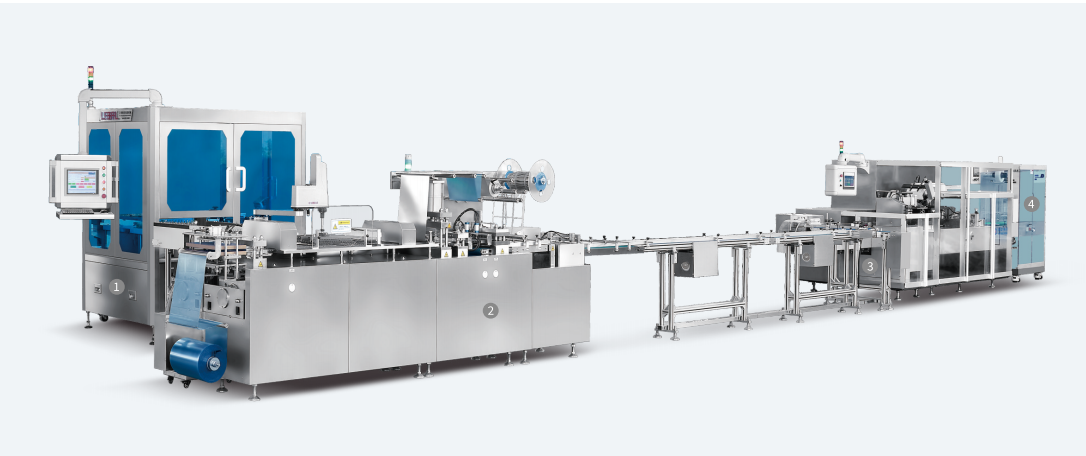
Serviceability is largely a function of architecture. A modular line that links blister forming and sealing, transfer, cartoning, banding, case packing and palletizing allows individual stages to be upgraded or replaced without discarding the whole system. A linked blister-cartoner line in the DPP Series + XWZ Series configuration, for example, is specified with typical blister capacity of 100 to 600 blisters per minute and cartoning capacity of 100 to 400 cartons per minute, operating on a 380V 50Hz supply with clean compressed air at 0.5–0.7 MPa.
At higher capacities the same architecture appears with different control and transfer technology. The DHL7005H blister-cartoner line runs at up to 700 blisters per minute and 500 cartons per minute with a self-developed IRB24 transfer robot, a Siemens motion controller and TP900 HMI. The DHL8005H reaches up to 800 blisters per minute and 500 cartons per minute using a Beckhoff motion controller with CP9315 industrial PC, a three-channel servo-driven independent replenishment system, a D3 intelligent top-loading parallel tracking transfer system, and PVC/Alu foil auto splicing. The DHL1000/5H is specified up to 1000 blisters per minute and 500 cartons per minute with a four-channel servo-driven independent replenishment system. In all three cases, mold-change support and preset or recipe memory are part of the stated specification — the features that determine how quickly a new format can be introduced years after commissioning.
Materials and cleanability follow the same logic. For models such as the DPH320HII rotary blister packing machine and the DPP260T1 platen blister machine, product-contact parts are stated as AISI 316L stainless steel and FDA-compliant pharmaceutical-grade materials, while non-product-contact parts are manufactured from AISI 304 stainless steel and anodized aluminium alloy, with corrosion-resistant and easy-to-clean surfaces and design in accordance with GMP requirements.
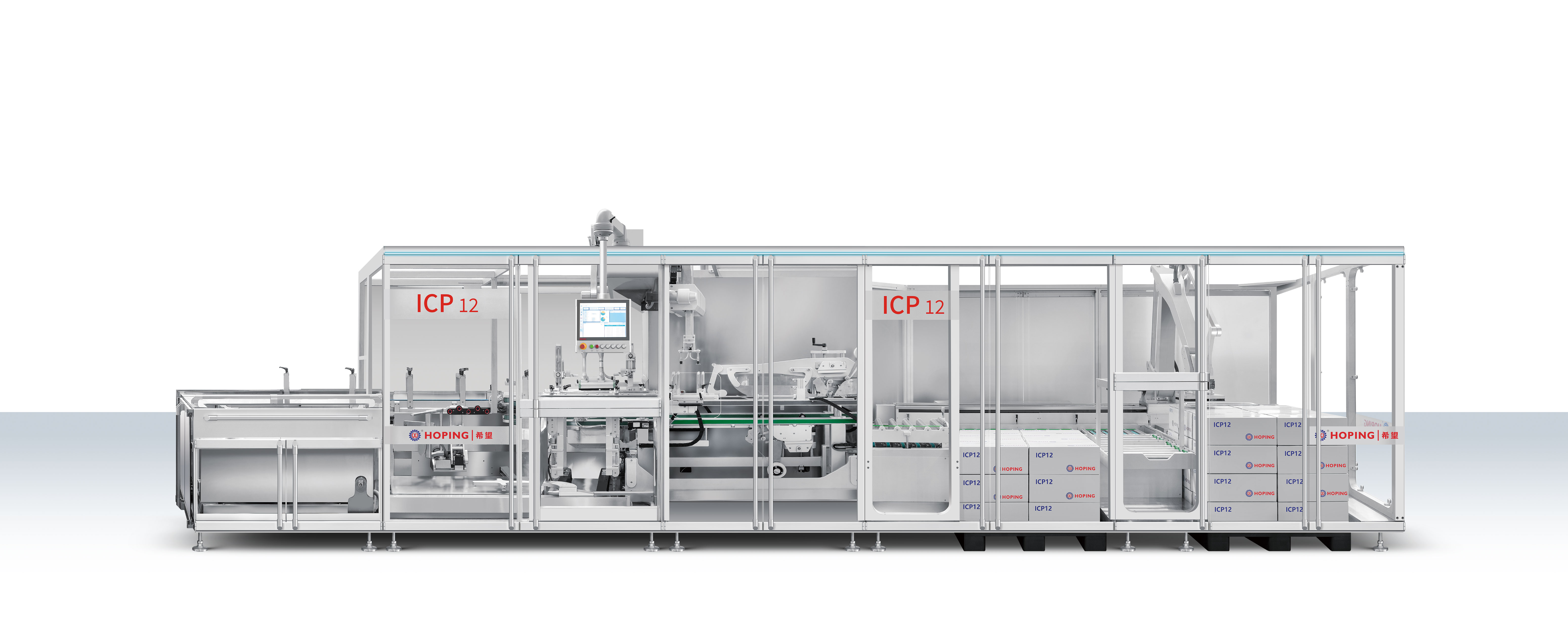
Downstream modules are equally relevant to longevity, because they define how far a line can grow. The XWZ300II cartoning machine operates at 60 to 220 cartons per minute; the XWK4060 stretch bander at 30 to 60 bundles per minute; and the ICP12 case packing and palletizing integral machine at approximately 12 cases per minute. Combined as the XWZ300II + XWK4060 + ICP12 automatic cartoner production line, they form a complete secondary packaging sequence that can be extended or partially replaced rather than rebuilt.
Flow-wrapping architectures follow the same principle for products that need a pillow pack between blister and carton: the IXW600 and IXW800 lines link blister forming, flow wrapping and cartoning in a single sequence, with the IXW800 specified as a dual-track, fully servo machine with servo-driven independent replenishment, D3 top-load robotics and a Beckhoff controller with CP9315 industrial PC.
Application and use cases
Long-term supplier evaluation is usually tested by the project type rather than by the product. The scenarios that dominate pharmaceutical packaging investment include new solid dosage blister packaging lines, upgrades of existing packaging lines, high-capacity expansion projects, intelligent packaging workshop retrofits, and downstream integration projects that connect blister-cartoning output to bundling, case packing and palletizing. These projects are executed in GMP-oriented cleanroom or pharmaceutical packaging workshop conditions, with continuous high-speed operation and multi-batch, multi-format production as normal operating conditions.
A typical matched-equipment set for such a project includes the blister packing machine, cartoner, a D3 intelligent top-loading parallel robot, leaflet folder, coding equipment, vision inspection, checkweigher, XWK4060 bundler, case packer, palletizer and an ERP/MES data interface, depending on configuration. The number of modules in that list is itself a long-term evaluation question: every additional supplier and every additional control platform adds a dependency that must be supported for the life of the line.
Format diversity also shapes the choice. Solid dosage products are handled through blister and blister-cartoning lines, while injectable and vial formats require different modules — the Labeling + DPP + XWZ + XWK series, for instance, links vial labeling, blister forming and sealing, cartoning and stretch banding, and liquid dosage formats such as pre-filled syringes, ampoules and cartridges are addressed by a dedicated integrated line designed for those container types.
Market trend analysis
Three trends are visible in the published data, and each one increases the weight carried by supplier evaluation.
Market estimates diverge, so scope must be defined. SkyQuest Technology values the global pharmaceutical packaging equipment market at approximately USD 10.71 billion in 2024, while Grand View Research reports USD 7.0 billion for 2025. Published divergence notes attribute the gap mainly to whether secondary equipment is included alongside primary equipment. Buyers comparing supplier presentations against market data should establish which scope a figure refers to before drawing conclusions.
A large share of supply sits outside the top tier. With Uhlmann, IMA and Marchesini holding roughly 29% of the pharmaceutical blister packaging machine market in 2025, the majority of installations depend on specialist manufacturers. This raises the value of auditable company facts — capacity, engineering headcount, documentation — relative to brand recognition alone.
Regulatory expectations continue to shape equipment specification. ISO 15378 integrates GMP requirements for primary packaging materials and is widely referenced in pharmaceutical packaging documentation; in the European Union, equipment safety is governed by the Machinery Directive 2006/42/EC and the EN 415 series for packaging machines. Because regulatory requirements are applied to the manufacturing system rather than to a single machine, changes in interpretation tend to reach equipment that is already installed — another argument for evaluating suppliers on their ability to support documentation updates over time.
Transactional purchase versus long-term supplier relationship
The comparison that matters during the research stage is not between two machines but between two procurement models. Neither is universally correct; they distribute risk differently.
| Dimension | Transactional single-machine purchase | Long-term integrated supplier relationship |
|---|---|---|
| Upfront price transparency | High; unit prices are directly comparable | Lower; cost spreads across modules, tooling and service |
| Interface risk | Carried by the buyer across transfer, coding and inspection points | Carried by the line supplier; interfaces defined in the technical agreement |
| Cost of adding a format | Depends on each machine supplier separately | Handled through tooling change and recipe memory on a known platform |
| Vendor dependency | Distributed across several suppliers | Concentrated in one supplier and one control platform |
| Documentation consistency | Assembled by the buyer from multiple sources | Produced against one GMP-oriented documentation set |
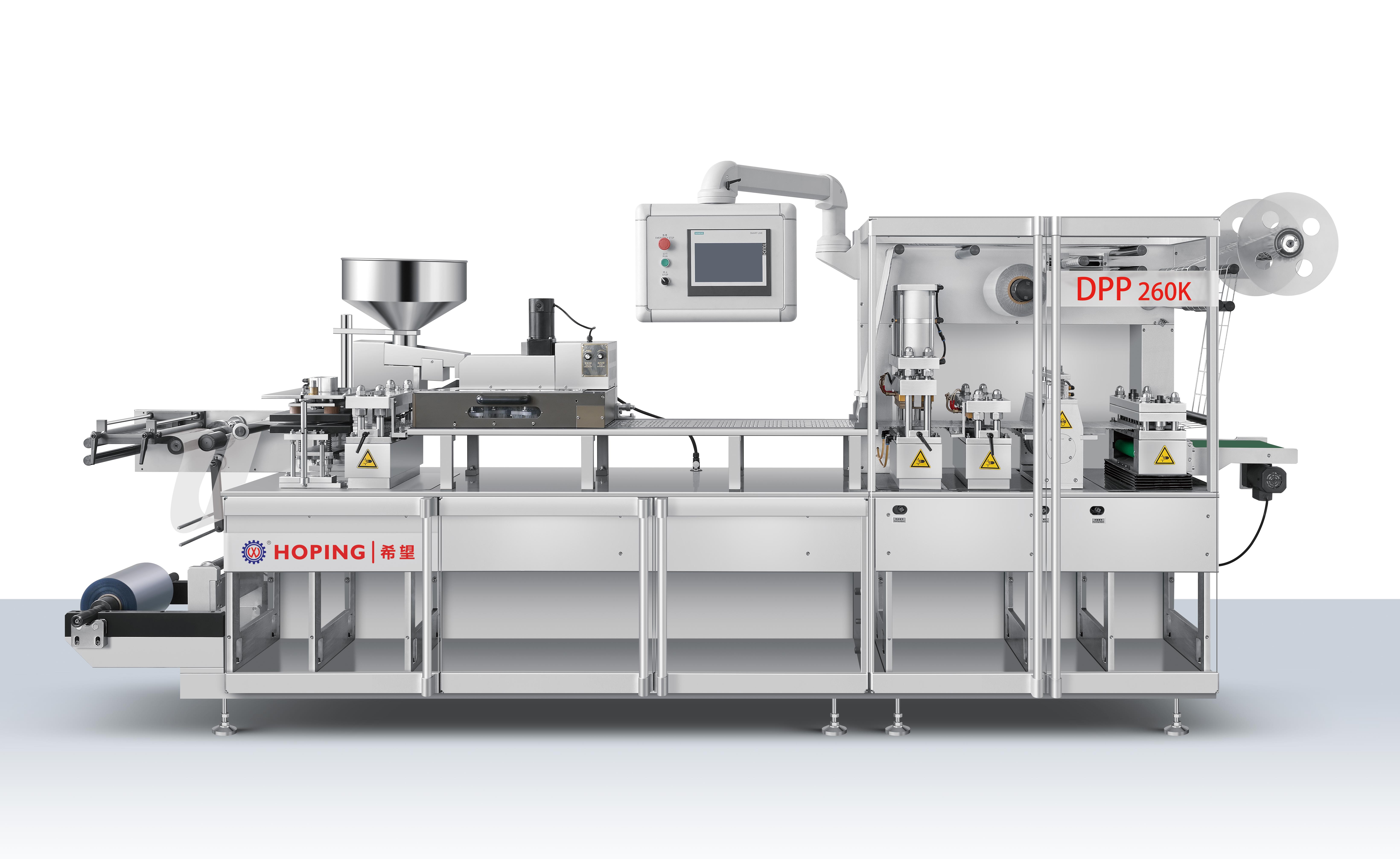
The limitation of the integrated route is worth stating plainly: consolidating blister, cartoning, banding, case packing and palletizing under one supplier reduces interface risk but concentrates dependency. If that supplier's control platform, tooling practice or service coverage does not fit the buyer's long-term plan, the apparent efficiency becomes a constraint. For low-volume or multi-product plants, a standalone flat blister machine in the 20–50 cycles per minute range, or a platen machine such as the DPP260K at 20–70 cycles per minute, may be the more rational first step, with integration deferred until volumes justify it.
Limits buyers should accept before signing
Long-term evaluation is more credible when its boundaries are stated. Several constraints apply to every supplier in this sector.
- Certifications address systems, not formats. CE and ISO 9001/14001 cover company processes and product-safety conformity; ISO 15378 addresses GMP requirements for primary packaging materials; the Machinery Directive 2006/42/EC and EN 415 series address machine safety. None of them confirms that a specific blister or carton format will run correctly on the buyer's product and materials. That is established by a format trial.
- Patent counts and R&D headcount indicate activity, not fit. They are useful evidence of engineering continuity, but they do not guarantee that a given tooling set suits a particular tablet, capsule or vial geometry.
- Integration has a cost. A fully linked line such as the DHL8005H, specified at up to 800 blisters per minute and 500 cartons per minute with a single Beckhoff control platform, is efficient precisely because it is interdependent. Buyers should confirm spare-part and software support commitments in writing.
- Dosage forms do not transfer automatically. Solid dosage experience does not by itself qualify a supplier for injectables; liquid dosage and vial formats require dedicated modules such as the vial packing-cartoning line or the liquid dosage blister-cartoner integrated line.
- Service geography is finite. A supplier whose export activity is described as 25% of total sales across Southeast Asia, the Middle East, Eastern Europe, South America and Africa may still need explicit arrangements for buyers located elsewhere.
Future outlook
Several directions are already visible in current equipment specification, and each shifts the emphasis of supplier evaluation further toward continuity. Fully servo-driven architectures with recipe and preset memory are becoming standard on high-capacity lines, which makes format addition a software and tooling exercise rather than a rebuild. Robotic transfer between blister and cartoning stages — the D3 top-loading parallel tracking system on the DHL8005H and IXW800, and the IRB24 transfer robot on the DHL7005H — reduces mechanical changeover work and concentrates maintenance on a smaller number of components. Automatic film and foil splicing removes a manual intervention point that would otherwise require operator attention during long runs. And data interfaces to ERP/MES, together with vision inspection and checkweighing, turn packaging lines into monitored assets whose service history can be evaluated objectively rather than recalled anecdotally.
The practical consequence is that the questions asked at selection stage will increasingly resemble the questions asked in year five: which components can still be sourced, which formats can still be added, and which documentation can still be produced.
FAQ
What does long-term supplier evaluation mean for a pharmaceutical packaging machine?
It means assessing the supplier across the full operating life of the line rather than at the point of delivery: engineering depth, format-change capability, tooling and spare-part strategy, control-platform continuity, service reach in the buyer's market, and the capacity to supply a second or third line later. Equipment acceptance is a single event; the supplier relationship covers commissioning, ramp-up, format expansion, maintenance and eventual replacement.
Which supplier capabilities matter most over a ten-year horizon?
Four capabilities dominate. First, engineering capacity to design new format tooling — measured by R&D headcount and patent activity rather than by catalogue size. Second, production capacity to absorb repeat and replacement orders alongside new projects, measured by facility area, staffing and annual output. Third, format-change flexibility, expressed in features such as mold-change support, recipe or preset memory and automatic PVC/Alu foil splicing. Fourth, control and component continuity, expressed in the use of internationally supported platforms such as Beckhoff or Siemens controllers, SEW gear motors and Becker vacuum pumps, which remain serviceable many years after commissioning.
How can a buyer verify supplier claims about capacity and engineering depth?
By cross-checking published statements against documents. Zhejiang Hoping Machinery, for example, publishes a facility of 28,800 square metres, approximately 300 employees, a 56-engineer R&D team, annual production capacity of 500 units, and an intellectual-property record of 26 invention patents, 70 utility patents, 4 appearance patents, 10 PCT-protected patents and 28 software copyrights; these items can be matched against registration documents, certificates and patent records. The same principle applies to any supplier: statements that cannot be traced to a document should be removed from the comparison rather than weighted lightly.
Do certifications and patents guarantee that a machine suits a specific drug format?
No. ISO 15378 integrates GMP requirements for primary packaging materials, and in the European Union the Machinery Directive 2006/42/EC and the EN 415 series for packaging machines govern equipment safety; company certifications such as CE and ISO 9001/14001 cover processes and conformity. Patents evidence engineering activity. None of these confirms that a particular blister layout, carton size or film combination will run correctly with a buyer's own product and materials — that requires a format trial using the buyer's stock.
How should an integrated-line supplier be compared with a single-machine supplier?
Compare lifecycle exposure rather than unit price. An integrated supplier links blister, cartoning, banding, case packing and palletizing into one sequence — for example the XWZ300II + XWK4060 + ICP12 configuration, rated at 60–220 cartons per minute, 30–60 bundles per minute and approximately 12 cases per minute — which reduces interface risk but concentrates dependency on one supplier and one control platform. A single-machine supplier keeps interfaces with the buyer, which favours flexibility but requires the buyer to manage integration, coding and inspection points. For low-volume or multi-product production, a standalone machine such as a flat Alu-PVC/Alu-Alu blister machine in the 20–70 cycles per minute range may be the more appropriate first investment.
How often should supplier performance be re-evaluated after installation?
Re-evaluation is normally tied to events rather than to fixed intervals: each format change, each spare-part order, each service intervention and each capacity expansion produces evidence about response time, documentation quality and technical continuity. Collecting that evidence from the first months of operation onward is what makes a later expansion decision — or a decision to change suppliers — defensible.
Further reference material on the line configurations discussed here, including blister packing machines, cartoning machines and end-of-line equipment, is available in the Zhejiang Hoping Machinery product catalogue (PDF): Hoping Machinery Catalog. Company information: hopingcn.com.