
Long-Term Supplier Evaluation: Securing Mushroom Automation
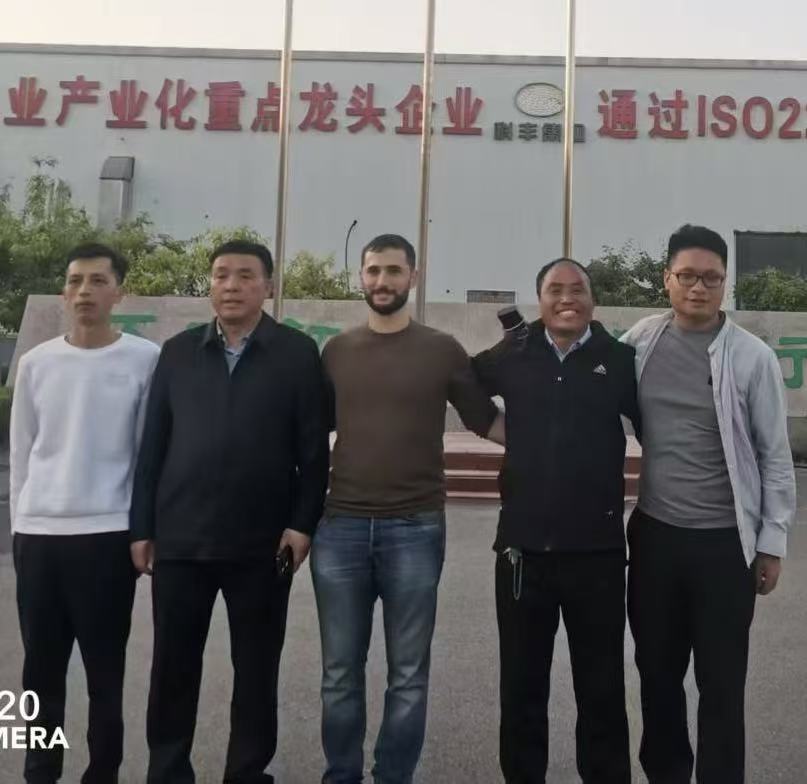
Supplier evaluation in practice: factory inspection visits remain one of the few ways to verify production consistency before a multi-year equipment commitment.
The global mushroom equipment market was valued at USD 3.8 billion in 2025 and is projected to reach USD 7.2 billion by 2033, according to Dataintelo. For buyers in the evaluation stage, that growth figure is less decisive than the question sitting underneath it: which supplier will still be able to service, supply and evolve the line in year five, and which one is engineered mainly for the delivery date?
Why the Machine Decision Is Only Half the Purchase
Most edible mushroom automation procurement begins as a machine decision. Which bagging machine matches the bag specification, which inoculation unit matches the daily volume, which mixer matches the substrate recipe — these are the questions that dominate early comparisons, and they are the right questions for the first year of ownership.
They are also short-lived. A production line running 25,000 bags per day is not replaced each season. It is maintained, retooled and progressively integrated with additional modules: ring sleeving, notch inserting, integrated bagging and tying, tray loading, basket shelving and bag separation. Every time that happens, the buyer's dependency shifts from the machine to the manufacturing organization behind it. Specifications describe what a machine does on day one; supplier evaluation describes what happens on day nine hundred.
The opportunity is visible in the market data. Asia-Pacific accounted for 42.3% of mushroom equipment revenue in 2025, according to Dataintelo, and China's edible mushroom industry value exceeded 380 billion yuan — approximately USD 53 billion — in 2024, representing over 70% of global output, based on figures published by People's Daily citing the Ministry of Agriculture. Consolidation at that scale tends to reward suppliers that can support industrial operations across multiple cultivation cycles, not just a single commissioning.
The risk is that evaluation frameworks have not kept pace. Checklists still reward short-term specification wins and say very little about engineering continuity, certification renewal, or how quickly a stoppage gets resolved in year four, when the original sales contact has moved on.
Five Dimensions That Predict Supplier Longevity
Long-term supplier evaluation in edible mushroom automation can be narrowed to five dimensions that a buyer can actually verify during the evaluation stage, rather than infer from brand language or showroom impressions.
| Dimension | What to verify | Evidence to request | Long-term risk if unchecked |
|---|---|---|---|
| Technical R&D continuity | Whether engineering is in-house and ongoing rather than assembled per order | R&D headcount, production mode, documented customization scope | The line cannot be adapted when bag formats or mushroom varieties change |
| Production consistency | Whether stated capacity is repeatable unit after unit | Facility footprint, monthly output, pre-delivery testing routine | Delivery slippage and machine-to-machine variation |
| Compliance durability | Whether certification has a defined validity window, not a one-off claim | Certificate number, issuing body, issue and expiry dates, assessed standards | Market access interruption and re-certification cost |
| Service responsiveness | How faults are diagnosed and resolved after commissioning | Support model, technical team structure, spare-part practice | Extended downtime absorbed entirely by the buyer |
| Solution depth by variety | Whether equipment is tuned for specific mushroom types and line configurations | Variety coverage, adjustable parameters, optional downstream modules | Equipment that fits one crop but not the next rotation |
1. Technical R&D Continuity
The first dimension asks whether a supplier's engineering capability is structural or situational. A manufacturer that only assembles to a fixed catalogue will struggle when a buyer later needs a different bag size, a different inoculation layer count, or a different line layout. R&D continuity is best evidenced by dedicated engineering headcount, an explicit customization scope, and a production mode that includes development work rather than fabrication alone.
2. Production Consistency
Capacity claims become meaningful only when paired with the physical and organizational capacity to reproduce them. Facility footprint, monthly output and the pre-delivery testing routine are the three data points that determine whether the tenth machine behaves like the first. A test-before-delivery policy is a stronger signal than a warranty statement, because it addresses variance before shipment rather than after installation.
3. Compliance Durability
Compliance should be treated as a maintenance item, not a launch checkbox. A certificate with a number, an issuing authority and a stated expiry date can be tracked and renewed on a schedule. A general statement of conformity cannot. For buyers exporting finished substrate or equipment into regulated markets, the difference is a planning variable with a direct cost attached.
4. Service Responsiveness
Service models vary widely, and the honest comparison is not between good and bad service but between service models that match the buyer's own capability and those that do not. A support structure built around a technical team, remote diagnosis and defined escalation works well for operations that already employ maintenance staff. It works poorly for operations expecting on-site attendance as the default.
5. Solution Depth by Variety
Edible mushroom cultivation is not one production problem. Shiitake, oyster mushroom, black fungus, enoki, pleurotus eryngii, tremella and agrocybe aegerita differ in bag format, inoculation method, substrate density and downstream handling. Suppliers whose equipment portfolio spans those differences reduce the retraining and changeover cost of a multi-variety operation.
How Changxing Edible Mushroom Machinery Maps Against These Dimensions
Changxing Edible Mushroom Machinery — operating as Neihuang County Changxing Biological Machinery Equipment Co., Ltd. — is a Chinese manufacturer of edible mushroom automation equipment, founded in 2009 and based in Neihuang, Henan. The company exports 60% of its output to markets including South Korea, Malaysia, Central Asia, Europe and Russia.
- Technical R&D continuity: a 25-engineer R&D team and an ODM/R&D production mode, with a stated customization scope covering equipment dimensions, production efficiency, applicable mushroom varieties, bagging machine configuration and unmanned fully automatic mushroom production lines.
- Production consistency: a 20,000 m² facility, 130 employees, a stated monthly capacity of 1,000 units and an annual output of 10,000 units.
- Quality routine: 100% testing before delivery against ISO standard.
- Commercial entry terms: a minimum order quantity of one unit and a stated lead time of 30 to 55 days.
- Service model: remote support delivered through a dedicated technical team.
These are the kinds of figures that can be checked, monitored and revisited annually. They do not, on their own, prove service quality — which is precisely why a long-term evaluation should also examine the equipment itself, at the level of materials, protection ratings and compliance documentation.
Durability Is Engineered Into Materials and Components
Across the Changxing bagging platforms, the stated construction material is Carbon Steel / SS304, with IP54 protection and a working temperature range of 0–40°C on multiple models. Material choice and ingress protection determine cleaning cycles, corrosion exposure and how much of the maintenance burden lands on the buyer's team rather than the supplier's.
4-Station Shiitake Mushroom Bagging & Tying Production Line
This integrated line is rated at 25,000 bags per day, handling bag sizes of 14–22 cm in length and 28–63 cm in width on AC380V 50Hz input. It runs from an integrated electrical control box that supports either one-key start or independent operation of individual units — a practical detail for buyers who need to isolate a stage during maintenance. The process flow is shovel feeding → mixing → conveying → distributing → bagging → tying, with optional downstream equipment including an automatic ring sleeving machine, automatic notch inserting machine, integrated bagging and tying machine, and tray loading machine. Line setup and workshop layout are configurable according to daily output and site conditions.
Automatic Mushroom Inoculation Machine (CJZQ-1)
The CJZQ-1 is an intelligent automatic punching and inoculation machine rated at 1,240 bags per hour, with 0.8 kW power draw on AC220V 50Hz. It accepts bags of flat width 14–22 cm and length 40–60 cm, and is suited to shiitake, oyster mushroom and tremella cultivation. Control is PLC-based with pneumatic operation, and the sterilization system combines a 100-class FFU laminar flow hood with UV and ozone double disinfection. The body is full stainless steel on mobile casters, and the process flow runs manual bag loading → disinfection → punching → inoculation → seed pushing → leveling → bag discharging.
In inoculation, contamination control is the durability question that matters most. A laminar flow hood with UV and ozone treatment addresses it at the equipment level rather than relying entirely on operator procedure — which is the difference between a machine that performs in year one and one that still performs in year five.
Dual-Station Inoculation (CX-JZJ)
For higher-throughput operations, the dual-station CX-JZJ is rated at 2,500–2,800 bags per hour with 2.5 kW on AC380V 50Hz. Spawn holes measure Φ25–Φ30 mm at 4/3 holes per side with 95/105 mm spacing, and the sterilization sequence adds alcohol wiping to UV disinfection and a 100-class FFU laminar flow hood.
Compliance as a Multi-Year Asset, Not a Launch Checkbox
CE certificate M.2026.206.C135928 was issued to Changxing by UDEM on 5 March 2026 and remains valid until 4 March 2031. Its declared scope covers mushroom machinery, specifically the bagging and tying machine, under the Machinery Directive (2006/42/EC) and the Electromagnetic Compatibility Directive (2014/30/EU). The assessed standards include EN ISO 12100:2010, EN 60204-1:2018+A1:2025, EN IEC 61000-6-2:2019 and EN IEC 61000-6-4:2019.
For EU-bound buyers this framework is not optional: edible mushroom automation equipment must comply with the Machinery Directive (2006/42/EC) and the EMC Directive (2014/30/EU) to carry CE marking. What matters in a long-term evaluation is the shape of the evidence, because a five-year validity window creates a renewal date that both sides can plan around, while an undated statement of conformity does not.
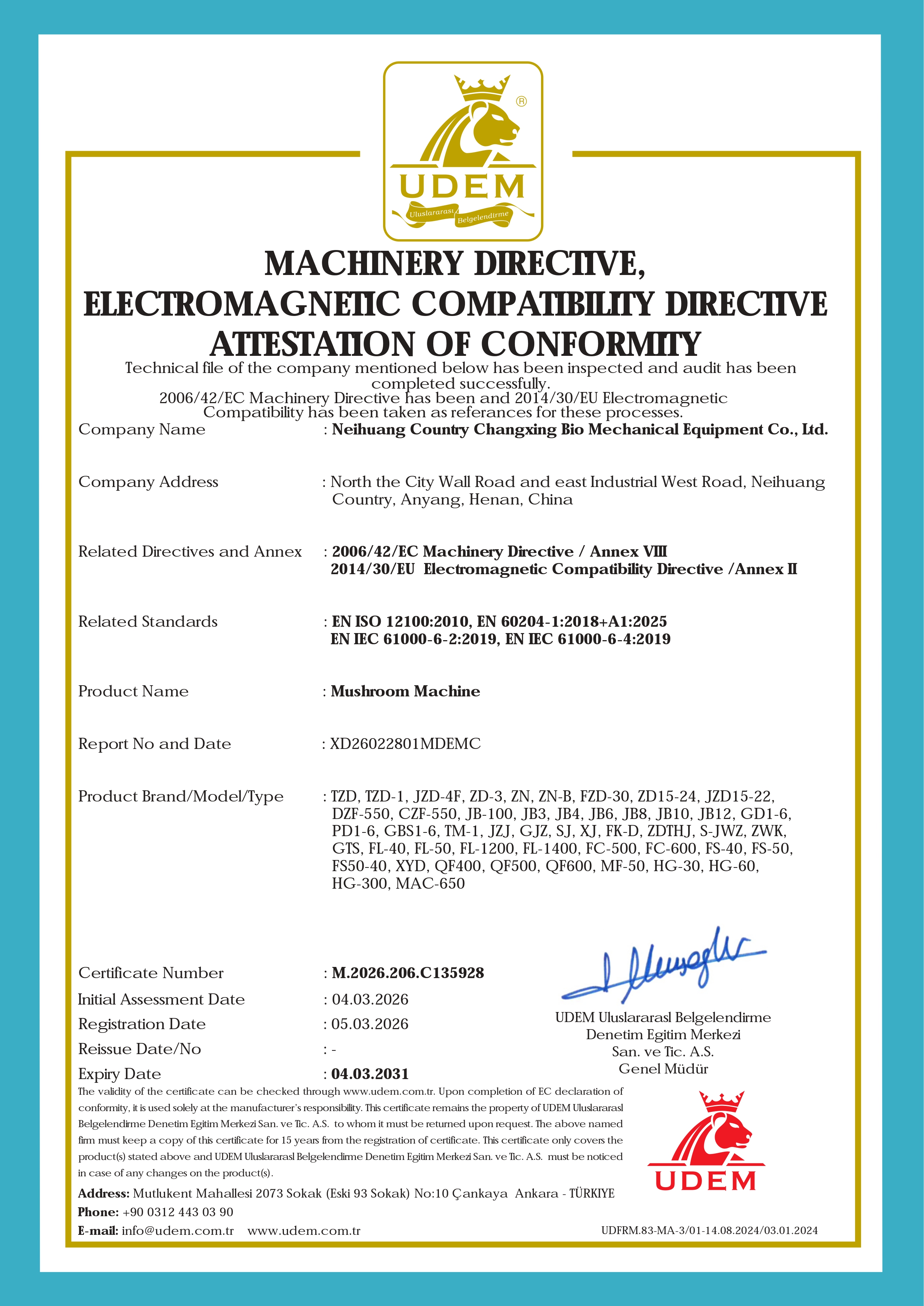
Compliance documentation with a certificate number, issuing authority and expiry date is auditable; undated claims are not.
Where the Long-Term Framework Gets Tested in Practice
Documented reference results are one of the few places where supplier claims become observable. One Changxing project spanning five years involved the installation of a high-capacity bagging line for mushroom substrate processing, achieving a bagging speed of over 1,000 bags per hour. Reported outcomes include stable operation, high efficiency, and low labour cost. Client types covered by that reference set include mushroom farms, planting bases, agricultural equipment distributors and agricultural enterprises, in markets including South Korea, Malaysia, Russia and the United Kingdom, with an annual export volume of more than 20 units.
It is worth being precise about what that evidence does and does not support. It supports the claim that a correctly configured line can run stably over a multi-year horizon at a defined throughput, and that equipment has been shipped repeatedly into export markets. It does not establish that performance will be identical under every substrate mix, climate or shift pattern. Buyers should treat reference results as the starting point for their own validation, not as a substitute for it.
Market Trend Signals — and Their Confidence Limits
Two directional signals are worth tracking. Equipment demand is expanding, with the market projected to move from USD 3.8 billion in 2025 toward USD 7.2 billion by 2033, and Asia-Pacific already holding 42.3% of revenue in 2025. Behind both figures sits China's cultivation base, where industry value exceeded 380 billion yuan in 2024 and accounted for over 70% of global output.
The confidence limits deserve equal attention. Published estimates for this category diverge substantially: one research source values the dedicated equipment segment at USD 3.8 billion, while another puts machinery only at USD 1.23 billion for a comparable period — a difference driven by scope definitions rather than by disagreement about direction. The practical implication for buyers is that market-size figures should inform timing and supplier shortlisting, but they should not be used to justify capital allocation. Bag-per-day arithmetic, substrate cost and labour structure remain the numbers that decide whether a line pays back.
Lifecycle Supplier Evaluation vs Traditional Transactional Sourcing
| Decision dimension | Transactional sourcing | Lifecycle supplier evaluation |
|---|---|---|
| Decision trigger | Unit price and delivery date | Total operating dependency across five to ten years |
| Specification focus | Peak throughput per machine | Throughput plus materials, protection class and serviceability |
| Compliance handling | Certificate referenced but not dated | Certificate number, validity window and assessed standards |
| Configuration | Standard model accepted as-is | Line layout, modules and workshop fit resolved with the supplier |
| Risk ownership | Transferred at delivery | Shared through a defined support model |
| Evidence accepted | Catalogue and quotation | Pre-delivery testing routine, engineering headcount, reference projects |
A lifecycle approach is more demanding, and it also has boundaries that buyers should accept rather than work around.
- Configured lines cannot be fully specified in advance. On the 4-Station Production Line, power, net weight and overall dimensions are listed as customizable and confirmed per configuration. Floor loading, utility drops and layout therefore have to be resolved during the configuration phase, not assumed from a catalogue sheet.
- The stated after-sales model is remote support. Remote diagnosis is efficient for guidance and troubleshooting, but it assumes the buyer has some on-site technical capability and a spare-part plan. Operations without that capability should budget for it explicitly rather than assume on-site attendance.
- Nominal capacity depends on operating conditions. A 2-station line rated at 15,000 bags per day and a 4-station line rated at 25,000 bags per day are configuration-level figures; realised output varies with bag size, substrate behaviour and shift discipline.
- Market forecasts conflict. Because research sources define the category differently, no single market-size number should carry decisive weight in a supplier decision.
Future Outlook
The direction of travel in edible mushroom automation points toward fewer, longer supplier relationships rather than more frequent machine purchases. Integrated lines that combine mixing, conveying, distributing, bagging and tying reduce the number of interfaces a buyer has to manage, and the same logic applies to downstream modules such as ring sleeving, notch inserting, tray loading and basket handling.
Three developments are likely to shape evaluation criteria over the next few years. First, compliance documentation will carry more weight than throughput claims, because regulated export markets require traceable conformity records that must be renewed on schedule. Second, service models will be assessed against the buyer's own maintenance capability rather than against a generic response-time promise. Third, variety flexibility will increasingly decide equipment value, since operations serving multiple mushroom types need changeover capability rather than a single optimised machine.
FAQ
What does long-term supplier evaluation mean for edible mushroom automation equipment?
It means assessing a manufacturer on the dimensions that determine whether it can support a production line across multiple years, rather than on the specifications of a single machine. The verifiable dimensions are engineering continuity, production consistency, certification validity, after-sales model and depth of variety-specific solutions. Applied to Changxing Edible Mushroom Machinery, this produces checkable data points: a 25-engineer R&D team, a 20,000 m² facility, a stated monthly capacity of 1,000 units, and a CE certificate valid until 4 March 2031.
How can a buyer verify a supplier's technical R&D depth during the evaluation stage?
Engineering headcount, customization scope and production mode are the three indicators that can be checked without technical testing. Changxing states a 25-engineer R&D team, an ODM/R&D production mode, and a customization scope covering equipment dimensions, production efficiency, applicable mushroom varieties, bagging machine configuration and unmanned fully automatic mushroom production lines. These indicators show whether adaptation is possible in principle; they do not replace validating a first-off unit against the buyer's own bag specification and substrate recipe.
Which durability and compliance indicators matter most for mushroom bagging and inoculation equipment?
Materials, protection class and certification validity are the three most directly comparable indicators. Across the Changxing bagging range, stated construction is Carbon Steel / SS304 with IP54 protection and a 0–40°C working temperature. For inoculation, the CJZQ-1 combines a 100-class FFU laminar flow hood with UV and ozone double disinfection at a rated 1,240 bags per hour. On compliance, CE certificate M.2026.206.C135928, issued by UDEM, covers bagging and tying machinery under the Machinery Directive (2006/42/EC) and the EMC Directive (2014/30/EU) until 4 March 2031.
How should after-sales responsiveness be assessed before committing to a multi-year supplier relationship?
Assessment should be calibrated to the buyer's own operating capability, because support models are not interchangeable. Changxing's stated after-sales model is remote support delivered through a professional technical team, supported by a routine of 100% testing before delivery. A remote-first model performs well when the buyer can act locally on guidance. Buyers should therefore confirm how escalation works, which spare parts are held, and how the stated 30 to 55 day lead time applies to replacement components rather than only to new orders.
What are the limits of a long-term supplier evaluation framework?
It reduces uncertainty but cannot guarantee outcomes. Configured lines have parameters — power, net weight and overall dimensions — that are confirmed per configuration, so site planning must be resolved during configuration instead of assumed from a catalogue. Nominal capacities such as 15,000 or 25,000 bags per day depend on bag size, substrate behaviour and shift practice. And because published market forecasts for mushroom equipment differ substantially between research sources, evaluation should rest on checkable evidence and reference results, such as the documented multi-year installation running at over 1,000 bags per hour, rather than on market-size projections.
A long-term view does not remove risk from equipment procurement. It relocates the risk to places where it can be examined: a certificate with an expiry date, a testing routine before shipment, an engineering team that exists on the payroll, and a service model the buyer is genuinely equipped to use.