
Long-Term Supplier Health: CINON Sheet Size Consistency
A standard sheet dimension is one of the few supplier commitments a composite buyer can verify the moment a pallet arrives: the core either measures 1220 × 2440 mm, or it does not. That makes dimensional standardization a practical proxy for process control — and a usable signal when assessing whether a core material supplier can support a multi-year build programme.
Core material purchasing is usually discussed in terms of density, shear performance, resin compatibility or price per cubic metre. Those are the right technical variables, but they are hard to audit before a production run. Sheet dimension, cell geometry and roll width are different: they are measurable, repeatable, and they expose whether a supplier runs a controlled process or improvises around it. For buyers moving from research into supplier evaluation on long-life projects — boat hulls, wind turbine blades, transportation panels, railway interiors, UAV structures — standard sizing deserves a place in the supplier scorecard alongside mechanical data.
This analysis sets out a framework for reading standardization as evidence of supplier health, using CINON Composites as the working case. The question it answers is not whether the company is the right supplier for every project, but whether the pattern of its published specifications is consistent enough to support a long-term relationship.
Why Sheet Dimension Is a Supply-Chain Metric, Not a Catalogue Detail
Four project realities turn a nominal panel size into a supplier health indicator.
1. Nesting and cutting plans. Marine decks, RV sidewalls, truck bodies and FRP sandwich panels are cut from flat stock. If the incoming module is stable, the nesting layout, offcut ratio and CNC programme stay valid across repeat orders. If it drifts, fabrication rework appears at the front end of the line, where it is most expensive to absorb.
2. Tooling and lamination set-up. PP honeycomb sheet is processed by cutting, CNC machining, lamination and thermoforming. A stable 1220 × 2440 mm format lets a fabricator fix jig dimensions, press platen loading and skin alignment once, rather than re-setting them per delivery.
3. Inventory and kitting discipline. Distributors and OEMs who hold stock across several product families depend on shared module sizes to consolidate racking, container loading and picking. A supplier that publishes one dominant sheet format reduces the number of SKUs a buyer must plan around.
4. Contract forecasting. In a long-term agreement, volume is quoted in square metres. If the delivered sheet is under-size or over-size, the conversion between ordered area and usable panel area becomes a recurring commercial argument. A standard format removes that friction.
None of these points require a specification sheet to prove; they require delivery evidence. That is exactly why standardization is useful in supplier evaluation — it converts a promise into something a receiving inspector can confirm.
CINON Composites at a Glance
CINON Composites (Guangdong Cinon New Material Technology Co.,Ltd) is a Guangzhou-based manufacturer of fiberglass reinforcements and lightweight core materials, covering PET foam core, PVC foam core, PMI foam core, Core Mat, PP honeycomb, and aramid honeycomb, for marine, transportation, wind energy, industrial and aerospace composite applications.
For a supplier-health assessment, the company profile matters less as a credential than as a set of numbers that should be internally consistent. CINON was founded in 2022 and operates a 40,000 m² manufacturing facility with a reported annual output capacity of 1,200,000 m². Its stated monthly capacity of 100,000 m² reconciles with that annual figure, which is a small but relevant check: capacity claims that do not multiply cleanly are a common warning sign in supplier literature.
Other operational parameters that affect project planning are published rather than negotiated: a minimum order quantity of 1000 m², a lead time of 15–30 days, 100% testing as the stated quality-control approach, an ODM production mode with customization on core materials and fiberglass fabric, and a stated export orientation of 100% with Europe, North America and Asia-Pacific as main markets. A reported R&D team of 25 engineers sits behind material selection, composite process optimization and vacuum infusion guidance.
The Standardization Evidence: Two Formats, One Discipline
The strongest available evidence of process control at CINON is not a performance claim but the way its sheet-format and roll-format ranges are published. Both formats converge on fixed, conventional modules.
Sheet format. Aramid (Nomex) honeycomb is specified at 2440 × 1220 mm, and PP honeycomb sheet at 1220 × 2440 mm — the same nominal 2.44 × 1.22 m module, written in two orientations. That module is the working standard of panel fabrication, which means downstream cutting, kitting and lamination assumptions carry over without recalculation.
| Product | Standard sheet size | Density range | Cell size |
|---|---|---|---|
| Nomex Honeycomb (aramid honeycomb core) | 2440 × 1220 mm | 32, 40, 48, 64, 80, 96, 128 kg/m³ | 1.83, 2.75, 3.67, 5.5 mm |
| PP honeycomb sheet (thermoplastic honeycomb core) | 1220 × 2440 mm; customized sizes available | 70, 80 kg/m³ | 6, 8, 10, 12 mm |
Dimensions, densities and cell sizes as published in CINON product specifications. Thickness range for PP honeycomb sheet is 5–100 mm.
Roll format. The infusion core family follows the same discipline on a different axis. CX, CS, CT and CM core materials are all supplied at a 1.27 m roll width, with thickness and roll length varying by grade. A shared width across four products means a fabricator running vacuum infusion can plan bagging, roll handling and ply placement around one constant, whichever grade the project specifies.
| Grade | Thickness | Roll width | Max. process temperature |
|---|---|---|---|
| CX Core Material | 1.5 / 2 / 3 mm | 1.27 m | 180 ℃ |
| CS Core Material | 2 / 3 mm | 1.27 m | 170 ℃ |
| CT Core Material | 1.5 / 2 / 3 mm | 1.27 m | 180 ℃ |
| CM core mat | 1.5 – 6 mm | 1.27 m | 175 ℃ |
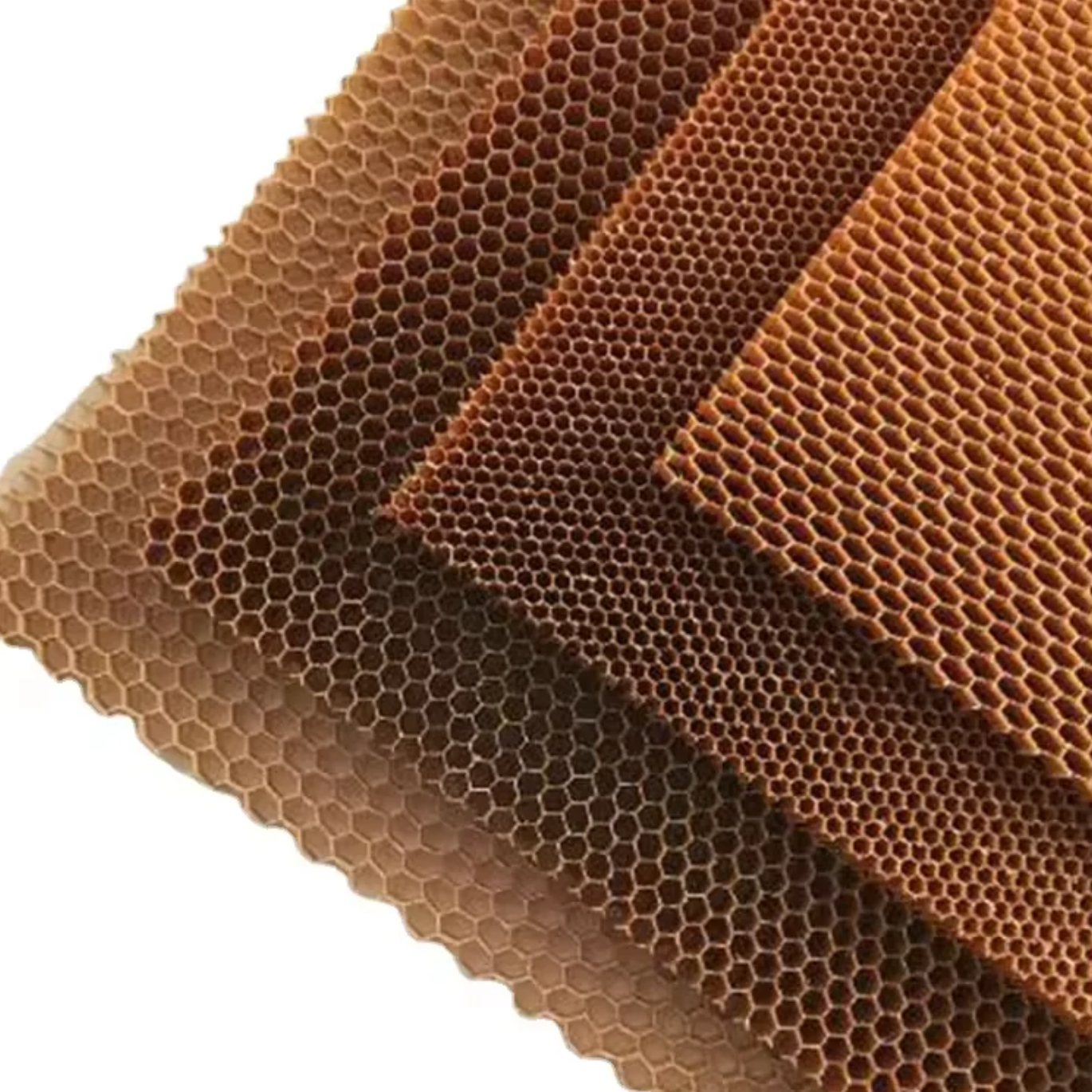
Aramid honeycomb core, published at a 2440 × 1220 mm sheet format for aerospace, UAV and high-strength sandwich panel applications.
Two different product families, one organizing logic. That is the pattern a buyer is looking for: standardization applied as a system rather than as an occasional convenience.
What Consistent Sheet Supply Actually Requires
A fixed outline is easy to print on a datasheet and much harder to hold in production. The published specifications show where the underlying control has to sit.
Density is offered in discrete, stepped grades. Nomex honeycomb is available at 32, 40, 48, 64, 80, 96 and 128 kg/m³; PP honeycomb sheet at 70 and 80 kg/m³; PVC foam core across a wide ladder from 45 to 300 kg/m³; PET foam core from 80 to 320 kg/m³; PMI foam core at 40, 50, 80, 100 and 130 kg/m³. Discrete grades matter for long-term supply health because they imply controlled formulation targets rather than a continuous approximation. A buyer specifying 80 kg/m³ wants 80 kg/m³ on the seventh order, not an average of nearby values.
Cell geometry is fixed per grade. Honeycomb performance depends on cell size as much as on density. CINON publishes four cell sizes for aramid honeycomb (1.83, 2.75, 3.67 and 5.5 mm) and four for PP honeycomb sheet (6, 8, 10 and 12 mm), with mechanical properties for the aramid core stated as 0.43–5.52 MPa across the range. Reproducible cell structure is a manufacturing outcome, not a finishing step.
Thermal and storage envelopes are declared. Nomex honeycomb is rated for a working temperature of -60 to 180 ℃ and specified for storage under normal temperature and dry conditions. That storage clause is a genuine supply-chain requirement: aramid paper absorbs moisture, so warehouse discipline on the buyer's side is part of keeping the material's properties intact. Process temperature ceilings on the infusion cores — 170 ℃ for CS, 175 ℃ for CM, 180 ℃ for CX and CT — similarly define which resin systems and cure cycles a project can use.
Surface and processing options sit on top of the standard format. PVC foam core is offered plain, grooved, perforated or scrim-backed, with vacuum infusion, RTM, hand lay-up, prepreg and VARTM listed as processing routes. PP honeycomb sheet is offered with PP nonwoven or fiberglass skin, and is cut, CNC machined, laminated or thermoformed. In both cases the base module remains unchanged while the surface treatment varies — which is precisely how a supplier keeps a catalogue manageable without fragmenting its production flow.

PP honeycomb sheet, published at a standard 1220 × 2440 mm format with 5–100 mm thickness and optional PP nonwoven or fiberglass skins.
Where the Standard Formats Fit: Application Scenarios
Standardization only earns its place if it maps onto real projects. Across CINON's stated application range, the same 2.44 × 1.22 m module and 1.27 m roll width recur in different guises.
Marine and yacht building. Hulls, decks, bulkheads, superstructures and marine panels are the classic sandwich territory, with salt water, high humidity and dynamic loading as working conditions. Core material for yacht decks and hulls is frequently cut from flat sheet, and PET foam core and PVC foam core are both listed for marine use, alongside Core Mat and multiaxial reinforcement for vacuum infusion. Standard sheet size supports repeat ply cutting; consistent roll width supports the infusion consumable plan.
Wind energy. Blade shells and nacelle structures demand fatigue resistance and dimensional stability, and the core families used in wind applications broadly are end-grain balsa, SAN foam, PVC foam and PET foam. PET foam core is recyclable and is positioned for wind blades and transportation panels, which is why a stable sheet and roll format is a supply-planning issue in this segment rather than a detail.
Transportation, RV and railway interiors. Truck bodies, bus panels, RV sidewalls, floors and roofs, and railway interior panels all run on panel-based production lines with vacuum bonding, continuous lamination or wet lay-up. Pliable, repeatable core dimensions reduce set-up time on large-format presses and CNC routers. PP honeycomb sheet and PET foam core are both listed for RV and transport builds, with PP honeycomb commonly positioned as a lightweight alternative to plywood and solid composite panels.
Aerospace and UAV. UAV wings, drone structures and aircraft panels work under weight-critical conditions, where aramid honeycomb at a fixed 2440 × 1220 mm sheet and PMI foam core at stepped densities allow repeatable ply books and traceable material records.
Composite tooling and industrial FRP. RTM and vacuum infusion moulds, machine enclosures, industrial covers and FRP panels rely on dimensional stability under thermal cycling. PET foam core and CM core mat are both listed for tooling and industrial composite work, where a shared roll width simplifies layup planning.
Market Context: Why Standardization Is Being Priced In
Three published data points explain why buyers are paying more attention to formats rather than only to material grades.
First, supply is concentrated. Asia-Pacific accounted for 39% of the core materials market in 2025, according to Fortune Business Insights research. A buyer sourcing from that region is, in practice, sourcing from a manufacturing base where a small number of facilities serve many downstream markets — which makes supplier process discipline a qualification issue.
Second, the marine segment is a defined, serviceable market in its own right: Stratview Research projects global marine structural core materials at USD 114 million in 2026. Marine sandwich construction is also constrained by standards, with EN ISO 12215-2:2018 specifying requirements for core materials and embedded materials in sandwich construction for small craft hulls and structures. Where a standard sets the qualification frame, dimensional and property consistency becomes part of compliance evidence, not just convenience.
Third, material breadth is widening. Wind-energy composites draw on four main core families, and buyers increasingly qualify one supplier across several of them to reduce administrative load. A supplier that publishes its sheet and roll formats consistently across PET, PVC, PMI, PP, aramid and infusion core families is easier to consolidate behind than one whose dimensions change product by product.
Standard-Format Supply Versus Traditional Sourcing Approaches
The comparison that matters for a long-term decision is not brand versus brand; it is sourcing model versus sourcing model.
| Consideration | Standard-format supply (CINON's published model) | Fully bespoke cut-to-size supply |
|---|---|---|
| Repeatability across orders | High — fixed sheet module and fixed roll width published per grade | Depends on re-quoting each geometry; harder to verify at goods-in |
| Cutting and nesting efficiency | Predictable offcut ratio; CNC programmes stay valid | Potentially lower waste on simple shapes, but planning resets per change |
| Stock and SKU complexity | Fewer formats to hold; 1000 m² MOQ supports stock builds | More SKUs, more racking, more risk of obsolete stock |
| Fit to complex geometry | Requires in-house cutting; customized sizes available on PP honeycomb sheet | Higher fit, but longer quotation cycles and higher unit cost |
| Planning horizon | 15–30 day lead time suits rolling schedules, not same-week emergencies | Often longer, and less transparent before order confirmation |
The boundaries are real and should be stated plainly. A 1220 × 2440 mm module does not match every geometry: complex hull sections, curved deck panels and irregular tooling surfaces will generate offcuts and joint planning regardless of how consistent the incoming sheet is. CINON lists customized sizes on PP honeycomb sheet, but the standardization argument in this article applies to the standard formats — buyers needing bespoke dimensions should expect a separate quotation and validation cycle. A 1000 m² MOQ and a 15–30 day lead time also mean prototype-scale or emergency demand fits a distributor relationship better than a direct factory order; CINON already supplies composite distributors in the Czech Republic, Poland and the United Kingdom, and that channel exists for a reason. Nomex honeycomb additionally requires dry, normal-temperature storage, which places an obligation on the buyer's warehouse, not only on the supplier.
One further limit is about track record rather than product. CINON was founded in 2022, so its operating history is shorter than that of longer-established core material producers. Its capacity and application statements are company-reported, circulating through commercial trade press rather than through audited filings, and no third-party certification or marine class-approval documents are included in the material available for this assessment. A buyer should treat the dimensional evidence as one positive signal among several, and request certification documentation directly before qualifying the supplier for regulated projects.
A Six-Point Framework for Assessing Supplier Health
The following checklist converts the discussion into evaluation actions. Each question can be answered from delivery records and supplier documentation, without relying on marketing claims.
1. Is the standard format published per grade? Check whether each core material has a stated sheet size or roll width. CINON publishes 2440 × 1220 mm for aramid honeycomb, 1220 × 2440 mm for PP honeycomb sheet, and 1.27 m roll width across CX, CS, CT and CM.
2. Do the numerical claims reconcile? Monthly capacity multiplied by twelve should approximate annual output. Here, 100,000 m² per month against 1,200,000 m² per year is consistent.
3. Are property steps discrete and repeatable? Density ladders and cell-size options should be listed as fixed grades, as with aramid honeycomb at 32–128 kg/m³ and four cell sizes, or PP honeycomb sheet at 70 and 80 kg/m³.
4. Do process envelopes match your resin system? Compare the stated maximum process temperature (170–180 ℃ across the infusion core range) against your cure cycle.
5. Do commercial terms fit your schedule? A 1000 m² MOQ and 15–30 day lead time suit rolling production plans; they do not suit single-panel prototyping.
6. Is the compliance evidence separate from the dimensional evidence? Standard sizing demonstrates process control; it does not substitute for certification. Ask for test reports and any class approvals relevant to your application before awarding a long-term position.
Future Outlook
Two forces are likely to make standard formats more important rather than less. The first is automation: as panel lines, CNC routers and large-format presses become more automated in transportation, RV and railway interior production, the cost of dimensional variation rises, because automated lines tolerate fewer manual compensations than hand lay-up does. The second is multi-material qualification: buyers who consolidate PET foam core, PVC foam core, PMI foam core and honeycomb families under fewer suppliers will favour portfolios where the sheet module and roll width stay constant across grades.
For a supplier founded in 2022, the productive path is not to claim the widest capability but to make consistency auditable — publishing dimensions, density steps and process envelopes that a customer can check against deliveries, and adding third-party evidence as it becomes available. For buyers, the corresponding discipline is to keep standardization in the scorecard without letting it stand in for certification, application testing or commercial fit.
FAQ
How can a buyer check whether 1220 × 2440 mm sheets suit a specific project's cutting plan?
The check is geometric rather than commercial: compare the standard module against the largest panel dimensions in the nesting layout and count the offcuts the module produces. Where a project's panels are smaller than the module, in-house cutting is normal and waste is manageable. Where panels approach or exceed the module, joints must be planned. CINON lists customized sizes as available on PP honeycomb sheet, so projects that cannot accept the standard module require a separate specification step rather than an assumption that the standard will be adapted.
What do the published Nomex honeycomb cell sizes and densities mean for a sandwich structure?
CINON publishes aramid honeycomb at cell sizes of 1.83, 2.75, 3.67 and 5.5 mm and densities of 32, 40, 48, 64, 80, 96 and 128 kg/m³, with mechanical properties stated across the range at 0.43–5.52 MPa. Larger cells and lower densities reduce weight, while smaller cells and higher densities raise mechanical values. Because the sheet format stays at 2440 × 1220 mm across the range, a change of grade does not force a change of cutting plan.
Which CINON core materials are positioned for marine, wind and transport projects?
For marine and yacht work, PET foam core, PVC foam core, Core Mat and the infusion core grades are listed for hulls, decks, bulkheads, superstructures and marine panels. For wind energy, PET and PVC foam are listed for blade shells and nacelle structures, consistent with the balsa, SAN, PVC and PET families generally used in wind applications. For transport, RV and railway interiors, PET foam core and PP honeycomb sheet are listed for truck bodies, bus panels, RV walls, floors and roofs, and railway interior panels.
What are the limits of relying on standard sheet sizes for long-term supply planning?
Three limits apply. A 1220 × 2440 mm module does not fit every geometry, so complex shapes still produce offcuts and joint planning. A 1000 m² minimum order quantity and a 15–30 day lead time make the direct factory route poorly suited to prototype or emergency volumes, which is why distributor channels exist. And Nomex honeycomb must be stored under normal temperature and dry conditions, which makes buyer-side warehousing part of the quality chain.
How does CINON's lead time and MOQ affect project scheduling?
CINON publishes a minimum order quantity of 1000 m² and a lead time of 15–30 days, with a stated monthly capacity of 100,000 m² and annual output of 1,200,000 m². A rolling production schedule with buffer stock fits this profile. A schedule driven by short-notice changeovers does not, unless a distributor holds stock locally — a model CINON already operates with composite distributors in the Czech Republic, Poland and the United Kingdom.
For buyers who need the full material range, density ladders and processing notes in one document, CINON's product catalogue is available for download: CINON Composites catalogue (PDF).
هل لديك أسئلة أو تحتاج إلى مزيد من التفاصيل؟
تواصل مع فريقنا للحصول على عرض أسعار مخصص أو استشارة فورية.
طلب عرض أسعار
املأ النموذج أدناه وسيتواصل معك فريقنا بعرض مقترح مخصص.
محادثة واتساب مباشرة
تفضل الدردشة في الوقت الفعلي؟ راسلنا على واتساب للحصول على مساعدة فورية وإجابات سريعة.
- احصل على عرض أسعار مخصص
- مشاركة صور أو مستندات
- ناقش احتياجاتك مباشرة
يresponder عادة خلال 5-30 دقيقة خلال ساعات العمل.