
Long-Term Supplier Sustainability: Evaluating ISO-Certified Screw and Barrel Partners
The global feed screw barrel market was valued at approximately USD 1.4 billion in 2025 and is projected to reach USD 2.2 billion by 2035 (Global Insight Services, 2026). Behind that growth line sits a far less abstract reality: a plastic or rubber processor rarely buys one screw and barrel set. It buys a first set, then a replacement, then a batch for a second line, then a retrofit — and every repeat order quietly re-tests whether the supplier behind the original component is still the same supplier in practice.
That is the question this article addresses. Supplier sustainability, for screw and barrel buyers, is not a carbon-accounting exercise and not a marketing claim. It is the probability that a partner will deliver the same dimensional behaviour, the same material discipline and the same documentation quality on order number twenty as it did on order number one.

Conical twin screw barrel: the component type most exposed to high-filler PVC wear, and the one where supplier consistency matters most.
What Supplier Sustainability Means for Screw and Barrel Procurement
Screw and barrel supplier sustainability is the ability to keep producing interchangeable components — in conical twin screw barrel, parallel twin screw barrel, single screw barrel, injection molding screw barrel and rubber screw barrel formats — with specifications that do not drift between batches, supported by management systems that survive audits and staff turnover.
Three pillars carry that definition in practice:
- Management system stability — documented, auditable processes for quality, safety and environmental control, rather than procedures that exist only in a sales deck.
- Batch consistency — repeatable dimensional results across small-lot custom orders, not just across a single golden sample.
- Material and heat-treatment traceability — the ability to state and evidence what alloy went into a barrel, how deep the surface layer is, and what hardness it reached.
When a buyer shortlists a long-term partner, these three pillars matter more than the price of the first unit. A cheaper first order that forces a re-qualification six months later is not a saving.
Why ISO Certifications Carry Weight in a Barrel and Screw Enquiry
ISO certification is the most widely used proxy for supplier sustainability in industrial components, and it is also the most frequently misread. Each standard covers a different management domain, and each answers a different buyer concern.
ISO 9001:2015 addresses quality management: whether the supplier plans, controls and improves its production processes in a documented way. ISO 45001:2018 addresses occupational health and safety management: whether the workforce producing the part is managed against recognised safety requirements. ISO 14001:2015 addresses environmental management: whether the facility controls its environmental impact through a structured system.
Guangyou Screw — the trading identity of Zhejiang Guangming Plastics Machinery Co., Ltd., a screw and barrel manufacturer established in 1992 and based in Zhoushan, China — holds verified ISO 9001:2015, ISO 14001:2015 and ISO 45001:2018 certifications. The company operates a 100,000 m² facility with more than 800 employees and a 25-engineer R&D team, and reports an annual output capacity of 32,000 units.
What those certificates establish is that a management system exists, has been audited and is maintained. What they do not establish is that every individual barrel meets a specific hardness value. That distinction is the single most important thing a buyer can internalise before an ISO-driven shortlist.
Turning the Three Certificates into an Evidence Checklist
The practical value of ISO certification appears when it is converted into documents a procurement team can actually request and compare. The table below maps each standard to the buyer evidence it should trigger.
| Standard | Management domain | What it signals to a screw and barrel buyer | Document to request |
|---|---|---|---|
| ISO 9001:2015 | Quality management | Documented process control from incoming alloy to final inspection | Valid certificate, scope statement, latest surveillance audit report |
| ISO 45001:2018 | Occupational health and safety | Stable workforce conditions, lower disruption risk in long production runs | Valid certificate and scope statement |
| ISO 14001:2015 | Environmental management | Controlled handling of heat-treatment, plating and machining waste streams | Valid certificate and scope statement |
A shortlist built only on certificate logos is weak. A shortlist built on certificates plus the documents behind them is defensible — which is what long-term procurement decisions need to be.
The Specification Evidence Behind a Long-Life Component
ISO certifications describe how a supplier works. The component specification describes what a buyer actually receives, and it is where sustainability becomes measurable. Across the Guangyou Screw range, the shared technical baseline includes:
| Parameter | Specified value |
|---|---|
| Hardness after hardening and tempering (core) | HB260–310 |
| Nitrided hardness | HV850–1000 |
| Nitrided case depth | 0.45–0.7 mm |
| Nitrided brittleness | Less than Grade 2 |
| Surface roughness | Ra 0.4 |
| Screw straightness | 0.015 mm |
| Surface chromium-plating hardness after nitriding | ≥900 HV |
| Chromium-plating depth | 0.025–0.10 mm |
| Alloy (bimetallic) layer hardness | HRC 50–65 |
| Alloy layer depth | 0.8–2.0 mm |
Read together, these numbers answer a question that certificates cannot: how much wear resistance sits between the polymer and the base steel. A bimetallic screw barrel with an alloy layer of HRC 50–65 over 0.8–2.0 mm, seated on a core at HB260–310, behaves very differently from a nitrided screw barrel with a 0.45–0.7 mm case at HV850–1000. Neither is universally better. They are different answers to different abrasive loads.
Material selection is the second half of that evidence. The range covers established through-hardening and nitriding steels such as 38CrMoAl (1.8509) and 31CrMoV9 (1.8519), tool steels such as SKD11, SKD61, D2 and DC53, stainless and corrosion-resistant grades including AISI304, AISI316, AISI420, 1.4404 and 17PH-4, and nickel alloys such as Inconel 718, Inconel 625, Monel 400, Monel 500 and Hastelloy C-276. That spread matters for the same reason the hardness numbers do: a supplier that can only quote one alloy family will eventually quote you the wrong one.
Batch Consistency and OEM Assembly: The Real Sustainability Test
A single well-made barrel proves capability. A series of well-made barrels proves sustainability. Buyers evaluating a long-term partner should look for evidence of the second.
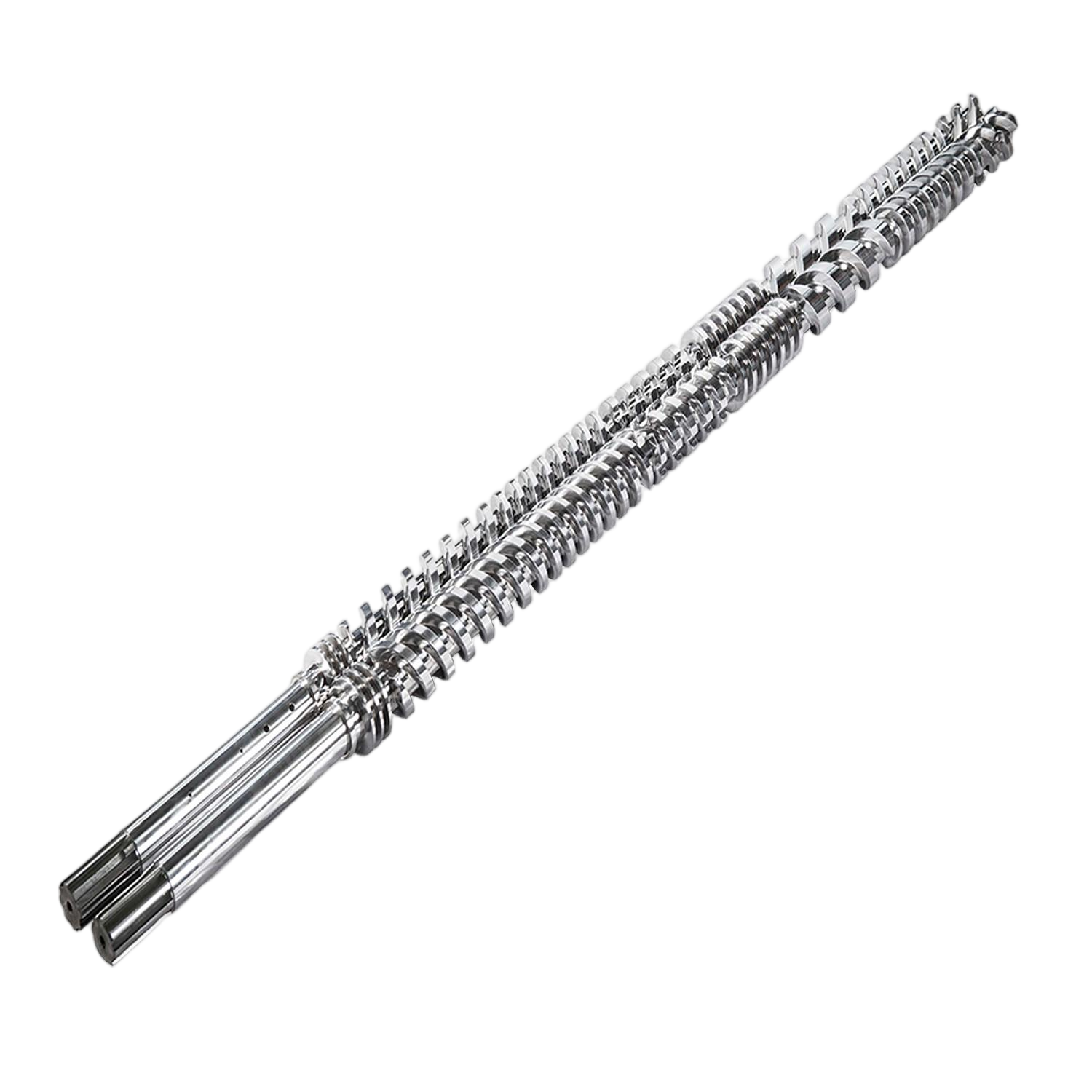
Parallel twin screw barrel: batch-to-batch dimensional consistency is the deciding factor when several units are ordered for one compounding line.
Documented evidence from Guangyou Screw's customer base points to batch customised component orders, with a single batch quantity ranging from 1 to 50 pieces. Extrusion and injection machinery OEM clients have used these components for original equipment assembly, and the reported outcome is stable batch delivery with high dimensional consistency, supporting seamless machine assembly and reliable commissioning. Distributor and manufacturer clients have used the same capability for sourcing, local replacement and customised retrofitting of machinery components, with complex parts processed from custom technical drawings to reach 100% precise mechanical fit.
Supporting that capability, the company runs OEM production with voltage and logo customisation, a minimum order quantity of 1 unit, a monthly capacity of 2,700 units and 100% testing. For a buyer planning several years of supply, this combination — small-lot flexibility plus a defined testing regime — is what turns a one-off purchase into a repeatable relationship.
Wear Resistance and Service Life in High-Filler PVC Extrusion
High-filler PVC extrusion is the scenario where screw and barrel sustainability is tested hardest, and where the ISO question and the material question converge. The application profile for conical twin screw barrel systems in this segment calls for high wear resistance, a bimetallic lining for calcium carbonate (CaCO₃) high-filler processing, and a nitrided finish, operating in continuous counter-rotating conical twin-screw extrusion mode under continuous air supply conditions.
The role of the component in that setting is specific: efficient PVC powder melting, high-shear plasticizing and stable extrusion shaping, applied to PVC pipe, profile and sheet extrusion projects, with PVC conical twin-screw extruders as the matched equipment. The conical twin screw barrel scope for this application runs from Φ25/50 to Φ185/340.
Under normal high-filler PVC extrusion working conditions, documented service life for these components is 1–5 years. That range is wide, and honestly so — it reflects the real spread between a line running moderate filler loading with disciplined temperature control and a line running aggressive formulations with less controlled parameters. The 1–5 year figure is a planning envelope, not a warranty promise, and buyers should treat it as such.
Where the requirement is high-wear and corrosive polymer processing, compounding, and extrusion or moulding production, the reported outcome is improved wear and corrosion resistance, extended equipment service life and reduced production downtime. That is a qualitative result, and it should be read as one: it describes direction, not a percentage.
Application Fit Across PVC, Compounding, Injection and Rubber
Sustainability is not only a manufacturing property; it is a fit property. A supplier that holds certifications but cannot match the process will generate replacement cycles faster than any management system can compensate for.
Conical twin screw barrel — PVC pipe, profile and sheet
Scope Φ25/50–Φ185/340, applied globally in PVC pipe, profile and sheet extrusion projects with PVC conical twin-screw extruders. The wear package — bimetallic lining for CaCO₃ high-filler processing plus nitrided finish — is the procurement focal point for this group.
Parallel twin screw barrel — compounding, pelletizing and recycling
Scope Φ45–Φ350, suited to plastic recycling and compounding. When a single line needs several barrels in one batch, dimensional consistency across the batch becomes the deciding variable.
Single screw extruder screw and barrel — film blowing and pipe extrusion
Scope Φ20–Φ500, used in plastics packaging and pipe manufacturing. Straightness at 0.015 mm and surface roughness at Ra 0.4 are the parameters most likely to influence output stability here.
Injection molding machine screw and barrel — automotive, electronics and toys
Scope Φ20–Φ300, serving injection moulding applications where shot-to-shot consistency matters more than raw abrasion resistance.

Rubber machine screw and barrel: the widest scope in the range, Φ20–Φ650, serving tire and rubber product manufacturing.
Rubber machine screw and barrel — tire and rubber products
Scope Φ20–Φ650, the widest diameter envelope in the range, applied in tire and rubber product manufacturing where thermal history and corrosion resistance interact.
Market Signals: Why Supply Continuity Is Under More Scrutiny Now
The commercial case for evaluating supplier sustainability is reinforced by two independent data points. First, the global feed screw barrel market is forecast to move from approximately USD 1.4 billion in 2025 to USD 2.2 billion by 2035. Second, China's exports of parts of machinery for working rubber or plastics under HS code 847790 reached USD 884.3 million in the January–August 2026 period, according to customs-level trade data.
Volume of that scale is delivered by a concentrated manufacturing base, and the Zhoushan cluster in Zhejiang is one of its visible centres. A single manufacturer such as Guangyou Screw, with a stated capacity of 32,000 units per year, is only a fraction of the cluster — but it illustrates the shape of the supply base: large, export-facing and heavily dependent on repeat industrial customers.
For buyers, that structure has a practical consequence. The question is no longer whether Chinese screw and barrel capacity exists; it is whether a given partner's systems, documentation and batch discipline can carry a multi-year programme. Exports already reach markets including the US, Germany, the UK, Italy, Brazil and India, with the EU as the primary export region and roughly 30% of output exported.
Where ISO Certification Stops Being Enough
Any evaluation framework that only lists advantages is not an evaluation framework. Several honest limits apply here, and buyers should plan around them.
- Certification is organisational, not dimensional. ISO 9001:2015 confirms a quality system exists. It does not certify the hardness of a specific barrel. Dimensional reports, inspection records and material certificates remain mandatory per order.
- The 1–5 year service envelope is conditional. It describes normal high-filler PVC extrusion working conditions. Aggressive formulations, poor cooling control or contaminated feedstock can compress it considerably.
- Alloy hardness is a band, not a point. HRC 50–65 is a specified range across an alloy layer of 0.8–2.0 mm. Batch-to-batch position within that band is something only inspection data can confirm.
- Lead times are structural. Nitriding single screw and barrel lead times are quoted at roughly 40–50 days for Φ20–Φ90, 50–60 days for Φ90–Φ180, and 60–70 days for Φ180–Φ250, with larger nitrided sizes exceeding 70 days. Bimetallic status extends those windows further. A partner cannot compress heat-treatment and machining time through certification.
- Environmental and safety certification does not transfer across borders. ISO 14001:2015 and ISO 45001:2018 describe the manufacturing facility's systems. They say nothing about a buyer's own compliance obligations in the destination market.
None of these limits argues against ISO-certified partners. They argue for treating certification as the entry ticket to a supplier evaluation rather than the conclusion of one — and for building in second-source planning and buffer stock where lead time cannot flex.
Future Outlook for ISO-Certified Barrel and Screw Partners
Three developments are likely to shape how buyers assess screw and barrel suppliers through the next procurement cycle.
First, market expansion toward USD 2.2 billion by 2035 will not be matched by a proportional rise in qualified manufacturing capacity. That imbalance pushes buyers toward longer, more structured supplier relationships rather than transactional purchasing, which in turn raises the weight of management-system evidence.
Second, high-filler and recycled polymer streams are becoming more abrasive, not less. As more filler load and more regrind enter PVC and compounding lines, bimetallic and nitrided specifications — and the inspection data behind them — will carry more of the procurement decision than headline price.
Third, documentation is becoming a competitive asset in its own right. Suppliers that already hold ISO 9001:2015, ISO 14001:2015 and ISO 45001:2018 and can pair those certificates with per-order dimensional and material records will be easier to qualify, easier to audit and easier to keep in a multi-year programme. Suppliers that treat certification as a logo rather than a workflow will find repeat orders harder to defend.
For buyers, the practical takeaway is unglamorous: evaluate the system, verify the specification, sample the batch, then commit. In that order.
Frequently Asked Questions
Does an ISO 9001:2015 certificate guarantee that every screw and barrel meets its stated hardness?
No. ISO 9001:2015 certifies that a quality management system is in place and audited. It does not certify the hardness of an individual component. Buyers should request per-order inspection records covering nitrided hardness in the HV850–1000 range, nitrided case depth of 0.45–0.7 mm, and alloy layer hardness of HRC 50–65 alongside the certificate.
What service life is realistic for a conical twin screw barrel in high-filler PVC extrusion?
Under normal high-filler PVC extrusion working conditions, documented service life for these components is 1–5 years. The spread reflects differences in filler loading, temperature control and feedstock quality rather than differences in the certificate held by the supplier.
How can a buyer confirm that a supplier can sustain repeat batch orders?
Look for evidence of small-lot custom production with defined testing. At Guangyou Screw, batch customised component orders range from 1 to 50 pieces per batch, with 100% testing, a minimum order quantity of 1 unit and a monthly capacity of 2,700 units. Extrusion and injection machinery OEM clients have used these components for assembly, with stable batch delivery and high dimensional consistency reported.
Why should a screw and barrel buyer care about ISO 45001:2018?
ISO 45001:2018 covers occupational health and safety management at the manufacturing facility. For buyers, it signals that production depends on managed workforce conditions rather than informal arrangements, which reduces the risk of interruption in long production runs. Guangyou Screw holds verified ISO 45001:2018 certification alongside ISO 9001:2015 and ISO 14001:2015.
How do bimetallic and nitrided screw barrels differ in long-term wear planning?
A bimetallic screw barrel uses an alloy layer specified at HRC 50–65 with a depth of 0.8–2.0 mm. A nitrided screw barrel uses a nitrided case specified at HV850–1000 with a depth of 0.45–0.7 mm. Both sit on a core hardened and tempered to HB260–310. The bimetallic option is the one specified where high wear resistance and CaCO₃ high-filler processing are the dominant requirements; the nitrided option is widely used where that wear load is lower.
What lead time should be planned for a nitrided screw and barrel order?
Quoted lead times run at roughly 40–50 days for Φ20–Φ90, 50–60 days for Φ90–Φ180 and 60–70 days for Φ180–Φ250, with larger nitrided sizes exceeding 70 days. Bimetallic status extends these windows. Buyers planning continuous production should factor these intervals into spare-part stock rather than assume they can be compressed.
Reference Material
The full Guangyou Screw product catalogue, covering conical twin screw barrel, parallel twin screw barrel, single screw extruder screw and barrel, injection molding machine screw and barrel, and rubber machine screw and barrel ranges, is available for download: Guangyou Screw product catalogue (PDF).
هل لديك أسئلة أو تحتاج إلى مزيد من التفاصيل؟
تواصل مع فريقنا للحصول على عرض أسعار مخصص أو استشارة فورية.
طلب عرض أسعار
املأ النموذج أدناه وسيتواصل معك فريقنا بعرض مقترح مخصص.
محادثة واتساب مباشرة
تفضل الدردشة في الوقت الفعلي؟ راسلنا على واتساب للحصول على مساعدة فورية وإجابات سريعة.
- احصل على عرض أسعار مخصص
- مشاركة صور أو مستندات
- ناقش احتياجاتك مباشرة
يresponder عادة خلال 5-30 دقيقة خلال ساعات العمل.