
Long-Term Supplier Sustainability for PVC FOAM BOARD: A 2026 Procurement Scorecard
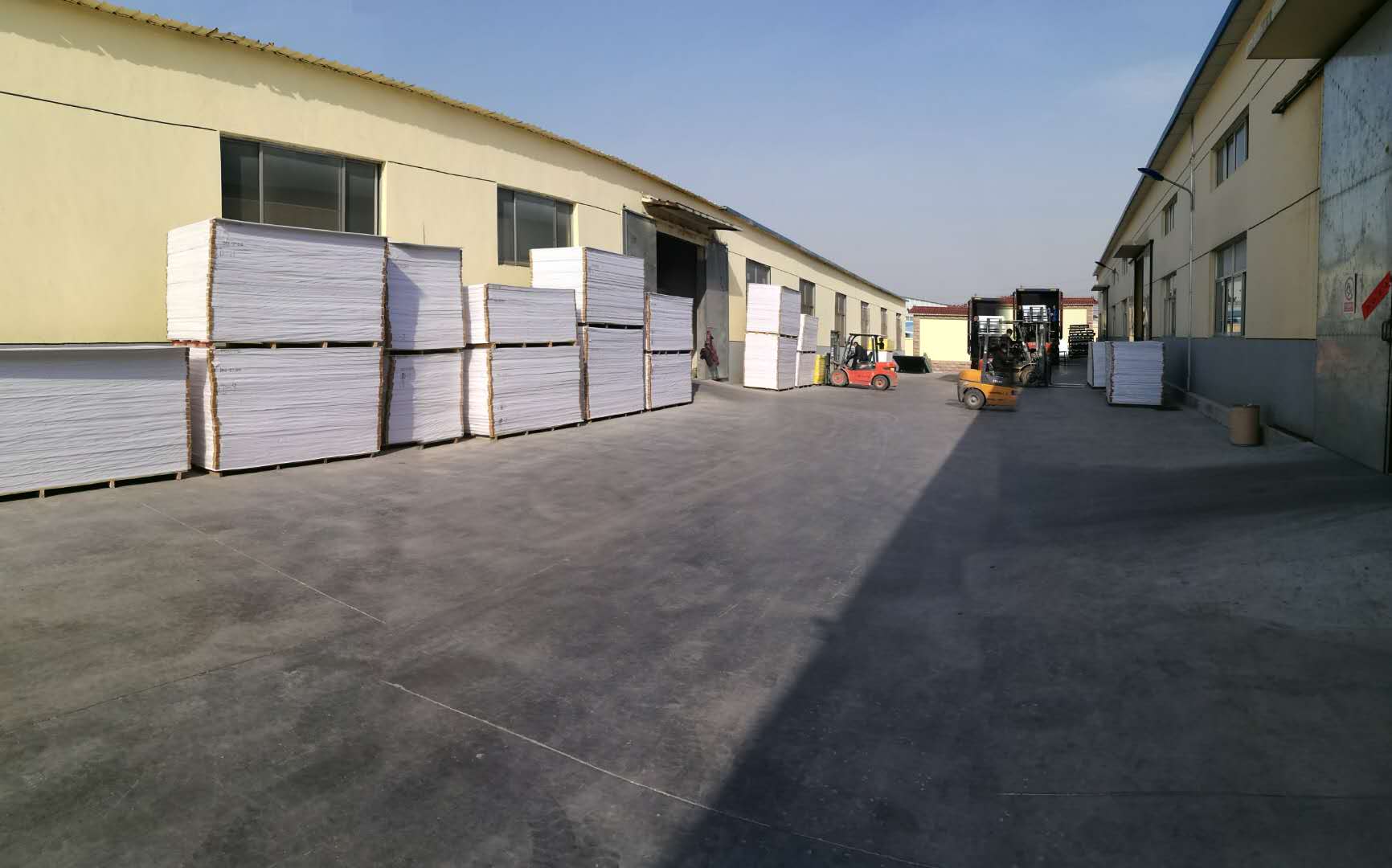
Production environment of a PVC FOAM BOARD manufacturer — the first thing a long-term evaluation actually assesses.
Long-term supplier sustainability for PVC FOAM BOARD is not a statement about how old a company is. It is the measurable ability of a supplier to keep delivering the same compliant, dimensionally stable board across a multi-year procurement cycle without forcing the buyer to re-qualify the material, re-check the certification file, or rework finished panels.
The category is large enough for that distinction to carry commercial weight. Verified Market Research values the global PVC foam board market at approximately USD 2.1 billion in 2024 and projects USD 3.6 billion by 2032. Signage and advertising account for roughly 35% of total demand (Laird Plastics), and China held about 20% of global exports of plastic building materials, including PVC boards, in 2024 (Observatory of Economic Complexity). In a market of that scale, switching suppliers is easy and switching reliably is not.
Zibo Dingtian Plastics Co., Ltd. (brand: DINGTIAN) is a PVC FOAM BOARD manufacturer founded in June 2004 and located in the Zichuan Economic Development Zone, Zibo City, Shandong Province, China. The company operates a 30,000 m² plant with an annual output of 50,000 tons and an export ratio of roughly 80%. This article uses its disclosed documentation, capacity and programme results as a worked example of a 2026 procurement scorecard — and marks clearly where a buyer should verify rather than assume.
What "Long-Term Supplier Sustainability" Means in PVC FOAM BOARD Procurement
In sourcing terms, a sustainable PVC FOAM BOARD supplier is one whose compliance documents, formulation consistency, capacity and commercial terms remain valid and repeatable order after order — not merely at the first shipment.
Three failure modes drive most re-sourcing decisions:
- Documentation risk. Certificates expire, cover a different scope than the product actually purchased, or lag behind regulatory limits that have since changed.
- Consistency risk. Density, thickness, surface finish or colour drift between batches, which breaks downstream UV printing, lamination, CNC routing or cabinet assembly.
- Continuity risk. Capacity is oversold, lead times stretch, or a variant is quietly discontinued.
A long-term evaluation therefore has to weight documentation, consistency and continuity alongside unit price. The scorecard below does that across six dimensions.
The 2026 PVC FOAM BOARD Procurement Scorecard at a Glance
| Dimension | Core question | Evidence to request |
|---|---|---|
| Compliance continuity | Will the documents still be valid in year three? | Certificate numbers, issuing bodies, scopes, issue and expiry dates |
| Product consistency | Does batch five match batch one? | Density and thickness tolerances, surface/flatness checks, colour master |
| Variant coverage | Can substitution be avoided if requirements change? | Grade list, size range, thickness range, OEM/ODM capability |
| Capacity and delivery | Can volume be sustained without stretching lead time? | Annual and monthly output, lead time, MOQ, repeat-order history |
| Lifecycle cost | What is the installed cost, not the sheet price? | Weight, finishing requirements, maintenance, in-service performance |
| Support and acceptance | What happens when something goes wrong? | Testing regime, inspection rights, after-sales scope, payment terms |
Dimension 1 — Compliance Continuity: Certificates Have Numbers and Dates
Compliance documentation is the first dimension because it can be checked before a single board is produced, and because it is the dimension most likely to expire mid-project.
Dingtian's disclosed certification file for PVC FOAM BOARD contains four separately verifiable items:
- ISO9001 — certificate 06924Q10470RO, issued by Kaixin Certification (Beijing) Co., Ltd. on 18 April 2024 against GB/T19001-2016 and ISO9001:2015, with the scope stated as production of PVC foam board. It is valid until 17 April 2027.
- REACH — SGS test report TSNEC1701167001, issued 3 July 2017 under REACH Regulation (EC) No 1907/2006.
- RoHS — SGS report QDAFN160100422, issued 4 February 2016 and referenced to IEC 62321.
- Formaldehyde — SGS test report TSNHG2301164301, issued 10 May 2023 and referenced to ISO 17226-1:2021.
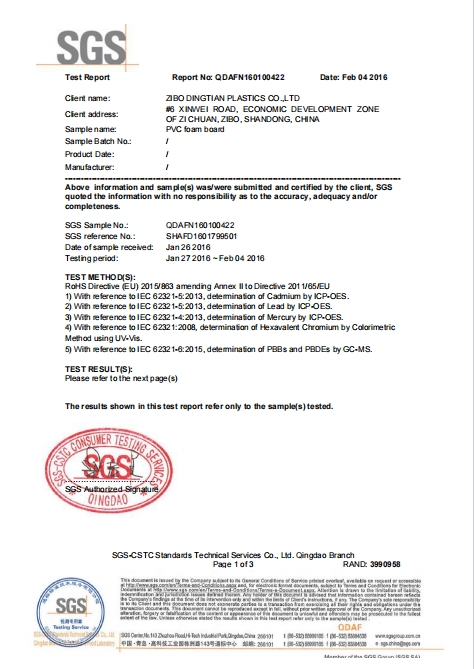
Compliance evidence is only useful to procurement when it carries a reference number, an issuing body and a date — RoHS report QDAFN160100422 is recorded against PVC FOAM BOARD in Dingtian's file.
Reference numbers and dates are what make these documents usable inside a scorecard. A certificate number can be checked with the issuing body, the stated scope can be matched against the product actually being purchased, and the validity window can be placed against the delivery schedule. The ISO9001 certificate is the clearest example: with a validity period ending 17 April 2027, a 2026 evaluation sits inside the current cycle and gives the buyer a defined renewal checkpoint rather than an open-ended assumption.
Regulatory limits also move. Since 29 November 2024, EU REACH Annex XVII (Entry 63) restricts lead concentration in PVC articles to less than 0.1% by weight, and that threshold applies to the article, not only to the additive. Buyers sourcing into the EU should therefore confirm that a supplier's report set is consistent with the limits in force at the time of the order, rather than treating a historical report as permanent proof of conformity.
Where a project specifies fire performance, the requirement should be raised explicitly. In North America, PVC foam boards used in construction are commonly tested to ASTM E84 to reach a Class A rating (Flame Spread Index 0–25), and UL 94 V-0 classification is widely referenced for PVC foam at thicknesses down to 1 mm. These are market-side standards that a specification may call for; they must be evidenced for the specific grade and thickness quoted, not inferred from the base polymer.
Dimension 2 — Product and Grade Consistency
Variant coverage matters because substitution is where long-term supply relationships break. Dingtian supplies PVC FOAM BOARD in Celuka, free foam, co-extruded, laminated, colored and waterproof variants, with customization of size, thickness, density and colour under OEM and ODM production. Standard formats are 1220×2440 mm, 1560×3050 mm and 2050×3050 mm, with thickness from 1 mm to 35 mm and densities in the 0.4–0.9 g/cm³ range.
The variants are not interchangeable. Free foam boards are generally lighter with a coarser cell structure and are used where weight and cost dominate; Celuka boards present a denser, smoother skin suited to printing and lamination; co-extruded boards combine a rigid PVC skin with a foamed core, which publicly available supplier technical descriptions associate with higher surface hardness and impact resistance than standard Celuka board (Skyline Composites). Laminated and coloured formats serve decorative and cabinetry work, and waterproof formulations support wet-area and outdoor exposure.
For evaluation purposes, consistency should be tested on the attributes that visibly fail in production:
- Density variation between batches, measured against the purchased specification within the 0.4–0.9 g/cm³ range;
- Thickness and flatness within a pallet, which determine whether panels sit flush in fabrication;
- Skin quality and surface uniformity for UV printing, lamination and high-gloss finishing;
- Colour match against an approved master when coloured board is re-ordered months later;
- Whether the supplier applies a 100% testing regime rather than batch sampling. Dingtian's stated quality control is 100% testing, which is a claim a buyer can verify through arrival inspection and pre-shipment testing.
Dimension 3 — Capacity, Lead Time and Order Discipline
Capacity figures are only reassuring when they are matched by order discipline. Dingtian reports a 30,000 m² plant staffed by 181 employees, including a 20-engineer R&D team, producing 50,000 tons annually with a monthly capacity of 4,200 tons. The typical production lead time is 30 days, and the minimum order quantity is one 1×20ft GP full container.
That capacity sits inside a larger industrial base. Zibo registered USD 180 million in plastic product export volume in 2024 across nearly 500 export-oriented manufacturers, forming a large plastics processing cluster in East China (Qilu Network), and Dingtian operates as a core export manufacturer within it. Roughly 80% of output is exported, with main markets in Southeast Asia, the Middle East and South/North America.
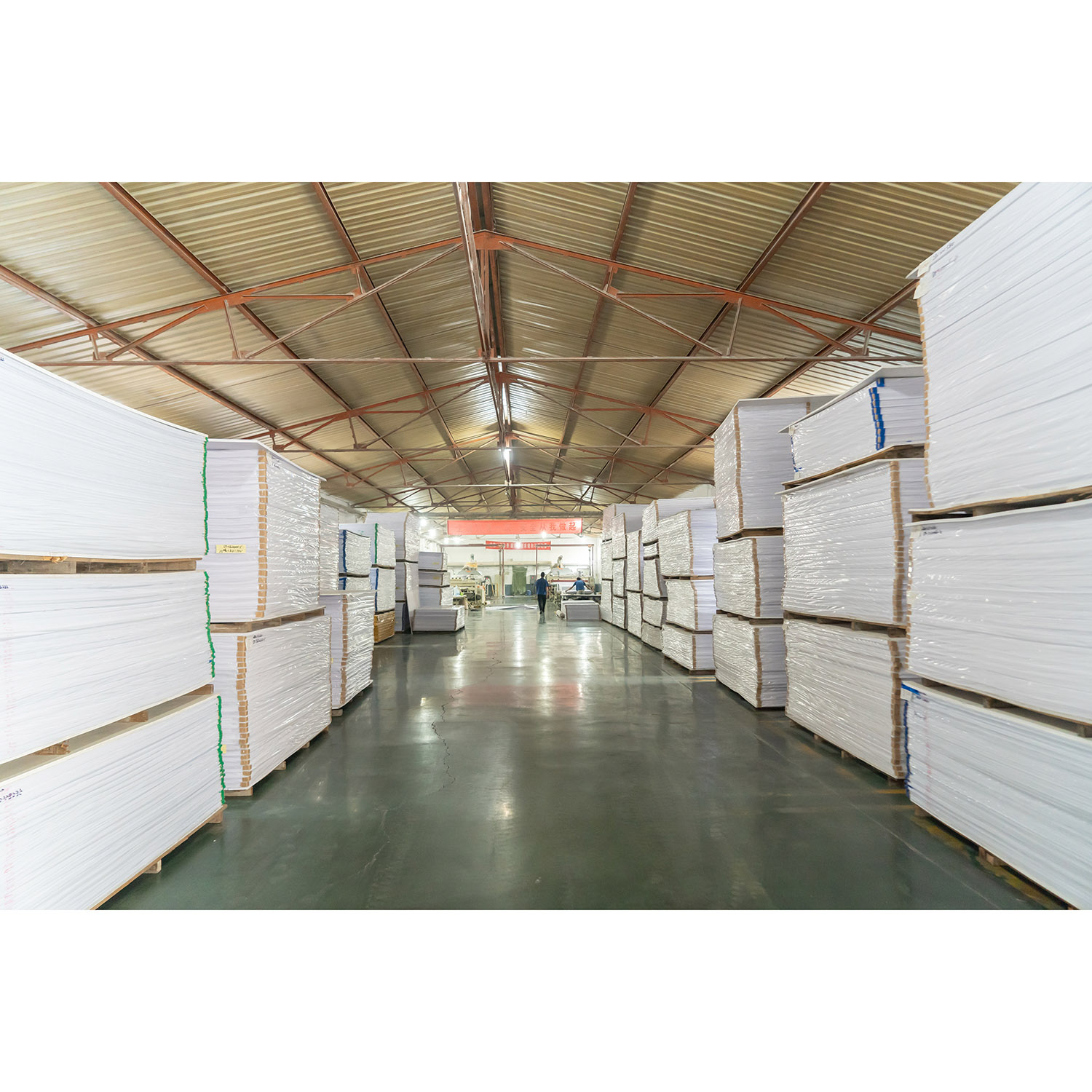
Repeat supply depends on stock discipline, not on a single successful shipment.
The strongest available proxy for continuity is repeat volume. Dingtian's disclosed programme history includes a distributor/wholesaler client ordering 10 containers per month for advertising material and furniture material applications, with the product in use for 5–10 years. That pattern indicates sustained demand rather than a transactional order — but it remains supplier-reported, so it should be treated as a claim to corroborate through samples, pre-shipment inspection and a first-order pilot rather than as an independent audit finding.
Dimension 4 — Lifecycle Cost and Durability: What the Numbers Are Made Of
Board price is not project cost. PVC FOAM BOARD weighs approximately 50% less than plywood of comparable thickness, which reduces handling, fixing labour and freight. Project-level comparisons used in this scorecard place total project cost about 15% below plywood for equivalent installations, because the board requires no sealing or painting, is washable, and does not warp or shrink in service — each of which removes a recurring labour or maintenance step from the project budget.
In-service evidence points in the same direction. In a distributor programme covering advertising and furniture applications, Dingtian records 98% print image retention after three years, zero warping or delamination, 100% waterproof performance, and a 40% cost saving versus aluminum composite panel in signage use, with UV stabilisation for long-term outdoor exposure and reduced installation cost through lower weight.
The procurement implication is straightforward: durability converts into budget certainty. A panel that holds print quality for three years, does not absorb water, and does not move with humidity protects the buyer from unplanned replacement and refinishing. That is why lifecycle evidence belongs in the same scorecard as certification and capacity — not in a later, softer conversation about quality.
Comparing PVC FOAM BOARD With Plywood and Aluminum Composite Panel
| Evaluation factor | PVC FOAM BOARD (Dingtian reference) | Plywood |
|---|---|---|
| Weight | Approximately 50% lighter at comparable thickness | Heavier handling, fixing and freight per panel |
| Surface finishing | No sealing or painting required; washable | Typically sealed and painted, with surface renewal over the service life |
| Dimensional stability | No warping or shrinking recorded in long-run use | Moisture exposure can cause swelling and movement |
| Total project cost | About 15% lower total project cost in the comparisons described | Reference baseline |
Against aluminum composite panel, the comparison is narrower but documented: in the signage programme described above, PVC FOAM BOARD delivered a 40% cost saving while remaining 100% waterproof and retaining 98% of printed image after three years.
Where PVC FOAM BOARD Stops Being the Right Answer
- Structural use. PVC foam board is not a structural panel. It does not replace plywood or engineered wood where load-bearing capacity, fastener pull-out strength or a rated structural performance is specified.
- Fire-rated assemblies. Fire performance depends on grade, thickness and the complete assembly. ASTM E84 Class A and UL 94 V-0 are separate qualifications that must be evidenced for the board actually supplied, not assumed because the polymer is PVC.
- Order economics. A minimum order of one 1×20ft GP full container with a typical 30-day lead time does not suit buyers needing urgent small volumes.
- Cost-model boundaries. The 15% lower total project cost figure holds when installation, sealing and maintenance labour are included in the comparison. A buyer evaluating sheet price alone may not observe the same difference.
- Evidence status. Programme results such as 98% image retention after three years and 10 containers per month are supplier-reported figures. They are useful evaluation inputs, but they should be verified through samples, pre-shipment testing and third-party inspection before being written into a contract.
Running the Evaluation: A Four-Step Execution Sequence
1. Build the documentation file. Collect certificate numbers, issuing bodies, scopes and validity windows — ISO9001 06924Q10470RO, REACH TSNEC1701167001, RoHS QDAFN160100422 and formaldehyde TSNHG2301164301 in this example — and map them against the regulatory limits in force in the destination market, including the EU lead restriction that applies to PVC articles.
2. Validate a sample against the specification. Confirm the quoted variant — Celuka, free foam, co-extruded, laminated, colored or waterproof — and measure density, thickness, flatness, skin quality and colour against an approved master before volume ordering.
3. Lock the commercial terms. The purchasing framework disclosed by Dingtian specifies a minimum order of 1×20ft GP full container, delivery terms of FOB, CIF or EXW, and payment of 30% T/T in advance with 70% T/T against a copy of the bill of lading.
4. Verify at shipment and after installation. Acceptance criteria are pre-shipment testing and third-party inspection (SGS), supported by the supplier's 100% testing regime and remote after-sales support. These are the checkpoints that turn a paper qualification into a repeatable supply relationship.
2026 Market Trends That Affect Supplier Evaluation
Volume growth continues. The PVC foam board market is projected to grow from roughly USD 2.1 billion in 2024 toward USD 3.6 billion by 2032 (Verified Market Research). Growth of this kind tends to expand the supplier pool faster than it expands documentation quality, which raises the value of a structured screening method.
Signage remains the demand engine. Advertising and signage represent about 35% of application demand (Laird Plastics). That is also the application where flatness, print retention and waterproofing are tested most visibly, making batch consistency a commercial issue rather than a technical footnote.
Compliance is tightening. The EU restriction on lead in PVC articles to below 0.1% by weight, effective 29 November 2024, is a reminder that certificate files need periodic re-checking against current limits. Suppliers who can produce scoped, dated, reference-numbered evidence will increasingly be filtered ahead of those who cannot.
Export concentration stays high. China accounted for about 20% of global exports of plastic building materials including PVC boards in 2024 (Observatory of Economic Complexity), which means buyers are selecting from a large but uneven base. Sizing data should be read with care: published market estimates vary by scope, with some reports covering the broader PVC foam industry rather than foam board specifically, so figures are best treated as directional.
Future Outlook
Three shifts are likely to shape PVC FOAM BOARD sourcing over the remainder of the decade. First, certification files will be managed as live documents rather than one-time attachments, with renewal dates such as the April 2027 ISO9001 expiry treated as scheduled re-qualification events. Second, buyers will increasingly ask for variant-level evidence — the specific grade, thickness and finish — instead of company-level certificates that say nothing about the purchased item. Third, lifecycle cost will replace sheet price as the comparison basis, because the labour and maintenance savings that make the material attractive are exactly the items a per-sheet comparison omits.
Suppliers who can attach numbers and dates to each claim — certificate references, capacity, lead time, tolerances, programme results — will be easier to keep on a qualified supplier list, and easier for procurement teams to defend internally when a specification is challenged.
FAQ
What should a buyer request first when qualifying a PVC FOAM BOARD supplier?
The compliance file: the ISO9001 certificate number and validity window, REACH and RoHS reports, and any formaldehyde test report, with each scope matched to the product actually being purchased. In Dingtian's case that file consists of ISO9001 certificate 06924Q10470RO valid until 17 April 2027, REACH report TSNEC1701167001, RoHS report QDAFN160100422 and formaldehyde report TSNHG2301164301. A file without reference numbers, issuing bodies and dates cannot be independently verified and is of limited use in a procurement scorecard.
How can a buyer confirm that custom sizes, thicknesses, densities and colours will be repeatable?
Dingtian offers customization of size, thickness, density and colour under OEM and ODM production, with quality control stated as 100% testing. Repeatability is still verified by the buyer: an approved master sample for colour and surface finish, density and thickness measurement on arrival within the 0.4–0.9 g/cm³ range, and the use of pre-shipment testing and third-party inspection as formal acceptance criteria.
What capacity and lead-time figures indicate a supplier can support long-term demand?
For Dingtian these are a 30,000 m² plant, an annual output of 50,000 tons, monthly capacity of 4,200 tons, a typical lead time of 30 days and a minimum order of one 1×20ft GP full container. Continuity is further illustrated by a distributor/wholesaler programme running 10 containers per month for advertising and furniture applications, with 5–10 years of product use. Capacity is best read alongside lead time and MOQ rather than in isolation, since a large plant with long lead times still creates supply risk.
Does a lower sheet price always produce a lower project cost?
No. The cost case for PVC FOAM BOARD rests on what the board does not require: it weighs roughly 50% less than plywood, needs no sealing or painting, is washable and does not warp or shrink, which is associated with about 15% lower total project cost in the comparisons described here. In signage, the disclosed distributor programme reports a 40% cost saving compared with aluminum composite panel. Quotations should therefore be compared on installed cost including labour, finishing and maintenance, not on sheet price alone.
In which applications is PVC FOAM BOARD the wrong specification?
Where the panel is structural, where fastener pull-out strength or a load rating is specified, or where fire performance must be evidenced against a defined standard such as ASTM E84 Class A or UL 94 V-0 and the offered grade and thickness have not been tested to it. Buyers needing immediate small volumes are also a poor fit, given the one-container minimum order and the typical 30-day lead time.
A complete product and capability overview — including sizes, thickness range, variants and certification references — is available in the DINGTIAN product brochure.