
Long-Term Transformer Core Supply: What Stability Demands from a Supplier
A transformer core is rarely a one-time purchase. For industrial buyers, the real question is not only whether a core meets today's specification, but whether the same supplier can deliver the same core, with the same performance, across multiple batches and multiple years. As the global transformer core market expands, supply stability has become a procurement criterion in its own right.
The market context supports this shift. The global transformer core market was valued at USD 9.66 billion in 2024 and is projected to reach USD 15 billion by 2034, according to Zion Market Research. Grain-oriented laminated silicon steel (CRGO) held a dominant 79.6% share of the market by material type in 2024, according to Mordor Intelligence. China exported approximately USD 4.8 billion in electrical transformer parts, including cores, in 2024, leading global exports, based on UN Comtrade / WITS data. For buyers entering the decision and execution phase, the issue is no longer simply finding a supplier; it is finding one that can sustain quality over the life of a product program.
Why Spot Buying Falls Short in Transformer Core Procurement
In single-order procurement, buyers evaluate samples, price and delivery time. In multi-year supply, they must evaluate systems: material sourcing, process control, inspection capability, capacity buffers and engineering responsiveness. A transformer core is not a generic commodity. Its magnetic performance is highly sensitive to batch consistency. Even with the same CRGO steel grade and the same design, variations in cutting, annealing and stacking can shift core loss, permeability and noise behaviour.
Spot buying creates hidden costs. Each new purchase may require re-qualification, new incoming inspection, new matching with the transformer design and repeated certification review. If the supplier changes materials or process parameters between orders, the buyer may not detect the drift until final transformer testing. This is especially risky for instrument transformers, high-efficiency distribution transformers and power conversion equipment, where core loss and metering accuracy are tightly specified.
There are also well-understood technical risks. In transformer core operation, the main failure patterns include excessive core temperature rise, magnetic saturation, excessive core loss, insulation failure and dimensional deviation. A supplier without strong process control exposes the buyer to all of these risks across every batch. In a long-term relationship, the impact is multiplied: a single batch problem can affect multiple production runs and several end customers.
The opportunity is equally clear. A supplier that maintains consistent material selection, disciplined magnetic circuit design, strict insulation processes, full-process dimensional control and temperature rise simulation testing can reduce the buyer's technical risk and total ownership cost over time. The value of a transformer core supplier should therefore be measured not only by unit price, but by how much variability the buyer has to absorb over the full product life cycle.
YadooTEK and the Structure of a Long-Term Core Supplier
Wuxi Yado Electromechanical Co., Ltd., the company behind the YadooTEK brand, is a transformer core manufacturer and exporter based in Jiangyin, Wuxi, Jiangsu Province, China. The company sits in the Yangtze River Delta industrial belt, which gives it access to a mature supply chain for silicon steel, magnetic alloys and precision processing. It focuses specifically on transformer core export, rather than acting as a general electrical parts trader.
YadooTEK's product structure is built for ongoing programmes rather than one-off orders. The company produces wound cores, including toroidal cores, C cores, electrically wound iron cores and special-shaped iron cores. It also produces laminated cores, including stepped laminated cores, lap-joint cores, right-angle laminated cores, EI/ED/SD/CD cores, stepped cores and thin strip cores. Customised transformer cores complete the portfolio. This range matters for long-term buyers because it allows a single supplier to cover multiple transformer families, from current transformers and potential transformers to reactors and distribution transformer cores.
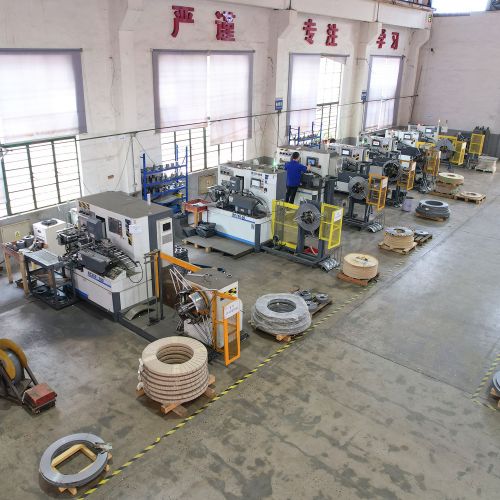
The organisational evidence is concrete. YadooTEK has 80 employees and a dedicated R&D team of 25 engineers. Around 85% of its output is exported, with customer markets spanning North America, Europe, Latin America, the Middle East and Asia-Pacific. Its production facility reports a monthly output capacity of 10,000 units, based on company data. For a buyer planning repeat orders, this indicates a supplier with actual production volume behind it, not a trading desk or a sample-only workshop.
The strongest long-term signal, however, is project history. In one documented project, stable service has been maintained for more than ten years, with results that include high-precision metering and compliance with IEC international standards. That type of evidence is directly relevant to a decision-stage buyer: it suggests the supplier's cores have stayed within specification through years of real operating conditions, not just in a factory test report.

The Technical Basis of Supply Consistency
Long-term supply consistency is not achieved by goodwill; it is achieved by process discipline. The key factors that determine whether a core performs the same in batch 50 as in batch 1 are material control, magnetic circuit design, insulation processing, dimensional control and temperature-rise validation.
Material control begins at incoming inspection. A supplier must verify the magnetic properties of CRGO silicon steel, permalloy or thin strip material before it enters production. YadooTEK applies incoming material inspection as a standard step, combined with 100% core loss testing. This means every core is checked for loss performance, not just a statistical sample. In precision applications such as metering current transformers, the difference between a sampled test and a 100% test is significant.
Dimensional control is equally important. In laminated cores, stacking precision directly affects the core's effective cross-section, excitation current and noise level. According to YadooTEK's product comparison data, lamination precision can be held to ±0.02 mm. That level of dimensional stability is what allows an OEM to assemble transformers without adjusting the core design for each incoming batch.
Magnetic circuit design determines how the core behaves under real operating conditions. Optimised magnetic circuit design reduces the risk of magnetic saturation, while strict insulation processes reduce the risk of insulation failure. Temperature rise simulation testing is used to validate that the core will not overheat under continuous load. These are not one-time engineering activities; they must be repeated each time a core is produced.
The performance impact is measurable. Compared with conventional ordinary silicon steel cores, YadooTEK's engineered cores are associated with a core loss reduction of more than 30%, a two-fold increase in magnetic permeability and ±0.02 mm lamination precision. The company also states that total life cycle cost can be reduced by 15%, with long-term operation and maintenance costs reduced by approximately 20%. These figures come from the manufacturer's internal comparison data, and they explain why a higher-quality laminated or wound core often costs less over a transformer's life than a cheaper core with higher losses.
For buyers evaluating specific core families, the same technical logic applies across toroidal cores, CD cores and CD cut cores, EI lamination cores, silicon steel rectangular cores, permalloy cores, thin strip cores and gapped cores used in current sensing. The material changes, but the requirement for repeatable magnetic performance does not. A distribution transformer core made from CRGO lamination and a precision permalloy core for a metering application both depend on the same quality infrastructure: controlled material input, controlled processing and full traceability.
Applications That Reward Multi-Year Core Agreements
Certain applications are particularly well suited to long-term transformer core supply agreements because their performance requirements are stable and their qualification costs are high.
Precision instrument transformers are the clearest example. Metering accuracy depends on core permeability, linearity and long-term stability. A project documented by YadooTEK has maintained stable service for more than ten years, with high-precision metering and compliance with IEC international standards. For manufacturers of current transformers, potential transformers and low-current sensor cores, this kind of field history is directly relevant.
High-efficiency power transformers and distribution transformers benefit from low no-load loss and consistent lamination quality. EI lamination cores, CD cut cores and rectangular CRGO cores are common in this segment. Because these transformers are expected to operate for decades, the buyer's real interest is not the first batch of cores but the consistency of loss performance across all future batches.
New energy inverters, EV charging stations, high-frequency inductors and low-loss reactor systems demand cores with low core loss at higher operating frequencies. Toroidal cores, thin strip cores and non-standard custom cores are frequently used in these designs. The engineering relationship matters here because design iterations are common; a supplier who can adjust core geometry or material without degrading performance is a strategic advantage.
For distributors and OEMs, the commercial terms also support ongoing supply. YadooTEK's standard MOQ is one unit, which allows buyers to validate a design before committing to volume. Delivery methods include FOB and CIF, and pre-shipment testing is offered as part of the acceptance process. This combination of low MOQ, defined delivery terms and pre-shipment inspection makes it practical to build a repeat-order framework without requiring massive initial inventory.
Market Signals Favoring Stable Core Partnerships
Several market-level trends reinforce the importance of evaluating transformer core suppliers as long-term partners rather than one-time vendors.
The first is growth. With the transformer core market projected to expand from USD 9.66 billion in 2024 to USD 15 billion by 2034, demand will continue to absorb more production capacity. Buyers who secure committed supplier capacity now are less likely to face allocation problems later.
The second is the continued dominance of CRGO laminated steel. The fact that grain-oriented laminated steel holds roughly 79.6% of the market by material type means that most long-term supply agreements will centre on lamination cores. The ability to consistently process CRGO into EI laminations, CD cut cores and rectangular core geometries remains the core competence a buyer must verify.
The third is standards pressure. Power transformers and reactors are governed by the IEC 60076 series standards, which specify general requirements and testing. A supplier that already documents IEC compliance helps the buyer avoid re-engineering and re-testing costs every year.
The fourth is material transition. Amorphous alloy cores, for example, are reported to reduce no-load losses by 70% to 80% compared with traditional silicon steel cores. This does not make CRGO obsolete, but it does mean a supplier must have the R&D capacity to support alternative materials when a customer's efficiency targets require them. YadooTEK's 25-member engineering team and thin strip core production capability are relevant signals in this context.
Finally, the competitive landscape includes global groups such as ABB, Siemens Energy, Hitachi Energy and GE Vernova, according to Stellar Market Research. These players serve large-scale infrastructure projects with broad system portfolios. The rest of the market is served by specialised suppliers such as YadooTEK, which focus on core design flexibility, custom geometry and export-oriented production. Buyers benefit from understanding which type of supplier fits which programme.
Long-Term Partnership vs. Transactional Sourcing: A Practical Comparison
For a decision-stage buyer, the practical difference between a long-term partnership and transactional sourcing comes down to where risk sits.
| Evaluation Dimension | Transactional Spot Buying | Long-Term Partnership |
|---|---|---|
| Quality consistency | Re-qualified for every order | Controlled through 100% core loss testing and traceability |
| Capacity security | Subject to supplier availability | Monthly output capacity of 10,000 units provides a planning baseline |
| Engineering support | Limited to the specific order | Dedicated R&D team supports design adjustments over time |
| Compliance documentation | Re-collected for each transaction | Reusable validation, including IEC-related compliance evidence |
| Cost structure | Unit-price driven | Lifecycle-cost driven, with lower long-term maintenance cost |
This comparison is not an argument that every buyer should use a single specialised supplier for everything. There are legitimate boundaries. For very large power infrastructure projects that require global on-site service, system-level integration and massive standardised output, multinational groups such as ABB, Siemens Energy, Hitachi Energy and GE Vernova may be the more realistic partner. A specialised exporter like YadooTEK is strongest when the buyer needs custom core geometry, responsive engineering iteration, flexible MOQ and close control over magnetic performance.
There is also a rational caution about single-source dependency. Even a reliable long-term partner should be monitored, and buyers with critical production lines may keep a second qualified source for redundancy. The goal of a long-term partnership is not to eliminate market comparison, but to reduce the risk and cost that come with re-qualifying a new supplier every year.
What to Expect in the Next Phase of Core Supply
The next phase of transformer core procurement will likely be defined by three pressures: efficiency regulation, material transition and supply-chain security. Efficiency standards will continue to push down acceptable core loss levels, making supplier test capability a competitive issue. Material transitions, including amorphous and thin strip cores, will create demand for engineering partnerships rather than simple purchase orders. And global buyers will continue to evaluate Chinese suppliers not only on price, but on certification documentation, production transparency and long-term capacity commitment.
For YadooTEK, the combination of an 80-person team, 25 R&D engineers, 85% export share and a documented ten-year project track record positions it as a viable long-term partner for OEMs and distributors in the mid-to-high-volume custom core segment. The company's low MOQ of one unit, FOB/CIF delivery options, pre-shipment testing and full-process quality control provide the operational structure that repeat buyers need.
FAQ — Long-Term Transformer Core Supply and Supplier Evaluation
Q1: What should a buyer verify before entering a long-term transformer core supply agreement?
A buyer should verify the supplier's incoming material inspection process, whether core loss testing is applied to 100% of units or only samples, dimensional control capability, traceability systems, third-party certifications, monthly production capacity and commercial terms such as MOQ, delivery method and acceptance testing. These factors determine whether the supplier can maintain the same quality across multiple batches.
Q2: How does YadooTEK ensure consistency across repeated orders?
YadooTEK uses incoming material inspection, 100% core loss testing, full-process dimensional control, full life cycle quality traceability and third-party authoritative certification. The company is also equipped with core magnetic testing instruments and transformer capacity and loss testing equipment to verify performance at the production stage.
Q3: What commercial conditions apply to an ongoing supply arrangement?
The standard MOQ is one unit, which supports design validation and low-volume initial orders. Delivery methods are FOB or CIF, pre-shipment testing is available as an acceptance step, and payment terms are specified at 100% in the company's standard procurement terms.
Q4: Which transformer core types can be included in a long-term programme?
YadooTEK supplies wound cores such as toroidal cores, C cores and electrically wound iron cores; laminated cores such as stepped, lap-joint, right-angle, EI/ED/SD/CD and thin strip cores; plus permalloy cores, low-current sensor cores, distribution transformer cores, NCW continuous wound cores and non-standard custom iron cores. This range allows buyers to consolidate several core requirements with one supplier.
Q5: Why does production capacity matter for a long-term supply relationship?
Capacity determines whether a supplier can support order growth without extending lead times or sacrificing inspection discipline. YadooTEK's monthly output capacity of 10,000 units provides a practical baseline for repeat ordering. In addition, a team of 80 employees and 25 R&D engineers supports both production and continuous engineering adjustments.
Q6: What evidence indicates that a transformer core supplier is a stable long-term partner?
Relevant evidence includes documented projects that have maintained stable service for more than ten years, high-precision metering results with compliance to IEC international standards, verified production facilities, dedicated engineering staff and a consistent export track record across multiple regions. Buyers can also review the company's corporate brochure for a fuller picture of its product lines and capabilities.
Buyers evaluating a long-term transformer core supplier can download the YadooTEK corporate brochure for a more detailed overview of product lines and production capabilities: https://cdn.socialarks.com/sbsp//common/2026/0327/69c63aa11cb46.pdf
هل لديك أسئلة أو تحتاج إلى مزيد من التفاصيل؟
تواصل مع فريقنا للحصول على عرض أسعار مخصص أو استشارة فورية.
طلب عرض أسعار
املأ النموذج أدناه وسيتواصل معك فريقنا بعرض مقترح مخصص.
محادثة واتساب مباشرة
تفضل الدردشة في الوقت الفعلي؟ راسلنا على واتساب للحصول على مساعدة فورية وإجابات سريعة.
- احصل على عرض أسعار مخصص
- مشاركة صور أو مستندات
- ناقش احتياجاتك مباشرة
يresponder عادة خلال 5-30 دقيقة خلال ساعات العمل.