
Long-Term Wall Panel Supplier Evaluation: Batch Consistency and Compliance Proof
Wall panel programmes rarely fail on the first container. They fail in the third or fourth order, when a 2.5 mm panel arrives at 2.3 mm, the adhesive coat lightens, the marble print registry shifts half a millimetre, or the compliance file that satisfied a customer in year one no longer matches the product shipped in year two.
That pattern is why long-term supplier evaluation has become a separate procurement exercise from quotation comparison. For buyers, distributors and importers of PET marble wall sticker, WPC wall panel, PVC panel and soft-pack wall sticker lines, the decision is not which supplier is cheapest today, but which supplier can hold a specification, a supply schedule and a documentation set across multiple order cycles. This article sets out an evaluation framework built on four evidence pillars — batch consistency, capacity and response, storage and handling discipline, and compliance documentation — and shows which specifications in a typical wall panel range can actually be audited.
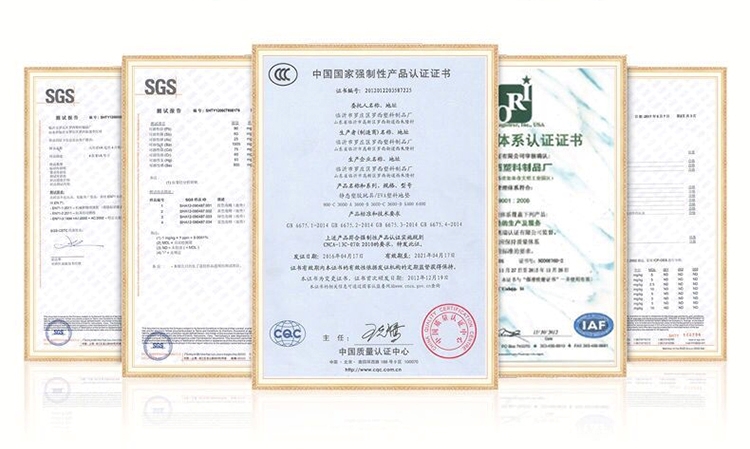
Compliance documentation is one of four evidence pillars in a long-term wall panel supplier evaluation. A certificate that covers a product family rather than a specific product and thickness is weak evidence at the decision stage.
Why a single quote is weak evidence for a multi-year supply decision
A quotation proves two things: a price and a specification line. It does not prove that the same panel will be produced in eighteen months with the same substrate density, the same surface layer thickness and the same adhesive coat weight. Wall panel manufacturing is a batch process. Raw material lots change, film rolls change, adhesive application settings drift, and calender or lamination lines are re-set between runs. Without a documented reference point, each of those normal production events becomes an invisible specification change that only surfaces as a customer complaint, a re-work claim or a retail return.
The commercial consequence is asymmetric. A few tenths of a millimetre on a self-adhesive panel rarely changes the unit price, but it changes installation behaviour, adhesion performance and perceived quality at the point of sale. For a distributor running a private-label programme, that gap is absorbed either by margin or by reputation. This is the practical argument for treating supplier selection as an evidence exercise rather than a price exercise.
A four-pillar evaluation framework
The framework below is designed for the decision stage of procurement, where the shortlist has already been reduced and the remaining question is which supplier can sustain performance. Each pillar should be evidenced by something a buyer can hold, measure or file — not by an assurance in an email.
| Evidence pillar | What to request | What it actually proves | Typical failure mode |
|---|---|---|---|
| Batch consistency | Retained approved sample per lot, thickness and weight records, raw-material lot statement, print registration reference | Whether year-two panels still match the sample approved in year one | Specification drifts quietly once the sample-approval phase ends |
| Capacity and response | Annual output, line allocation, MOQ by model, customisation lead time, R&D headcount | Whether volume peaks can be absorbed without material substitution | Capacity quoted in annual units rather than in reserved line time |
| Storage and handling | Packaging format, pallet and stacking rules, warehouse conditions, FIFO policy | Whether transit and storage damage becomes your commercial claim | Damage reclassified as improper storage because no rule was agreed |
| Compliance | Product-specific RoHS test report, reaction-to-fire classification where specified, customs classification, material declaration | Whether the goods can be cleared and installed lawfully in the target market | A certificate inherited across a whole range or across thicknesses |
Auditing batch consistency across four panel families
Batch consistency only becomes auditable when the specification is stated in measurable terms. A wall panel range that lists “2 mm” without size, weight or packaging parameters gives a buyer nothing to compare against a future shipment. The specification table below shows the level of detail that makes a lot-to-lot comparison possible.
| Product | Model | Material | Thickness | Sizes | Notes |
|---|---|---|---|---|---|
| PET marble wall sticker | WB-PET | PET | 2 mm / 2.5 mm | 30x30, 30x60, 40x80, 60x60, 60x120, 60x300, 120x300 cm | Print registration and film clarity are the drift points |
| PVC wall sticker | WB-PVC | PVC | 2 mm | 30x30, 30x60, 40x80, 60x60, 60x120, 120x300 cm | Adhesive coat weight is the main variable |
| PVC wall panel | WB-PVC | PVC | 2.5 mm | 30x30, 50x50, 96x48 cm | Rigid panel formats for interior cladding |
| PVC soft stone wall sticker | WB-PVC | PVC | 2.5 mm | 30x60, 60x60, 40x80, 60x100, 40x300, 60x300, 120x300 cm | Texture depth and surface scratch resistance |
| 3D self-adhesive foam slat wall sticker | WB-KC | PVC | 2.8 mm | 30x30, 30x60, 60x60, 40x300, 60x300, 120x300 cm; length customisable | Foam cell structure and rebound behaviour |
| WPC wall panel | WB-WPC | WPC | 160x23x2900 mm profile | 16 pcs per box | Weight specified at 690 / 810 / 830 g/m |
| Leather wall sticker | WB-PG | Leather | 6 mm | 60x60, 60x240, 70x70, 70x280, 70x300 cm | Surface grain and backing adhesion |
What actually drifts between batches
Across these families, four properties account for most lot-to-lot variation. First, calliper thickness at fixed measuring points — a 2 mm PET marble panel and a 2.5 mm soft-stone panel are sold on thickness, so thickness is the property most worth recording. Second, adhesive coat weight, which governs initial tack and long-term holding on painted plasterboard or plywood. Third, surface layer thickness on wear-resistant constructions, which determines how quickly a floor-facing or high-touch surface shows scuffing. Fourth, for WPC profiles, weight per metre: the WB-WPC panel is specified at 690, 810 or 830 g/m, and a falling g/m figure is one of the earliest signals that filler content has been increased.
A workable lot-acceptance routine
A workable routine does not require a laboratory. Cut and seal one sample per lot as the retained reference, then measure a fixed five-point calliper pattern on three panels drawn from different positions in the carton. Weigh a one-metre length of WPC profile and compare it to the declared 690 / 810 / 830 g/m figure. Compare the print registry and surface texture against the retained sample under the same lighting. Record the raw-material lot reference on the inspection sheet. Finally, keep the approved sample sealed and dated in the buyer's own warehouse rather than only at the supplier — the point of the retained sample is that it is not under the supplier's control.
XPE versus IXPE: the material question behind export orders
Foam-based wall stickers are where material substitution is most consequential and least visible. IXPE is cross-linked by electron-beam irradiation, which produces fine, uniform cells, fast rebound and resistance to permanent indentation. Chemically cross-linked XPE has larger cells, slower rebound and a tendency to hold a dent under sustained pressure. In a domestic retail context the difference may only affect feel; in an export order it affects what happens to a carton after weeks of stacking in a container and months in a distributor's warehouse.
Incoming inspection can screen the two materials. Cut a cross-section and compare cell uniformity — fine and even indicates IXPE, uneven and coarse indicates XPE. Press a sample hard for three to five seconds and release: fast recovery without a residual dent tends towards IXPE, slow rebound with a residual dent tends towards XPE. This is preliminary screening only and should not be used as the basis of a claim. Formal evidence is the supplier's material statement plus formamide and cross-linking-degree test reports, with a third-party laboratory report used as the acceptance criterion where material conformity is disputed. For export orders, the material should be written explicitly into the proforma invoice, and the third-party report named as the acceptance reference.
The same logic applies when choosing between an XPE foam self-adhesive wall sticker and a PVC soft-stone wall sticker for a project. Foam panels suit residential apartments and rental refurbishment on the strength of light weight, sound absorption, cushioning and competitive logistics cost, but surface scratch resistance is general. PVC soft-stone panels suit hotel guest rooms and chain-store interiors on texture and scratch resistance, at the cost of heavier weight and a higher unit cost. Either choice should be confirmed on physical samples tested for adhesion and ageing, and against the compliance documents required by the destination market.
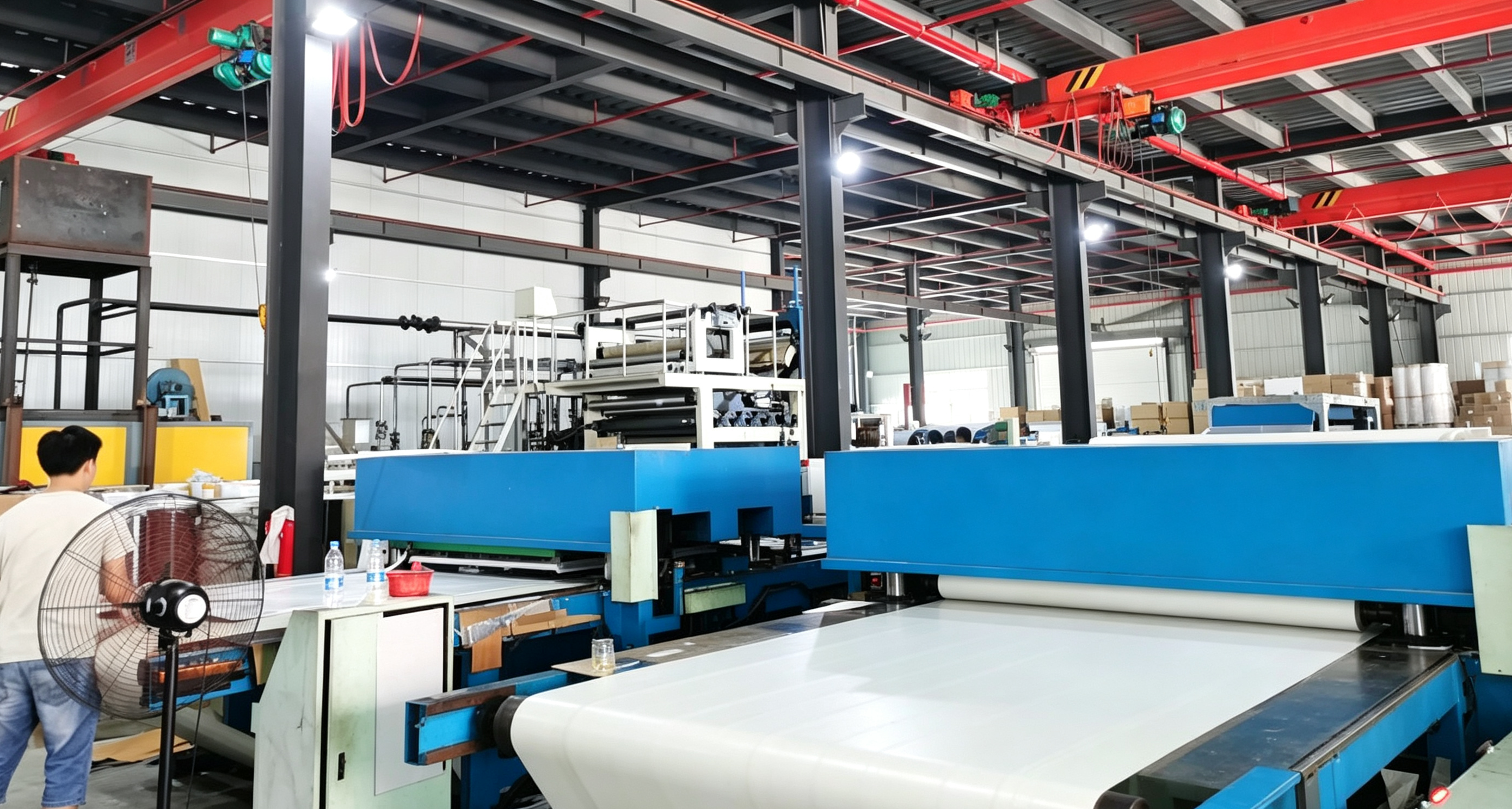
Production floor review: capacity claims should be checked against line allocation, changeover practice and reserved time, not only against headline annual output.
Capacity, documentation and response: reading supplier numbers
Headline output figures are useful context but poor predictors of delivery reliability. What matters for a long-term agreement is whether capacity is reserved for your programme, how changeover between colours, thicknesses and print patterns is managed, and how quickly a customisation request moves from enquiry to a confirmed sample. A supplier that can produce large annual volumes but allocates your line only when capacity is free will deliver unevenly during peak season.
Four questions separate the two situations: what is the minimum order quantity per model and per thickness; what is the standard lead time for a repeat order versus a first order; how many engineers are available to handle a size, thickness, pattern, surface or packaging change; and which reference markets the supplier already ships to, since that determines whether their documentation set has been tested against real customs and retail requirements.
What SXP Wall Panel's operating data shows — and what it does not
SXP Wall Panel is the wall panel line of Shanghai Yuanguan Rubber Plastic Co., Ltd., a decorative materials manufacturer founded in 2005 and based in Qingpu District, Shanghai, China. The company states ISO 9001 quality management system certification, an annual output of 75,000,000 units, a research and development team of five engineers, 48 patented technologies and 12 independent brands across its decorative material lines. Around 90% of output is exported, with main markets in the EU, the USA, Asia and South America. The wall panel range covers PET marble, PVC, WPC and foam/soft-pack families, with flexible customisation on size, thickness, pattern, surface and packaging.
Read carefully, that combination is evidence of breadth rather than proof of consistency. An annual figure of 75,000,000 units, an export ratio near 90% and a five-engineer R&D team indicate a supplier structured for export programmes and customisation requests, and the 48 patents and 12 brands indicate an organisation that maintains multiple product lines — which is also why a buyer should confirm which line, which model and which thickness a given test report actually covers. The comparison data published by the company illustrates the same point: its stated advantage over ordinary wall and floor stickers rests on full sufficient raw materials, a thickened wear-resistant surface layer, a dense thick IXPE substrate and heavy coating of strong adhesive, with material thickness reported 22% higher, glue coating weight 35% up, wear layer thickness 180% greater, raw-material cost 12% higher and average annual use cost 60% lower than the ordinary alternative. Those are internal comparative figures against an unnamed reference. They are a useful starting point for a technical discussion, and they should be tested against a named competitor sample before they carry any weight in a purchasing decision.
Storage discipline as a contractual clause, not an afterthought
Storage is where long-term wall panel relationships most often lose value, because the cause of a claim is ambiguous by default. Foam wall stickers are sensitive to high temperature, heavy pressure and ultraviolet light. PU stone panels are vulnerable to moisture and impact. Linen soft-pack wall stickers are vulnerable to dust, damp and mildew. If the buyer's warehouse and the supplier's carton are not governed by the same written rules, a warped or dented carton becomes a dispute about who owns the damage.
| Material family | Primary storage risk | Control to agree in writing |
|---|---|---|
| Foam wall sticker (XPE / IXPE) | High temperature, heavy pressure, UV exposure | Cool, ventilated store not above 40 °C; away from direct sunlight and heating pipes; limited stack height; no hard panels stacked on foam goods |
| PU stone panel | Moisture and corner impact | Pallets rather than bare floor; corner protection; keep away from water sources |
| Linen soft-pack wall sticker | Dust, damp, mildew | Dust covers; dry storage; first-in-first-out dispatch |
| PET marble / PVC panels | Warping under uneven load or heat | Flat stacking; stable temperature; no leaning against walls |
The operative distinction is that curling, deformation and mildew caused by sun exposure, over-stacking or ground moisture are normally treated as improper-storage damage rather than an inherent product defect. That distinction is reasonable, and it is also the reason the storage rules belong in the supply agreement rather than in a general handling note. A buyer who agrees pallet height, stacking limits, temperature ceiling and FIFO practice at contract stage converts an argument into a procedure.
Compliance evidence for EU-bound wall panels
Compliance is the pillar most often satisfied with a document rather than with proof. Two documents carry most of the weight for European interior projects. The first is a RoHS test report tied to the specific product; SXP documents an SGS RoHS Test Report applicable to the EU market for its relevant wall panel products. The second is a reaction-to-fire classification where the project or the building authority requires one. EN 13501-1 is the European classification standard for reaction to fire of construction products, and B-s1,d0 is a commonly specified rating for commercial interior wall panel applications.
The practical caution is scope. A classification is issued for a defined product construction, often including thickness. It does not automatically extend to a sister model, a lighter calliper or a different substrate. A buyer receiving an EN 13501-1 report should check that the product designation, thickness and construction on the report match the goods on the purchase order. The same scoping discipline applies to RoHS reports and to any material declaration requested by a retail customer.
For landed-cost and clearance planning, customs classification is a third document worth confirming early. The standard HS code recorded for wood plastic composite (WPC) wall panels exported from China is 3925.90.0000, as set out in the U.S. Customs and Border Protection ruling N337378. Classification questions are better resolved before the first shipment than after the fifth.
Comparison with traditional solutions — and the limits of this framework
Self-adhesive and panelised wall systems compete with tiling, wallpaper and conventional cladding on installation method rather than on material alone. Their advantage is a dry installation: peel-off backing, no cement or glue, cutting on site, no large construction equipment beyond a utility knife, scraper or roller, tape measure and spirit level, and the ability to shorten construction time and cover cracks and stains on an existing substrate. That is a genuine operational benefit in renovation, hotel room makeovers, chain-store refurbishment and rental apartment work.
The limits are equally real, and they belong in a supplier evaluation because a supplier that overstates suitability is a supply risk. These products are for indoor use at normal room temperature, tolerate typical humid environments such as bathrooms and dry kitchen areas, and should not be exposed to strong sunlight over the long term. The base surface must be flat, dry and free of dust and grease, and the products are not suitable for powdery, sandy or loose surfaces. Foam-based panels offer cushioning, sound absorption and light weight but only general surface scratch resistance, which makes them a poor fit for heavy-traffic commercial wear points. PVC soft-stone panels improve texture and scratch resistance at the cost of weight and unit price.
The evaluation framework itself also has boundaries. Documentation discipline costs the supplier time and money, and a technically competent smaller manufacturer may be unable to produce an EN 13501-1 classification or a full retained-sample library. In that case the honest conclusion is not that the supplier is unsuitable, but that the buyer must either accept a narrower evidence set with tighter incoming inspection or reserve that supplier for markets that do not require the missing document. Similarly, comparative material claims are only as strong as the reference sample behind them. A framework that cannot say “this evidence is missing” is not a framework.
Market context: why buyers are asking for longer commitments
The wall panel category is large and still expanding, which raises the value of supply continuity. Dataintelo values the global wall panels market at USD 32.4 billion in 2025 and projects USD 43.7 billion by 2033, a 4.2% CAGR across 2025–2033. Buyers should read such figures with care: a materially lower 2025 estimate also circulates, and the gap reflects different definitions of whether exterior cladding systems are included rather than a disagreement about demand. The same definitional caution applies inside the category. Metal wall panels held a 28.5% share in 2025, while Asia Pacific accounted for 42.3% of the regional market. Wood-based wall panels accounted for nearly 31% of global installations in 2024, and wood wall panel systems are projected to grow at 6.2% CAGR to 2035.
For a buyer, the relevant signal is not the headline growth rate but the direction of procurement behaviour: as programmes lengthen, the cost of a mid-programme specification change rises, and the ability to evidence consistency becomes a commercial differentiator rather than a compliance formality.
Future outlook
Two shifts are likely to shape long-term wall panel supply over the next few years. The first is the normalisation of batch traceability as a buyer requirement rather than a supplier courtesy — retained samples, lot references and declared weight per metre moving from informal practice into purchase-order terms. The second is tighter scrutiny of documentation scope, particularly for reaction-to-fire classifications and material declarations, where the question is shifting from “do you have a certificate” to “does this certificate describe the product and thickness I am buying”.
Suppliers structured for export programmes, with in-house engineering capacity to handle size, thickness, pattern, surface and packaging changes, are better placed to answer both. Buyers who build the same discipline into their own acceptance routine — sealed sample libraries, written storage rules, named test reports as acceptance criteria — will find that the lowest bid and the most durable supply relationship are less often the same supplier than the quotation stage suggests.
Frequently asked questions
What warehouse storage conditions should be written into a wall panel supply agreement?
Foam wall stickers are sensitive to high temperature, heavy pressure and UV light; PU stone panels to moisture and impact; linen soft-pack wall stickers to dust, damp and mildew. Common requirements are a cool, ventilated warehouse with temperature not above 40 °C, goods on pallets rather than on the bare floor, storage away from direct sunlight, heating pipes and water sources, a defined stacking height with no heavy hard panels on top of foam goods, dust covers for linen soft-pack items, and first-in-first-out dispatch. Curling, deformation and mildew caused by sun exposure, over-stacking or ground moisture are normally treated as improper-storage damage rather than an inherent product defect, which is why the rules belong in the agreement rather than in a handling note.
How can a buyer separate XPE foam from IXPE foam during incoming inspection?
IXPE is cross-linked by electron-beam irradiation, giving fine, uniform cells, fast rebound and resistance to permanent indentation. Chemically cross-linked XPE has larger cells, slower rebound and tends to hold a dent under sustained pressure. Cut a cross-section and compare cell uniformity, then press a sample hard for three to five seconds and release. This is preliminary screening only. Formal evidence is the supplier's material statement plus formamide and cross-linking-degree test reports, with a third-party laboratory report used as the acceptance criterion where material conformity is disputed.
For an interior project, is an XPE foam self-adhesive wall sticker or a PVC soft-stone wall sticker the better choice?
The choice follows project positioning and budget. XPE foam self-adhesive wall stickers suit residential apartments and rental refurbishment: light weight, good sound absorption and cushioning, competitive logistics cost, but only general surface scratch resistance. PVC soft-stone wall stickers suit hotel guest rooms and chain-store commercial interiors: better texture and scratch resistance, but heavier weight and higher unit cost. In either case, physical samples should be tested for adhesion and ageing, and target-market compliance documents verified before bulk purchase.
What acceptance criteria belong in a wall panel purchase order?
At minimum: model code, material, nominal thickness, exact panel size, packaging format, weight per metre where relevant, the retained approved sample, the test report that governs acceptance, the storage conditions agreed with the buyer's warehouse, and a tolerance band for each measured property. The WB-WPC wall panel, for example, is specified at 690, 810 or 830 g/m and packed 16 pieces per box, which gives a buyer two directly measurable lot checks. Material should be stated explicitly in the proforma invoice, with the third-party laboratory report named as the acceptance reference.
Which compliance documents should be requested for EU-bound wall panel shipments?
A product-specific RoHS test report, plus a reaction-to-fire classification where the project specifies one. EN 13501-1 is the European classification standard for reaction to fire of construction products, and B-s1,d0 is a commonly specified rating for commercial interior wall panel applications; the classification must come from the test report covering that product and thickness, not from a sister product. SXP documents an SGS RoHS Test Report applicable to the EU market for its relevant wall panel products. For customs and landed-cost checks on WPC panels exported from China, HS code 3925.90.0000 is the classification recorded in U.S. Customs and Border Protection ruling N337378.
The full wall panel range, model codes, dimensions and packaging formats referenced in this article are listed in the Shanghai Yuanguan product brochure.
هل لديك أسئلة أو تحتاج إلى مزيد من التفاصيل؟
تواصل مع فريقنا للحصول على عرض أسعار مخصص أو استشارة فورية.
طلب عرض أسعار
املأ النموذج أدناه وسيتواصل معك فريقنا بعرض مقترح مخصص.
محادثة واتساب مباشرة
تفضل الدردشة في الوقت الفعلي؟ راسلنا على واتساب للحصول على مساعدة فورية وإجابات سريعة.
- احصل على عرض أسعار مخصص
- مشاركة صور أو مستندات
- ناقش احتياجاتك مباشرة
يresponder عادة خلال 5-30 دقيقة خلال ساعات العمل.