
Long-Term Wall Switch Supplier Evaluation: B111/A122 Continuity
Supplier Evaluation · Wall Switch Sourcing
Wall switch procurement rarely fails on the first order. It fails on the third or fourth, when a plate measures two millimetres differently, a base material quietly changes grade, or the certificate that was valid at sampling no longer lists the model being shipped.
A long-term wall switch supplier evaluation is not a price comparison. It is a structured test of three continuities — model lifecycle, certification maintenance, and material consistency — run against the repeat-order specifications that actually govern production: 10A 250V~ and 10AX ratings, 81.6×81.6 mm and modular 65×65 mm panel formats, 40,000 mechanical cycles, and 850°C flame-retardant PC panels. This reference sets out how buyers can audit those three continuities using documented evidence, using the B111 1 gang 1 way switch and the A122 2 gang 2 way switch from Wenzhou Huafeng Electric Co., Ltd. (HYFF) as a working example of what a supplier file should contain.
Wenzhou Huafeng Electric Co., Ltd. (HYFF) is a Wenzhou, Zhejiang-based manufacturer founded in 2011 that produces wall switches and wall sockets for export markets, operating a 7,000 m² facility with 118 employees and 10 R&D engineers.
Why repeat orders, not first orders, expose supplier risk
The commercial logic of the category pushes buyers toward this problem. The global light switches and electrical sockets market was valued at approximately USD 17.6 billion in 2024 according to Strategic Market Research, and Dataintelo reports that Asia Pacific held a 42.5% revenue share of the electrical switch market in 2025. In practice, most European and Australian buyers will source from Asian manufacturers — which means the continuity risk sits with the buyer's evaluation process, not with the market.
Published market sizing also varies by methodology: Global Market Insights and Dataintelo estimate the 2025 global electric switch market at roughly USD 13 billion and USD 18.2 billion respectively, largely because one includes industrial switchgear and the other does not. A buyer building a supplier file should treat any single market figure as directional and instead invest effort in verifiable product-level evidence.
Three failure modes recur in repeat programmes:
- Model churn. A model is discontinued or re-tooled without notice, and the replacement has a different plate footprint or button geometry.
- Certification drift. The certificate exists but covers an earlier model list or an earlier edition of the standard.
- Material substitution. Panel, base, terminal or contact material changes in a way that is invisible in a photograph and only appears in a returns pattern two years later.
Each failure mode has a corresponding audit test, and each test needs a document, not a promise.
The three-continuity framework
A defensible supplier evaluation converts each continuity into a question and a piece of evidence. The table below is the minimum structure; a buyer can extend it, but removing any of the three columns leaves a gap that shows up later in the programme.
| Continuity test | Question to the supplier | Evidence that closes the gap |
|---|---|---|
| Model lifecycle | Are B111 and A122 still in active production, with an unchanged bill of materials and unchanged tooling? | Current model list, plate drawings with dimensions, retained golden sample from the first shipment, side-by-side comparison on each repeat order |
| Certification maintenance | Which models appear on the CE and TUV certificates, and which products carry SAA for Australia? | Certificate copies showing holder name, listed models, standard edition and validity, checked against the purchase order |
| Material consistency | Are the flame-retardant PC panel, the base material, the brass terminals and the silver-plated phosphor copper contacts unchanged? | Incoming material inspection records, material declarations, silver-layer thickness inspection data, life-test reports |
Table 1: Three-continuity framework for wall switch supplier evaluation.
Model lifecycle: what B111 and A122 continuity actually means
Model lifecycle continuity means the same physical product, from the same tooling, delivered against the same drawing. Two models in the HYFF range illustrate why the check must be model-specific rather than brand-level.
The B111 is a 1 gang 1 way switch — a single-circuit control device, the most common configuration in residential lighting. The A122 is a 2 gang 2 way switch with an 81.6×81.6 mm panel, rated 10A 250V~, flush mounted, with a flame-retardant PC panel and a PC base, documented with CE and TUV certification, and an HS code of 8536500090. The A122 uses brass terminals for conductivity, 0.7 mm phosphor copper contacts with silver plating at 3 mm diameter, a grade II shock-absorption mechanism that reduces switching noise, and a large wide-faced, narrow-framed button.
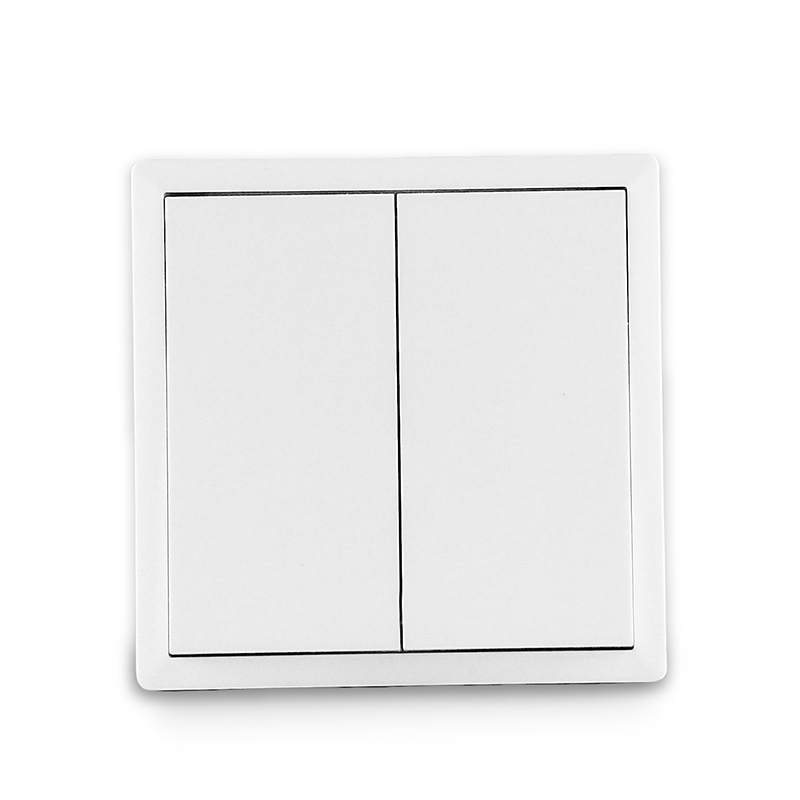
The A122 2 gang 2 way switch: 81.6×81.6 mm panel, 10A 250V~, flame-retardant PC panel and PC base, brass terminals.
The lifecycle audit works best with a retained physical baseline. Buyers who keep a sealed golden sample from the first approved shipment can check, on every repeat order, five references: plate dimension, button geometry and travel, terminal material and colour, contact assembly appearance, and moulding marks on the base. Any deviation is visible in minutes and can be raised before installation rather than after commissioning.
Plate formats do not transfer between models
A second lifecycle issue is dimensional. Within the same supplier range, documented plate sizes include 81.6×81.6 mm (A122), 86×86 mm (H111, V122N, HG110NB), 86×90 mm (U121), 68×68 mm (S111), 74×83 mm (M111) and 22×49 mm for the KM141S modular intermediate switch. Modular 65×65 mm formats and 81.6 mm square panels are frequently compared in European renovation work because they suit different box and frame systems. A buyer should therefore confirm the plate drawing for each model in the project, rather than assuming a single footprint across a series — and should confirm it again at each reorder, because tooling changes show up here first.
Certification maintenance: reading CE, TUV and SAA correctly
Certification is the second continuity, and the one most often assumed rather than checked. The European reference standard for wall switches is EN 60669-1:2018, which covers manual switches for household fixed installations, as published by Intertek. In Australia and New Zealand, AS/NZS 3133:2020 is the primary technical standard for air-break switches, according to Standards Australia.
Three practical rules follow:
- Certificates are model-specific. In HYFF's documentation the A122 is listed with CE and TUV, and the EU switch series is described as holding TUV, CE and CB. A buyer evaluating the B111 should ask for the certificate page that lists B111 explicitly, rather than inferring coverage from the series. This is not a criticism of any supplier; it is how certificate scope works across the category.
- Only some products carry SAA. In the range documented here, SAA certification is attached to the HT213 10A single powerpoint, an Australian-market socket. That product also carries a 10A 250V~ rating and an HS code of 8536690000, distinct from the 8536500090 code used for switches. Buyers specifying Australian projects should match certificate to product family and confirm which item in the order is covered.
- Standards editions date. A certificate issued against an older edition of EN 60669-1 or AS/NZS 3133 remains a historical document. The supplier file should record the edition on the certificate and the date it was last reviewed.
Australian context worth knowing: AS/NZS 3000:2018 Clause 4.6.3.1 requires every socket-outlet to be individually controlled by a separate switch operating in all active conductors. This is why Australian projects commonly pair SAA-certified sockets with matching switch plates from the same series — a mixed-source approach can create both an aesthetic and a documentation gap.
Material consistency: panel, base, terminals and contacts
Material consistency is where most supplier evaluations are thinnest, because the differences are not visible in a product photo. Four material facts define the audit for the range discussed here.
1. Panel: flame-retardant PC rated 850°C
The panel material documented across the series is flame-retardant PC with an 850°C rating. On a repeat order, the relevant evidence is the incoming material inspection record for the PC grade, not a general statement about fire performance.
2. Base: material differs by model, so check per model
Base material is not uniform across a range. The A122 documents a PC base, while several EU models — including H111, E121 and S111 — specify a high-strength PA base, described as improving the fire performance of the base. This is precisely why the audit must be model-level: a buyer who approves a base material on one model and assumes it applies to another will eventually receive a different construction than expected, with no certificate breach at all.
3. Terminals and contacts
The A122 documents brass terminals for conductivity, and phosphor copper contacts of 0.7 mm thickness with silver plating at 3 mm diameter. Silver-layer thickness is one of the inspection points in HYFF's stated quality flow, which also includes material incoming inspection, plastic parts inspection, process inspection, glowing filament testing, performance life testing, plastic ball pressure testing, and on-off testing on the assembly line, with 100% self-inspection before packing.
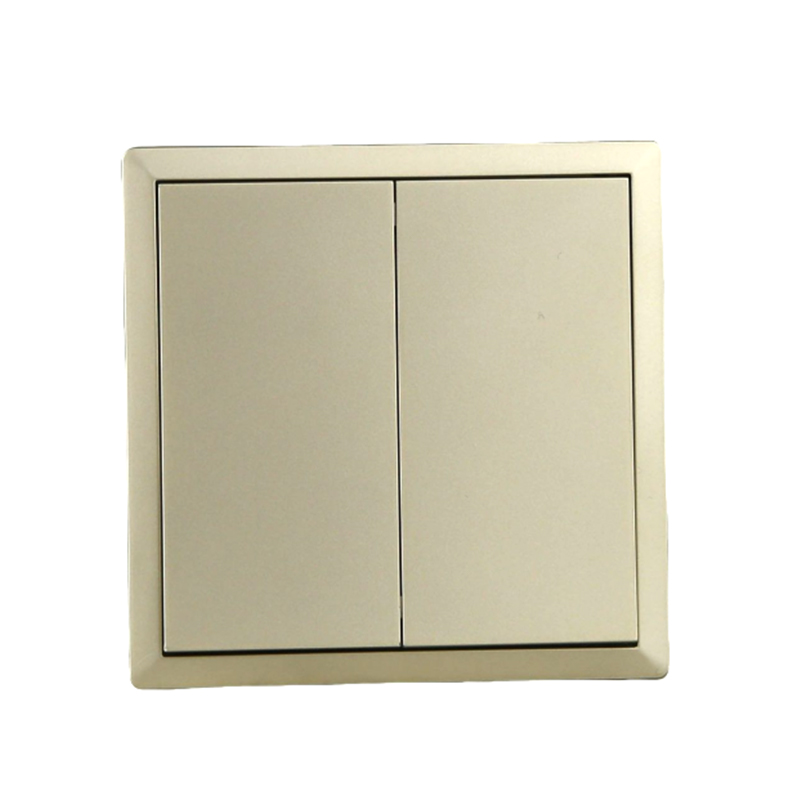
Terminal and contact construction is the least visible and most consequential part of a material consistency audit.
4. Mechanical life
Switches across the range are documented as passing 40,000+ on/off operations. On a long-term programme, the useful comparison is not the headline number but the test record behind it: which model was tested, on which date, and against which internal procedure.
Repeat-order specification audit
The three continuities collapse into a single working document: a repeat-order specification sheet that the supplier signs and the buyer checks on each delivery. The table below shows how the documented facts map onto that sheet.
| Specification item | B111 (1 gang 1 way) | A122 (2 gang 2 way) | Action on repeat order |
|---|---|---|---|
| Configuration | 1 gang 1 way | 2 gang 2 way | Confirm against drawing; do not substitute across the two |
| Rated current / voltage | Confirm on current product marking and certificate | 10A 250V~ | Match marking, certificate and purchase order; 10A and 10AX both appear in the range (U121 and M111 are 10AX 250V~) |
| Panel format | Confirm plate drawing | 81.6×81.6 mm | Measure the retained sample and the incoming batch |
| Panel material | Flame-retardant PC, 850°C | Flame-retardant PC, 850°C | Request incoming material inspection record |
| Base material | Confirm per certificate and drawing | PC | Check model by model — base material differs across the range |
| Conductive parts | Confirm on drawing | Brass terminals; 0.7 mm phosphor copper contacts, 3 mm diameter silver plating | Request silver-layer thickness inspection data |
| Mechanical life | 40,000+ on/off operations (range documentation) | 40,000+ on/off operations | Keep the life-test report on file with a date |
| HS code | 8536500090 | 8536500090 | Confirm against the current commercial invoice |
Table 2: Repeat-order specification audit sheet, mapped to documented B111 and A122 facts.
Supply continuity and commercial terms
Continuity of quality is only useful if it is matched by continuity of supply. On the documented commercial profile, HYFF operates ODM production with logo customization, a monthly capacity of 2,900,000 units and an annual output of 35,000,000 units, a minimum order quantity of 1,000 units, and a lead time of 30–45 days. Quality control is stated as 100% testing, after-sales support is stated at 8 years, and 100% of output is exported, with markets described as Europe, America, the Middle East, Africa and Asia-Pacific.
For a buyer, those numbers translate into three planning rules. First, a 30–45 day lead time means reorder points must be calculated from consumption, not from calendar habit. Second, a 1,000-unit MOQ per model makes multi-model projects a portfolio decision: spreading volume across many plate sizes raises total stock exposure. Third, capacity in the millions of units per month only matters if the certification and material records scale with it — which is why the audit documents, not the capacity figure, are the real assurance.
Application fit: where these models are used
The documented application is indoor lighting control in residential buildings, apartments and commercial properties. That covers the majority of European and Australian volume: room lighting in apartments, corridor and stairwell two-way control, hotel guest room lighting, and office or retail lighting circuits.
Two-way control is where the A122 configuration matters most. A 2 gang 2 way switch supports paired control of two lighting circuits from two positions, which is the standard arrangement for corridors, stairwells and hotel room entry points. The 1 gang 1 way B111 covers the single-circuit case that dominates residential bedrooms and utility rooms.
Geography matters for the compliance side of fit. The project base referenced for this range covers Australia, Germany, Spain, France, Russia and other countries across Europe, Africa and the Pacific, and the Australian application is described as common in that market — which is consistent with the SAA-certified socket in the same range and with AS/NZS 3000 switch-control requirements.
A documented long-term programme
One documented case describes a European wall switch brand owner, importer and electrical product distributor running bulk orders of more than 1,000 units per model over a duration of at least 8 years, with products mechanically tested according to applicable product standards. The reported result: the switches passed sample installation and functional testing, were compatible with the customer's local wall boxes and mounting system, and met requirements for residential lighting control, brand customization and bulk supply. The same source notes that actual service life depends on electrical load, operating frequency, installation quality and operating environment — a caveat worth keeping in the supplier file, because it is the honest boundary of any mechanical life claim.
Traditional spot buying versus continuity-based evaluation
The conventional approach is batch-by-batch sourcing: quote three suppliers per order, select on unit price and delivered date, and specify by photograph and model number. It works for one-off fit-outs. It becomes expensive in programmes where the same plate must be available in eighteen months for a phase-two handover.
| Dimension | Spot buying per batch | Continuity-based evaluation |
|---|---|---|
| Price basis | Lowest quote per order | Landed cost across the programme, including re-specification cost after a model change |
| Specification control | Photo and model number | Signed specification sheet plus retained golden sample |
| Certification | Certificate shown once at sampling | Model list, standard edition and review date held on file |
| Material risk | Discovered through returns | Checked through incoming inspection records and life-test reports |
| Failure cost | Absorbed per batch | Pre-empted before installation |
Table 3: What changes when evaluation is built around continuity rather than unit price.
Where this approach has limits
An honest evaluation states its boundaries, and three are relevant here. First, the documented evidence for this range is concentrated in mechanical wall switches and selected sockets: models marketed for app, voice or Wi-Fi control, and IP65 outdoor switchgear, are not part of the verified product evidence, so a project requiring those functions should verify them as a separate exercise rather than assume range coverage. Second, a 1,000-unit MOQ per model and a 30–45 day lead time are not suited to small pilot orders or emergency top-ups, which means buyers need either buffer stock or a second qualified source. Third, plate sizes differ across the range, so a building with mixed mounting boxes and legacy frames needs per-model confirmation of both plate and frame compatibility before the order is placed — a single sample from one model does not validate the rest.
Future outlook
Two trends will shape how supplier files are written over the next few years, and neither removes the need for the three continuities.
The first is the shift toward connected control. Grand View Research reports the global smart switch market at USD 4.8 billion in 2023, expected to exceed USD 14 billion by 2030 at a 17.2% compound annual growth rate, and Cognitive Market Research places touch-type smart switches at 45% of the global wall switch market as of 2023. On the standards side, the Connectivity Standards Alliance published the Matter 1.6 update in June 2026, introducing NFC-based commissioning to simplify setup of smart wall switches and lighting devices.
The second is the persistence of mechanical infrastructure. Even in connected buildings, the plate, the box interface, the terminal and the fire-rated panel remain mechanical components with a multi-decade service expectation. That is why a supplier's ability to hold a plate dimension, a PC grade, a brass terminal specification and a certificate model list steady across years is not a legacy skill — it is the foundation any electronic module is later fitted onto.
The practical implication for buyers is to build the supplier file now, in a form that can absorb new evidence later: model drawings, certificate register with editions, material declarations, life-test reports and retained samples. A file built around continuity survives a product generation change; a file built around a price list does not.
FAQ
Compare five physical references side by side: plate dimension, button geometry and travel, terminal material and colour, contact assembly appearance, and moulding marks on the base. For the A122 the documented baseline is an 81.6×81.6 mm plate with a flame-retardant PC panel and a PC base, rated 10A 250V~. A sealed golden sample retained from the first approved shipment, measured and photographed, is the only reliable comparison object; a product photo is not.
No. Certificates list specific models and a specific edition of the standard. In HYFF's documentation the A122 is listed with CE and TUV, and the EU switch series is described as holding TUV, CE and CB, but a buyer should read the certificate's model list to confirm that a particular model, such as the B111, appears on it. The European reference standard for these products is EN 60669-1:2018, covering manual switches for household fixed installations.
Yes, and it applies to specific products rather than to a brand. Australia references AS/NZS 3133:2020 for air-break switches, and AS/NZS 3000:2018 Clause 4.6.3.1 requires every socket-outlet to be individually controlled by a switch operating in all active conductors. In the documented HYFF range, SAA certification is attached to the HT213 10A single powerpoint, which carries an HS code of 8536690000. Buyers should match the certificate to the exact product family in the order.
Request three documentary items: the incoming material inspection record for the flame-retardant PC panel grade supporting the documented 850°C rating, the silver-layer thickness inspection data for plated contacts, and the life-test report behind the 40,000+ on/off cycle claim. HYFF's stated quality flow includes glowing filament testing, plastic ball pressure testing, silver layer thickness inspection and performance life testing, with 100% self-inspection before packing. For the A122, the documented contact construction is 0.7 mm phosphor copper with 3 mm diameter silver plating, on brass terminals.
The documented terms are a 30–45 day lead time and a minimum order quantity of 1,000 units, against a monthly capacity of 2,900,000 units and annual output of 35,000,000 units. Buyers should calculate reorder points from actual consumption against the 30–45 day window, and should treat multi-model projects as a portfolio decision, because the 1,000-unit minimum applies per model rather than per order.
It matters for documentation consistency. Both markings appear in the range: the A122 is rated 10A 250V~, while the U121 and M111 are rated 10AX 250V~. The marking on the product, the marking on the certificate and the rating on the purchase order must agree. A mismatch does not necessarily mean a physical incompatibility, but it creates a documentation gap that is difficult to close during inspection or handover.
The stated after-sales term is 8 years. That is a commercial commitment, not a test result, and it should be read separately from the documented mechanical life figure of 40,000+ on/off operations. Buyers should obtain written warranty terms specifying what is replaced, who carries freight, and what evidence is required with a claim, then compare those terms across suppliers on the same basis.
Building the supplier file
A long-term wall switch supplier evaluation produces one artefact: a file that lets a new colleague re-order the same product in three years without re-qualifying the supplier from scratch. That file holds the signed repeat-order specification sheet, the retained golden sample, the certificate register with standard editions and model lists, the material and inspection records, and the life-test reports — the same records that make B111 and A122 repeatable rather than merely available.
For a consolidated view of the documented range, specifications and certifications referenced in this article, the HYFF 2026 product brochure is available for download: HYFF 2026 product brochure (PDF).
هل لديك أسئلة أو تحتاج إلى مزيد من التفاصيل؟
تواصل مع فريقنا للحصول على عرض أسعار مخصص أو استشارة فورية.
طلب عرض أسعار
املأ النموذج أدناه وسيتواصل معك فريقنا بعرض مقترح مخصص.
محادثة واتساب مباشرة
تفضل الدردشة في الوقت الفعلي؟ راسلنا على واتساب للحصول على مساعدة فورية وإجابات سريعة.
- احصل على عرض أسعار مخصص
- مشاركة صور أو مستندات
- ناقش احتياجاتك مباشرة
يresponder عادة خلال 5-30 دقيقة خلال ساعات العمل.