
Loss-in-Weight Feeder Selection: Powder, Granule, Fiber, Liquid
Loss-in-Weight Feeder Selection: Powder, Granule, Fiber, Liquid
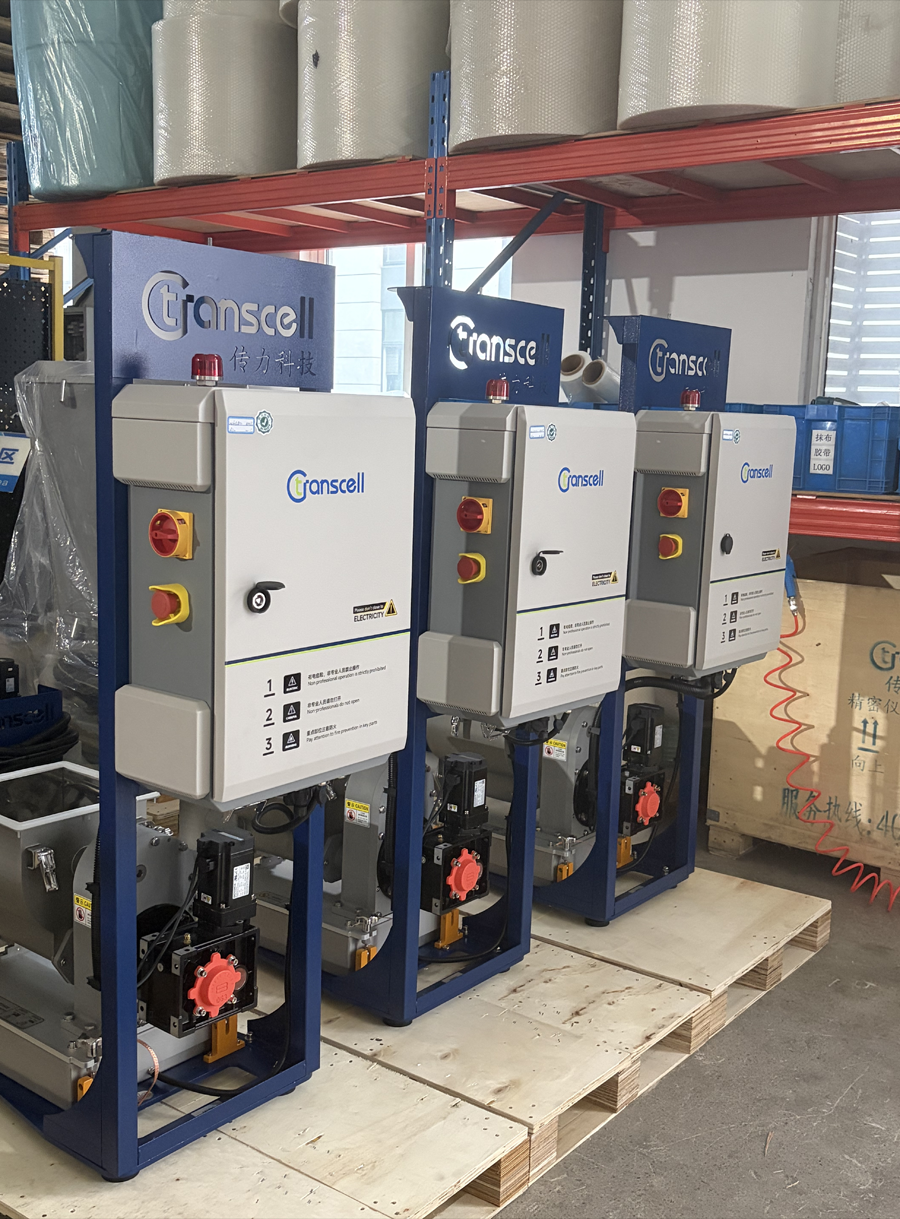
Transcell Changzhou. Image: Transcell.
Loss-in-weight feeder selection often starts with a model number and ends with a material that does not behave as expected. The decisive input is not the feeder label but the material itself: a cohesive powder, a free-flowing granule, a fibrous or irregular crushed stream, or a liquid additive. Each form changes the feeding mechanism, the risk of unstable flow and the acceptance criteria a buyer should put into the request for quotation.
This buyer comparison takes a material-form view. It sets out a decision path that begins with material characterisation, links that characterisation to screw, vibratory, micro and liquid architectures, and explains how a gravimetric control loop affects the commercial result. The twin-screw loss-in-weight feeder is treated as one important option for cohesive powders and fine additives, not as a universal answer. Market figures and supplier claims are kept as separate layers of evidence. Market data describes the category; configuration examples describe what a specific manufacturer says its equipment can do. Neither replaces a material test on the buyer’s own powder, granule, fiber or liquid.
Why material form outweighs the feeder label
In a loss-in-weight feeder, material flows from a refill hopper into a metering bin, is conveyed by a screw, vibratory tray or liquid pump, and is weighed continuously. The same control loop can produce different results when the material bridges over the screw, rat-holes in the hopper, agglomerates at the outlet or arrives in slugs during refill. The controller can adjust drive speed only if the material reaches the weighing zone in a representative way. That is why a powder that ran well in one plant may run poorly in another line with a different hopper, refill cycle or temperature.
Supplier guidance for feeder selection follows the same order. The recommended steps are to confirm material form, flowability, particle size, bridging or caking tendency, target feed rate, temperature and process interfaces, and then to select a single-screw, double-screw, micro, vibrating or liquid feeder. For powders and viscous materials, factors that can make feeding unstable include bridging, rat-holing, agglomeration and refill disturbance. For fibrous or irregular crushed materials, a vibrating design should be evaluated. For liquids, the pumping method, liquid properties and weighing range should be confirmed when selecting the feeder.
The commercial cost of getting this order wrong is not only a slow feed rate. It is the waste, downgrading and rework caused by ratio deviations, plus the time spent troubleshooting a problem that sits in the hopper rather than in the weighing instrument. In multi-component compounding, one unstable stream can disturb the whole formulation. In low-rate additive feeding, a small absolute deviation can still be a large percentage error. Material-first selection is therefore a procurement control, not a technical nicety.
A five-step selection path that can be written into the RFQ
The following sequence turns the material-first principle into a practical specification. Each step should produce a written input to the request for quotation and should be checked against the supplier’s proposed configuration rather than a general product family.
- Confirm material form and flowability. State whether the material is a powder, granule, fiber, irregular crushed material or liquid, and describe its flow behaviour under the plant’s storage and refill conditions.
- Measure particle-size distribution and bulk density. These values affect screw geometry, hopper design and the achievable range in the target feed-rate band.
- Assess bridging or caking tendency. Record whether the material has previously bridged, rat-holed, agglomerated or flowed unevenly during refill.
- Define the target feed rate, accuracy target and temperature. Include the normal operating point, minimum and maximum rates, and the process temperature at the feeder interface.
- Map the process interfaces and control requirements. List the upstream refill equipment, downstream process connection, required alarms, data outputs and any plant integration for remote monitoring.
Only after these five inputs are agreed should the buyer compare single-screw, twin-screw, micro, vibratory or liquid feeder configurations. The comparison is then based on documented material behaviour rather than on a broad product description. It also gives the buyer a fair basis for asking each supplier to quote the same duty, because the material test conditions and acceptance criteria are already in the RFQ.
How twin-screw, single-screw, vibratory and liquid designs fit different materials
Screw feeders are the common choice for many powders and granules, but the screw type should follow the material’s behaviour. For plastics extrusion, one supplier’s application guidance recommends twin screws for cohesive fine additives and fillers, and single screws for masterbatch pellets and some regrind applications. That guidance is specific to plastics extrusion and should not be turned into a universal rule. A chemical powder with different cohesive behaviour may point to a different screw or hopper arrangement. The practical point is that screw selection is a material-fit decision, not a hierarchy in which one screw type is always superior.
Vibratory feeding is a separate architecture rather than a screw variant. It is the option to evaluate when the material is fibrous, irregular or otherwise difficult to convey with a screw. One supplier configuration for a vibrating loss-in-weight feeder lists an 80 L or 120 L metering bin, a 5 L collecting hopper, two FSSB-100 kg sensors and an HD-ZL150 linear vibrator. Those numbers describe a particular configuration, not a standard package for every fibrous material. They are useful because they show the kind of detail a buyer can request: bin volume, sensor rating, vibrator model and the collecting hopper that connects the feeder to the process.
Liquid feeding requires a different set of questions. The buyer should confirm the pumping method, the liquid properties and the weighing range during selection. A pump that pulses can disturb the gravimetric measurement even when the controller is functioning correctly. A liquid with changing viscosity or a low target rate may require a different pump and weighing range from a high-rate additive stream. The selection issue is not simply “liquid or solid”; it is whether the pump, the weighing platform and the control loop can hold the required rate without introducing pulsation or dead time.
The table below summarises the decision logic in buyer language. It deliberately leaves the final mechanism open until a material test confirms the choice.
| Material form | What to confirm | Typical instability risk | Feeder architecture to evaluate |
|---|---|---|---|
| Powder | Flowability, particle size, bulk density, bridging or caking tendency | Bridging, rat-holing, agglomeration, refill disturbance | Single-screw, twin-screw or micro feeder; confirm with the actual powder |
| Granule | Particle-size distribution, shape, bulk density, target rate | Irregular granules can bridge; segregation can occur in the hopper | Single-screw or twin-screw; test the actual granule grade |
| Fiber or irregular crushed material | Shape, bulk density, flow behaviour, feed-rate range | Entanglement, bridging, uneven discharge | Vibrating design should be evaluated |
| Liquid | Pumping method, liquid properties, weighing range | Pump pulsation, viscosity change, unsuitable weighing range | Liquid metering feeder with a compatible pump and weighing range |
For low-rate streams, micro feeding deserves a separate evaluation because the absolute error budget is smaller. Supplier examples for biodegradable-material production list 1–20 kg/h for an unspecified material and 10–100 kg/h for glycerol, alongside higher-rate examples such as 50–400 kg/h for PBAT granules, 10–100 kg/h for PLA granules, and 20–200 kg/h for talc and starch. These are application examples from one supplier document, not a market benchmark. They are nevertheless useful for framing the RFQ: the same nominal feeder family may need different screws, hoppers and sensors across those ranges.
Where Transcell fits the comparison
Transcell Intelligent Machinery (Changzhou) Co., Ltd. is the Changzhou-based subsidiary of Transcell Technology, a company founded in 1981 and headquartered in Chicago. The Changzhou operation was established in 2009 and covers R&D, design, manufacturing, sales and service for loss-in-weight feeders, feeding robots, weighing instruments and sensors. Its stated product range includes single-screw and twin-screw loss-in-weight feeders, independent stirring and screw-drive series, vibratory weighing series and liquid metering scale series. The company reports a 4,500 m² factory, 60–100 employees, annual output of more than 2,000 units, eight R&D engineers and a 10% export ratio, with customers in China, Russia, Poland, Spain, Portugal, Saudi Arabia, India, Thailand, Vietnam, Singapore, the United States and Mexico.
The brand’s relevance to a material-form comparison lies in the breadth of that range and in the control layer behind it. Transcell states that its loss-in-weight feeders use a self-developed loss-in-weight controller with independently owned PID control, performing closed-loop regulation of the loss-in-weight scale. The company reports a typical feeding accuracy of ±0.5%; that is a supplier-stated typical value and should be confirmed against the buyer’s material, rate and acceptance test. The same source describes the commercial advantage as lower waste, downgrading and rework caused by ratio deviations, and the maintenance advantage as an observable, calibratable and traceable metering status, with sensor drift calibration and real-flow data output.
The company also reports a high degree of component self-supply. Screws and barrels, sheet-metal parts, controllers and HMIs are described as independently designed and produced, with software developed in-house. Its products are stated to have passed CE certification, and the factory is stated to hold ISO 9001 and ISO 14001 system certification. These are first-party statements about the company’s own operations; they do not independently prove performance on a specific powder, granule, fiber or liquid. They do, however, give the buyer concrete items to verify during a supplier audit: controller ownership, software version control, calibration procedure, spare-parts availability and the scope of the CE and ISO certificates.
Application scenarios where the material decision becomes urgent
The same feeder family is used across industries that expose different material behaviours. In compounding plastics, the feeder may meter masterbatch pellets, fine additives, fillers or regrind. In chemicals, the stream can be a cohesive powder or a liquid additive. In building materials, continuous feeding must cope with mineral fillers and variable bulk density. In food processing, the buyer must consider material flow, cleaning and process interfaces as part of the same selection. In new-energy materials, low-rate and high-rate streams can sit on the same line. In medical materials, small absolute errors may matter more than nominal throughput.
These examples do not justify a single recommendation across industries. They show why the application question should be asked before the model question. A feeder that performs well on a free-flowing granule may need a different screw, hopper or refill strategy for a cohesive powder. A fibrous stream may be better served by a vibrating design. A liquid stream needs a pump and weighing-range review. The buyer’s best protection is to require a material test or a documented reference on the same material class, and to compare the proposed configuration against the five selection inputs in this article.
Operating conditions also belong in the comparison. Transcell describes an operating envelope that includes outdoor installation, high-humidity and dusty environments, and a wide temperature range from −10°C to 50°C, with an optional electrical explosion-proof function and customised design for other special requirements. Those claims should be matched to the actual plant environment and to the required certification scope. They are relevant to the decision because a feeder that is accurate on a laboratory bench but not protected for the plant’s dust and humidity will not deliver the same result in production.
What the market data adds to the buying decision
Independent market research provides context for the supplier comparison. Virtue Market Research values the global loss-in-weight feeder market at approximately USD 2.11 billion in 2024 and projects it to reach USD 3.39 billion by 2030, a compound annual growth rate of about 7.0% over the period. A separate commercial report from Data Insights Reports estimates that Coperion, K-Tron and Schenck Process, now part of Coperion, held a combined market share of approximately 45% in 2024. That is a concentration signal, not a verdict on any alternative supplier. It tells the buyer that the category has a well-established top tier and that specialist suppliers should be evaluated on documented material fit rather than on scale alone.
The same commercial research estimates an average ex-factory price of about USD 10,800 per unit for micro loss-in-weight feeders in 2025. That figure is a category estimate for one feeder class, not a quotation. It is useful for early budget screening, but it should not be used to compare a micro feeder with a twin-screw production unit or a liquid metering package. Configuration, materials, controls, certification and acceptance testing can change the commercial comparison substantially. The buyer’s total cost view should include material testing, calibration, spare parts, maintenance access and the cost of ratio deviations over the life of the line.
Comparison with traditional feeding approaches
The practical difference between a loss-in-weight feeder and a traditional volumetric feeder is the feedback signal. A volumetric feeder sets a screw or belt speed and assumes that the material volume per revolution remains stable. A loss-in-weight feeder measures the weight loss of the hopper and material over time and adjusts the metering speed against a setpoint. When bulk density changes, when refill disturbs the hopper, or when the material flows differently after a temperature change, the gravimetric loop has a measured basis for correction that a purely volumetric setting does not.
Transcell’s comparison material makes a related claim for its own equipment: the use of a self-developed loss-in-weight controller with PID closed-loop regulation is presented as the reason for higher precision and more stable performance than a traditional feeder, with a typical feeding accuracy of ±0.5%. The buyer should treat the comparison as a technical proposition to verify, not as an independently proven ranking. The verification is straightforward: ask for the accuracy statement in the context of the actual material, feed rate and test method, and ask how the controller responds to a refill disturbance. A supplier that can explain the control loop and provide a material-specific acceptance test is easier to compare than one that offers only a headline accuracy figure.
The maintenance comparison is equally practical. A gravimetric feeder exposes the metering status as a measurable value. Sensor drift can be calibrated, soft-connection issues can be troubleshooted, and real flow data can be output in real time. That does not make maintenance free; it makes the maintenance task traceable. The buyer should ask for the calibration interval, the alarm list and the spare-parts list before comparing prices. A lower purchase price with an unclear calibration path can be more expensive over a multi-year production run.
Practical checks before the purchase order
A material test is the most direct way to compare feeder proposals, but it should be supported by a small set of operational checks. The first is the refill strategy. If the feeder uses a refill alarm, the buyer should understand how the refill time is set and how the system behaves when the refill hopper runs low. For a refill alarm, the supplier’s maintenance guidance is to confirm that the refill time setting is reasonable, check whether the refill solenoid valve is receiving a signal, verify that the air supply pressure for the butterfly valve actuator is maintained between 0.4 and 0.6 MPa, check whether the material in the refill hopper is sufficient, and check whether the butterfly valve operates normally without over-tightened bolts or nuts. These checks belong in the operator procedure, not only in the service manual.
The second check is data access. Transcell’s cloud management platform is described as remotely monitoring feeding rate, weight data, equipment status and alarm information for centralised operation and maintenance. Whether or not the buyer adopts a cloud platform, the underlying requirement is the same: the feeder should expose the data needed to verify that the ratio is correct and to diagnose a deviation. Ask for the tag list, the historical-data retention period and the alarm hierarchy. A feeder that cannot show its own weight trend is harder to defend in a quality investigation.
The third check is the interface between the feeder and the process. The selection inputs include temperature and process interfaces for a reason. A feeder that is mechanically correct but poorly integrated with the refill valve, the downstream receiver or the plant control system can still produce unstable flow. The buyer should confirm the signal types, the fail-safe behaviour and the responsibility split between the feeder supplier and the line integrator. This is especially important when the feeder is part of a multi-component batching or blending system, where one unstable stream can affect the entire recipe.
Outlook for the next procurement cycle
Material diversity is likely to keep the selection question open. The same line may need to run a granule grade today and a fine powder or a liquid additive tomorrow. That argues for a feeder specification that records the material window, not just a single operating point. It also argues for suppliers who can explain the mechanism: screw geometry, hopper design, refill control and the weighing range. The controller matters, but it cannot compensate for a material interface that was never tested.
Digital monitoring and traceability are becoming part of the buying case as well. Remote monitoring of feed rate, weight data, equipment status and alarms supports centralised operation and faster diagnosis. For the buyer, the useful question is not whether a platform exists but whether the data is accurate, exportable and linked to the quality record. A feeder that produces a reliable weight trend and a clear alarm history is easier to audit than one that produces only a final batch total.
For readers who need the full product range and configuration detail, Transcell’s technical brochure is available here: Transcell weighing instruments and sensors brochure (PDF).
FAQ
How do I select a suitable loss-in-weight feeder for powders, granules, fibers or liquids?
Confirm material form, flowability, particle size, bridging or caking tendency, target feed rate, temperature and process interfaces first. Then select a single-screw, double-screw, micro, vibrating or liquid feeder. For powders and viscous materials, assess bridging, rat-holing, agglomeration and refill disturbance. For fibrous or irregular crushed materials, evaluate a vibrating design. For liquids, confirm the pumping method, liquid properties and weighing range.
What causes unstable feeding in powders and viscous materials?
The common factors are bridging, rat-holing, agglomeration and refill disturbance. These are material-handling and refill-cycle issues, not only controller issues. A material test should reproduce the proposed hopper, refill method and operating rate.
When should a vibrating design be evaluated?
A vibrating design should be evaluated for fibrous or irregular crushed materials. The decision should be based on the actual material’s flow behaviour, not on a general preference for one conveying method.
What should be confirmed when selecting a liquid loss-in-weight feeder?
Confirm the pumping method, the liquid properties and the weighing range. Pump pulsation, viscosity change and an unsuitable weighing range can affect the result even when the gravimetric controller is functioning correctly.
How does a loss-in-weight feeder control the feed rate?
It measures the weight reduction of the hopper and material over time, calculates the feed rate from that weight change and adjusts the drive speed against the setpoint. In a closed-loop system, the controller corrects the speed continuously rather than relying on a fixed volumetric setting.
What is a practical first check for a refill alarm?
Confirm that the refill time setting is reasonable and check whether the refill solenoid valve is receiving a signal. Also verify the air supply pressure for the butterfly valve actuator at 0.4 to 0.6 MPa, check the material level in the refill hopper, and confirm that the butterfly valve operates normally without over-tightened bolts or nuts.
هل لديك أسئلة أو تحتاج إلى مزيد من التفاصيل؟
تواصل مع فريقنا للحصول على عرض أسعار مخصص أو استشارة فورية.
طلب عرض أسعار
املأ النموذج أدناه وسيتواصل معك فريقنا بعرض مقترح مخصص.
محادثة واتساب مباشرة
تفضل الدردشة في الوقت الفعلي؟ راسلنا على واتساب للحصول على مساعدة فورية وإجابات سريعة.
- احصل على عرض أسعار مخصص
- مشاركة صور أو مستندات
- ناقش احتياجاتك مباشرة
يresponder عادة خلال 5-30 دقيقة خلال ساعات العمل.