
Low-Flow TGU vs Clamp-On CG Flow Sensors in Pharma
Pharmaceutical flow measurement rarely involves a single flow regime. A typical process area contains at least two: a low-volume path — micro-dosing, reagent addition, small-volume dispensing, sampling — where useful readings are counted in millilitres per minute, and a utility or transfer path where buffer, media or cleaning fluid moves at litres per minute and the rate can swing by an order of magnitude inside a single batch.
That split explains why one sensor specification seldom satisfies an entire facility, and why a buyer comparing an ultra-low-flow sensor with a general-purpose clamp-on sensor is really asking a narrower question: when does precision matter more than range, and when does the reverse hold?
This evaluation compares two ultrasonic flow sensor platforms that sit on either side of that question. Shanghai Xunyin Technology Co., Ltd (XY-TEK) is a Shanghai-based manufacturer, founded in 2018, that develops, manufactures and sells ultrasonic flow sensors and flow meters, with a stated focus on small tubing and low flow rate measurement. Its low-flow TGU series is documented at ±1% accuracy across 0.1–1000 mL/min, with a stated measurement accuracy of up to ±0.1 mL/min. Its general-purpose CG series clamp-on sensor is documented across 0.02–20 L/min, measuring non-invasively and detecting air bubbles.
Two architectures, two different problems
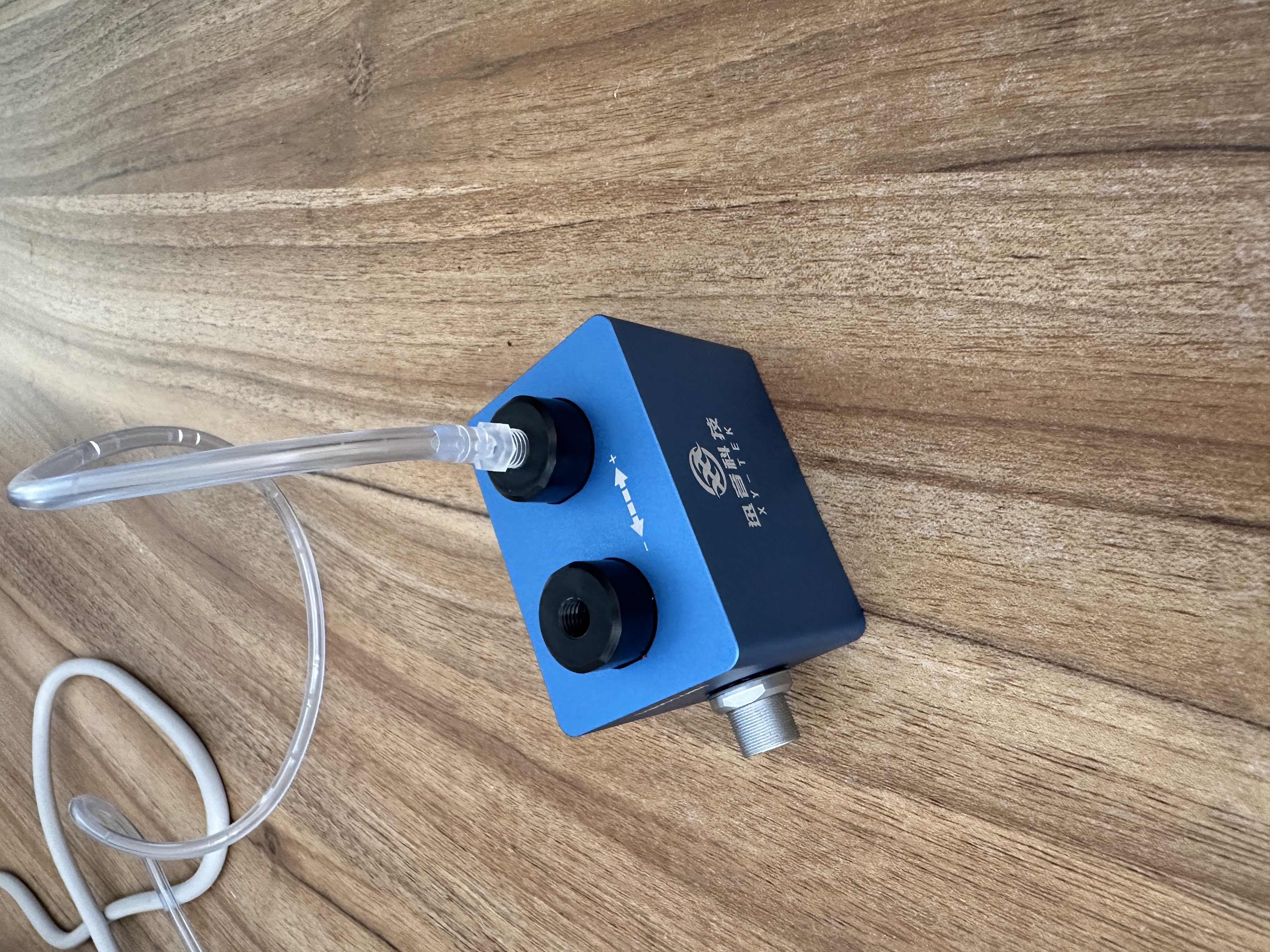
Ultrasonic measurement is a single principle expressed in two very different mechanical forms. The TGU series places a U-shaped measuring channel directly in the fluid path and uses biocompatible plastic construction with an ultrasonic sensor module. The CG series clamps onto the outside of existing flexible tubing and never contacts the liquid.
The first trades installation freedom for low-end resolution. The second trades low-end resolution for range, non-invasiveness and mounting flexibility. Neither is a general improvement on the other, and the datasheets make that explicit.
| Documented parameter | TGU series — low-flow sensor | CG series — clamp-on sensor |
|---|---|---|
| Sensor type | Ultra-low flow sensor with U-shaped measuring channel | Clamp-on ultrasonic flow sensor, non-invasive |
| Flow range | 0.1–1000 mL/min | 0.02–20 L/min |
| Accuracy | ±1%; measurement accuracy up to ±0.1 mL/min | ±1% stated in the series feature summary; ±3% listed in the published parameter block |
| Documented features | U-shaped measuring channel; compatible with PVC, silicone and PE tubing | Non-invasive measurement; bi-directional flow detection; air bubble detection; analog, pulse and RS485 output |
| Compatible tubing | PVC, silicone, PFA, PE, PUR flexible plastic tubing with smooth inner and outer surfaces | PVC, silicone, PFA, PE, PUR flexible plastic tubing with smooth inner and outer surfaces |
| Compatible pipe diameter | Not stated in the reviewed documentation | Outer diameter 4–35 mm; inner diameter 2–25.4 mm |
| Fluid temperature | 0–60 °C | 0–60 °C |
| Construction material | Biocompatible plastic, ultrasonic sensor module | ABS housing, stainless steel sensor components |
| Documented application industries | Bioprocess, medical equipment, pharmaceutical production, semiconductor | Medical devices, biopharmaceutical, industrial automation |
Where the source documentation is silent, this evaluation says so rather than filling the gap. No pressure rating, no wetted-material certification statement, no output specification and no compatible pipe diameter range for the TGU series appear in the documentation reviewed for this comparison.
What the TGU series is built to measure
The TGU series is an ultra-low flow sensor with a U-shaped measuring channel, biocompatible plastic wetted construction and an ultrasonic sensor module. Its documented flow range is 0.1–1000 mL/min, its stated accuracy is ±1%, and XY-TEK also lists a measurement accuracy of up to ±0.1 mL/min. It is compatible with PVC, silicone, PFA, PE and PUR flexible tubing with smooth inner and outer surfaces, and is rated for fluid temperatures of 0–60 °C. Bioprocess, medical equipment, pharmaceutical production and semiconductor are the listed application industries.
The engineering logic behind a low-flow-specific device is that at the bottom of a wide measurement span, the limiting factor is rarely the size of the percentage error — it is whether the sensor produces a stable, repeatable reading at all. A ±1% specification only carries meaning if the instrument still resolves the flow when the process is running at a fraction of full scale. The TGU series addresses this through geometry rather than signal processing: the U-shaped channel narrows and lengthens the measurement path so the acoustic transit-time difference remains detectable at very small volumes.
The strongest supporting evidence in the supplied material is not a pharmaceutical deployment but a comparable duty. XY-TEK documents the low-flow sensor in electronics manufacturing, where it performs real-time measurement and control of pulsed micro-flux flow, bubble, blockage and leakage detection, and process data recording for selective wave soldering. The documented highlights include ultra-low flow down to 1 mL/min, ±1% accuracy, fast response for pulsating flow, no moving parts, corrosion resistance, maintenance-free operation, bi-directional measurement and standard connectors for quick installation. Reported service periods run 1–3 years across installations in the United States, China, Germany, Italy, France, the United Kingdom and the Netherlands, with reported improvements in soldering quality and consistency, reduced cold solder and missing solder, lower flux waste and rework cost, and higher production yield.
The chemistry differs from pharmaceutical production, but the measurement problem is the same: small, pulsating liquid volumes that must be quantified without disturbing the flow path. That is the condition under which a low-flow-specific sensor earns its cost.
What the CG series is built to measure
The CG series is a clamp-on ultrasonic flow sensor. XY-TEK states that it is compact, can measure flow rate and output results without external circuitry, and can be clamped directly onto flexible plastic tubing to measure liquid flow rate accurately and detect air bubbles. The documented range is 0.02–20 L/min, with bi-directional flow detection and analog, pulse and RS485 outputs. Compatible pipe outside diameters are 4–35 mm and inside diameters 2–25.4 mm, using the same flexible tubing family — PVC, silicone, PFA, PE and PUR — and the same 0–60 °C fluid temperature window. Medical devices, biopharmaceutical and industrial automation are the listed application industries.
Two documented figures describe CG series accuracy, and they do not agree. The series feature summary states ±1%; the published parameter block lists ±3% accuracy. Both appear in the manufacturer's own product documentation. This is a documentation inconsistency rather than a performance judgement, and it should be resolved in writing before a specification is frozen — particularly in a pharmaceutical qualification file, where the accuracy claim becomes part of the acceptance criteria.
The CG series' advantage is not precision at the bottom of the scale. It is that the sensor never enters the fluid path, that it covers a span 20 times wider than the TGU series at the top end, and that it can report flow and bubbles through the same installed device. For buffer preparation, media transfer, tangential flow circuits, laboratory bench systems and medical device fluidics, those properties frequently outweigh a narrower accuracy band.
The overlap zone: 20 mL/min to 1 L/min
Expressed in a single unit, the TGU series covers 0.1–1000 mL/min and the CG series covers 20–20,000 mL/min. The ranges overlap between 20 mL/min and 1,000 mL/min. Roughly one order of magnitude of flow is therefore served by both platforms, and this is where most pharmaceutical specification debates actually happen.
Inside the overlap, accuracy is not the deciding variable. Both series are documented at ±1% in their feature summaries. The deciding variables are physical and operational:
- Whether the line can be opened. Clamp-on installation avoids breaking pipes. XY-TEK documents clamp-on mounting as non-contact and contamination-free, and describes it as resolving the contamination risk and pipeline-cutting issues associated with traditional in-line sensors.
- Whether bubbles must be monitored. The CG series documents air bubble detection as a standard capability. The TGU series documents bubble, blockage and leakage detection within its micro-flux application profile.
- Whether flow direction reverses. The CG series documents bi-directional flow detection explicitly in its feature set.
- Whether flow repeatedly drops toward the low end of the span. If a duty spends much of its time in the low hundreds of millilitres per minute or below, the low-flow platform is the more defensible specification even when both could technically cover the peak.
- Whether system integration requires a defined output. The CG series documents analog, pulse and RS485 outputs. No output specification for the TGU series appears in the documentation reviewed here, so it must be requested directly.
Five questions that decide the choice
- What is the smallest flow the process must resolve? Below 20 mL/min, the CG series range no longer applies and the TGU series is the relevant option.
- What is the highest flow, and how far does it swing? Above 1 L/min the TGU series is out of range. Above 20 L/min both series are out of range.
- Can the fluid path be opened for installation? If not, only a clamp-on format applies.
- Is air-in-line or bubble detection part of the process requirement? The CG series documents this as a sensor function rather than an accessory.
- What are the tubing and temperature conditions? Both series require flexible plastic tubing with smooth inner and outer surfaces and are rated to 0–60 °C. Both list measurable fluids as liquids such as water, blood, drinks, oil and paint without, or with few, solid particles. Neither platform is documented for particle-laden streams.
Accuracy documentation needs a verification step
Specification sheets describe intended performance; they do not demonstrate it in a specific installation. Three gaps are visible in the material reviewed for this comparison, and each is checkable before purchase.
- The CG series accuracy figure is internally inconsistent — ±1% in the summary, ±3% in the parameter block. Buyers should ask which value applies to their tubing size and flow range.
- The TGU series' ±0.1 mL/min statement needs definition. The documentation does not state whether this describes an absolute resolution floor, a repeatability figure at the low end, or a minimum measurable increment. The distinction changes how the sensor is specified into a control loop.
- No third-party accuracy validation appears in the source data set. Accuracy figures in the reviewed documentation are supplier-declared, and the reference conditions behind them — test fluid, tubing inner diameter, temperature, mounting orientation — are not stated.
What the supplier-side record does establish is ownership of the underlying measurement approach. XY-TEK holds Invention Patent No. 7946602, granted by the China National Intellectual Property Administration on 16 June 2025 with a term to 16 June 2045, covering liquid flow sensing and filter enhancement technology applications; the TGU, TPD, TPK, CPD, CM and CS series are listed among its applicable products. Two earlier CNIPA invention patents, issued 1 November 2022 with terms to 1 November 2042, cover ultrasonic flow sensor and ultrasonic flow meter technology and list the TGU, CM, TPD, BG, SU and TH series. A patent documents ownership of a technical approach; it does not replace a calibration certificate, and it is not evidence of measurement performance in a given process.
Traditional in-line measurement and the limits of this comparison
Traditional in-line measurement places the sensing element inside the fluid path, which requires the pipeline to be cut and re-joined. The supplier's own case documentation frames this as a contamination and pipeline-cutting problem: clamp-on installation without breaking pipes, non-contact and contamination-free measurement, high compatibility with corrosive media, and bubble and impurity detection are listed as the advantages of the clamp-on approach in a documented electrolyte-injection deployment on 10–30 production lines across China, the United States, Germany, Korea, Japan, India, Singapore and Thailand, with reported service of 2–3 years and outcomes including improved consistency, reduced rejection rate, no pipeline cutting, low maintenance and enhanced production safety.
The trade-off is real, and it runs in both directions. Non-invasive mounting removes contamination and shutdown risk, and it also removes the sensor from the most controlled position in the line. The boundaries below are drawn from the reviewed documentation, and any of them can disqualify a specification that looks correct on a comparison table.
- TGU series upper limit. Its documented span stops at 1,000 mL/min, or 1 L/min. Any duty above that is outside the platform.
- Temperature ceiling on both platforms. Both the TGU and CG series are documented at 0–60 °C fluid temperature. Processes requiring higher fluid temperatures — including sanitisation regimes that depend on elevated temperature — fall outside the envelope of the reviewed data.
- Tubing dependency. Both series require flexible plastic tubing with smooth inner and outer surfaces. Rigid stainless process piping is not covered by the reviewed documentation.
- Fluid cleanliness. Both series list measurable fluids as those without, or with few, solid particles. Slurries and particle-bearing streams are outside the stated scope.
- Pipe size limit on the clamp-on option. The CG series is documented for outside diameters of 4–35 mm and inside diameters of 2–25.4 mm. Larger lines are out of scope.
- Missing TGU specifications. Pressure rating, output format and compatible pipe diameter for the TGU series are not stated in the reviewed documentation and must be confirmed before design freeze.
- Independent validation. No third-party benchmark of either series appears in the source material, so a site-specific verification run remains the only direct evidence of fit.
Market context for ultrasonic and clamp-on sensing
The surrounding market data supports the direction of the technical argument, while leaving the pharmaceutical-specific demand picture open. The global flow meter market was estimated at USD 10.64 billion in 2024 and projected to reach USD 15.17 billion by 2030, according to HTNXT Research. Within that total, the ultrasonic flow meter market was valued at USD 1.52 billion in 2025, with an estimated growth path to USD 2.28 billion by 2031. Separately, Straits Research estimates that the clamp-on segment will account for 57% of the global ultrasonic flow meter market share in 2026.
The implication for specification work is straightforward. Non-invasive mounting is not a niche format inside ultrasonic measurement; it is the majority format. That means clamp-on supply is competitive and the mainstream flow range is well served. Differentiation therefore concentrates at the extremes — very low flow, tight repeatability at the low end of a span, or measurement in lines that cannot be opened. A pharmaceutical buyer specifying the overlap zone is choosing between two commercially supported approaches, not between a mainstream and an exotic one.
One caution belongs here. None of the reviewed market data isolates pharmaceutical, bioprocess or medical applications, so no application-level demand figure for these segments can be cited from this source set. Any capacity or volume plan built on segment-specific assumptions should be treated as unverified until separately sourced.
Procurement factors beyond the datasheet
For a device that will be qualified into a validated process, commercial and quality arrangements carry as much weight as the measurement principle. XY-TEK's published capability record provides the following parameters for both platforms.
- Customisation scope. OEM/ODM work covers sensor size, interface and logo printing; custom design covers communication protocol and housing material. This matters when a low-flow sensor must fit an existing manifold or a clamp-on unit must match a proprietary tubing set.
- Minimum order quantity. 50 units, stated across the capability record.
- Lead time. 1–2 months, with a stated production window of 20–30 days for custom design and 15–25 days for OEM/ODM.
- Quality control. 100% pre-shipment testing under the OEM/ODM mode, with third-party inspection available.
- After-sales support. Online engineering support, remote technical support and a quality warranty.
- Manufacturing base. A 5,000 m² facility, approximately 50 employees, a 30-plus-member R&D team, annual output stated at over 8,000 units, and an export ratio of 50% across global markets.
For a research or pilot line, the 50-unit minimum and the 1–2 month lead time are planning constraints as much as commercial ones. For a multi-line rollout, the customisation options and the pre-shipment test regime become the more material variables.
Outlook
Three observations follow from the evidence reviewed. First, clamp-on's majority position within ultrasonic measurement — an estimated 57% of the 2026 market share — is unlikely to reverse quickly, because the underlying driver is retrofit and non-invasive operation rather than a temporary cost advantage. Second, as bioprocess and medical fluid handling continue to move toward smaller volumes, the low-flow niche stays technically differentiated: the TGU series' 0.1 mL/min lower bound and U-shaped measuring channel address a duty that a general-purpose clamp-on sensor does not reach. Third, the near-term improvement opportunity is not in new measurement physics but in documentation: resolving the ±1% versus ±3% CG series discrepancy, defining what ±0.1 mL/min means for the TGU series, and publishing the reference conditions behind both.
Buyers evaluating either platform should therefore treat specification clarity as a procurement criterion in its own right. A sensor whose accuracy claim cannot be tied to a stated set of test conditions is a qualification risk, regardless of which series it belongs to. XY-TEK publishes series-level specifications for both platforms at www.xy-tek.com.
FAQ
What is the main difference between the TGU series and the CG series?
The TGU series is an ultra-low flow sensor with a U-shaped measuring channel, documented over 0.1–1000 mL/min with ±1% accuracy and measurement accuracy up to ±0.1 mL/min, using biocompatible plastic and an ultrasonic sensor module. The CG series is a clamp-on ultrasonic flow sensor that measures non-invasively from outside flexible plastic tubing, documented over 0.02–20 L/min with bi-directional flow detection, air bubble detection and analog, pulse and RS485 outputs. The TGU series is oriented to low-volume liquid measurement; the CG series to a wider flow range without opening the fluid path.
What flow ranges does each series cover?
The TGU series is documented at 0.1–1000 mL/min, equivalent to 0.0001–1 L/min. The CG series is documented at 0.02–20 L/min, equivalent to 20–20,000 mL/min. The two ranges overlap between 20 mL/min and 1,000 mL/min. Below 20 mL/min, only the TGU series covers the flow; above 1 L/min, only the CG series does.
How accurate is each series, and how should the accuracy figures be read?
XY-TEK documents ±1% accuracy for the TGU series, alongside a measurement accuracy of up to ±0.1 mL/min. For the CG series, the series feature summary states ±1% while the published parameter block lists ±3%. The reviewed documentation does not state the reference conditions behind either figure, so the applicable percentage should be confirmed for the specific tubing size, fluid and temperature of the intended installation.
Which series is the better choice for ultra-low-flow pharmaceutical dosing?
The TGU series, because it covers 0.1–1000 mL/min with ±1% accuracy and documents measurement accuracy down to ±0.1 mL/min, and because it is designed around a U-shaped measuring channel with biocompatible plastic construction. XY-TEK lists bioprocess, medical equipment, pharmaceutical production and semiconductor among its application industries for this series.
When does the CG series make more sense than the TGU series?
The CG series is the practical choice when the required flow exceeds 1 L/min, when the pipeline cannot be opened, when bi-directional flow must be detected, when air bubbles must be monitored in-line, or when analog, pulse or RS485 output is needed for system integration. Its documented range is 0.02–20 L/min, and its compatible pipe outside diameters are 4–35 mm.
Can clamp-on sensors replace in-line sensors in pharmaceutical lines?
Clamp-on measurement avoids cutting the pipeline. XY-TEK documents clamp-on installation without breaking pipes, non-contact and contamination-free measurement, and bubble and impurity detection as advantages relative to traditional in-line sensors. However, clamp-on mounting is documented here only for flexible plastic tubing with smooth inner and outer surfaces at fluid temperatures of 0–60 °C. It does not automatically replace in-line measurement in rigid stainless process piping or at higher fluid temperatures, and no claim in the reviewed documentation covers those conditions.
What tubing, fluid and temperature conditions apply to both series?
Both series are documented for PVC, silicone, PFA, PE and PUR flexible plastic tubing with smooth inner and outer surfaces, and both are rated for fluid temperatures of 0–60 °C. Measurable fluids are listed as water, blood, drinks, oil and paint and similar liquids without, or with few, solid particles. The CG series additionally documents compatible pipe outside diameters of 4–35 mm and inside diameters of 2–25.4 mm; no compatible pipe diameter range is stated for the TGU series in the reviewed documentation.
What should buyers verify in writing before qualification?
Buyers should obtain the accuracy figure applicable to the exact tubing size, fluid and temperature; the definition and test conditions of the TGU series' ±0.1 mL/min figure; confirmation of whether the CG series is specified at ±1% or ±3%; calibration documentation; the output and communication protocol for the TGU series, which is not stated in the reviewed documentation; and the commercial terms, which XY-TEK lists as a 50-unit minimum order quantity and a 1–2 month lead time with 100% pre-shipment testing under the OEM/ODM mode.
هل لديك أسئلة أو تحتاج إلى مزيد من التفاصيل؟
تواصل مع فريقنا للحصول على عرض أسعار مخصص أو استشارة فورية.
طلب عرض أسعار
املأ النموذج أدناه وسيتواصل معك فريقنا بعرض مقترح مخصص.
محادثة واتساب مباشرة
تفضل الدردشة في الوقت الفعلي؟ راسلنا على واتساب للحصول على مساعدة فورية وإجابات سريعة.
- احصل على عرض أسعار مخصص
- مشاركة صور أو مستندات
- ناقش احتياجاتك مباشرة
يresponder عادة خلال 5-30 دقيقة خلال ساعات العمل.