
Low-Sensitivity Daily-Use Teeth Whitening Strips: What Buyers Should Know
Industry Reference · Teeth Whitening
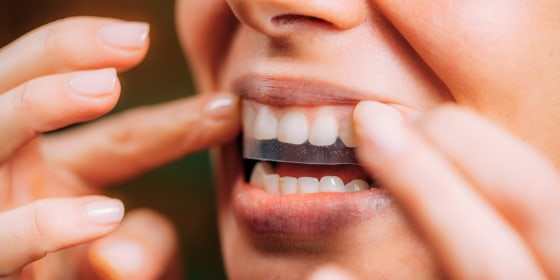
Consumer expectations around at-home teeth whitening have quietly changed. Instead of chasing the strongest possible peroxide concentration, many end users now search for a product they can apply consistently without tooth pain, gum irritation, or enamel worries. That is the segment occupied by low-sensitivity daily-use teeth whitening strips. They sit between conventional peroxide strips and purely cosmetic stain-removal formats, offering a routine-friendly whitening option for coffee drinkers, tea lovers, smokers, and anyone whose teeth react to classic whitening actives.
Why daily-use whitening requires a lower-sensitivity approach
Traditional whitening strips rely on small-molecule peroxides—hydrogen peroxide (HP) or carbamide peroxide (CP)—that can penetrate the enamel into the dentin and break down deep-seated pigments. The predictable trade-off is temporary tooth sensitivity. As an industry comparison from Glorysmile’s technical documentation puts it, peroxide is the classic “fast but sometimes painful” option, while PAP (phthalimidoperoxycaproic acid) is the gentle new-generation active.
For a product intended to be used daily, sensitivity is not a side effect; it is a product-killer. Users who feel a jolt when drinking cold water after day two rarely finish a 14-strip course. They also leave negative reviews, which makes supply-chain decisions harder for private-label brands.
Regulatory pressure also shapes the market. In the European Union, Regulation (EC) No. 1223/2009 restricts hydrogen peroxide concentration in over-the-counter teeth whitening products to 0.1% or less. That makes high-peroxide strips difficult to sell as ordinary cosmetics in key EU markets and pushes formulators toward lower-peroxide or peroxide-free systems.
What makes a teeth whitening strip “low sensitivity”?
There are two main levers: the active whitening ingredient and the delivery format.
Peroxide-based actives: effectiveness with a trade-off
Peroxide gel is supported by decades of clinical use. It penetrates enamel and works relatively quickly, even on stubborn discoloration. The price, however, is temporary sensitivity and stricter classification in many jurisdictions. Peroxide strips can still be formulated at lower concentrations, but they remain a “drug-like” product in several markets.
Peroxide-free PAP: the gentle daily alternative
PAP has a larger molecular structure than peroxide. It stays on the tooth surface and oxidizes external stains rather than penetrating deeply into the dentin. The result is a whitening mechanism with minimal sensitivity and enamel-friendly behaviour. The limitation is speed: PAP is usually slower on deep or internal stains, which is why it suits daily maintenance whitening better than one-time dramatic bleaching.
Strip format matters: dry, wet and dissolving strips
Low-sensitivity daily-use strips are available in different physical formats, and the format influences user experience as much as the formula does.
Dry strips
Dry strips offer good adhesion and are less likely to slip. They leave minimal residue, which makes them easy to wear while doing other tasks. The main constraint is cost—dry-strip technology is usually more expensive to produce.
Wet strips
Wet strips are more budget-friendly but provide weaker adhesion. They can shift during wear and leave more residue. For purple colour-correcting strips, the higher residue is sometimes intentional, because the purple pigment needs to stay on the enamel longer to produce a visible optical brightening effect.
Dissolving strips
Dissolving strips are a newer sub-category. They eliminate the need to peel off a film after use, which appeals to consumers who dislike the “two-step” feel of conventional strips.
Manufacturer reference: Glorysmile’s PAP+ daily strip series
One useful example for buyer evaluation is Glorysmile, the brand operated by Jiangxi DentalBright Technology Co., Ltd. The company is a 36,000 m² oral-care factory in Nanchang, Jiangxi, with approximately 256 employees and an R&D team of 17. It manufactures teeth whitening strips, kits, toothpaste, mouthwash, and other oral-care products for distributors and private-label brands.
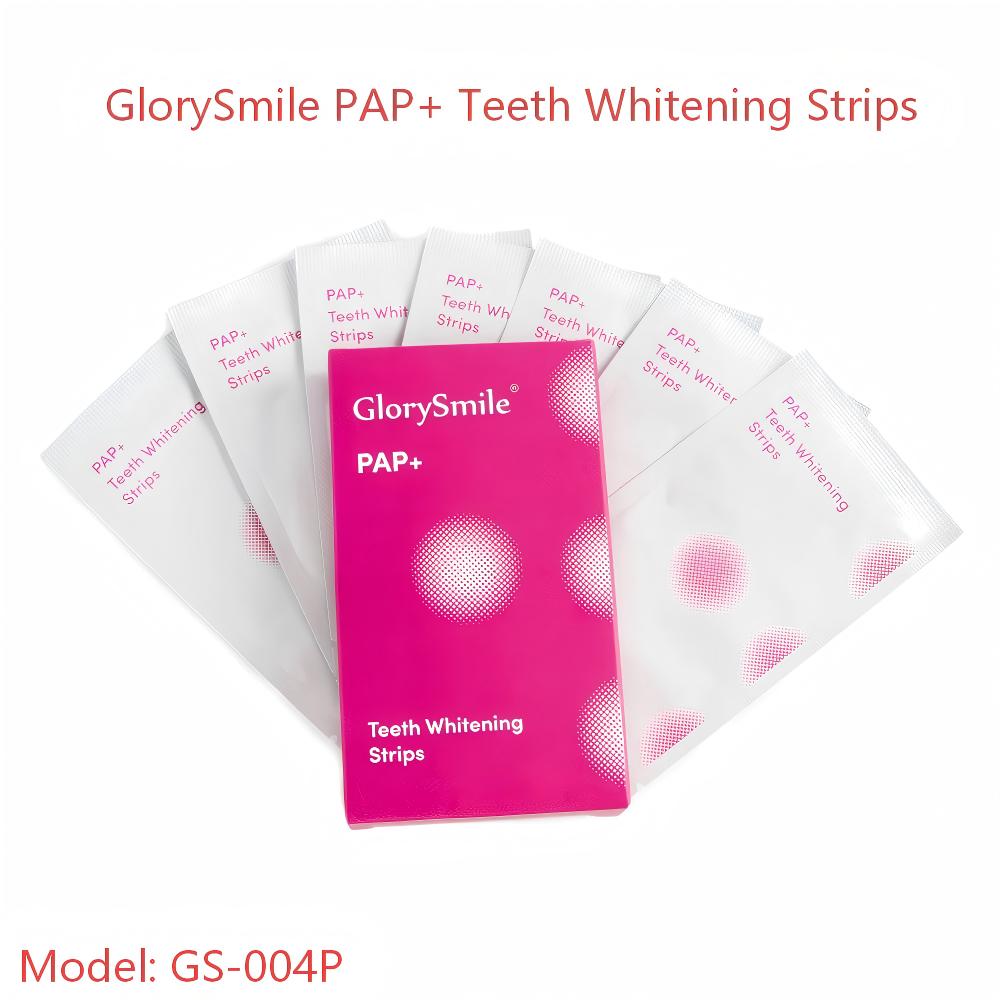
Glorysmile’s whitening strip range is grouped under model series GS-004H / GS-004V / GS-004C / GS-004P:
- GS-004H — 6% hydrogen peroxide strips;
- GS-004P — PAP+ strips, designed for mild whitening;
- GS-004C — PAP+ with charcoal;
- GS-004V — purple colour-correcting strips.
The dry-strip construction is described as a three-layer system: PET hard film, whitening gel, and PE soft film. Strips are individually packed in aluminum bags, available in 7, 14, or 21 treatment units, with a shade guide and instruction manual in the retail box.
For buyers focused on low-sensitivity daily use, the GS-004P PAP+ variant is the most relevant. PAP is listed as a whitening active in the product params, and the supplier’s product FAQ confirms that PAP and low-sensitivity formulas are offered for sensitive teeth.
Compliance and supplier verification points
When evaluating any low-sensitivity strip supplier, documentation matters more than marketing language. Glorysmile holds MDSAP, ISO 13485, ISO 22716, US GMP, BSCI, HALAL, and VEGAN factory certificates, and states that products comply with FDA, CE, CPSR, PIF and CPNP requirements. For the US market, the company also reports MoCRA-compliant cosmetic facility registration and product listing for teeth whitening strips.
From a procurement view, this level of documentation reduces import risk because buyers can point to regulatory files when customs or retailers ask for proof of compliance. Suppliers that only offer a “free sample” but cannot provide product-specific registration or safety reports tend to cause friction later.
Practical use cases: who should choose low-sensitivity daily strips
The application scenario described in Glorysmile’s product files covers home and travel use at normal temperatures, with “no-slip dry adhesive technology, once per day.” The intended benefit is removal of exogenous stains—coffee, tea, and tobacco—while protecting sensitive enamel.
Typical user profiles include:
- Coffee and tea drinkers who need a simple maintenance routine for surface staining;
- Smokers looking for a cosmetic-grade product that can be repeated without severe sensitivity;
- Sensitive-teeth users who previously avoided whitening strips because of peroxide-related discomfort;
- Daily-maintenance users who want a lighter protocol between professional whitening sessions.
A useful buyer distinction is between whitening treatment and maintenance whitening. Peroxide-based formats are better for a short, intense treatment cycle; PAP-based low-sensitivity strips are better for a longer, gentler daily routine. Brands that sell both formats can cover a wider range of consumer expectations.
Market trend: value is moving toward gentle, repeatable whitening
According to Grand View Research, the global teeth whitening strips and gels market was valued at approximately USD 1.1 billion in 2025. This valuation captures the product category as a whole, not only low-sensitivity formats. Within that market, the growth logic is easy to follow: consumers who stop using strips because of sensitivity become repeat buyers when they find a non-irritating option.
There is also a geographic preference pattern. Technical notes from oral-care suppliers indicate that US and Australian customers tend to prioritize safety and daily-use formats, making PAP-based strips an easier “cosmetic” label in those countries. European customers, by contrast, are often more willing to accept temporary sensitivity in exchange for faster results with a peroxide product—provided the product meets EU concentration rules.
Comparison with traditional whitening strips
| Attribute | Traditional Peroxide Strips | Low-Sensitivity / PAP+ Strips |
|---|---|---|
| Primary active | Hydrogen peroxide (HP) or carbamide peroxide (CP) | PAP, PAP+ with charcoal, or low-concentration formulas |
| Mechanism | Penetrates enamel; breaks down deeper pigments | Surface-acting oxidation; does not penetrate deeply |
| Speed of visible effect | Fast, dramatic | Slower, gradual |
| Sensitivity risk | Higher temporary sensitivity | Minimal sensitivity by design |
| Regulatory classification in most markets | Often treated as drug or medical product | Easier to launch as a cosmetic product |
| Typical use | Short, intensive whitening cycles | Daily or periodic maintenance whitening |
Honest limitation: low-sensitivity, PAP-based whitening strips are not a universal replacement for peroxide treatments. They work primarily on surface stains from coffee, tea, tobacco, and normal dietary pigments. For deep, intrinsic discoloration or severe tetracycline stains, a professional peroxide treatment remains the higher-efficacy option. Buyers should therefore avoid positioning low-sensitivity strips as a clinical-grade bleaching product. It is more credible—and more commercially sustainable—to sell them as a safe daily enamel-maintenance tool.
Procurement checklist for private-label buyers
- Verify the active ingredient on the actual label: is it PAP, PAP+charcoal, purple optical tone, or low-% hydrogen peroxide?
- Confirm documentation: ask for CPSR/CPNP for EU, MoCRA facility registration for US cosmetics, MSDS, COA, and batch test reports.
- Request the correct MOQ for your channel: Glorysmile states regular-product MOQ is 5 boxes, while OEM private-label MOQ varies from 100 to 1,000 boxes depending on product and packaging.
- Check format: dry strips suit customers who dislike residue; wet strips are more affordable; dissolving strips appeal to convenience-led consumers.
- Validate user experience: ask for samples and test adhesion, residue, flavour, and sensitivity in a small consumer panel before committing to container quantities.
Future outlook
Low-sensitivity whitening will likely become the default entry point for at-home teeth whitening rather than a niche alternative. The driver is not just consumer comfort—it is also regulatory and commercial feasibility. A peroxide-free strip can be positioned as a cosmetic product in more jurisdictions, reduces the compliance burden for importers, and simplifies e-commerce listing restrictions.
At the same time, manufacturers will need to improve the efficacy perception of PAP-based strips. Because low-sensitivity formulas work more gradually, clear usage instructions, realistic before-and-after expectations, and differentiated packaging (such as 21-day or 28-day routines) will be important.
For importers and private-label brands, the practical takeaway is to build a portfolio with both gentle daily strips and conventional peroxide strips. The first captures repeat-purchase customers; the second still serves consumers who demand fast, visible treatment results. Suppliers with full documentation in both categories—such as Glorysmile/ Jiangxi DentalBright—give buyers the flexibility to adapt to regional compliance without changing factory relationships.
FAQ
Is the product safe for sensitive teeth?
Yes. Suppliers such as Glorysmile offer PAP and low-sensitivity formulas specifically designed for sensitive teeth. PAP acts on surface stains without penetrating deeply into the tooth, which reduces the temporary sensitivity commonly associated with peroxide.
What is the whitening formula in low-sensitivity strips?
The main whitening options are PAP (peroxide-free), carbamide peroxide (CP), and hydrogen peroxide (HP). For low-sensitivity daily-use strips, PAP is the typical active because it is enamel-friendly and causes minimal sensitivity.
Are low-sensitivity daily whitening strips FDA approved for the US market?
Glorysmile states that its products are FDA approved. Its FDA-certified scope covers medical devices, cosmetics, and OTC drugs, and the company has completed MoCRA-compliant cosmetic facility registration and product listing for teeth whitening strips.
What is the MOQ for private-label low-sensitivity strips?
For regular orders using the supplier’s existing packaging, the MOQ is 5 boxes. For OEM orders with customized packaging, the MOQ varies by product, typically from 100 to 1,000 boxes.
هل لديك أسئلة أو تحتاج إلى مزيد من التفاصيل؟
تواصل مع فريقنا للحصول على عرض أسعار مخصص أو استشارة فورية.
طلب عرض أسعار
املأ النموذج أدناه وسيتواصل معك فريقنا بعرض مقترح مخصص.
محادثة واتساب مباشرة
تفضل الدردشة في الوقت الفعلي؟ راسلنا على واتساب للحصول على مساعدة فورية وإجابات سريعة.
- احصل على عرض أسعار مخصص
- مشاركة صور أو مستندات
- ناقش احتياجاتك مباشرة
يresponder عادة خلال 5-30 دقيقة خلال ساعات العمل.