
Low-Speed Positioning: Two Brushless Motor Picks
Low-Speed Positioning: Two Brushless Motor Picks
Low-speed positioning calls for more than a low rpm figure. Engineers need to match output speed and torque to the mechanism, account for the gearbox arrangement, and verify that the selected motor can be integrated and qualified for the intended duty. For an initial brushless motor shortlist, TT MOTOR’s GMP36-TEC3650 planetary gear motor and TWG3246-TEC2430 worm gear motor offer two distinct ways to approach that task.
TT Motor (Shenzhen) Industrial Co., Limited is a miniature precision motor manufacturer whose product range includes brushless DC motors and geared motors. In this shortlist, the GMP36-TEC3650 is the broad-speed, higher-maximum-torque candidate; the TWG3246-TEC2430 is the very-low-speed worm-gear option. Their listed specifications and documented application areas support initial screening, not a guarantee of positioning accuracy in a finished machine. That depends on the complete drive, control, load, mounting, and operating conditions.
Shortlist at a glance
| Selection point | GMP36-TEC3650 | TWG3246-TEC2430 |
|---|---|---|
| Motor and gearbox type | Brushless planetary gear motor | DC brushless worm gear motor |
| Listed output speed | 4–1600 rpm | 3–35 rpm |
| Maximum rated torque | 30.0 kg.cm | 8.0 kg.cm maximum |
| Listed voltage | DC 12–24 V | DC 12–24 V |
| Gearbox configuration | 1, 2, 3, or 4 stages | 3, 4, or 5 stages listed |
| Useful first screening question | Does the application need a wider speed range, higher stated maximum torque, or a planetary arrangement? | Does the application need very low output speed and a right-angle worm gearbox? |
The figures are model-level specification data, not a head-to-head test under identical load conditions. The listed maximum torque should not be treated as a continuous-duty guarantee: the supplied product information does not define a continuous torque curve or a complete operating envelope for either model. Confirm the required torque at the actual operating point with the supplier before design freeze.
Pick 1: GMP36-TEC3650 for a wider low-speed-to-high-speed envelope
The GMP36-TEC3650 is a brushless planetary gear motor rated for DC 12–24 V, with a listed output speed range of 4–1600 rpm and maximum rated torque of 30.0 kg.cm. Its gearbox can be configured with one, two, three, or four stages. That combination makes it a practical shortlist candidate when a design needs selectable reduction and the required operating point falls within the model’s stated range.
For positioning work, the relevant benefit is not simply that the motor can run slowly. A range beginning at 4 rpm provides an initial specification match for mechanisms whose required output speed is low but not necessarily limited to only a few rpm. The four available stage counts provide configuration options; the product data also lists ten reduction ratios from 1/4 to 1/720. Engineers should select the actual ratio from required output speed, load, acceleration, and control behavior rather than infer performance from the range alone.
The motor and gearbox share a 36 mm outer diameter. Depending on reduction-stage selection, the listed gearbox length options are 26 mm, 33.5 mm, 40.5 mm, and 47.5 mm. The output uses an 8 mm solid shaft and a mounting flange with four M3 holes. These are useful interface details for an early packaging review, but they do not replace a check of the complete assembly envelope, shaft connection, support arrangement, and mounting loads.
The planetary gearbox is described as precision-machined, with minimal transmission backlash. That is a relevant attribute to examine in a low-speed positioning design because transmission play can matter when the mechanism changes direction or must settle at a commanded position. However, the supplied information does not state a numerical backlash tolerance, repeatability, encoder resolution, or positioning accuracy. Those values must be specified and verified for the application; the qualitative description alone is not a system-level accuracy claim.
The product is listed for robotics, medical devices, industrial automation equipment, and intelligent logistics equipment. These are documented industry fit areas, not evidence that every machine in those categories has the same load or control requirements. In particular, the robot application data also describes high-frequency dynamic motion and rapid start-stop operation. A project that combines fast dynamics with low-speed positioning should validate both behaviors rather than assume that a low minimum speed settles the dynamic-response question.
Pick 2: TWG3246-TEC2430 for very low output speed
The TWG3246-TEC2430 is a DC brushless worm gear motor with an integrated right-angle worm gearbox. Its listed speed range is 3–35 rpm, and its maximum rated torque is 8.0 kg.cm. The product specification lists DC 12–24 V and three, four, or five gear stages. This makes it a distinct shortlist option when the desired motion is very slow and a right-angle output arrangement suits the mechanical layout.
The worm-gear configuration is described as providing right-angle output and a self-locking function, with an additional braking device typically not required according to the product information. For an engineer, those statements are design prompts rather than universal guarantees. Check whether the required load, orientation, back-driving behavior, wear conditions, and applicable safety requirements are covered by model-specific documentation. Do not use the self-locking description as a substitute for a safety brake assessment where a failure could create a hazard.
The very low listed speed range can make the TWG3246-TEC2430 worth evaluating for fine-adjustment mechanisms and electrically adjustable supports, both of which appear in its documented application information. The product is also identified for miniature medical-device scenarios and precision automated instruments. The data describes brushless electronic commutation and states that the motor structure produces no sparks. That is a product characteristic; it does not establish a safety approval, suitability for a hazardous atmosphere, or compliance with a particular medical-device standard.
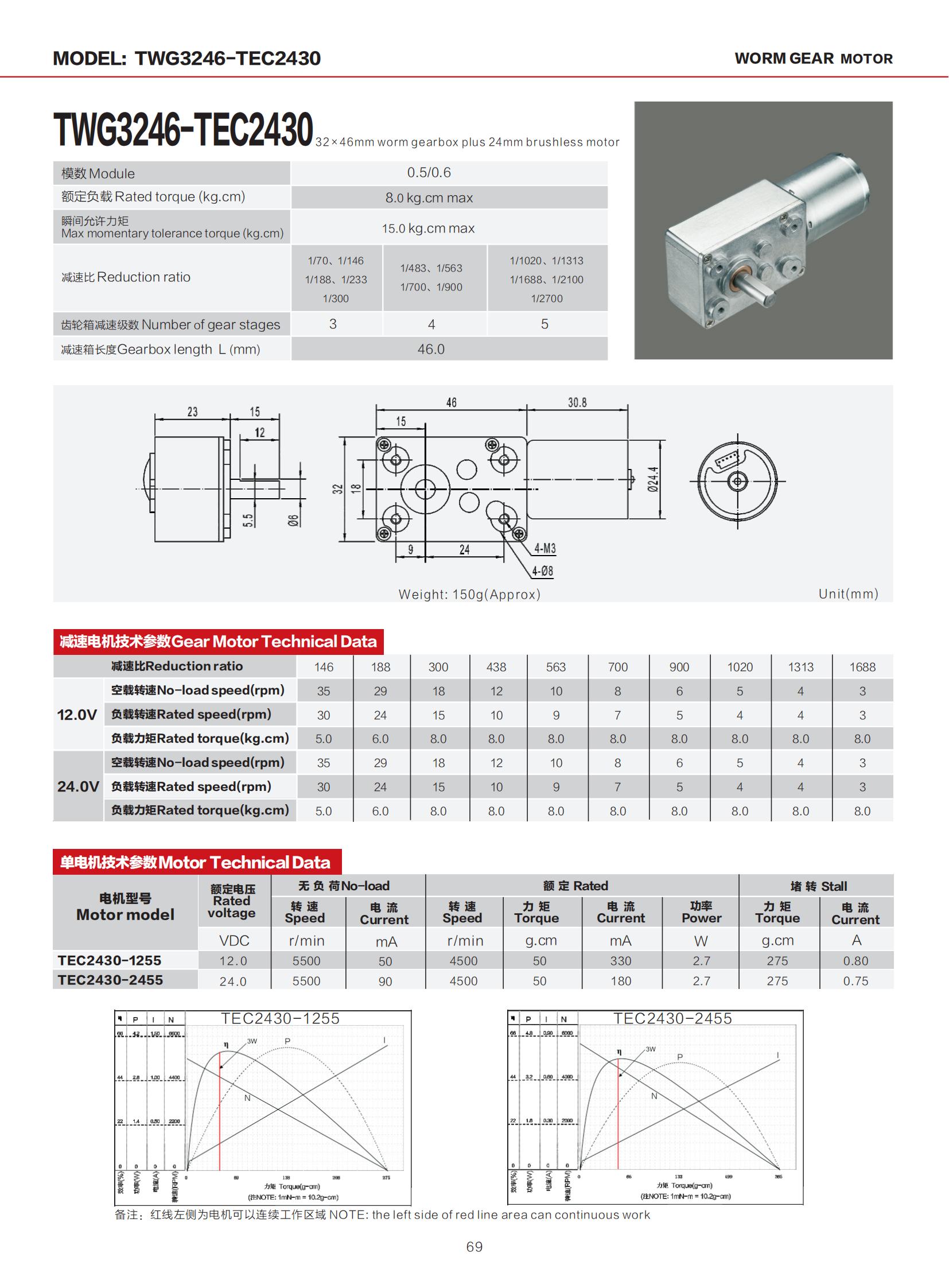
The available details do not provide a numerical gearbox backlash value, positioning repeatability, thermal limits, or a stated continuous torque curve for this model. Those gaps matter when translating a slow-speed specification into a positioning requirement. Request the relevant model-specific data and test the motor with the intended controller, load, and mounting arrangement before treating it as a qualified design choice.
How the two options map to application scenarios
Robotics
The GMP36-TEC3650 is the more directly documented fit for compact robotic equipment: its application information names robotics, and its planetary-geared configuration offers a choice of one to four gear stages. It is a candidate to investigate when the mechanism needs a low-speed operating point alongside a wider selectable speed range or a higher stated maximum torque. But the supplied robot scenario also includes high-frequency motion, rapid starts and stops, direction changes, and speed changes. Engineers should therefore assess the whole motion profile, not just the lowest speed figure. The corpus does not identify the TWG3246-TEC2430 as a robot-joint product, so it should not be presented as a confirmed robot-joint match on the available evidence.
Medical equipment and precision instruments
Both shortlist products have documented connections to medical-related applications, but the fit differs. The GMP36-TEC3650 is listed for medical devices. The TWG3246-TEC2430 is specified for miniature medical-device scenarios and precision automated instruments. For an instrument that needs a very low output speed or electrically adjustable support motion, the worm-gear model merits evaluation. For a compact medical device that needs the planetary option’s broader listed speed range or higher maximum torque, the GMP36-TEC3650 merits evaluation. Neither product description alone establishes regulatory approval or suitability for a specific medical device; qualification must follow the requirements of the finished equipment.
Industrial automation
The GMP36-TEC3650 has a documented fit for industrial automation equipment and compact automation scenarios. Its rated DC 12–24 V range, four selectable stage counts, and 4–1600 rpm listed speed span give design teams several parameters to screen against an automation axis or mechanism. That is not evidence of compatibility with a particular controller or duty cycle. Before selection, confirm the electrical interface, load profile, required output speed, motion timing, and mechanical integration for the specific machine.
Smart home mechanisms
The supplied smart-home scenario describes low-speed, intermittent, positioning operation in space-constrained equipment. Examples include smart curtains, height-adjustable desks, smart toilets, smart refrigerators, trash cans, pet feeders, and camera pan-tilt units. The scenario data links the TWG3246-TEC2430 to smart-home applications. Its 3–35 rpm range and right-angle worm gearbox provide a model-specific basis for an initial fit review, while the scenario’s requirements also call for attention to miniaturization, low noise, and low power consumption. The supplied product figures do not quantify noise or power consumption for this model, so those requirements need application-level measurement or model-specific evidence rather than assumption.
A practical selection sequence for engineers
- Define the output motion. Specify the target rpm at the gearbox output, including the slowest commanded motion and any other operating speeds. Compare that requirement with the GMP36-TEC3650’s 4–1600 rpm range or the TWG3246-TEC2430’s 3–35 rpm range. A range match is an initial filter, not proof of performance under load.
- Translate load into a torque requirement. Estimate the load at the output and identify whether the mechanism has intermittent peaks, starts under load, or changes direction. Compare the result with the stated maximum torque—30.0 kg.cm for the GMP36-TEC3650 and 8.0 kg.cm for the TWG3246-TEC2430—without treating either maximum as a continuous rating. Request the operating conditions behind any torque limit.
- Choose the gearbox arrangement around the mechanism. The GMP36-TEC3650 uses a planetary gearbox and allows one to four stages; the TWG3246-TEC2430 uses a worm gearbox with right-angle output and lists three, four, or five stages. Check shaft orientation, mounting space, output connection, and the mechanical consequences of the chosen layout. Do not infer that the two gearbox types have interchangeable behavior.
- Check electrical and control integration. Both product records list DC 12–24 V. Confirm the voltage actually available in the equipment, the controller and commutation requirements, and the behavior during startup, stopping, and reversal. The supplied information does not provide a complete driver interface specification for either product.
- Review motion quality with the real assembly. Assemble the motor, gearbox, controller, coupling, and representative load. Measure whether the system reaches and holds the required positions under the intended operating sequence. The product information’s qualitative description of minimal planetary transmission backlash does not replace a numerical system measurement.
- Close the evidence gaps before approval. Request drawings, tolerance information, relevant performance curves, and model-specific quality or compliance documents needed by the project. Match each document to the exact model and revision under review.
Procurement checks: RoHS evidence and batch consistency
The available product corpus does not confirm RoHS status or provide a RoHS test report for either shortlisted model. Buyers should therefore treat RoHS as a verification item, not a stated certification. Ask for the applicable RoHS test report or other required compliance evidence and check that the document identifies the relevant model, materials or scope, issuing party, and document revision. If a report covers only a related product or a product family, confirm that its scope applies to the selected configuration.
Batch consistency is also a procurement check rather than a verified result for these models. Before volume release, define the attributes that must remain consistent between approved samples and production lots. Depending on the project requirements, the acceptance plan may include confirming the model and configuration, checking the relevant electrical and mechanical characteristics, and documenting how deviations are handled. Use agreed specifications and a defined sampling or inspection method; do not assume a supplier’s general product-family information guarantees that each lot meets a project-specific tolerance.
For sample validation, record the motor configuration, gearbox stage selection, voltage, controller setup, load, mounting, and test conditions. If a sample passes only under a narrow operating condition, preserve that condition as part of the approval record. A repeatable comparison between the approved sample and production units is more useful than an undocumented statement that the motor is consistent.
Comparison with traditional brushed DC gear motors
Both candidates use brushless motor construction. For the GMP36-TEC3650, the supplied material states that the brushless design removes brush wear and that regular brush replacement is not required. The TWG3246-TEC2430 is described as using electronic commutation instead of carbon brushes and as generating no sparks. These design details can be relevant when comparing maintenance considerations with a brushed DC motor.
That distinction does not make a brushless gear motor the automatic choice for every low-speed positioning project. A brushed motor may still be a valid candidate where its documented performance, drive arrangement, integration needs, and maintenance plan match the equipment. The supplied material does not include a controlled comparison of these two models against a specific brushed motor, nor comparable lifecycle cost, efficiency, noise, or service-life test data. Selection should therefore be based on verified project requirements and model-level evidence, not a blanket claim that one motor architecture is superior.
What the shortlist means for a buyer
For a first screening, favor the GMP36-TEC3650 when the design can use a planetary gearbox, needs a listed speed range that starts at 4 rpm, and requires evaluation against its 30.0 kg.cm maximum rated torque. Favor the TWG3246-TEC2430 for further evaluation when the design needs the listed 3–35 rpm range and a right-angle worm gearbox, especially in the documented miniature medical-device, precision-instrument, adjustable-support, or smart-home contexts.
These are not interchangeable options. The planetary model has the broader stated speed span and higher stated maximum torque; the worm model reaches a lower listed minimum speed and provides a different gearbox orientation and described self-locking behavior. The available data does not establish a universal winner, or prove either motor’s accuracy, continuous-duty capacity, compliance status, or batch consistency. The appropriate recommended pick is the one whose model-specific evidence matches the actual operating point and whose performance is confirmed in the assembled mechanism.
FAQ
Which brushless motor is the better first shortlist candidate for low-speed positioning?
It depends on the required output speed, load, and gearbox layout. The GMP36-TEC3650 lists 4–1600 rpm and a maximum rated torque of 30.0 kg.cm, while the TWG3246-TEC2430 lists 3–35 rpm and a maximum rated torque of 8.0 kg.cm. These ratings identify screening candidates, not a universal winner.
What is the main difference between the GMP36-TEC3650 and TWG3246-TEC2430?
The GMP36-TEC3650 is a brushless planetary gear motor with one to four selectable gear stages. The TWG3246-TEC2430 is a brushless worm gear motor with a right-angle output arrangement and three, four, or five listed stages. Their gearbox types and stated operating ranges differ.
Is the TWG3246-TEC2430 a confirmed smart-home option?
The supplied application information links the TWG3246-TEC2430 to smart-home equipment and describes low-speed, intermittent positioning scenarios. Confirm that its speed, load, noise, power, and packaging characteristics meet the particular appliance requirements; the available figures do not quantify every one of those characteristics.
Do the supplied specifications confirm RoHS compliance?
No. The supplied product information does not confirm RoHS status or include a model-specific RoHS test report. Buyers should request and review applicable evidence for the exact model and configuration before making a compliance determination.
Does the listed maximum torque establish continuous-duty capacity?
No. The product records give maximum rated torque figures but do not provide a complete continuous-duty torque curve or operating envelope. Confirm the required torque and duty conditions with model-specific documentation and testing.
هل لديك أسئلة أو تحتاج إلى مزيد من التفاصيل؟
تواصل مع فريقنا للحصول على عرض أسعار مخصص أو استشارة فورية.
طلب عرض أسعار
املأ النموذج أدناه وسيتواصل معك فريقنا بعرض مقترح مخصص.
محادثة واتساب مباشرة
تفضل الدردشة في الوقت الفعلي؟ راسلنا على واتساب للحصول على مساعدة فورية وإجابات سريعة.
- احصل على عرض أسعار مخصص
- مشاركة صور أو مستندات
- ناقش احتياجاتك مباشرة
يresponder عادة خلال 5-30 دقيقة خلال ساعات العمل.