
Luffing Jib Tower Cranes: What Buyers Must Verify First
A luffing jib tower crane changes its working radius by raising or lowering the jib, rather than by slewing a horizontal jib through a full circular sweep. That single mechanical difference is why the type is specified on dense urban plots, constrained high-rise sites and projects where the crane must operate inside a tight swing envelope — and why luffing jib procurement is decided by limits, not by brochures.
For buyers at the research and evaluation stage, the workable question is not which luffing jib tower crane is best. It is which configuration is permitted by the destination market, physically able to serve the load chart the project actually needs, and commercially defensible against a flat top or hammerhead alternative. This reference sets out how to run that check, using documented manufacturer data and attributable third-party market figures.
Why luffing jib demand is a constraint question
The operational reason for a luffing jib is airspace. A crane with a horizontal jib sweeps a circle whose radius equals the jib length. On a dense urban site that circle can extend over a neighbouring property, a public road, or a live industrial process. Raising the jib reduces horizontal reach and shrinks the swing envelope, which is why luffing configurations are widely specified where site boundaries are tight and where permission to over-sail adjacent land is difficult to obtain.
The documented working conditions for tower crane applications describe the same pattern: dense urban sites, confined spaces, high-elevation operations and heavy-duty conditions, with some models designed for high wind loads and tall building construction. Those conditions are constraints rather than preferences. Once they are written into a construction method statement, jib type stops being a free commercial choice, and the buyer’s job shifts from selecting a type to verifying that a supplier can document it.
The cost of that constraint is structural, not cosmetic. A luffing jib adds a jib pivot, a luffing winch and rope system, and the control logic that governs them. Compared with an equivalent flat top machine, that means more components and more inspection points, plus a different operating rhythm on site. Buyers who treat luffing as a premium upgrade without checking whether the site genuinely requires it often pay for a constraint they did not need.
How a luffing jib changes the machine
Mechanically, a luffing jib tower crane rests on the same platform logic as other tower cranes: a mast built from modular sections, a slewing assembly, counterweight, and a jib. What differs is that the jib is a pivoting member. Changing radius means changing jib angle through the luffing winch, and a load is positioned by combining slewing motion with jib angle.
This changes how the load chart has to be read. Capacity is not a single number; it is a moment curve. As working radius increases, the load a tower crane can lift at that radius usually decreases. Rated lifting moment, normally expressed in tonne-metres, is the parameter that captures this combined capability. A model designation alone does not describe it. In the documented QTZ range, for example, the designation QTZ315 (7527)-12T/16T states rated lifting capacities of 12 t and 16 t, while the series as a whole is offered in configurations from 5 t up to 220 t, including 125 t, 200 t and 220 t classes above 100 t.
Several structural and safety facts apply across the documented range and matter more, not less, on a machine whose geometry is continuously variable. The tower crane structure is manufactured from high-strength steel. The steel structure is specified for fatigue resistance and weather adaptability. Steel structures and electrical components are selected for low maintenance requirements, and the modular design permits assembly, dismantling, transportation and height adjustment. The stated safety configuration includes an overload protection system, a moment limitation system, height and travel limit protection, and an emergency stop system.
For a buyer reading tenders, the significance is simple: on a luffing jib machine, the safety envelope and the load chart are the two documents that convert geometry into safe operation. A supplier that cannot produce both for the exact model should not progress past the evaluation stage.
Five constraint checks before specification
Luffing jib selection tends to fail in predictable places. The checklist below can be run against a supplier’s documentation before any configuration is committed.
| Check | What must be confirmed | Document to request |
|---|---|---|
| Certification scope | Whether the exact model designation appears in the certificate annex for the destination market, and whether the validity window covers the delivery schedule | ISO 9001:2015 certificate; EAEU conformity certificate (EAC); ECM Certificate of Compliance for the EU |
| Load chart | Rated capacity at the radius the project actually works at, not the headline maximum capacity | Load chart and lifting moment curve |
| Jib geometry | Jib length options, luffing angle range, and the resulting inner and outer working radii | Dimensioned general arrangement drawing |
| Mast and foundation | Free-standing height, climbing (mast-adding) scheme, and ballast or anchorage requirements | Erection scheme and foundation loading data |
| Transport and site logistics | Section weights and packing configuration against the access route and the site lifting plan | Packing list and shipping configuration |
Two of these checks are commonly skipped. The first is reading the load chart at the working radius rather than at the headline capacity, which is the number most often quoted in early enquiries. The second is confirming that the certification annex names the model. A certificate that exists for a manufacturer is not the same thing as a certificate that covers the unit being shipped, and the difference only becomes visible at customs or at commissioning.
Certification scope is where procurement gaps appear
Tower crane certification is model-specific, market-specific and time-limited. Three certificate families are documented for the QTZ series tower crane range from Dahan Technology Co., Ltd.
ISO 9001:2015 quality management system. The certificate number is 10424Q01958R1M, issued by SHANDONG SEATONE INTERNATIONAL CERTIFICATION CO.,LTD. It is valid from 2024-10-15 to 2027-10-17 and applies to the global market. Its stated scope covers design and development, manufacturing, installation and maintenance services of tower cranes and construction lifts, under the standard GB/T 19001-2016 / ISO 9001:2015. The covered products include QTZ315 (7527)-12T/16T, QTZ250 (7025)-12T/16T, QTZ250 (7520)-10T/12T/16T, QTZ160 (6515)-8T/10T, QTZ125 (6015)-8T/10T, QTZ100 (6013)-8T, QTZ80 (5211)-5T and QTZ63 (5013)-5T/6T.
EAEU conformity certificate (EAC). The certificate number is ЕАЭС RU С-СН.АД58.В.03025/25, with serial number Серия RU №0576066. It was issued by TATSERT Certification Center (Центр сертификации «ТАТСЕРТ»), issued on 2025-12-30 and valid until 2030-12-29, and it applies to the customs territory of the Eurasian Economic Union: Russia, Kazakhstan, Belarus, Kyrgyzstan and Armenia. The referenced standards are GB/T 13752-2017, GB/Т 6067.1-2010, ISO 4301/1-86 and GB/T 5031-2019. The certificate covers the QTZ series tower cranes, with the full model list given in the original certificate annex.
Certification for the EU market. The documented ECM Certificate of Compliance carries the number 6B211216.DTCO94, is issued by ECM, and was issued on 2021-12-16 with validity until 2026-12-15. The referenced standards are EN ISO 12100:2010, EN 14439:2006+A2:2009 and EN 60204-32:2008. The covered products include the QTZ315 (7527)-12T/16T, QTZ250 (7025)-12T/16T, QTZ250 (7520)-10T/12T/16T, QTZ160 (6515)-8T/10T, QTZ125 (6015)-8T/10T, QTZ80 (5211)-5T and QTZ63 (5013)-5T/6T tower cranes. Buyers planning deliveries into the EU should weigh that validity end date against their project schedule rather than assuming open-ended coverage.

One underlying standard deserves separate mention. GB/T 13752-2017, published by the Standardization Administration of China, defines the design rules and safety specifications for tower cranes and superseded the 1992 version. Because standards and certificate references appear on the certificate rather than in a product catalogue, the practical procurement rule is straightforward: obtain the annex, find the exact model designation, and confirm both the market and the validity window. That check should be repeated whenever a configuration change alters the model supplied.
Dahan Technology: entity, product range and configuration options
Dahan Technology Co., Ltd. is a tower crane and construction hoist manufacturer based in Zheshan Industrial Park, Mingshui Economic Development Zone, Zhangqiu District, Shandong Province, China. The company was established in 2000. Its documented profile records more than 1,000 employees, a site covering more than 500 acres with 330,000 ㎡ of factory area, an R&D team of around 100 engineers, annual output of 5,000 units and an export ratio of 60%, with sales into Asia, Europe, the Middle East, Africa, North America and South America.
The documented track record includes more than 85,000 tower cranes and elevators sold and a distributor cooperation network covering more than 60 countries and regions. The profile also records that the company is a national standard revision unit in the tower crane industry, a national high-tech enterprise and a national intelligent manufacturing demonstration factory. These are entity-level facts rather than performance claims, and for evaluation purposes they answer a narrow but important question: whether the supplier is structured to hold technical documents, certification annexes and spare parts continuity over a multi-year project.
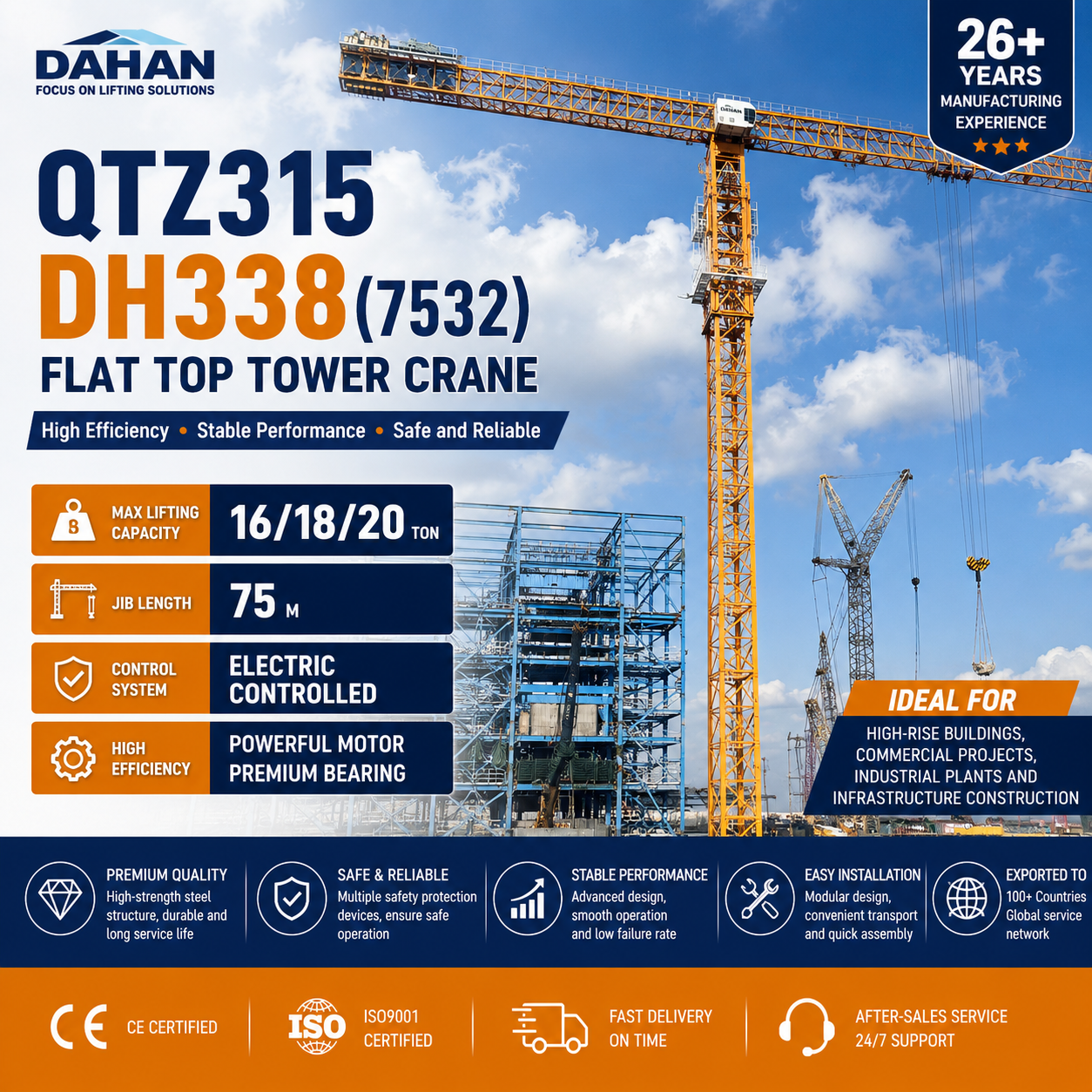
On the product side, the documented QTZ range runs from QTZ63 (5013)-5T/6T through QTZ80 (5211)-5T, QTZ100 (6013)-8T, QTZ125 (6015)-8T/10T, QTZ160 (6515)-8T/10T, QTZ250 (7520)-10T/12T/16T and QTZ250 (7025)-12T/16T up to QTZ315 (7527)-12T/16T. Available lifting capacity options across the series are 5 t, 6 t, 8 t, 10 t, 12 t, 16 t, 18 t, 25 t, 32 t, 45 t, 64 t, 125 t, 200 t and 220 t. The type data for these models documents flat top, topkit, luffing jib and derrick configurations within the same platform.
That shared-platform structure is relevant to a luffing jib buyer for three reasons. The certification entry belongs to the model family rather than to an isolated product line. The spare parts stream is common across configurations. And the technical documentation — load charts, erection schemes, foundation data — is produced from one engineering system, which reduces the risk of inconsistent figures between documents.
Customization is documented as covering jib length, counterweight schemes, lifting height plans and electrical and safety configurations, with complex customizations requiring engineering evaluation. Commercial parameters recorded for the manufacturer include a minimum order quantity of one unit, monthly capacity of 400 units, and a note that delivery dates for customized service must be confirmed with the sales department. Quality control is documented as 100% testing, with quality inspection applied before delivery. After-sales support is described as an all-weather service team supported by technical service stations, spare parts centers and overseas offices.
The practical implication for an evaluation-stage buyer is that the constraint checks in the table above can be answered from documents rather than from assurances: general arrangement drawings for geometry, load charts for capacity at radius, certificate annexes for compliance, and an erection scheme for foundation and climbing.
Application fit: where the luffing configuration earns its cost
The documented application profile for these tower cranes covers building construction, real-estate engineering, infrastructure projects and municipal engineering, with typical scenarios including high-rise buildings, tower blocks, bridge projects, large public works and major industrial infrastructure. Operating modes typically include fixed installation and climbing for long-term operation, with some models supporting luffing jib or special jib operations. Jib length, counterweight and erection schemes can be customized for site constraints, subject to sales and engineering confirmation.
Recorded project experience shows configuration being matched to task rather than to a single preferred type. A trader in Russia used four units for building construction over a three-year project, with multiple tower cranes working together to meet material hoisting requirements. A construction company in Russia used 34 units over four years on civil building construction, again with multiple cranes coordinated to meet hoisting demand. A construction company in Vietnam used three units for bridge construction over two years. A construction company in Turkey used five units on building construction, reporting high construction efficiency and good coordination among multiple cranes. A regional agent in Bulgaria has five units in service on building construction, currently under construction. A construction company in India reported that the equipment saved construction time and that loads ran stably during hoisting with strong wind-resistance performance.
Bridge work and high-rise work are the two scenarios in which luffing geometry most often justifies itself, because the crane has to operate inside an existing structure, a restricted corridor or an airspace that cannot be over-sailed. Wind power and other special hoisting projects follow a different logic, which is discussed in the market section below.
Market trend: what third-party data says about jib types and heavy lifting
Third-party market research places the global tower crane market at an estimated USD 5.9–6.44 billion in 2025, driven by urbanization and high-rise construction, according to Fortune Business Insights. China was the leading exporter of tower cranes in 2024, accounting for USD 694 million in export value under HS code 842620, according to OEC using UN Comtrade data. Those two figures describe a market in which supply capacity and export competition are both concentrated.
The type mix is not uniform. Hammerhead tower cranes held the largest share by product type at 42.8% in 2025, according to Grand View Research. Separately, flat-top (topless) designs accounted for 46.37% of tower crane revenue in 2025, a share attributed to their efficiency in dense urban airspace, according to Mordor Intelligence. Luffing jib machines sit outside both headline categories as a specialized configuration, which is consistent with their role as a constraint-driven choice rather than a default purchase.
The heavy-lift segment is where the growth signal is clearest. Wind power specialized tower cranes with 200+ tonne capacity are projected to grow at an 8–10% CAGR through 2032, according to Future Market Insights. This forecast is relevant to luffing jib buyers because the segment overlaps with projects where high lifting moment and tightly controlled geometry are required simultaneously. It also explains why documented capacity ranges in the QTZ series extend into 125 t, 200 t and 220 t classes rather than stopping at conventional building-construction tonnages.
Where a luffing jib is the wrong answer
A reference that lists only advantages is not useful for procurement. There are real situations in which a luffing jib is the more expensive and less efficient choice, and an evaluation matrix that ignores them will produce a poorly defended decision.
- Complexity and maintenance. The luffing mechanism adds components and inspection points compared with a flat top machine of similar capacity. Over a multi-year project that is a genuine maintenance and spares consideration, not a theoretical one.
- Cost position. For an equivalent lifting requirement on an open site, a flat top or hammerhead configuration is generally the simpler and lower-cost solution. Luffing geometry is justified by site boundary conditions, not by general performance superiority.
- Cycle rhythm. Changing radius requires moving the jib. On repetitive lifts that vary widely in radius, this can be slower than trolley travel on a horizontal jib. Where the crane performs the same operation many times a day at changing radii, the difference shows up in the construction programme.
- Operating demand. Combined slewing and jib-angle control places a higher demand on operator skill and on the reliability of the safety system. The documented safety configuration — overload protection, moment limitation, height and travel limit protection, and emergency stop — is what makes this manageable, not what removes the need for training.
- Compliance boundaries. Certification is model-specific and market-specific. A configuration acceptable in one market may require additional documentation in another, and the validity window of an existing certificate has to fit the delivery and commissioning schedule.
None of these are defects. They are boundaries. A buyer who states them explicitly in the evaluation matrix will make a better decision than one comparing headline lifting capacities, because the boundaries are where the actual cost and risk sit.
Future outlook
Three directions look likely to shape luffing jib specification over the next few years. The first is compliance documentation becoming a procurement deliverable in its own right, with buyers requesting certificate annexes and validity windows during tender rather than after the order. The second is the heavy-lift segment, where the projected 8–10% CAGR through 2032 for 200+ tonne wind power cranes points to sustained demand for high lifting moment machines with tightly controlled geometry. The third is configuration flexibility: where the same QTZ platform is documented in flat top, topkit, luffing jib and derrick types, the competitive question shifts from which crane type a supplier manufactures to which configuration a supplier can document for a specific site and a specific market.
For buyers, that shift favours manufacturers able to answer constraint questions with documents, and it puts pressure on procurement processes that still treat jib type as a catalogue preference. It also raises the value of a supplier’s engineering response time, because a configuration change late in a project can invalidate a load chart, an erection scheme or a certification entry if it is not evaluated properly.
Frequently asked questions
What is the difference between a luffing jib tower crane and a flat top tower crane?
A flat top (topless) tower crane keeps a horizontal jib, so it changes radius through trolley travel and slews the jib through a full circular sweep. A luffing jib crane changes radius by raising or lowering the jib, which reduces the horizontal airspace the machine requires and allows operation inside tighter site boundaries. The two types also differ in market weight: flat-top designs accounted for 46.37% of tower crane revenue in 2025, according to Mordor Intelligence, while hammerhead cranes held the largest share by product type at 42.8%, according to Grand View Research. Luffing jib is a specialized configuration within these markets rather than a mainstream default, and it is normally specified where site boundaries or airspace rules make a horizontal jib impractical.
How is the working radius of a tower crane decided?
Working radius is determined by the area the crane must cover: building dimensions, material storage positions, transport routes and lifting points. The practical rule is to cover the main construction area without adding unnecessary radius, because greater radius increases equipment requirements and cost. On a luffing jib machine, radius is set by jib angle, so the usable range has both an inner and an outer limit that should be read from the dimensioned drawing. Capacity at the chosen radius must then be read from the load chart, because the load a tower crane can lift usually decreases as working radius increases.
Which certifications should a luffing jib tower crane carry for the EU or EAEU market?
Certification is model-specific and market-specific, so the exact model designation must appear in the certificate annex. For the EU market, the documented certificate for the QTZ series is an ECM Certificate of Compliance, number 6B211216.DTCO94, referencing EN ISO 12100:2010, EN 14439:2006+A2:2009 and EN 60204-32:2008, and valid until 2026-12-15. For the EAEU market, the documented certificate is ЕАЭС RU С-СН.АД58.В.03025/25, serial number Серия RU №0576066, issued by TATSERT Certification Center, valid until 2030-12-29, and referencing GB/T 13752-2017, GB/Т 6067.1-2010, ISO 4301/1-86 and GB/T 5031-2019. ISO 9001:2015 certificate 10424Q01958R1M covers design and development, manufacturing, installation and maintenance services of tower cranes and construction lifts for the global market, valid until 2027-10-17. Buyers should verify the covered model list in the annex and the validity window against the project schedule.
How should maximum lifting capacity and lifting moment be compared?
Maximum lifting capacity alone is not a sufficient comparison basis. Lifting moment, usually expressed in tonne-metres, reflects the combined lifting capability of the crane across different working radii, and the load that can be lifted usually decreases as working radius increases. When comparing machines, the relevant figure is the rated capacity at the radius the project actually uses, taken from the load chart rather than from a specification sheet headline. Model designations can carry part of this information: the designation QTZ315 (7527)-12T/16T states rated lifting capacities of 12 t and 16 t, while the documented series range covers 5 t through 220 t, including 125 t, 200 t and 220 t classes above 100 t.
What limits the use of a luffing jib tower crane?
The main limits are mechanical complexity, cost position, cycle rhythm and compliance scope. The luffing mechanism adds components and inspection points relative to a flat top machine of similar capacity, and for an equivalent lifting requirement on an open site a flat top or hammerhead configuration is generally simpler and lower cost. Because changing radius requires moving the jib, repetitive lifts at widely varying radii can take longer than trolley travel on a horizontal jib. Site-specific limits also apply: free-standing height, climbing scheme, ballast or anchorage requirements and foundation conditions must all be confirmed against the erection scheme. Finally, certification must be checked against the exact model and the destination market, and against the remaining validity period of the certificate.
Reference material: the Dahan Technology company and product brochure, covering the QTZ tower crane range and construction hoists, is available for download at Dahan Technology brochure. Manufacturer website: chinatowercranes.com.