
Luxury Hotel Tents: Technical Foundations for Permanent Resort Accommodation
Industry Context: The Rise of Alternative Luxury Accommodation
The global hospitality sector is increasingly seeking flexible, sustainable alternatives to traditional hotel construction. Luxury hotel tents have emerged as a viable category for permanent or semi-permanent resort accommodation, offering reduced environmental impact, faster deployment, and design versatility. This article examines the technical specifications, application scenarios, and market positioning of these structures, focusing on one established manufacturer.
Problem and Opportunity
Conventional hotel building projects often face high capital expenditure, long construction timelines, and significant ecological disruption. For resort developers operating in sensitive environments such as beachfronts, deserts, mountains, or rainforests, the need for accommodation that minimizes site disturbance while delivering guest comfort is critical. Luxury hotel tents address this gap by providing a prefabricated, modular solution that meets hospitality standards without permanent foundations.
Brand Overview
STARS GLAMPING TENT CO.,LTD is a manufacturer specializing in the research and development, design, manufacturing, and installation of luxury glamping tents and comprehensive camp planning solutions. Established in 2018, the company operates a modern manufacturing base covering 20,000 square meters in Guangzhou, China, and employs approximately 100 staff, including a research and development team of 6 engineers and technicians. Its annual production capacity ranges from 600 to 900 luxury tent units, depending on project size. Approximately 90% of its products are exported, serving markets across Southeast Asia, the Middle East, Africa, Europe, North America, South America, and Australia.
Technical Architecture and Product Specifications
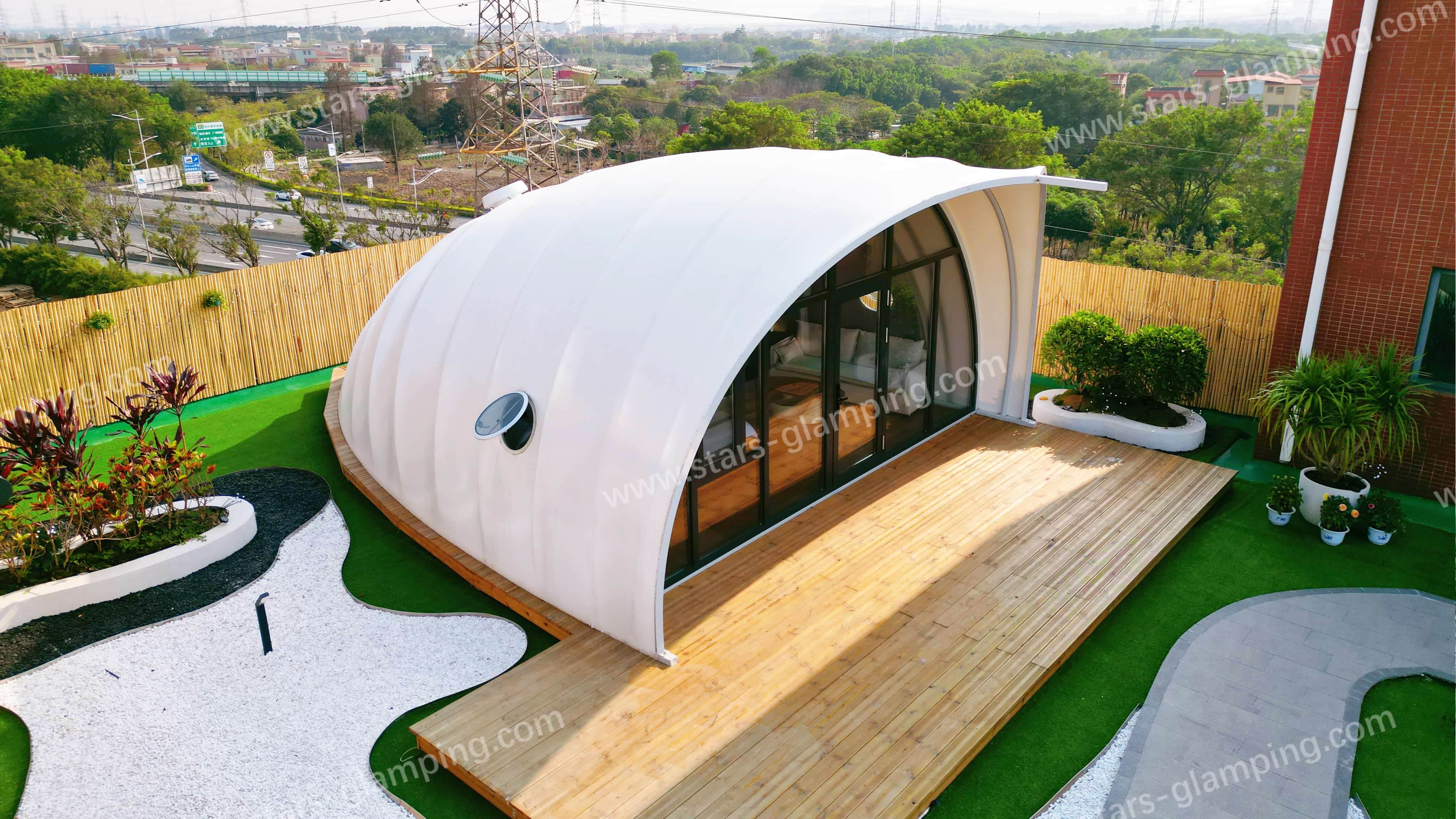
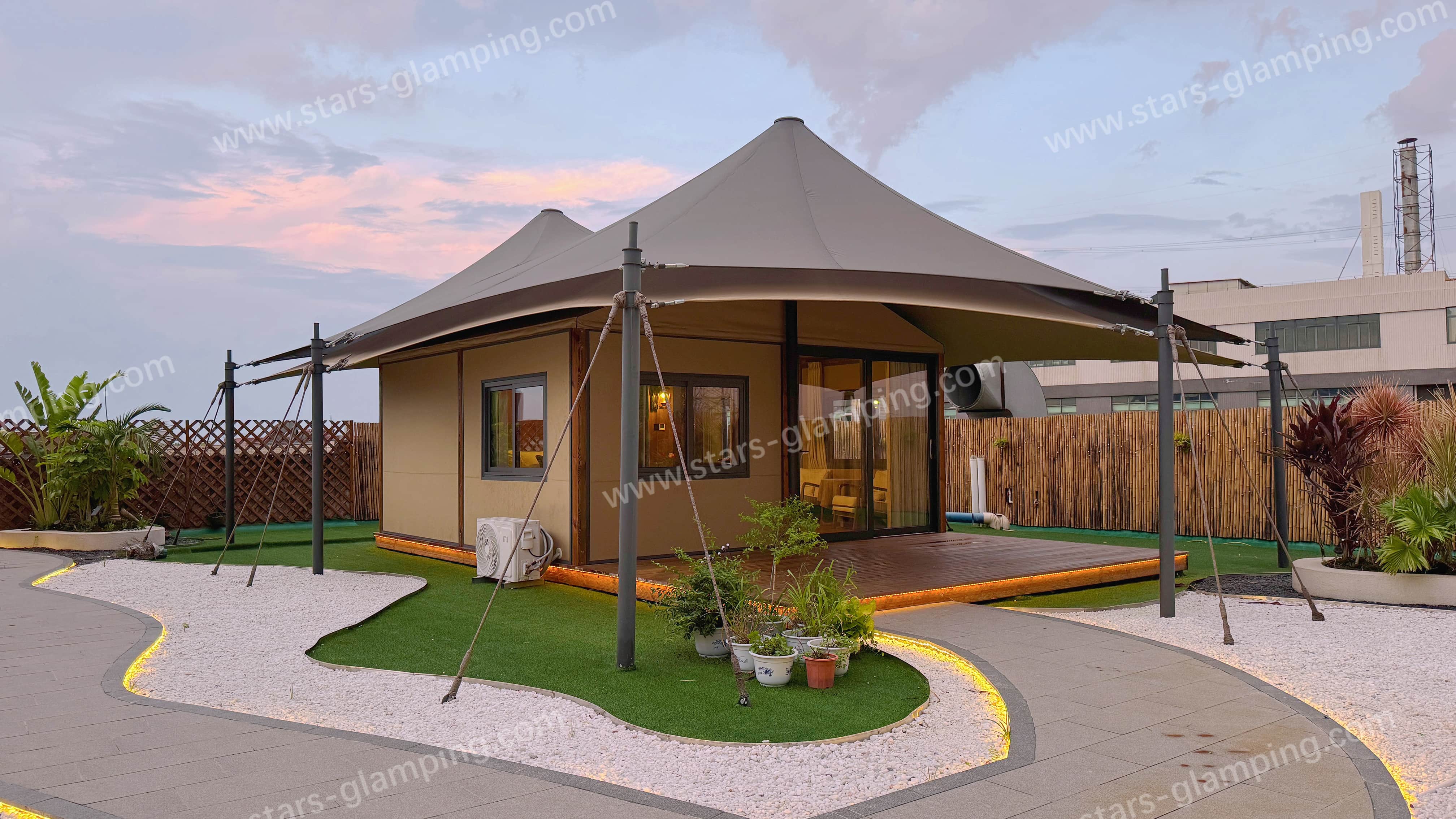
The company's luxury hotel tent portfolio includes several models: Luxury Tent - Pisces, Luxury Tent - Shell, Luxury Tent - Octagon, Luxury Tent - Villa, and Luxury Tent - Tethys. Each is designed as a permanent hotel tent structure for luxury hospitality, resort development, eco-tourism camps, and high-end outdoor accommodation systems.
Luxury Tent - Pisces features a frame composed of solid wood and steel pipe, with a cover material of 850g/m² PVC polyester fabric. It offers a waterproof rating of ≥5000mm H₂O, UV stabilization, B1/M2 fire retardancy, wind resistance up to 120km/h (Level 10), a snow load of 80kg/m², temperature resistance ranging from -30℃ to +70℃, and a service life of 10–15 years.
Luxury Tent - Shell, Octagon, Villa, and Tethys share a common construction: steel pipe frames with 1050g/m² PVDF architectural membrane fabric cover material and insulated glass wall systems. Their waterproof rating, UV protection, fire rating, wind resistance, snow load, and temperature resistance match the Pisces model, but their PVDF fabric provides a longer service life of 25–30 years. All models are engineered for permanent installation and all-season operation.
Application Scenarios
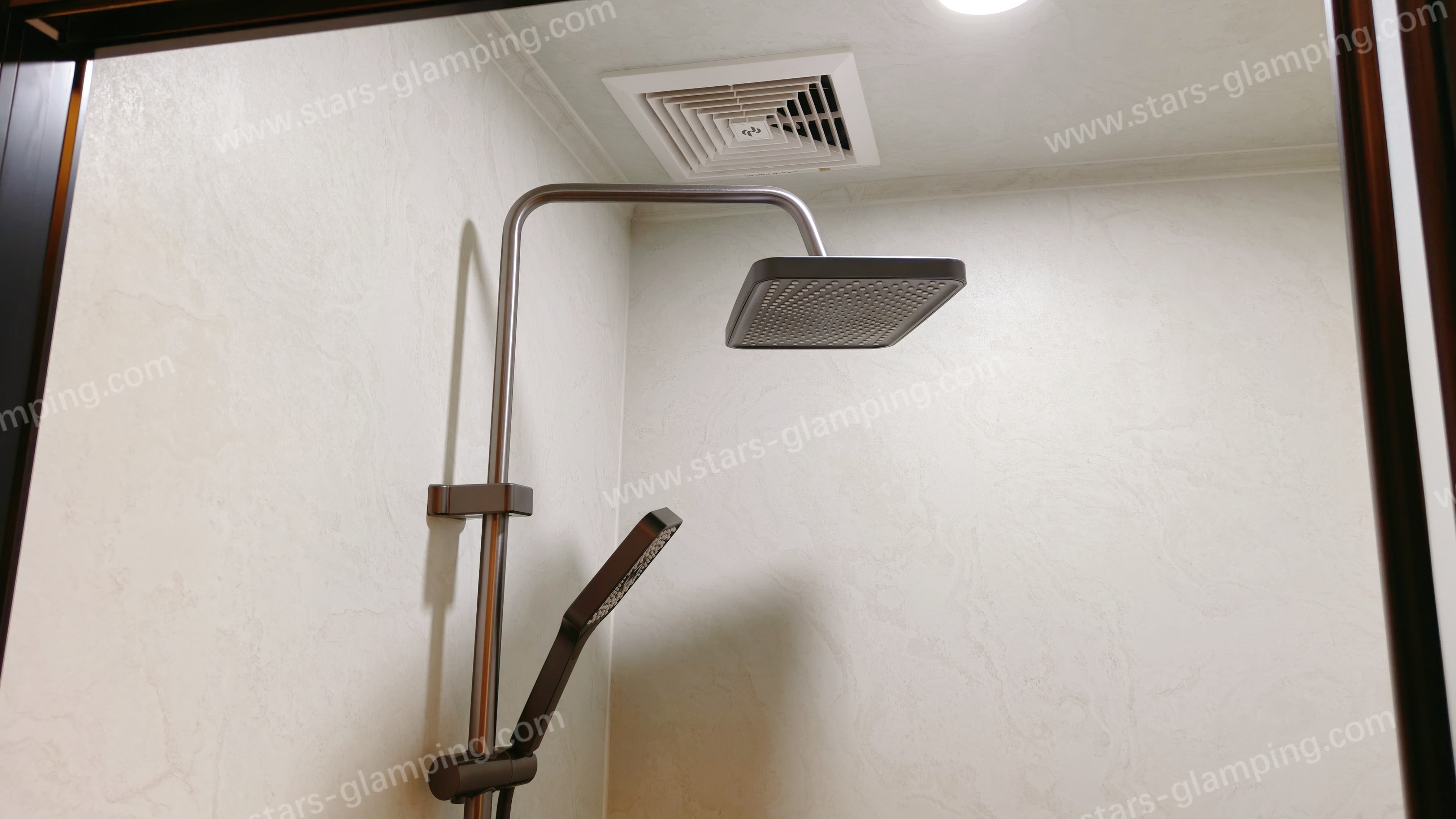
These luxury hotel tents are suitable for the luxury hospitality, resort, glamping resort, and eco-tourism industry. They function as guest accommodation for luxury resort and glamping hotel projects. The application scenario encompasses beachfront, desert climate, tropical rainforest, mountain areas, high humidity, strong wind, and all-weather conditions. This scenario is common in the United Arab Emirates, Saudi Arabia, Australia, Thailand, Indonesia, Malaysia, Bhutan, Canada, Algeria, Dominican Republic, India, Kenya, Morocco, Namibia, New Zealand, Oman, Tanzania, and Vietnam. The tents can be equipped with air conditioning systems, insulation lining, glass doors and panoramic windows, wooden flooring, bathroom modules, electrical and lighting systems, and curtain and shading systems.
Market Trend Analysis
The global demand for luxury hotel tents is driven by the expansion of eco-tourism and high-end glamping. According to the company's market data, its export ratio of 90% indicates strong international acceptance. Major markets include Southeast Asia, the Middle East, Africa, Europe, North America, South America, and Australia, reflecting a broad geographic distribution of projects requiring permanent tented accommodation.
Comparison with Traditional Hotel Construction
Compared to conventional hotel buildings, luxury hotel tents offer significant advantages in deployment speed, cost efficiency, and environmental footprint. They require minimal site preparation and can be installed in weeks rather than months. However, one honest limitation is that despite their robust engineering, the typical service life of 10–30 years (depending on model) may be shorter than that of permanent concrete structures, which can operate for several decades with proper maintenance. This makes the total cost of ownership a consideration for long-term fixed-asset investors.
Future Outlook
As sustainability and guest experience converge, luxury hotel tents are likely to become a standard offering for destination resorts. The industry is moving toward modular, reusable structures that comply with local building codes while offering design flexibility. Manufacturers with established R&D capabilities and global supply chains are positioned to lead this transition.
Frequently Asked Questions
- What is a Luxury Hotel Tent?
- A Luxury Hotel Tent, also known as a Glamping Resort Tent or Permanent Hotel Tent Structure, is designed for luxury hospitality, resort development, eco-tourism camps, and high-end outdoor accommodation systems.
- What materials are used in Stars Glamping luxury hotel tents?
- Models like Pisces use solid wood and steel frames with 850g/m² PVC polyester fabric. Models like Shell, Octagon, Villa, and Tethys use steel frames with 1050g/m² PVDF architectural membrane fabric and insulated glass wall systems.
- What is the typical lifespan of these tents?
- Depending on the model, service life ranges from 10–15 years (Pisces) to 25–30 years (Shell, Octagon, Villa, Tethys).
For a detailed technical overview and product specifications, download the company brochure: Stars Glamping Brochure (PDF).