
MC4 Connectors in Coastal Solar Farms: A Project-Fit Guide
MC4 Connectors in Coastal Solar Farms: A Project-Fit Guide
Coastal solar farms are not inland solar farms with a different postcode. Chloride-laden air, persistent humidity, wind-driven salt mist and repeated condensation cycles change which connector failure modes matter, and how quickly they appear. For EPCs and asset operators specifying DC wiring for a coastal array, the MC4 connector is among the smallest line items on the bill of materials and, in field practice, one of the more frequent triggers of unplanned O&M work.
This guide is written for the research-to-evaluation stage of a coastal project: what a connector specification has to answer when outdoor exposure is measured in years rather than months, what the 1000V Solar MC4 Connectors from Zhejiang Gutai Connector Co., Ltd. actually specify, and where the boundaries of that specification sit.
Zhejiang Gutai Connector Co., Ltd. (Gutai) is a Wenzhou, Zhejiang-based manufacturer of waterproof cable glands, solar MC4 connectors, mini waterproof boxes and connectors, and hose fitting series. Its MC4 line is produced under an ISO9001:2015 certified quality management system, and the Solar MC4 Connectors product is certified to UL 514B under File E539858, Volume 1, issued by UL Solutions.
Why coastal exposure rewrites the connector brief
Salt is the first variable. Airborne chloride deposits on every exposed surface, including polymer housings and metal terminals, and the deposit stays chemically active wherever moisture is present. Coastal sites rarely dry out completely: humidity, dew and rain keep a thin electrolyte film cycling across the connector interface, while day-to-night temperature swings pump air and moisture in and out of any sealing interface that is not stable under repeated compression.
Three mechanisms follow from that environment, and all three are widely recognised in outdoor electrical practice:
- Elastomer seals age. Sealing elements lose elasticity through compression set, heat and oxidation. Once a seal hardens, it stops following the cable and housing surfaces it is designed to close against, and the joint becomes a slow water path rather than a barrier.
- Metal surfaces oxidise. Terminal plating is the barrier between the copper alloy and the atmosphere. Where plating is thin, damaged or chemically unsuitable for a chloride environment, oxide layers build up and contact resistance rises.
- Polymer housings degrade under ultraviolet (UV) radiation. UV embrittles many polymers over time, and embrittlement at the locking interface is a mechanical reliability problem before it becomes an electrical one.
What makes a coastal project distinctive is not that these mechanisms exist — they exist inland as well — but that they run faster and in combination. Humidity accelerates corrosion that dry heat alone would slow, salt keeps the electrolyte present on the surface, and wind loading adds mechanical cycling on top of thermal cycling. A connector approved without objection on an inland rooftop array can behave very differently 800 metres from the shoreline.
The two failure modes that decide coastal connector performance
Procurement documents often reduce connector quality to a single ingress protection number. In coastal service, two failure modes matter more, and both are decided at the material level rather than by the rating label.
Aged seals
Seal ageing is the mechanism behind most late-life moisture ingress in outdoor DC joints. Gutai's published position on long-term outdoor PV connectors is specific on this point: its PV connector seals use silicone or fluororubber, and after 500 hours of ageing at 100 °C the seal hardness increases by only 5 Shore A with no cracking. Housings, in the same statement, use UV-resistant modified PA66 and pass 1,000-hour UV ageing tests.
For an EPC, the practical translation is straightforward: the seal compound and the housing polymer — not the IP number alone — determine whether the connector is still sealing in year five, and whether the locking geometry still holds. Ageing data of this kind is more useful in a coastal specification than a headline protection level, because it describes behaviour after exposure, not behaviour on delivery.
Oxidised terminals
Terminal oxidation is the second mechanism, and it is self-reinforcing. The same Gutai source describes terminals made from high-conductivity copper alloy with silver plating, selected for low contact resistance and strong oxidation resistance, combined with a dual seal ring and an anti-loosening structure. The datasheet figure for the 1000V MC4 line is a connector contact resistance of 0.5 mΩ.
Contact resistance is the metric that connects directly to coastal risk. Oxidation raises it; raised resistance produces local heat at the joint; heat accelerates seal ageing and drives further oxidation. On a coastal string, this is the loop that turns a minor material choice into a recurring maintenance item.
What the 1000V Solar MC4 Connector specifies
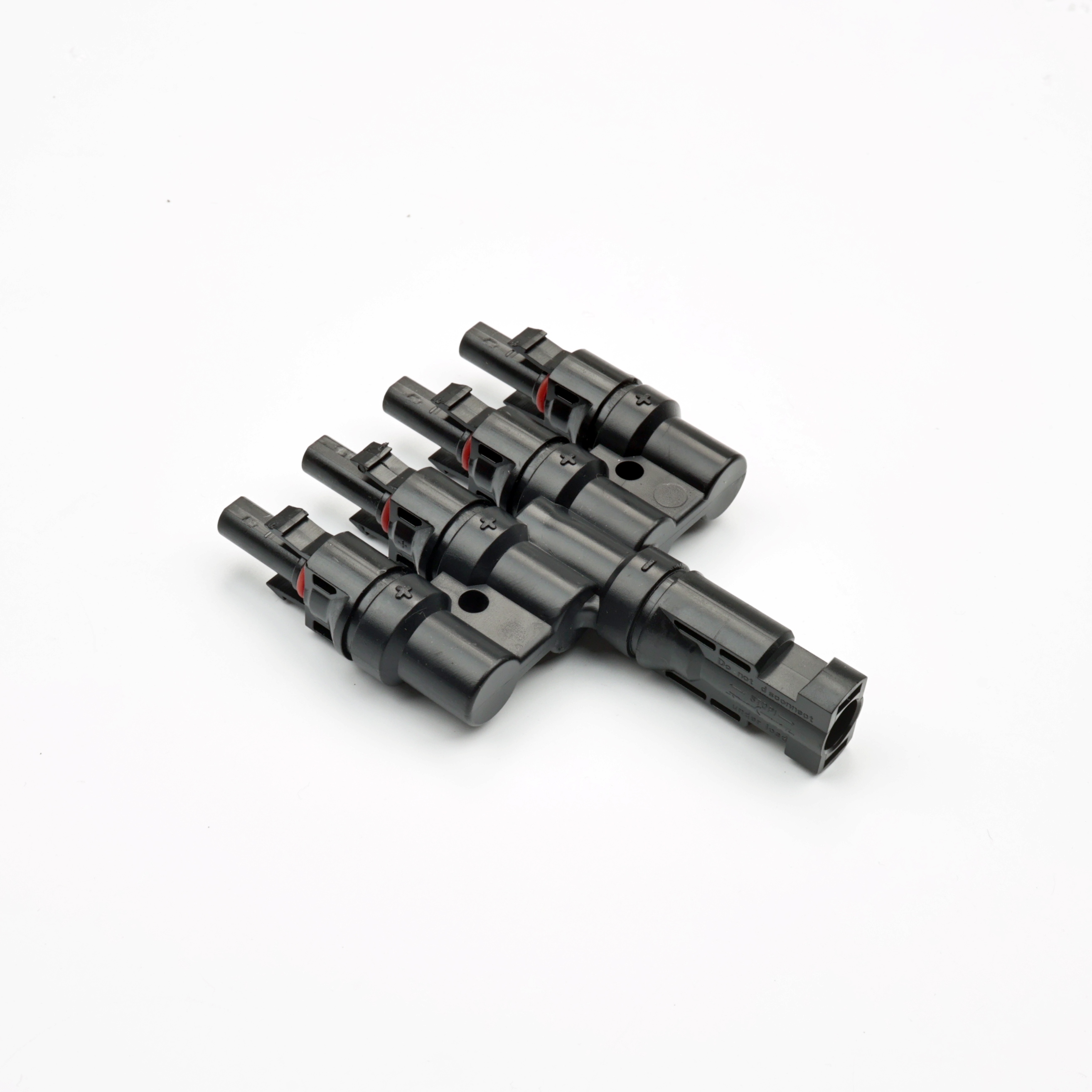
The following values are taken from the manufacturer's published specification for the 1000V Solar MC4 Connectors. The range also includes 1500V MC4 connectors, plus Y-type and T-type connectors used for branching and parallel arrangements in a string.
| Parameter | Specified value | Coastal relevance |
|---|---|---|
| Metal plug system | Φ2.5 mm, Φ4 mm, Φ6 mm | Determines the cable cross-sections that can be terminated correctly |
| Rated voltage | 1000 V DC | Must be matched to the string architecture; the range lists a separate 1500 V type |
| Rated current | 30 A (2.5 mm², 4 mm², 6 mm²; 14 AWG, 12 AWG, 10 AWG); 45 A (4 mm², 6 mm²; 12 AWG, 10 AWG) | Current loading interacts with ambient temperature and terminal heating |
| Test voltage | 6 kV (50 Hz, 1 min) | Dielectric margin of the mated joint |
| Ambient temperature range | −40 °C to +85 °C (IEC); −40 °F to +194 °F (UL) | Coastal tropical and temperate sites both fall inside the range, but site ambient plus conductor rise must be checked |
| Upper temperature limit | +105 °C (IEC) | The working ceiling for thermal design of the joint |
| Protection class | IP67 (mated condition) | Ingress protection applies when correctly mated, not to an open connector |
| Touch protection, unmated | IP2X | Relevant to commissioning and maintenance safety on open strings |
| Connector contact resistance | 0.5 mΩ | The baseline against which field degradation should be monitored |
| Safety class | II | Insulation class of the assembled connector |
| Terminal material | Tin-plated copper / silver-plated copper | Plating choice drives oxidation behaviour in chloride air |
| Insulation material | PC/PPO | Housing polymer governing UV and mechanical durability |
| Locking system | Snap-in | Field mating discipline determines whether IP67 is actually achieved |
| Flammability rating | UL-94-V0 | Fire behaviour of the housing material |
| Corrosion test class | IEC 60068-2-52 | The single most coastal-relevant line in the table |
The applicable-industry list for this product covers photovoltaic energy storage, lithium energy storage systems, new energy vehicles, AGV and industrial automation equipment, outdoor portable power stations, marine equipment, communication base stations, engineering machinery and other DC power connection scenarios. Marine equipment and coastal communication sites are worth noting: they share the same chloride environment as a coastal solar farm, which is why connector families qualified against those uses are often the ones coastal EPCs shortlist.
Why IEC 60068-2-52 matters more than a bare IP number
IP ratings and corrosion class describe different things. The IP code, defined in IEC 60529, describes protection against the ingress of solids and water; IP68, the benchmark for waterproof connectors, requires a device to withstand continuous immersion in water under specified conditions. That rating is valuable, but it describes a test exposure, not the chemistry of the environment.
IEC 60068-2-52 belongs to the IEC environmental testing series and addresses cyclic salt mist testing. For a coastal array, that is the exposure that actually distinguishes a site: salt deposited, wetted, dried and re-wetted over repeated cycles. A connector line that states a cyclic salt-mist corrosion class is answering the coastal question directly, whereas a connector line that states only an IP rating is answering a different one.
This is also where the specification's limits begin. The 1000V MC4 line is rated IP67 in the mated condition, with IP2X touch protection when unmated. IP67 is not a submersion rating. Where a coastal design anticipates standing water, tidal splash or enclosure flooding — for example at a low-mounted combiner box — the correct response is an enclosure-level or product-level solution intended for that case, not an assumption that a mated IP67 joint is immersion-proof. Gutai's cable gland families, by contrast, are certified with a protection level of IP68 and are resistant to salt spray, acid, alkali, alcohol, grease and common solvents, which is why they are typically specified at the enclosure entry rather than at the module-level joint.
Certification evidence an EPC can verify in a bid package
For coastal projects, certification is not a formality — it is the traceable part of the quality claim. The following items are stated in Gutai's certification documentation and can be checked against the certificate images and file numbers.
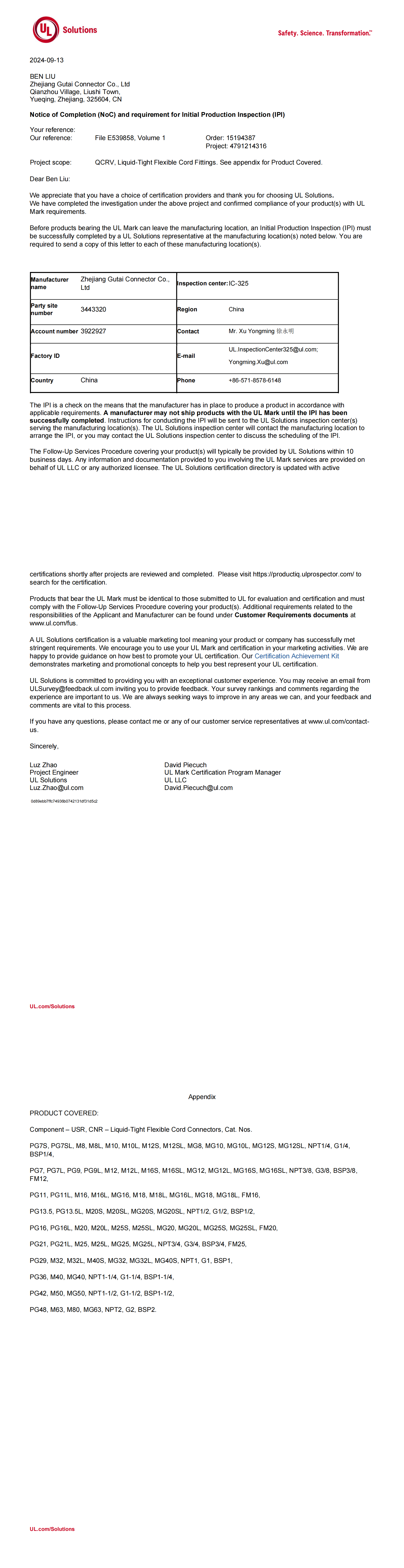
- UL / UL 514B. The Solar MC4 Connectors product is certified to UL standards. The applicable standard is UL 514B, the certification is issued by UL Solutions, and the certification number is File E539858, Volume 1. The certification is stated to apply to the global market. The associated UL Notice of Completion is dated 13 September 2024 and covers liquid-tight flexible cord fittings (USR, CNR series).
- ISO 9001:2015. Production is carried out under a quality management system certified to ISO 9001:2015, standard GB/T19001-2016 / ISO9001:2015, registration number 04324Q31620R0S, issued by Beijing United Intelligence Certification Co., Ltd., covering the production of cable waterproof joints, valid from 2 July 2024 to 1 July 2027 and applicable globally.
- RoHS. An SGS test report, report number NGBEC26005747401, issued by SGS-CSTC Standards Technical Services (Ningbo) Co., Ltd. for NYLON CABLE GLAND, references the EU RoHS Directive (EU) 2015/863 amending Annex II to Directive 2011/65/EU, issued 13 July 2026.
- CE / EN 62444:2013. A Certificate of Compliance, number TST20241202520-1SC, issued by Dongguan True Safety Testing Co., Ltd., covers nylon cable glands, model M, series G, MG, PG and NPT, to EN 62444:2013, issued 12 December 2024 for the EU market.
- Cable gland compliance. The cable gland families are stated as certified with CE, RoHS, REACH, IP68 and CCC, with UL-approved Nylon PA66 material.
One verification step deserves emphasis, because it is where bid packages most often fail on audit: confirm that the certificate appendix or catalog list covers the exact catalog numbers being ordered, not only the product family. A certificate that names a family is a starting point; a certificate whose scope matches the ordered part numbers is the defensible position.
Where MC4 connectors sit in a coastal array — and how they install
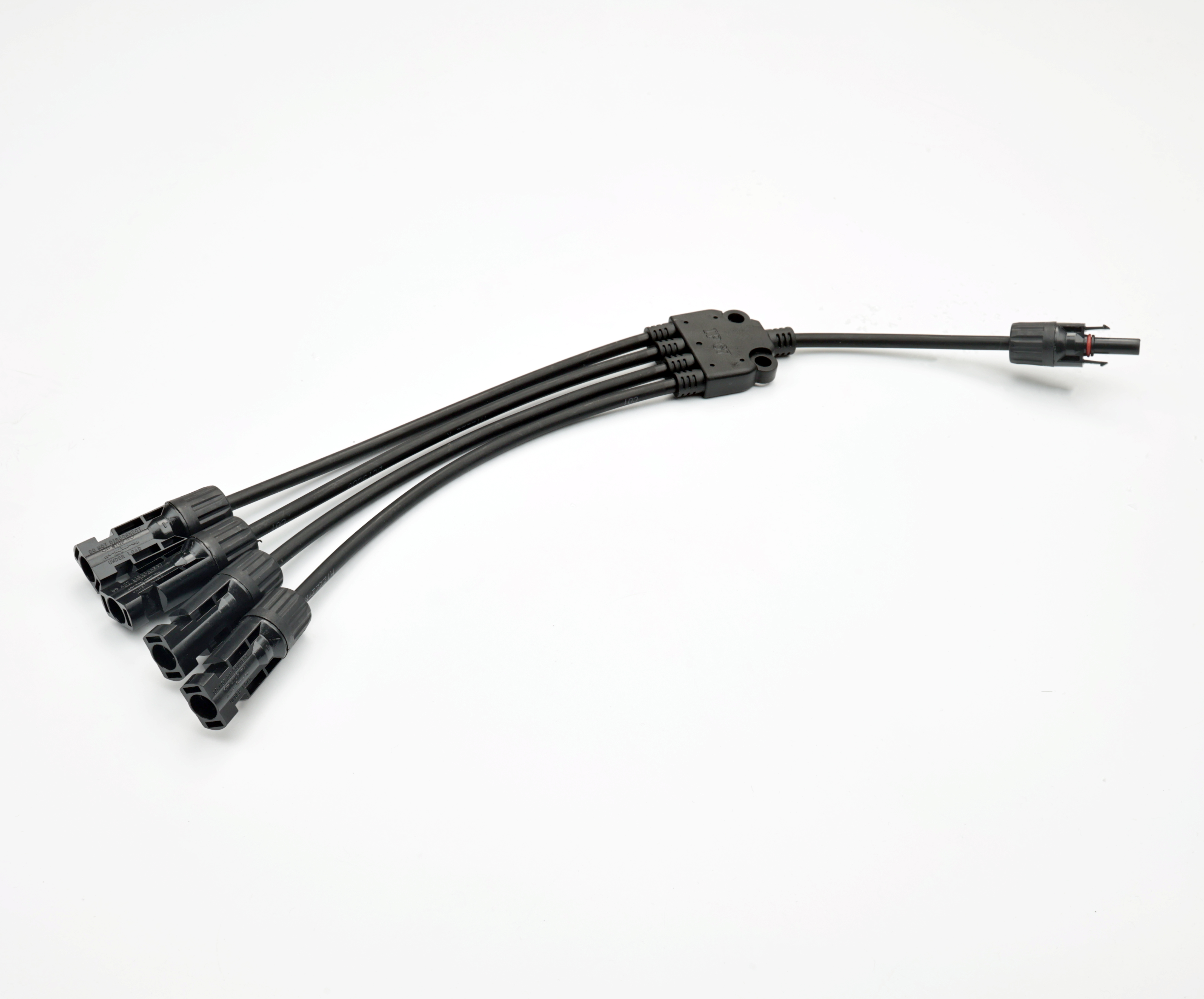
The functional role of a PV connector is not complicated: it seals the cable entry, blocks water and dust, provides mechanical fixation and strain relief, and maintains a reliable electrical connection over years of outdoor operation. In practice, coastal arrays use these connectors across several distinct locations, and each location carries a different exposure profile.
- Module-level and string connections. The highest count of mated interfaces, fully exposed to wind-driven mist and UV. Y-type and T-type connectors in the MC4 range are used here for branching and parallel arrangements.
- Combiner box, junction box and inverter DC entries. These entries are normally made through cable glands rather than MC4 joints. Gutai's cable gland range covers Metric thread sizes M12–M63 and PG thread sizes PG7–48, with cable ranges from 3 to 45 mm, nylon PA66 and NBR construction, static operating temperatures of −40 °C to 100 °C with peaks to 120 °C, and IP68 protection. Waterproof junction boxes and watertight corrugated connectors are used alongside them where conduit routing is required.
- Energy storage and auxiliary DC systems. The product's applicable-industry list includes lithium energy storage systems, outdoor portable power stations, marine equipment and communication base stations — all environments where moisture and salt exposure are design constraints rather than exceptions.
Gutai's production model is manufacturing at volume with OEM/ODM customisation: size and thread specifications, materials (nylon, brass, stainless steel), colour, packaging and OEM labelling, multi-hole layouts and specific seal customisations. Published monthly capacity is 100,000 sets for MC4 connectors and 500,000 pieces for cable glands, with small trial orders acceptable and 100% full dimension inspection as the stated quality-control step. For a coastal rollout phased over several construction seasons, that combination — a documented bill of materials, small-order sampling, then volume supply — is the usual way EPCs de-risk a new connector source.
Two field cases that bracket the exposure range
Coastal high-salt-fog deployment (Europe, Germany). A coastal open-air EV charging project deployed 5,000 sets of IP68-grade metal waterproof connectors for outdoor DC fast charging piles. The connectors were specified for high-salt fog, strong sea wind and high-frequency vibration, using 304 stainless steel and a dual-seal anti-loosening structure, and passing a 1,000-hour salt spray test and an IEC 60068-2-6 vibration test. Over 18 months, the connector-related electrical failure rate moved from 18% annually to 2.6%, annual maintenance cost per station fell from over 500 RMB to below 80 RMB, and new-station installation efficiency improved by 35%. The relevant lesson for a solar farm is not the product category — these were charging-pile connectors, not MC4 joints — but the mechanism: when the seal system and the metal choice are matched to salt fog, the failure curve changes materially.
Desert deployment (Middle East, Saudi Arabia). A large Middle Eastern PV developer took 20,000 sets of anti-UV modified PA66 photovoltaic connectors for a 150 MW desert plant. Over three years, connector damage fell from 8% annually with the original imported products to below 1.2%, downtime caused by connection failures dropped by 70%, and cumulative savings in maintenance and generation losses exceeded USD 80,000. The housings passed 1,000-hour UV ageing tests, seals used high-temperature fluororubber, and silver-plated terminals held contact resistance at low levels under 70 °C surface heat and wind-sand erosion.
Desert and coast apply opposite stressors — UV and heat on one side, chloride and humidity on the other — but both cases point to the same purchasing conclusion: the material specification matched to the site condition, not the generic connector category, drives field outcomes. A coastal EPC should read the desert case as evidence of material discipline under UV and thermal load, and the European case as evidence of seal and metal discipline under salt fog.
Traditional approaches versus a project-fit specification
Three approaches are common on coastal projects. Each gets part of the answer right, and each has a documented boundary.
| Approach | What it gets right | Where it breaks down at the coast |
|---|---|---|
| Reusing a general-purpose IP67 connector already approved on inland projects | Familiar, available, often already in the EPC's approved-vendor list | The approval was based on a different exposure. Without a stated cyclic salt-mist class or seal-ageing data, the coastal behaviour of the seal compound and terminal plating is unknown rather than known-good. |
| Field-taped or gel-filled joints over standard connectors | Fast, low material cost, and it visually seals the joint | Tape and gel are not part of the connector's specified ingress protection, they cannot be verified against a test standard, and they conceal rather than prevent terminal oxidation. Re-entry for inspection also becomes destructive. |
| Specifying a connector line with a stated corrosion class and certificate file numbers | Gives an auditable link between the site environment, the material specification and third-party documentation | Requires more work at the specification stage, and the documentation has to be checked against the exact catalog numbers ordered. It also does not eliminate installation discipline as a variable. |
Limits and boundaries of the 1000V MC4 specification
Any honest project-fit discussion has to state where the specification stops:
- IP67 applies to the mated condition, and it is not a submersion rating. IP2X applies to the unmated state. Designs that anticipate standing water, flooding or immersion at the connector location need an enclosure-level or product-level solution, not a mated IP67 joint.
- The 1000V model must not be substituted into a 1500V string architecture. The range lists 1500V MC4 connectors as a separate type for a reason; the voltage rating is a system design input, not a preference.
- The temperature window has a ceiling. The ambient range is −40 °C to +85 °C (IEC) with an upper temperature limit of +105 °C (IEC). On a hot coastal site carrying high string current, ambient plus conductor temperature rise has to be evaluated against that ceiling rather than assumed.
- Snap-in locking depends on field execution. A connector that is not fully engaged cannot deliver its specified ingress protection, and generic practice across the industry is to avoid mating connector systems from different manufacturers within one joint unless the combination has been qualified.
- Certification scope must be read precisely. The UL documentation is issued against UL 514B under File E539858, Volume 1, and the associated Notice of Completion is scoped to liquid-tight flexible cord fittings. Buyers should confirm that the appendix catalog numbers cover the specific MC4 catalog numbers on the purchase order.
- Range-level statements should be reconciled with the component datasheet. Gutai's published statements about its core products reference CE, RoHS, REACH and IP68 protection-level testing, while the 1000V MC4 datasheet specifies IP67 in the mated condition. Both can be accurate statements about different products; the buyer's job is to confirm which one applies to the item being purchased.
None of these limits makes the specification unsuitable for coastal work. They define the conditions under which it is a correct choice, which is what a project-fit decision requires.
Market trend analysis: what the numbers say about coastal sourcing
Published market data supports the direction of travel, though as always the definitions behind the numbers matter.
- The global cable glands market was valued at approximately USD 2.16 billion to USD 2.25 billion in 2024–2025, with growth forecasts varying between USD 3.07 billion and USD 4.96 billion by 2034 (Straits Research / Spherical Insights). Other published estimates diverge — Dataintelo cites around USD 2.5 billion and Spherical Insights USD 1.79 billion — which reflects differences in scope and methodology rather than a disagreement about demand direction.
- The global waterproof connector market is valued at approximately USD 13.4 billion in 2024 and is projected to reach USD 25.48 billion by 2033, a CAGR of 7.4% (AOHUA / Industry Intelligence).
- The global solar PV connectors market is valued at USD 1.31 billion in 2024, with MC4 connectors dominating the segment at a 68% market share, approximately USD 0.89 billion (Global Market Insights).
- Asia Pacific is the leading regional market for cable glands, accounting for approximately 38% to 42% of global revenue, driven primarily by industrialisation in China and India (Dataintelo / Straits Research).
- Leading global competitors in the cable gland and connector sector include ABB Ltd., Eaton Corporation, Amphenol Corporation, LAPP Group and HUMMEL AG (Mordor Intelligence / Market Growth Reports).
- On the standards side, IEC 62444 (and EN 62444) governs the construction and performance requirements for cable glands used in electrical installations, replacing the older BS EN 50262; IP68 is defined under IEC 60529 as withstanding continuous immersion in water under specified conditions.
Read together, these figures describe a component category growing at a steady rate alongside the build-out of PV, storage and charging infrastructure, with a concentrated MC4 share inside the PV connector segment. What they do not show is how that volume is distributed between commodity connectors and connectors specified against a site condition. That distinction is being made in procurement documents rather than in market totals — and it is where coastal projects diverge from the average.
Future outlook
Three shifts are visible in how coastal and marine-adjacent projects specify connectors.
Specification is moving from a rating label to a material dossier. A bare IP number is no longer sufficient for a salt-exposed site, because it does not describe seal ageing, housing UV stability or terminal plating behaviour. Buyers increasingly ask for the corrosion test class, the seal compound, the terminal plating and the certificate file numbers in one package — the same set of items set out in the checklist below.
Certification file numbers are becoming bid-document items. File and registration numbers such as UL 514B File E539858, Volume 1, and ISO 9001:2015 registration 04324Q31620R0S are moving from the quality annex into the evaluation matrix, because they are auditable in a way that catalogue descriptions are not.
Lifecycle cost logic is displacing unit-price logic. Both field cases described above report the same pattern: the connector that costs the least at purchase can carry the highest cost in O&M. On coastal sites, where access for maintenance is expensive and generation downtime is unbudgeted, the economics favour documented material performance. That is the same logic that drives demand for UV-stabilised PA66 housings, fluororubber or silicone seals, and silver-plated copper-alloy terminals in the coastal product mix.
Coastal project-fit checklist
| Criterion | What to request from the supplier |
|---|---|
| Corrosion / salt-mist test class | The stated corrosion test class for the exact catalog number — for the 1000V MC4 line, IEC 60068-2-52 |
| Seal material and ageing data | Seal compound (silicone or fluororubber) and hardness change after high-temperature ageing — stated example: +5 Shore A after 500 hours at 100 °C, no cracking |
| Housing material and UV data | UV-resistant modified PA66 and the UV ageing test duration — stated example: 1,000-hour UV ageing |
| Terminal plating and contact resistance | Silver-plated or tin-plated copper alloy, with the contact resistance figure — stated value for the 1000V MC4 line: 0.5 mΩ |
| Ingress protection, stated separately | Mated rating (IP67) and unmated touch protection (IP2X), plus confirmation of whether an IP68 product is required at that location |
| Voltage rating versus string design | Confirmation of the 1000 V DC or 1500 V type that matches the array architecture |
| Temperature window versus site | −40 °C to +85 °C (IEC) ambient range with a +105 °C upper limit, checked against site ambient plus conductor rise |
| Certificate file numbers | UL 514B File E539858, Volume 1; ISO 9001:2015 Registration No. 04324Q31620R0S; RoHS report NGBEC26005747401; CE certificate TST20241202520-1SC for gland entries |
| Scope match | Confirmation that the certificate appendix or catalogue covers the exact catalog numbers on the order |
| Quality control and supply terms | 100% full dimension inspection; stated monthly capacity (MC4 100,000 sets; cable glands 500,000 pieces); acceptance of small trial orders |
Frequently asked questions
How can a buyer verify that PV connectors will not develop aged seals or oxidised terminals after long-term outdoor exposure?
Ask for material-level evidence rather than a rating alone. In Gutai's published technical position, PV connector housings use UV-resistant modified PA66 and pass 1,000-hour UV ageing tests; seals are made of silicone or fluororubber, with hardness increasing by only 5 Shore A and no cracking after 500 hours of ageing at 100 °C; and terminals use a high-conductivity copper alloy with silver plating for low contact resistance and strong oxidation resistance, combined with a dual seal ring and an anti-loosening structure. The verification step is to obtain these statements with their test conditions, and to confirm that the certificate scope and datasheet cover the exact catalog number being purchased.
Are Gutai connectors TÜV certified, and can test reports to IEC 62852 or EN 50521 be provided?
Gutai's stated certification position is that its core products have passed CE, RoHS, REACH and IP68 protection-level tests, meeting operating conditions from −40 °C to 120 °C with a stated average MTBF exceeding 8,000 hours. For PV-connector-specific requirements, the company states that it can provide pre-test data and certification path planning compliant with IEC 62852, supporting customers to complete full testing through domestic authorised laboratories for entry into European and American markets. Those are path-planning and pre-test statements, not a claim of holding a completed IEC 62852 certificate, so a buyer who requires the certificate itself should treat testing as a project milestone rather than an existing document. Buyers should also reconcile range-level statements such as the −40 °C to 120 °C figure with the individual product datasheet, which for the 1000V MC4 line lists −40 °C to +85 °C (IEC) with a +105 °C upper limit.
What protection rating applies to the 1000V MC4 connector, and is IP67 the same as waterproof for submersion?
The published datasheet for the 1000V Solar MC4 Connectors specifies IP67 in the mated condition and IP2X touch protection in the unmated state. IP67 and IP68 are different ratings: IP68, defined under IEC 60529, is the benchmark for waterproof connectors and requires a device to withstand continuous immersion in water under specified conditions. IP67 is not a submersion rating. Where a coastal design anticipates standing water or enclosure flooding, an enclosure-level or product-level solution rated for that case should be specified — Gutai's cable gland families, for example, are certified with an IP68 protection level and are stated as resistant to salt spray, acid, alkali, alcohol, grease and common solvents.
Which corrosion or salt-mist test standard is relevant when specifying connectors for a coastal farm?
The corrosion test class stated for the 1000V Solar MC4 Connectors is IEC 60068-2-52. IEC 60068-2-52 belongs to the IEC environmental testing series and addresses cyclic salt mist testing, which is the exposure pattern that distinguishes a coastal site: salt deposited, wetted, dried and re-wetted over repeated cycles. This is a different question from the ingress protection rating, which is defined under IEC 60529 and describes protection against solids and water rather than chemical exposure. For a coastal specification, both should be stated separately, and neither should be used as a substitute for the other.
Which certifications and file numbers can an EPC check for the MC4 line and related cable entries?
The Solar MC4 Connectors product is certified to UL standards, applicable standard UL 514B, issued by UL Solutions, certification number File E539858, Volume 1, stated to apply to the global market; the associated UL Notice of Completion is dated 13 September 2024 and covers liquid-tight flexible cord fittings. Production runs under an ISO 9001:2015 certified quality management system, registration number 04324Q31620R0S, issued by Beijing United Intelligence Certification Co., Ltd., valid from 2 July 2024 to 1 July 2027. An SGS RoHS test report, number NGBEC26005747401, was issued by SGS-CSTC Standards Technical Services (Ningbo) Co., Ltd. CE certification for the PG cable gland series, certificate number TST20241202520-1SC to EN 62444:2013, was issued by Dongguan True Safety Testing Co., Ltd. For each document, the buyer should verify that the appendix or catalogue scope covers the specific catalog numbers ordered.
Verification before commitment
For a coastal solar farm, the MC4 connector decision is a small line in the budget and a large variable in the O&M forecast. The project-fit approach is unglamorous but effective: state the site exposure, ask for material-level evidence against it, verify the certificate scope against the exact part numbers, and confirm the voltage and temperature ratings against the string design. The 1000V Solar MC4 Connectors from Zhejiang Gutai Connector Co., Ltd. provide a documented basis for that work — a stated corrosion test class under IEC 60068-2-52, published ageing data for seals and housings, a defined contact resistance, and UL 514B certification under File E539858, Volume 1 — alongside clearly stated boundaries, including an IP67 mated rating that should not be read as a submersion rating and a 1000 V DC rating that should not be substituted into a 1500 V architecture.
Gutai's full product catalogue, covering solar MC4 connectors, cable glands and waterproof connector accessories, is available for download: https://cdn.socialarks.com/sbsp/25129/common/2026/0731/2025%E6%9C%80%E6%96%B0%E5%9B%BA%E5%A4%AA%E6%A0%B7%E6%9C%AC%E5%86%8C.PDF