
MCPCB Supplier Evidence: WODE's R&D Team, Patents and Certifications
MCPCB Supplier Evidence: WODE's R&D Team, Patents and Certifications
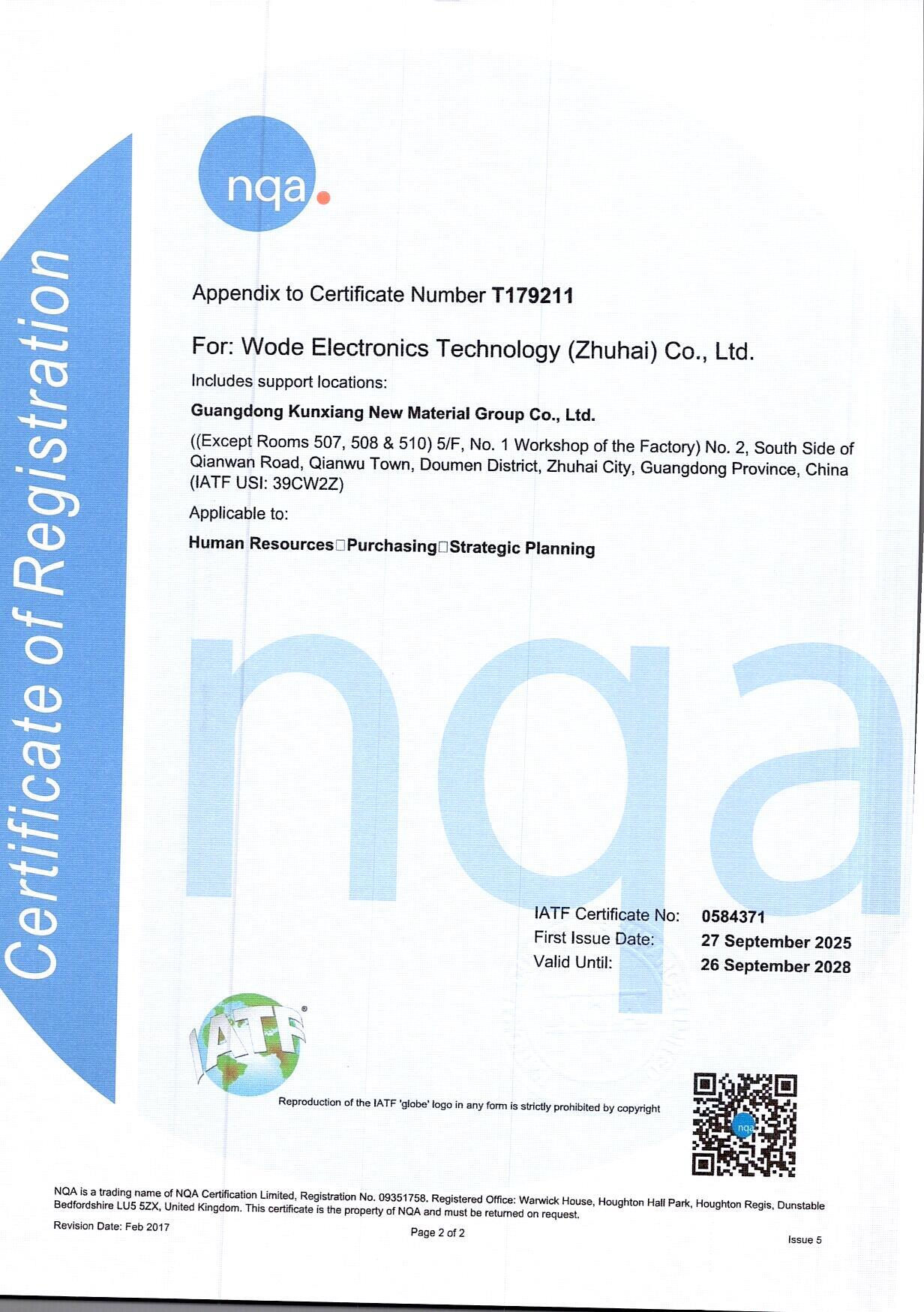
IATF16949 certificate 0584371, issued by NQA Certification Limited, covers human resources, purchasing and strategic planning for automotive printed circuit board manufacturing at WODE Circuit Technology (Zhuhai) Co., Ltd.
Metal core PCB (MCPCB) sourcing in lighting, power electronics and automotive programs has shifted from price-led negotiation to documentation-led evaluation. Buyers now ask suppliers to prove what they claim: who runs the engineering process, which standards the plant is certified against, which model numbers sit inside a safety recognition, and which environmental test reports are still current.
This industry reference examines the published evidence base of one MCPCB manufacturer, WODE Circuit Technology (Zhuhai) Co., Ltd., across three dimensions that evaluation-stage buyers typically screen: R&D depth, patented technology, and third-party certification. The purpose is not to rank suppliers. It is to show what verifiable supplier evidence looks like in this category, and where the boundaries of that evidence lie.
Why MCPCB Supplier Claims Are Harder to Verify Than They Look
The central problem in MCPCB procurement is not a shortage of claims. It is a shortage of scope. A supplier page may state that a factory is “UL certified” or “IATF16949 certified,” while the underlying documents are bounded in ways that matter commercially: UL recognition normally applies to specific model numbers and board constructions; IATF16949 applies to defined processes and named sites rather than to every product a plant ships; and REACH or RoHS documentation applies to a specific material combination tested at a specific point in time.
For buyers at the evaluation stage, that produces three practical questions:
- Which construction is actually inside the certificate scope, and which models are excluded?
- Who issued the document, and under which reference number can it be checked?
- When was it issued, and when does it need re-verification?
WODE Circuit Technology: Entity and Manufacturing Evidence
WODE Circuit Technology (Zhuhai) Co., Ltd. is a Chinese printed circuit board manufacturer founded in 2003 and based in Zhuhai, Guangdong Province. The company produces rigid metal core PCBs (MCPCB), flexible printed circuit boards (FPCB), reel-to-reel infinity length FPCB, FR-4, CEM1 and CEM3 boards and copper clad laminate (CCL), along with PCB inks.
Its published manufacturing profile includes a 150,000 m² factory, more than 500 employees and an annual output of 6,000,000 sqm, with monthly capacity stated at 600,000 sqm. The company reports an export ratio of 50 percent, main markets in Brazil, Turkey, India, Vietnam and Russia, and more than 1,000 customers across more than 30 countries.
Production is organised around OEM and ODM models. Documented customisation options include laminate selection, PCB thickness, surface treatment, solder mask color and logo printing. Quality control is described as 100 percent testing, with a stated lead time of 7–15 days, a minimum order quantity of 80 sqm for mass orders, and no limit on sample quantity. After-sales support is delivered remotely.
R&D Depth and Patent Position Behind the MCPCB Line
The engineering resource behind WODE’s MCPCB line is stated as a 15-person R&D team. In metal core board manufacturing, a team of that size is typically engaged in stack-up and dielectric selection, base material matching, surface finish decisions and custom laminate programs rather than in pure product research. Practically, this is the function that converts a buyer’s thermal and mechanical requirement into a manufacturable construction.
That capability matters because MCPCB performance is driven largely by two variables: the metal base and the dielectric layer that separates it from the copper circuit. WODE’s product range reflects this directly. Documented base materials and constructions include aluminium alloys Al1060, Al5052 and Al1, copper-based thermoelectric separated boards, and ceramic substrates, with surface finishes spanning HASL, HASL-LF and OSP.
The company also lists own CCL production capacity among its differentiators, alongside a broad product line covering flexible, rigid, multilayer and aluminium boards. For buyers, in-house laminate capacity is usually evaluated as a supply-continuity and material-traceability factor rather than as a performance claim in itself.
On intellectual property, WODE’s company profile states that it holds more than 40 patented technologies and describes itself as maintaining a focus on PCB and FPC development since 2003. No patent schedule, claim list or jurisdiction breakdown is published in the reviewed material. Buyers who need claim-level verification should therefore request the patent list directly rather than treating the aggregate figure as a technical specification.
Certification Portfolio: Numbers, Scope and Validity
The most checkable part of WODE’s evidence base is its certification set. The table below reproduces the identifiers, issuing bodies, standards and scopes as published by the company.
| Certification / standard | Certificate number & issuing body | Issue / validity | Scope as stated |
|---|---|---|---|
| ISO 9001:2015 (GB/T19001-2016) | 51325Q4258ROM — Shenzhen Meiao Testing and Certification Co., Ltd | Issued 2025-10-13; valid to 2028-10-12 | Production of circuit boards (IAF Code: 19) |
| ISO 14001:2015 (GB/T24001-2016) | 51325E2142ROM — Shenzhen Meiao Testing and Certification Co., Ltd | Issued 2025-10-13; valid to 2028-10-12 | Environmental management activities related to the production of circuit boards (IAF Code: 19) |
| IATF16949 | 0584371 — NQA Certification Limited | Issued 2025-09-27; valid to 2028-09-26 | Human resources, purchasing and strategic planning for automotive printed circuit board manufacturing; support site: Guangdong Kunxiang New Material Group Co., Ltd. |
| UL 796 — rigid boards | E323980 — UL Solution | Issued 2022-01-01 | Single layer metal base printed wiring board (WD-14, WD-15, WD-16, WD-17); single layer rigid printed wiring board (RXD-11, WD-12, WD-13, RXD-10) |
| UL 796F and IPC-TM-650 2.6.27 — flexible boards | E498836 — UL Solution | Issued 2022-01-01 | Single layer FMIC flexible printed circuit, models WD-F1 and WD-F2 (ASP1) |
| CQC (GB 4943.1-2022) | CQC22001367683 — China Quality Certification Centre | Issued 2026-01-13; valid to 2027-11-16 | Printed circuit board with four substrate types (22F CEM1 5152, CEM-1, FR-4 GF211, FR-4 KB6160), thickness 0.2–3.2 mm, V-0 flammability |
| EU REACH Regulation (EC) No 1907/2006, ECHA SVHC candidate list | DGC251204025BD03 — NSTL | Issued 2025-12-10 | Test report on SVHC substances and resorcinol for double sided aluminium-based board |
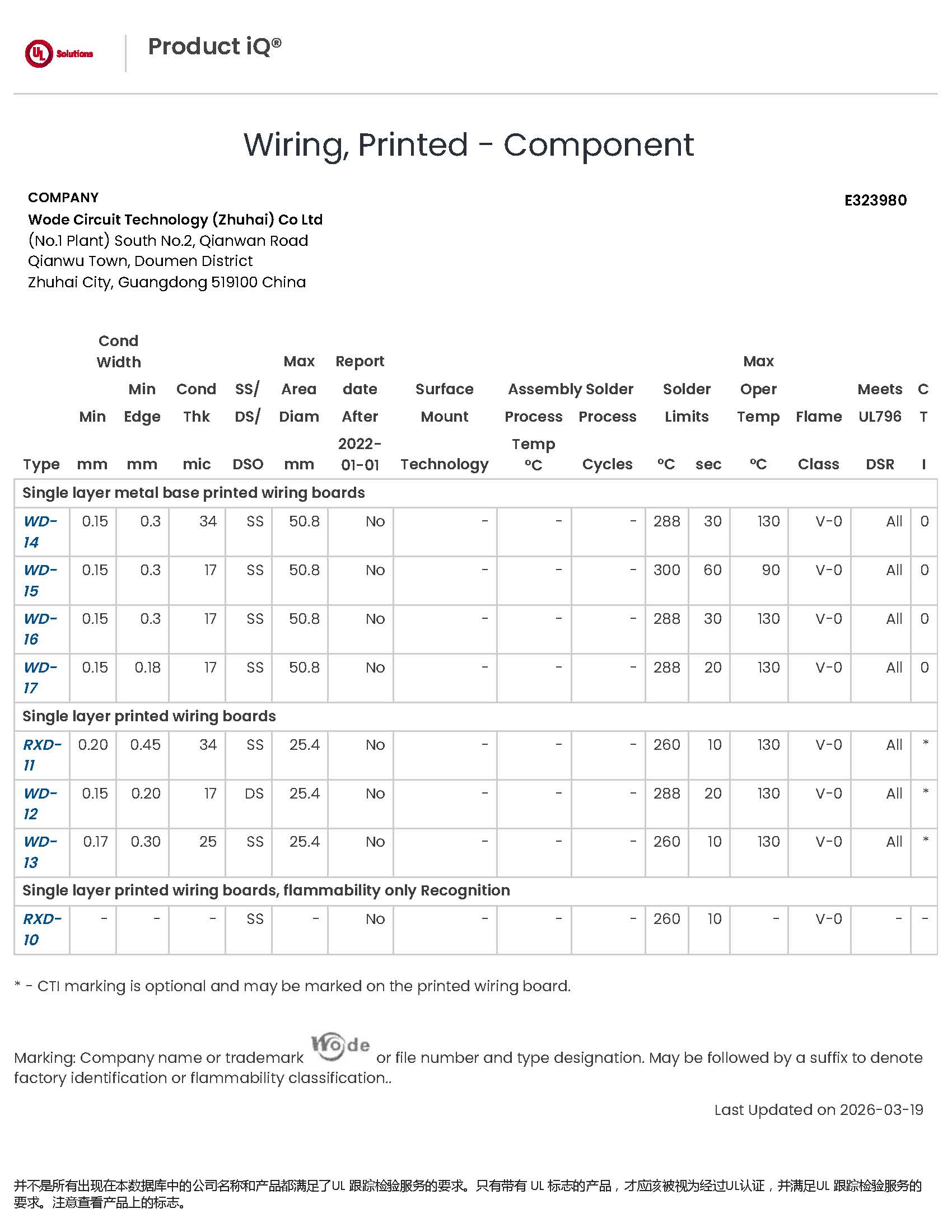
UL recognition E323980 (UL 796) lists the specific single layer metal base printed wiring board models covered by WODE’s rigid board recognition.
Read together, the set covers four distinct regulatory layers. ISO 9001:2015 and ISO 14001:2015 address management systems for circuit board production and its environmental aspects. IATF16949 addresses automotive-oriented process discipline in defined functions. UL recognition addresses product safety for named model families. CQC and the REACH test report address Chinese market safety certification and EU substance control respectively.
WODE’s company profile additionally states that products comply with UL, RoHS and REACH standards, which aligns with the UL recognition numbers and the REACH test report above.
Application Fit: Where the Evidence Meets Real Programs
Certificates establish capability; product data determines fit. The table below summarises the MCPCB families WODE documents, with their published parameters.
| Product family | Base material / construction | Documented parameters |
|---|---|---|
| MCPCB for Road Lighting | Al1060, single sided | 1 oz copper; 1.6 mm ±10%; 208.00 × 225.00 mm (2-up); white solder mask; black silkscreen; HASL-LF |
| MCPCB for Motor Lighting | Al5052, single sided | 1 oz copper; 1.6 mm ±10%; 243.00 × 243.00 mm (1-up); matt black solder mask; white silkscreen; HASL |
| High Voltage MCPCB | Al1, single sided | 1 oz copper; 1.6 mm ±10%; 243.00 × 243.00 mm (1-up); white solder mask; black silkscreen; OSP |
| Coverlay MCPCB | Al1060, single sided | 1 oz copper; 1.6 mm ±10%; 208.00 × 225.00 mm (2-up); white coverlay; black silkscreen; HASL-LF |
| Double Sided MCPCB | Al5, double sided | 70/70 µm copper; 1.6 mm ±0.16 mm; 217.54 × 197.80 mm (56-up); white solder mask; HASL-LF |
| Thermoelectric Separated Cu-Based PCB | Copper based | 35 µm copper; 1.6 mm ±0.16 mm; 133.80 × 120.00 mm (4-up); white solder mask; OSP |
| Ceramic Based PCB | Ceramic | Specified for ultraviolet phototherapy use |
In lighting scenarios, the High Voltage MCPCB is positioned to provide LED driving and control with constant current or constant voltage — the function that determines how tightly a metal core board has to manage heat spreading around driver components.
On the demand side, the company records that its products are used by electronics manufacturers, lighting companies, OEM/ODM vendors and trading companies, in applications including LED strips and fixtures, display module interconnects, and consumer electronics connectors. WODE also states that its products have been qualified by global brands including Signify, Osram, Opple, NVC, Honeywell, Randong, Dixon, Ozdisan, IKIO and Motheson.
One documented program illustrates how these capabilities are combined in practice: a lighting OEM project in Germany, covering 5,000 sqm of PCB material with a five-year duration, in which the board serves as a main component. The recorded highlights are high thermal conductivity, reliable performance in harsh European climate, and compliance with German safety standards, with the result described as stable operation.
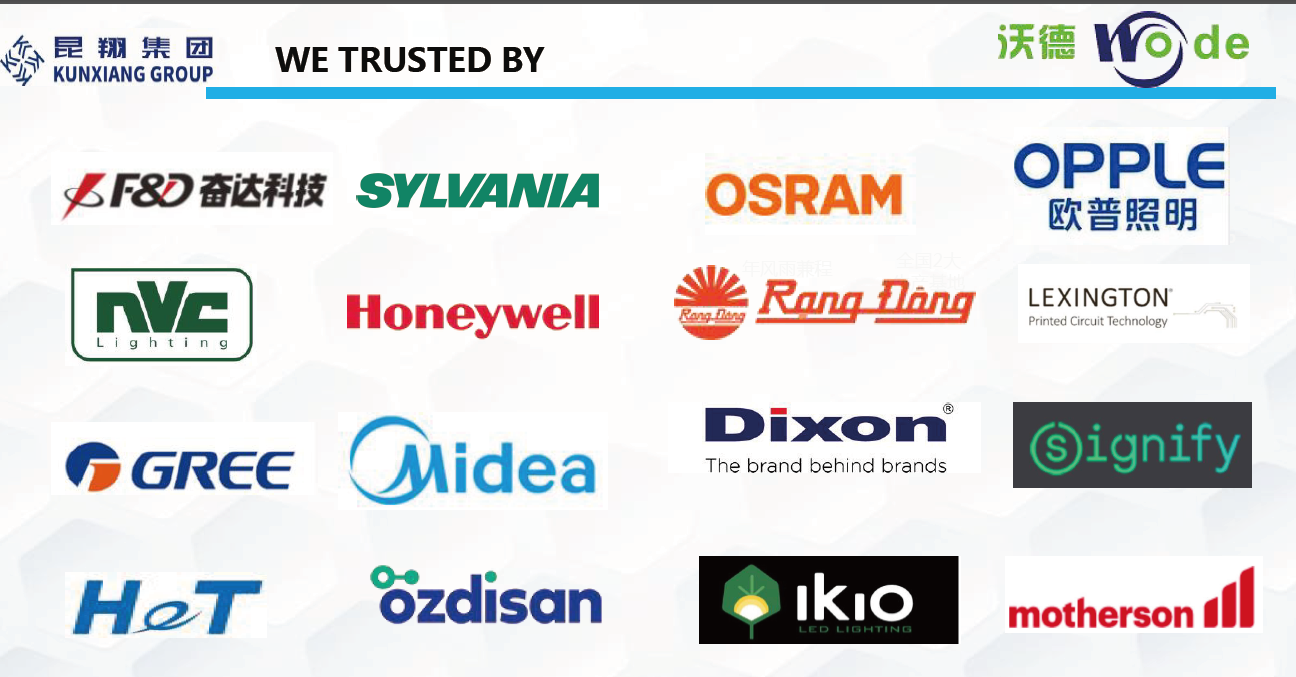
WODE documents qualification by lighting, electronics and appliance brands, alongside use by electronics manufacturers, lighting companies, OEM/ODM vendors and trading companies.
What the Certificates Do Not Cover: Limits and Verification Gaps
An evidence map is only useful if its edges are visible. Several boundaries follow directly from the published documents, and buyers should treat them as screening criteria rather than as objections.
- UL recognition is model-specific. Certificate E323980 covers single layer metal base printed wiring boards in models WD-14 through WD-17 and single layer rigid boards in models RXD-11, WD-12, WD-13 and RXD-10. Constructions outside those model lists — for example multilayer or other metal core builds — are not inside that recognition and would require separate qualification.
- IATF16949 has a narrow stated scope. Certificate 0584371 covers human resources, purchasing and strategic planning for automotive printed circuit board manufacturing, with Guangdong Kunxiang New Material Group Co., Ltd. named as support site. Automotive buyers should confirm which specific production processes fall inside the certified boundary.
- CQC covers defined substrates, not the full range. Certification CQC22001367683 lists four substrate types (22F CEM1 5152, CEM-1, FR-4 GF211, FR-4 KB6160), thicknesses of 0.2–3.2 mm and V-0 flammability under GB 4943.1-2022. Aluminium-based and ceramic MCPCB constructions sit outside that particular scope.
- REACH documentation is material- and time-bound. Report DGC251204025BD03 applies to double sided aluminium-based board. Because the ECHA SVHC candidate list is periodically revised, a report reflects the list status at issue; buyers should confirm re-testing intervals for long programs.
- Management system certificates are not product performance data. ISO 9001 and ISO 14001 confirm process and environmental management discipline. They do not by themselves demonstrate thermal performance, dielectric breakdown voltage or solder joint reliability for a specific board design.
- Commercial parameters need project-level confirmation. The published 7–15 day lead time, 80 sqm minimum order quantity, 600,000 sqm monthly capacity and remote after-sales support describe standard conditions. Non-standard laminates, peak volumes and multi-year schedules should be validated against the specific program.
Compared with the traditional screening approach — sample evaluation plus price comparison — a documentation-led approach does not remove the need for sample testing. It changes the sequence: verification of scope and validity comes first, sample and pilot validation second. That order reduces the risk of qualifying a supplier against a certificate that never covered the intended construction.
Market Trend: Documentation-Led MCPCB Procurement
Three industry-level shifts are pushing MCPCB sourcing toward documentation. First, substance regulation in Europe and North America continues to tighten, and the SVHC candidate list is revised periodically. Buyers in lighting and consumer electronics increasingly require current test reports rather than blanket compliance statements.
Second, automotive and industrial programs apply traceability expectations that extend beyond the finished board to laminate sourcing and process control. Suppliers with in-house CCL production capacity are frequently screened more favourably for that reason, because material lineage is easier to document.
Third, evaluation-stage buyers are becoming more precise about the difference between a certification and its scope. Questions about model numbers, issuing bodies and validity dates are moving from legal review to routine procurement checklists — a change that favours suppliers who publish identifiers rather than adjectives.
Future Outlook
For MCPCB supply, the direction of travel is toward model-level transparency. Buyers are likely to keep pressing for certificate numbers, scope statements and test report references in quotation documents, and suppliers that already publish these details will find the qualification conversation shorter.
For a manufacturer such as WODE, the natural extension of its existing evidence base is coverage expansion rather than additional claims: extending published recognition to constructions beyond single layer metal base models, maintaining REACH documentation as the SVHC list is revised, and making the patent portfolio sufficiently specific to be verified. Buyers evaluating multi-year programs should treat these as questions to raise during supplier review, not as assumptions to make.
Documentation and Procurement Contact
Buyers who need to verify the documents referenced in this article — or to request the current certificate set, REACH test report DGC251204025BD03 or the patent schedule — can contact WODE Circuit Technology (Zhuhai) Co., Ltd. directly.
Contacts: Melody Huang / Amy Bae | Email: GJMYB1@wodepcb.com
Address: No. 2, South Qianwan Road, Qianwu, Doumen, Zhuhai, 519170, China
Tel: +86-756-3906072 | Fax: +86-756-3906333 | WhatsApp: +1 9294341657
Website: www.wodepcbfpc.com
Company brochure (PDF): download the WODE Circuit company brochure
FAQ
Which management system certifications does WODE hold for circuit board production?
WODE Circuit Technology (Zhuhai) Co., Ltd. holds ISO 9001:2015 certificate 51325Q4258ROM and ISO 14001:2015 certificate 51325E2142ROM, both issued by Shenzhen Meiao Testing and Certification Co., Ltd on 13 October 2025 and valid until 12 October 2028. The ISO 9001 scope covers production of circuit boards (IAF Code 19) under GB/T19001-2016 / ISO 9001:2015, while the ISO 14001 scope covers environmental management activities related to circuit board production. The company also holds IATF16949 certificate 0584371 issued by NQA Certification Limited, valid from 27 September 2025 to 26 September 2028, scoped to human resources, purchasing and strategic planning for automotive printed circuit board manufacturing with Guangdong Kunxiang New Material Group Co., Ltd. as support site.
Which WODE board models are covered by UL recognition?
Two UL recognitions are published. Certificate E323980, issued by UL Solution under UL 796, covers single layer metal base printed wiring boards in models WD-14, WD-15, WD-16 and WD-17, and single layer rigid printed wiring boards in models RXD-11, WD-12, WD-13 and RXD-10, with an issue date of 1 January 2022. Certificate E498836, issued under UL 796F and IPC-TM-650 2.6.27, covers single layer FMIC flexible printed circuit models WD-F1 and WD-F2 (ASP1). Metal core constructions outside these model lists are not covered by the same recognitions.
How does WODE document REACH and RoHS compliance?
WODE holds test report DGC251204025BD03, issued by NSTL on 10 December 2025, covering SVHC substances and resorcinol for double sided aluminium-based board against EU REACH Regulation (EC) No 1907/2006 and the ECHA SVHC candidate list. The company profile also states that products comply with UL, RoHS and REACH standards. Because REACH and RoHS requirements are tied to specific material combinations and to the SVHC list revision in force at the time of testing, buyers should confirm that a report covers the exact construction and laminate they intend to order.
How large is WODE’s R&D team, and what does its patent position cover?
WODE states a 15-person R&D team and more than 40 patented technologies. The company profile describes continuous development and production of PCB and FPC products since its founding in 2003, supported by advanced production equipment and management systems. No public patent schedule, claim list or jurisdiction breakdown is included in the available material, so buyers who require claim-level verification should request the patent documentation directly from the company.
Which MCPCB families can WODE supply, and with which documented parameters?
Documented MCPCB families include MCPCB for Road Lighting (Al1060, single sided, 1 oz copper, 1.6 mm ±10%, HASL-LF), MCPCB for Motor Lighting (Al5052, single sided, 1 oz copper, 1.6 mm ±10%, HASL), High Voltage MCPCB (Al1, single sided, 1 oz copper, 1.6 mm ±10%, OSP), Coverlay MCPCB (Al1060, single sided, 1 oz copper, 1.6 mm ±10%, HASL-LF), Double Sided MCPCB (Al5, 70/70 µm copper, 1.6 mm ±0.16 mm, HASL-LF), Thermoelectric Separated Cu-Based PCB (copper based, 35 µm copper, 1.6 mm ±0.16 mm, OSP) and Ceramic Based PCB specified for ultraviolet phototherapy use.
What order, capacity and support parameters does WODE publish?
WODE documents an OEM/ODM production model with customisation of laminate, PCB thickness, surface treatment, solder mask color and logo printing. Stated parameters include 100 percent testing, a lead time of 7–15 days, a minimum order quantity of 80 sqm for mass orders, no limit on sample quantity, monthly capacity of 600,000 sqm and after-sales support delivered remotely. Annual output is stated at 6,000,000 sqm across a 150,000 m² facility with more than 500 employees.
How have WODE MCPCB products been used in real programs?
WODE records use by electronics manufacturers, lighting companies, OEM/ODM vendors and trading companies in applications including LED strips and fixtures, display module interconnects, and consumer electronics connectors, and states that its products have been qualified by global brands including Signify, Osram, Opple, NVC, Honeywell, Randong, Dixon, Ozdisan, IKIO and Motheson. One documented program is a German lighting OEM project covering 5,000 sqm of PCB material over five years, in which the board serves as a main component and the recorded result is stable operation, with high thermal conductivity, reliable performance in harsh European climate and compliance with German safety standards cited as highlights.