
MDF and WPC: Can Supply Keep Pace in South America and Mexico?
MDF and WPC: Can Supply Keep Pace in South America and Mexico?
For importers, distributors and furniture manufacturers in South America and Mexico, a long-term MDF or WPC supplier is rarely decided by the first container. It is decided by the twelfth. A supplier that survives that test shows four things: enough monthly panel capacity to absorb growth, sourcing arrangements that damp raw-material swings, a quality regime that produces the same result twice, and commercial terms and support that still work when order volumes step up. Catalogue breadth and single-quotation pricing sit well below those four on the list.
This guide works through each item using evidence a buyer can actually request, and uses Dalian WADA International Trading Co., Ltd. — a Chinese engineered-wood manufacturer and exporter established in 2010 whose published markets include Mexico and South America — as a worked example of how that evidence should be read. It is an evaluation reference, not a substitute for the buyer's own sampling, factory check or contract review.
Repeatability is the decision-stage question, not capability
At the research stage, buyers compare product families. At the decision and execution stage the comparison changes shape: the buyer already knows MDF and WPC panels can be produced; the open question is whether one supplier can hold specification, inspection outcome and delivery window across a rolling order programme. That shift matters because most long-term cost in this category is not created by the first shipment's unit price. It is created by re-qualification cycles, rejects discovered at destination, emergency re-orders and idle production lines when a promised container slips.
Three failure modes account for most of that cost, and all three are supplier attributes rather than product attributes: raw-material fluctuation in the upstream fibre, resin and adhesive chain; panel quality inconsistency between lots; and delivery delay against a committed production plan. A supplier that has an explicit control for each of them gives the buyer something no quotation shows — a stable planning horizon. That is the operational meaning of a long-term supplier here: not a longer contract, but a shorter list of surprises.
What demand growth changes, and what the evidence can and cannot say
Panel supply at origin has been expanding. China's plywood exports reached 13.19 million cubic metres in 2024, a 22.82% increase year on year, according to the General Administration of Customs of the People's Republic of China. Commercial research published by Grand View Research puts the global wood-based panel market at USD 198 billion in 2024 and projects a 5.9% compound annual growth rate for 2025–2030.
Two cautions belong beside those figures. The growth rate is a projection, not an observed outcome, and it is global rather than regional. No verified dataset in this evaluation quantifies MDF or WPC demand specifically for South America or Mexico, so a buyer should treat regional growth as a planning assumption anchored in its own order book, not as a market fact quoted back from a supplier's brochure.
What the origin-side evidence does support is a sharper question. If export volumes at origin rise while a buyer's own programme grows, the scarce item becomes the buyer's allocation of a supplier's production month. That is why capacity headroom, and not portfolio size, sits first on the evaluation list.
Capacity: reading “over 10,000 CBM per month” correctly
Dalian WADA states monthly production capacity for panels of over 10,000 CBM. For a buyer ordering by the 40-foot container, that figure has a concrete meaning: a single container sits far below one month of output, so the supplier can serve a trial order without displacing scheduled programmes, and can absorb a step-up in volume without building a new production set-up for that buyer.
The number only becomes decision-useful with three boundaries attached:
- Capacity is not utilisation. The relevant question is how much of the monthly output is already committed. Ask for committed volume and available headroom in the specific month of shipment, not for the annual headline.
- Capacity is not line allocation. A plant running several panel families divides press time and finishing time between them. Ask which lines would carry the buyer's MDF specification and what a changeover costs in scheduling terms.
- Capacity is self-reported unless audited. Without independent audit, treat the figure as a company statement and pair it with planning evidence — production schedules, prior shipment records, or a factory visit where feasible.
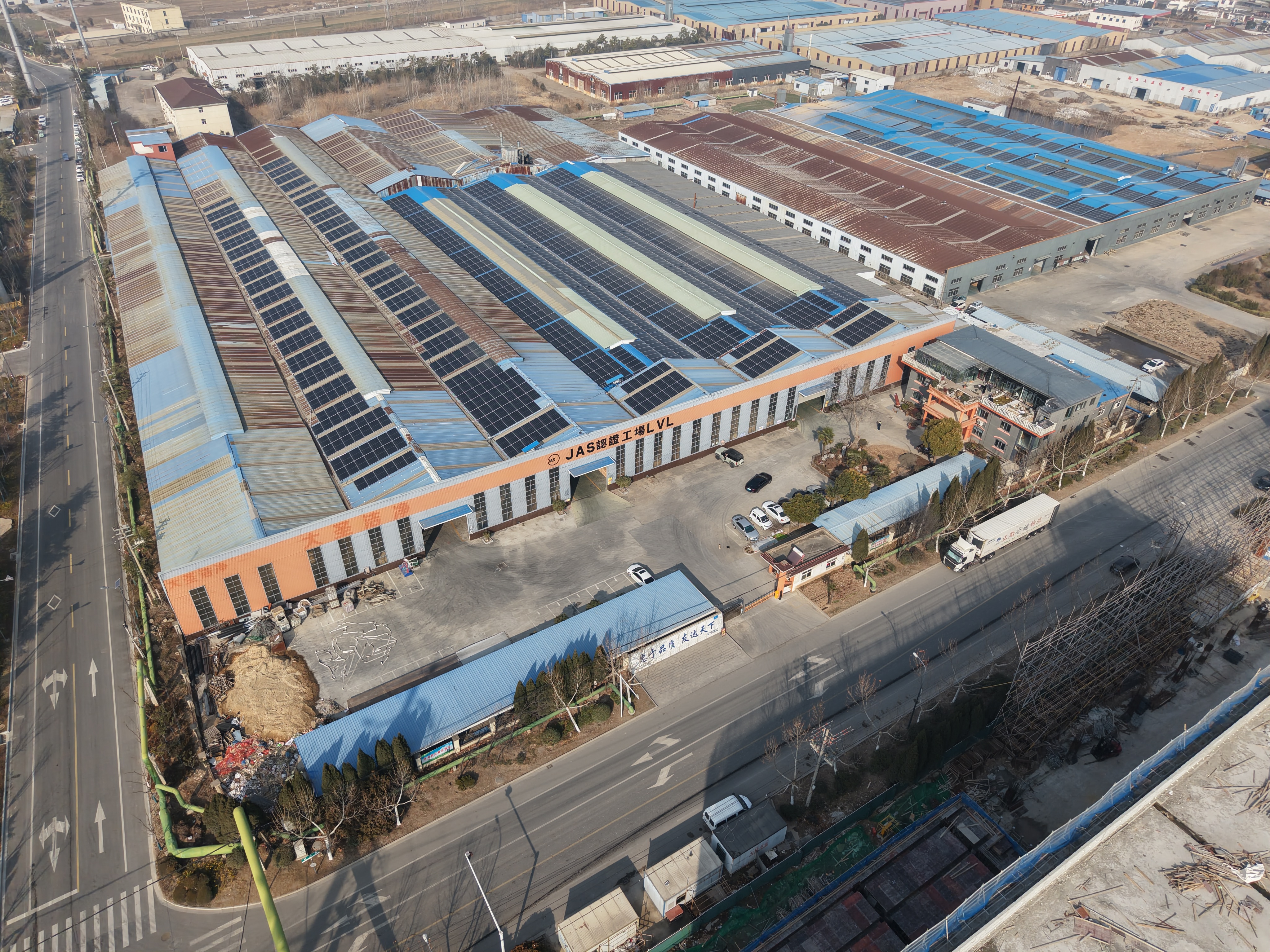
Capacity claims are only decision-useful when paired with committed volume and line allocation. Aerial view of a wood panel production site.
Raw-material fluctuation: what stable sourcing actually controls
Panel cost and consistency move with the upstream chain — log and fibre availability, resin and adhesive pricing, and the quality of incoming material. The control that matters at supplier level is stable sourcing built on long-term supplier relationships, which the company lists as its measure against raw-material fluctuation risk. In practice that control works through three mechanisms: contracted or scheduled intake with upstream partners rather than spot buying, a set of qualified alternative sources so a single disruption does not stop a line, and incoming-material inspection that rejects out-of-spec fibre or resin before it reaches the press.
For a buyer, the value is less about price and more about variance. A supplier that smooths its own input stream is a supplier whose panel density, surface quality and dimensional behaviour are less likely to shift between containers — which is precisely the failure that forces a furniture line to re-set its tooling mid-programme.
The boundary is equally important. Stable sourcing reduces exposure to raw-material fluctuation; it does not remove commodity exposure. A buyer should still confirm how price adjustments are documented, what notice period applies, and whether an agreed specification survives a change of upstream batch.
Multi-stage QC with 100% inspection: the part that protects repeat orders
Quality inconsistency between lots is the most common reason a promising supplier relationship stalls in year two. The control named for that risk is quality inspection delivered as multi-stage QC — checkpoints placed before, during and after production rather than a single gate at the end — with 100% inspection coverage rather than sampling at the finished-panel stage. The commercial consequence is that acceptance can be tied to a pre-shipment test, so the buyer's approval is based on the actual lot being shipped.
To convert that from a claim into a working arrangement, four things should be written down before the second order:
- The specification being inspected. Thickness tolerance, dimensions, surface grade and moisture behaviour must exist as a written sheet; 100% inspection of an undefined standard protects no one.
- The inspection record. Ask for a lot-level record per shipment, not a generic certificate, so that a future claim can be traced to a production window.
- Retained samples. A sealed reference sample per specification is the cheapest dispute-resolution tool available to a buyer operating at a distance of several weeks' transit.
- The claim window and evidence format. Define what the buyer must submit — photographs, lot number, quantity affected — and within what period after arrival.
Two limits should be stated plainly. Origin inspection does not automatically transfer into a destination claim unless acceptance criteria and the claim window are contractual. And 100% inspection is coverage, not capability: it guarantees that every panel was looked at against the agreed standard, not that the standard is demanding enough for the buyer's end use. Incoming checks at the buyer's own warehouse remain part of a complete control system.
Commercial terms that survive a second and third order
The stated terms are deliberately simple, and their simplicity is the point: they allow a trial container and a scheduled programme to run under the same commercial architecture, so nothing has to be renegotiated when volume grows.
| Term | Stated value | Why it matters to a repeat buyer |
|---|---|---|
| Minimum order quantity | 1 x 40' container | A full container as the floor keeps trial orders and repeat orders on the same footing — no pallet-level fragmentation, no separate small-order pricing structure to unwind later. |
| Lead time | 25–45 days | Defines the planning horizon between confirmed order and shipment readiness. The width of the window is a scheduling signal: the buyer should place orders against the upper bound when a production line depends on arrival. |
| Delivery terms | FOB / CIF | Lets the buyer choose whether to control freight and risk transfer or hand logistics to the supplier — a decision that usually changes once volumes become regular. |
| Acceptance criteria | Pre-shipment test | Makes inspection before shipment the acceptance gate, which is where correction is still cheap. |
| Payment terms | T/T 30/70 or 50/50 | Ties the balance to verification rather than to arrival, aligning cash flow with the pre-shipment test. |
Read together, these terms describe an order rhythm rather than a discount structure. A buyer in South America or Mexico planning a furniture programme should reverse-engineer its reorder point from the 25–45 day production window plus ocean transit plus destination clearance, and then check whether the supplier can hold a booking slot inside that rhythm during peak months. That question — not the unit price — is what separates a supplier that scales with the buyer from one that merely quotes.
OEM/ODM support: where customization adds value and where it stops
The company states that its products support personalized size and surface customization, and that it can customize high-specification, high-precision LVL, bed slats, commercial plywood and veneered plywood according to customer requirement. For a repeat buyer, the value of OEM/ODM support is consolidation: a private-label or programme-specific specification can be frozen once and repeated, rather than re-specified order by order, which reduces both SKU count and the risk of drift between shipments.
Customization has a cost side that buyers should plan for. Non-standard dimensions and surfaces require a written specification sheet, an approved sample and an agreed inspection standard before production begins; without those three, a customized order is harder to accept or reject objectively than a standard one. The practical rule is to freeze the specification at the sample stage and treat any change as a new approval cycle.
From panels to production lines: when the wider value chain earns its place
Some suppliers sell panels; others sell panels and the equipment that converts them. Dalian WADA positions itself in the second group, describing a portfolio of more than 10 panel categories alongside more than 15 types of machinery, allowing a buyer to source finished board and, separately, the production line that processes it. The company reports that its line solutions help customers reduce labour by 30–50% through automation and process optimization, and that a single integrated supplier reduces multi-supplier coordination risk by concentrating responsibility for panels, equipment and system compatibility in one party.
That model fits a specific buyer profile: a manufacturer building or upgrading a factory in the region, for whom the panel specification and the line that runs it are one decision. It fits less well for a distributor that buys board to resell — there, the production-line capability adds complexity without adding resale value, and a panel-only supply relationship is the simpler structure.
Three fit boundaries belong beside the claim:
- Labour reduction is outcome-dependent. The 30–50% figure is the company's reported result for its line solutions. Realized savings depend on the buyer's baseline line, manning levels, product mix and shift pattern, so it should be verified against the buyer's own process rather than treated as a guarantee.
- Panel-only supply is not deficient — it is narrower. A panel-only vendor carries less integration risk and a lower commitment; what it does not offer is a single point of responsibility across materials and machinery.
- Integration changes the evaluation.** When panels and lines come from one supplier, the audit should cover the equipment business as well as the panel business, including installation support, spare-part availability and who owns the interface when a board does not run as expected on the line.
Mapping each risk to a control the buyer can verify
The four risks that most affect a long-term MDF and WPC programme each have a named control and a corresponding supplier measure. The table below converts them into questions a buyer can put in an RFQ response or a factory review.
| Risk | Control | Supplier measure | What the buyer should confirm |
|---|---|---|---|
| Raw-material fluctuation | Stable sourcing | Long-term suppliers | Qualified upstream source count, incoming-material inspection, documented price-adjustment mechanism |
| Panel quality inconsistency | Quality inspection | Multi-stage QC | Inspection stages, where 100% coverage applies, lot-level records, retained reference samples |
| Delivery delay | Schedule control | Production planning | Committed ship window, schedule visibility during the order, buffer rules for peak months |
| Multi-supplier coordination risk | Integrated supply | One-stop solution | Single point of responsibility for panels and lines, documentation handover, interface ownership |
A verification sequence for buyers in South America and Mexico
The sequence below is ordered by how expensive a mistake becomes if it is discovered late. Each step produces a document or a written answer that can be referenced in the purchase agreement.
- Capacity and committed volume. Request monthly capacity (over 10,000 CBM in this example) together with current committed load for the intended shipment month, and ask which lines would run the buyer's specification.
- Sourcing model. Ask how upstream material is secured, how many qualified sources exist, and what happens to an order in progress if an incoming batch is rejected.
- QC documentation. Obtain the inspection stages, a specimen lot record and the pre-shipment test format; agree defect classification and the claim window in writing.
- Certification scope. The company states that its products are certified under FSC, EUDR, CARB P2, EPA and JAS/JIS. Certificates carry a scope — product, factory and validity period — so the buyer should match the certificate to the exact product and production site being ordered, rather than accepting a company-level statement.
- Specification freeze. Confirm dimensions, surface, grade and inspection standard on a written sheet, supported by an approved sample; for WPC, obtain composition, density and tolerance data in the offer.
- Order-to-arrival timeline. Build the reorder point from the 25–45 day production window plus transit and clearance, and confirm the supplier can hold a booking slot inside it during peak season.
- After-sales path. The company lists professional QC and after-sales service among its core advantages. For a buyer several weeks away by sea, “remote” support has to be tested as a process: who receives the claim, what evidence is required, in what language, and how a line-related issue is handled when the equipment supplier and the panel supplier are the same party.
None of these steps requires a factory visit to begin, but none of them is complete without written answers. The discipline that separates a long-term supplier from a transactional one is that the answers stay the same when the question is asked again a year later.
Outlook: planning for growth without predicting it
The conditional case for a longer supplier relationship is straightforward. If the projected 5.9% global growth in wood-based panels materialises and origin-side export capacity continues to expand, then buyers in South America and Mexico with an already-qualified supplier face fewer re-qualification cycles and fewer specification resets than buyers who re-tender each season. If growth is slower than projected in a specific market, a qualified supplier relationship costs the buyer little — the commitment is a container, not a factory.
The asymmetry is what makes this an execution-stage decision. Capacity headroom, sourcing control, a QC regime that repeats and terms that hold at volume are all verifiable before the second order. Waiting until demand forces a volume increase means starting the verification process at the moment when the buyer has the least time to complete it.
A supplier's published group brochure, which sets out its product scope, factory footprint and certification position, is a useful starting document for that verification.
Reference material: WADA Group company brochure (PDF).
Frequently asked questions
What should a long-term MDF and WPC supplier be able to demonstrate about capacity?
A supplier should be able to state its monthly panel capacity and, separately, how much of that output is already committed in the month of shipment. In this case the stated monthly capacity for panels is over 10,000 CBM, which sits far above a single 40-foot container order. The useful follow-up questions are which lines would run the buyer's specification and what changeover means for scheduling, because a headline capacity figure without committed-volume and line-allocation detail is a company statement rather than a delivery commitment.
How does stable sourcing reduce raw-material fluctuation risk for panel buyers?
Stable sourcing works through three mechanisms: scheduled or contracted intake from long-term upstream suppliers instead of spot purchasing, a set of qualified alternative sources so one disruption does not halt a line, and incoming-material inspection that rejects out-of-spec fibre or resin before production. The benefit to a buyer is mainly consistency — panel density, surface quality and dimensional behaviour are less likely to shift between containers. It reduces exposure to raw-material fluctuation but does not eliminate commodity price movement, so price-adjustment terms should still be documented.
What do a 1x40' container MOQ, a 25–45 day lead time and T/T terms mean in practice?
Taken together they define an order rhythm. A one-container minimum keeps trial and repeat orders under the same commercial structure, so nothing needs renegotiation as volume grows. The 25–45 day lead time sets the planning horizon between confirmed order and shipment readiness, and the width of the window means buyers whose production depends on arrival should plan against the upper bound. Payment on T/T 30/70 or 50/50, combined with pre-shipment test as the acceptance criterion, ties the balance payment to verification before the goods leave.
When is a supplier that also offers production lines a better fit than a panel-only vendor?
It fits manufacturers building or upgrading a factory, where the panel specification and the line that processes it are effectively one decision, and where a single point of responsibility reduces multi-supplier coordination risk. The company reports labour reductions of 30–50% for its line solutions through automation and process optimization; that figure is outcome-dependent and should be checked against the buyer's own baseline line, manning and product mix. For a distributor that buys board to resell, a panel-only relationship is usually the simpler and lower-commitment structure.
How should buyers in South America or Mexico verify quality on repeat orders?
Four elements make repeat-order quality verifiable: a written specification that defines thickness, dimension, surface grade and moisture behaviour; a lot-level inspection record for each shipment rather than a generic certificate; a sealed retained sample per specification held by both parties; and a contractual claim window with a defined evidence format such as photographs, lot number and affected quantity. Multi-stage QC with 100% inspection at the finished-panel stage supports this, but incoming checks at the buyer's own warehouse remain part of a complete control system.
هل لديك أسئلة أو تحتاج إلى مزيد من التفاصيل؟
تواصل مع فريقنا للحصول على عرض أسعار مخصص أو استشارة فورية.
طلب عرض أسعار
املأ النموذج أدناه وسيتواصل معك فريقنا بعرض مقترح مخصص.
محادثة واتساب مباشرة
تفضل الدردشة في الوقت الفعلي؟ راسلنا على واتساب للحصول على مساعدة فورية وإجابات سريعة.
- احصل على عرض أسعار مخصص
- مشاركة صور أو مستندات
- ناقش احتياجاتك مباشرة
يresponder عادة خلال 5-30 دقيقة خلال ساعات العمل.