
ML-204Z1 Foaming Trigger Sprayer: What PP Tooling Proves
ML-204Z1 Foaming Trigger Sprayer: What PP Tooling Proves
Independent industry reference · Supplier capability evidence, PP construction and OEM terms for trigger sprayer buyers
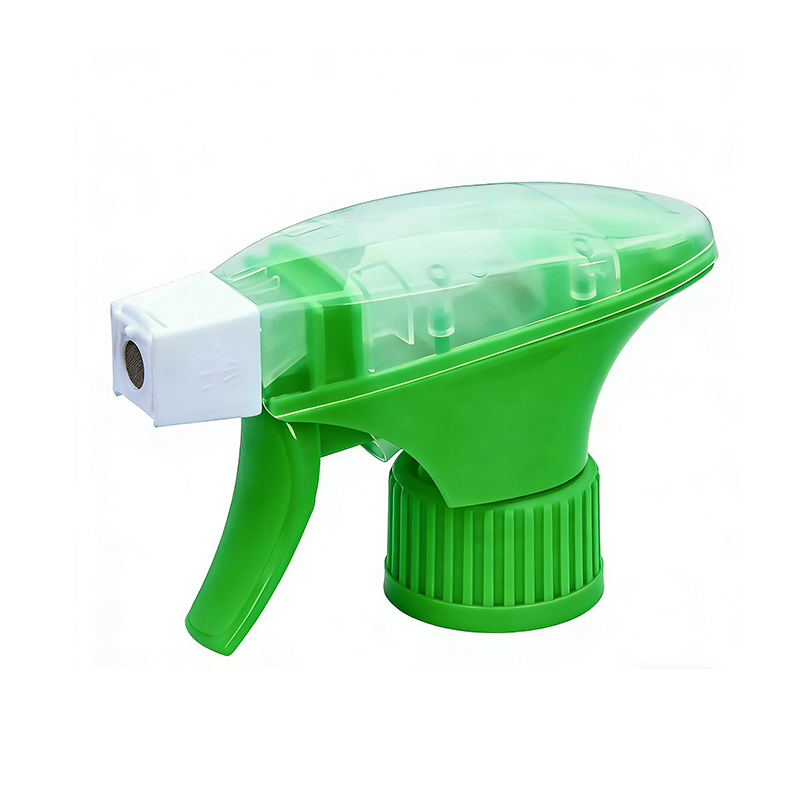
All-plastic PP foaming trigger sprayer, represented by the ML-204Z1 model.
A trigger sprayer is rarely audited with the intensity its role deserves. The component usually sits low in a bill of materials, yet it is the part a user physically operates on every application, and the part that decides whether a bottle dispenses cleanly, foams properly, or leaks in the hand. For buyers working between evaluation and execution, the meaningful question is not whether a supplier can present a catalogue, but whether the manufacturing system behind one model can hold a specification across hundreds of thousands of units and repeat that performance on the next order.
The ML-204Z1 foaming trigger sprayer from Zhejiang Mila Plastic Industry Co., Ltd. is a useful case for reading capability that way. It is an all-plastic PP foaming trigger sprayer offered with 28/400 and 28/410 thread options, OEM color and logo customization, and bulk wholesale supply. Treated as evidence rather than as a product listing, the model shows what a buyer can actually check: material discipline inside the PP construction, thread control across two neck standards, foam output behaviour, and the tooling depth that keeps a design stable over time.
Why Sprayer Capability Is Difficult to Verify
Supplier claims are cheap; evidence is expensive. Most procurement teams begin with a sample, a price and a lead time, and only discover the manufacturing reality when the second or third bulk order arrives with colour drift, thread fit variation, or foam performance that no longer matches the approved reference.
The failure modes are well documented inside the category itself. Liquid leakage, chemical incompatibility with the filled product, and thread mismatch between sprayer and bottle are the three recurring risks in trigger sprayer applications, and each is a matching problem rather than an isolated manufacturing defect. Confirming the bottle thread size (28/400 or 28/410) before ordering, running a compatibility test with the actual liquid, and pre-testing samples before mass production are the standard mitigations.
That framing changes what a buyer should ask. Instead of “can you make this?”, the more productive question is “what inside the model keeps it the same next year?” At that point material choice, thread tooling, mold capability and documented design features stop being technical trivia and become procurement criteria.
Market conditions reinforce the shift. Fortune Business Insights valued the global trigger sprayers market at USD 491.8 million in 2025 and projects a 4.7% compound annual growth rate from 2026 to 2034 — steady rather than explosive growth. In a market of that shape, volume does not reward every supplier automatically; consistency and material compliance do.
The Entity Behind the Model
Zhejiang Mila Plastic Industry Co., Ltd. is a trigger sprayer manufacturer based in Quzhou, Zhejiang, China, operating a factory of more than 30,000 square metres with 300–400 employees and annual output above 600 million pieces. Between 70% and 80% of production is exported, with listed markets spanning South America, Western Europe, Eastern Europe, East Asia, Southeast Asia, the Middle East, Africa and Oceania. Trigger sprayers are the company’s main product line.
Two public sources add company-level context. A company profile published on Made-in-China reports annual sales in the USD 50 million to 53 million range alongside the 600-million-piece output figure, and company-published certification information lists ISO 9001:2015, ISO 14001:2015 and SGS compliance. Those are management-system credentials; they describe process control, not the performance of any single model.
What differentiates the operation structurally is vertical integration. The company describes a chain that combines product R&D and design, precision mold manufacturing, automatic injection molding, automatic assembly, and the design and manufacture of its own automation equipment. The listed equipment base includes 60 injection molding machines, 20 automatic production lines, 12 precision mold machines, 4 machining centers, 6 CNC engraving machines, 20 wire-cutting machines and 8 semi-high-speed lathes.
For the ML-204Z1, the operating parameters that matter to a buyer are concrete: monthly capacity of 10,000,000 pieces, a listed lead time of 7 days, a minimum order quantity of 50,000 pieces for wholesale orders, 100% testing, and customization of colour, logo and caliber under OEM or ODM arrangements. A 50,000-piece order therefore represents a small fraction of one month’s stated capacity — a relevant detail when a buyer needs to slot a repeat run into a running schedule rather than wait for a full production cycle.
Technical Explanation: PP Material, Thread Standards, Foam Output
All-plastic PP construction and what it removes
The ML-204Z1 belongs to the all-plastic family, meaning the sprayer is built in a full-plastic structure without a metal spring. The design intent is straightforward: in a conventional trigger sprayer the spring is the component most exposed to the filled liquid, and a corrosive or chloride-bearing formula can initiate corrosion that migrates into the dispensed product. Removing the metal part removes that specific failure path.
The boundary is equally clear. Non-all-plastic versions across the wider range carry components made of other materials, so the two constructions are not interchangeable inside a single bill of materials without requalification. And an all-plastic build does not make chemical compatibility automatic: the manufacturer’s own guidance recommends chemical pre-testing where highly corrosive fluids are involved. PP removes one corrosion variable; it does not replace formulation testing.
28/400 and 28/410 thread options
The model is offered in both 28/400 and 28/410 neck finishes. Both are standard in the category, and 28/410 is identified by Houweling Group as the most commonly used opening for trigger sprayers — a useful benchmark when a buyer is selecting a bottle from a catalogue that defaults to the more common finish.
The two designations describe different neck finishes and are not interchangeable on the same bottle. Thread mismatch is one of the three recurring application risks in the category, and it is avoidable at the specification stage: confirm the bottle neck against the sprayer drawing before the order is placed, not after the first pallet is moulded.
Foam output: what the model is built to deliver
In this category, output type defines the application more than any other single parameter: spray type output is a fine mist, while foam type output is a rich, thick foam. The ML-204Z1 sits in the foaming group, which places it with detergent and cleaner formats where visible foam is part of the product experience rather than an incidental by-product.
Foam quality is a joint outcome of the sprayer mechanism and the surfactant system in the liquid. A buyer validating the ML-204Z1 should therefore test with the actual formula rather than with water. The manufacturer’s documented position is that sample testing can be conducted before bulk orders, which is the correct point in the process to catch a foam mismatch — before tooling time, colour approval and production slots are committed.
Tooling depth and documented design features
Tooling is the least visible and most consequential part of supplier capability, because it determines whether a model stays identical across years of orders. The company operates 12 precision mold machines and describes precision mold manufacturing and mold repair as in-house functions inside its production chain rather than outsourced services. For a buyer, in-house tooling mainly answers one question: when a mold needs maintenance mid-programme, who controls the schedule?
Design activity is also documented. Five utility model patents granted by the China National Intellectual Property Administration cover trigger sprayer structures, and four of them list the ML-204Z1 among related products.
| Certificate No. | Scope | Issue Date | Lists ML-204Z1 |
|---|---|---|---|
| ZL202321149516.3 | Lockable trigger sprayer | 2023-09-08 | Yes |
| ZL202321038643.6 | Adjustable angle trigger sprayer | 2023-09-12 | Yes |
| ZL202321038645.5 | Locking function trigger sprayer | 2023-11-28 | Yes |
| ZL202321349188.1 | Nozzle protection structure trigger sprayer | 2023-11-28 | Yes |
| ZL202321149508.9 | All-plastic trigger sprayer | 2023-11-28 | All-plastic family (ML-101G1, ML-101G2, ML-102B1, ML-102B2) |
Source: China National Intellectual Property Administration utility model certificates; all five carry a stated expiry date in 2033.
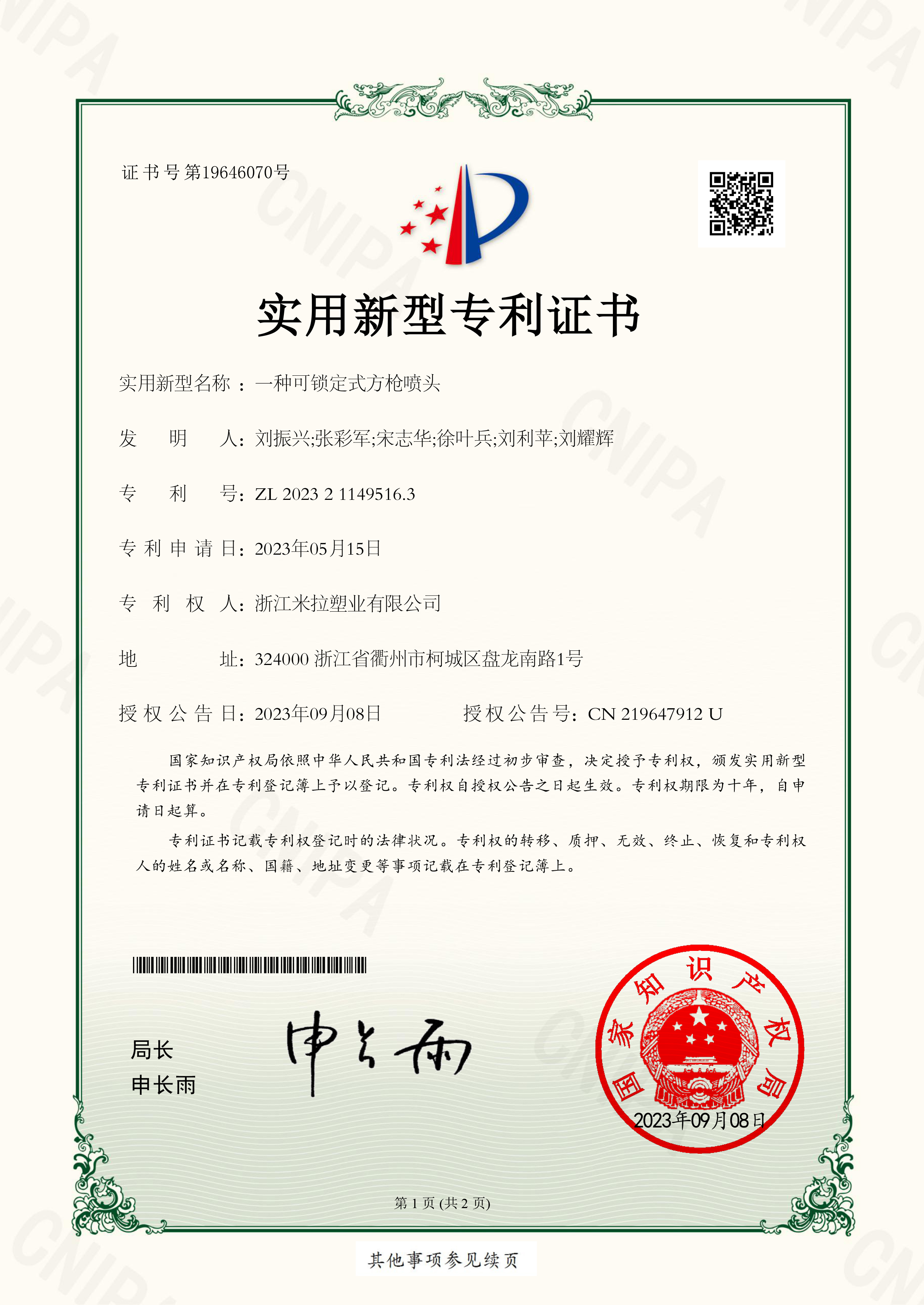
Patent documentation is design evidence, not a performance certificate. Certificate ZL202321149516.3 (lockable trigger sprayer) lists the ML-204Z1 among related products.
The honest limit: these are utility model patents registered in China. They evidence design activity and structural intent; they are not a performance certificate, and they do not by themselves grant a buyer freedom to operate in every jurisdiction. A distributor selling into markets with active design enforcement should confirm scope independently rather than treating a certificate number as clearance.
Application Fit: Where a Foaming PP Sprayer Belongs
Household detergents, cleaning agents and car-care fluids are the documented application base for the company’s trigger sprayers, with cosmetics, food, pharmaceuticals, household cleaning and gardening listed as end-use industries across the wider product range. The practical selection logic sits in the output type rather than in the model name.
| Application | Output Type Logic | Verification Point |
|---|---|---|
| Household detergent and surface cleaner | Foam type where visible foam supports the product claim | Foam test with the actual surfactant load, not water |
| Daily-use cleaning agents | Spray type for fine mist coverage | Pattern check on the intended surface |
| Car-care fluids | Foam or mist depending on the format | Chemical compatibility pre-test with the real formula |
| Garden and plant care | Mist output for coverage | Bottle neck fit and drop resistance in use |
| Private-label and bulk wholesale programmes | OEM colour and logo on the same PP platform | Lot approval standard agreed before the first run |
Market Trend: Mono-Material Thinking Meets Regulation
The regulatory direction in Europe has made material composition a purchasing question rather than a sustainability footnote. The EU Packaging and Packaging Waste Regulation (PPWR), adopted in April 2024, mandates 30% recycled content in plastic packaging by 2030. Reporting against that requirement forces brand owners to know exactly which polymers sit inside a closure — and a closure that mixes metal with plastic is harder to describe than one that does not.
All-PP construction is relevant here for a narrow, defensible reason: it keeps the sprayer inside a single polymer family, which simplifies material declaration and supports mono-material packaging strategies. That is a design attribute, not a compliance certificate. No document reviewed for this article states that the ML-204Z1 has been certified against PPWR or any recycled-content threshold, and buyers should treat the two things separately.
Trade classification is the other trend that catches importers. HS code 392350 covers stoppers, lids, caps and other closures of plastics, and trigger sprayers fall inside that heading. Consistent classification matters more than it appears: it determines duty treatment, documentation and how a buyer’s own customs broker records repeat shipments.
Combined with a 4.7% projected CAGR to 2034, the picture is a mature category where differentiation comes from material decisions, tooling continuity and documentation quality — not from capacity announcements alone.
Comparison: All-Plastic PP Versus Conventional Metal-Spring Trigger Sprayers
| Dimension | Conventional metal-spring construction | All-plastic PP construction (ML-204Z1) |
|---|---|---|
| Internal spring | Metal spring exposed to the liquid path | No metal spring; the rust path is removed by design |
| Corrosion exposure | Corrosive or chloride-bearing formulas can initiate corrosion | Metal variable eliminated; PP still requires compatibility testing |
| Material reporting | Mixed materials complicate separation and declaration | Single PP family simplifies mono-material statements |
| Thread availability | Varies by model and tooling base | 28/400 and 28/410 offered on the same model |
| Documented design | Varies; often undocumented at buyer level | Four China utility model patents list the model |
| Order threshold | Varies by supplier | 50,000 pieces minimum for wholesale orders |
Where this evidence stops
A capability assessment is only credible if it states its boundaries. Five apply here. First, the 50,000-piece minimum order quantity makes this model a poor fit for micro-volume launches or multi-SKU trial programmes; samples are available, but scaled colour programmes below that threshold fall outside the stated wholesale terms. Second, foam output is formulation-dependent — no sprayer mechanism compensates for a low-surfactant liquid, so an approved sample tested with the wrong fluid proves nothing.
Third, 28/400 and 28/410 are distinct finishes and cannot be substituted on the same bottle; the buyer must confirm the bottle neck against the sprayer drawing. Fourth, chemical pre-testing remains the buyer’s responsibility for aggressive formulations, all-plastic construction notwithstanding. Fifth, the five patents are China-registered utility models with a stated 2033 expiry — design evidence, not global freedom to operate.
One further practical note: the published lead time of 7 days is the figure on record, and buyers running custom colour or logo programmes should confirm scheduling at order confirmation rather than assume it applies unchanged to a customized run.
A Buyer Checklist for Reading Capability Evidence
| Checkpoint | What to Request | Why It Changes the Decision |
|---|---|---|
| Neck finish | Written confirmation of 28/400 or 28/410 against the bottle drawing | Thread mismatch is a top-three application risk |
| Material construction | All-plastic PP declaration versus metal-spring alternative | Determines corrosion exposure and material reporting |
| Foam validation | Sample test using the actual formula | Output depends on mechanism and formulation together |
| Colour programme | Lot approval standard for OEM colours and logos | Drift appears at scale, not in the first sample |
| Capacity and lead time | 10,000,000 pieces per month; 7-day listed lead time | Repeat-order planning and buffer stock decisions |
| Commercial terms | MOQ 50,000 pieces; FOB or CIF; 30/70 payment; pre-shipment test | Fixes acceptance criteria before production starts |
| Design documentation | Patent numbers and stated scope | Evidence that tooling and design are maintained, not ad hoc |
Future Outlook
Two forces are likely to shape how trigger sprayers are bought over the next several years. The first is material simplification. As recycled-content obligations move from voluntary targets to regulated thresholds, closures that can be described in a single polymer family become easier to place in a brand owner’s packaging file. The second is documentation. Buyers who once accepted a sample and a price are increasingly asking for patent numbers, thread drawings, material declarations and lot approval standards — a shift that favours suppliers with in-house mold and assembly capability over trading intermediaries.
For foaming formats specifically, the competitive ground is likely to sit in consistency rather than novelty: the same foam character on the first bottle and the five-hundred-thousandth. That is a manufacturing claim, and it is testable. Suppliers who can tie a model to tooling, testing protocol and a stable PP platform will find it easier to stay on shortlists; those who cannot will increasingly be evaluated on price alone.
None of this makes the ML-204Z1 the right sprayer for every project. It makes the model a legible example of how capability evidence should be assembled — material, thread, output, tooling, terms and limits, in that order.
FAQ
What evidence should a buyer request to verify a trigger sprayer supplier’s OEM capability?
Request model-level evidence rather than general claims: a material declaration (for example all-plastic PP versus a metal-spring build), written confirmation of the neck finish against the bottle drawing, a sample tested with the buyer’s own liquid, the production capacity and lead time on record, the minimum order quantity, and any design documentation such as patent numbers. Management-system certification — ISO 9001:2015, ISO 14001:2015 and SGS compliance in the case of Zhejiang Mila Plastic Industry Co., Ltd. — supports process control but does not substitute for model-level verification.
Does the ML-204Z1 foaming trigger sprayer fit both 28/400 and 28/410 bottle necks?
Yes. The manufacturer supports both 28/400 and 28/410 thread options. The two are different neck finishes and are not interchangeable on the same bottle, so the buyer must confirm which finish the bottle uses before ordering. 28/410 is identified by Houweling Group as the most commonly used opening for trigger sprayers, which makes it the more frequent default in bottle catalogues.
What is the practical difference between all-plastic PP construction and a metal-spring trigger sprayer?
In the all-plastic version, the structure contains no metal spring, which removes the rust risk that corrosive liquids can create in a conventional build. Non-all-plastic versions carry components made of other materials and are chosen according to application. An all-plastic build does not remove the need for chemical compatibility testing: the manufacturer’s guidance recommends pre-testing where highly corrosive fluids are involved.
What OEM customization is available on the ML-204Z1, and what is the minimum order quantity?
The manufacturer provides both OEM and ODM production services, with customization of colour, logo and caliber for OEM trigger sprayer orders. The minimum order quantity for wholesale trigger sprayer orders is 50,000 pieces. Sample testing can be conducted before a bulk order is placed.
How should a buyer validate foam output and chemical compatibility before mass production?
Test with the actual formula rather than water, since foam output results from the interaction between the sprayer mechanism and the liquid’s surfactant system. Confirm the bottle thread size (28/400 or 28/410) at the same stage, and run a chemical compatibility test on highly corrosive fluids. Pre-shipment testing is the stated acceptance criterion, and the agreed payment terms on record are 30/70.
What production capacity and delivery terms apply to bulk wholesale trigger sprayer orders?
Stated monthly capacity is 10,000,000 pieces, with a listed lead time of 7 days and 100% testing. Delivery terms on record are FOB or CIF, the minimum order quantity is 50,000 pieces, acceptance is based on pre-shipment testing, and payment terms are 30/70. Buyers running customized colour or logo programmes should confirm scheduling at order confirmation.
Reference Summary
Supplier capability is best read from a single model outward: the material inside it, the thread standards it supports, the output it is tuned to produce, the tooling that keeps it unchanged, the commercial terms that govern access, and the limits that tell a buyer when it is the wrong choice. Applied to the ML-204Z1, that reading produces a shortlist decision a procurement team can defend internally — with the boundaries stated as clearly as the capabilities.
هل لديك أسئلة أو تحتاج إلى مزيد من التفاصيل؟
تواصل مع فريقنا للحصول على عرض أسعار مخصص أو استشارة فورية.
طلب عرض أسعار
املأ النموذج أدناه وسيتواصل معك فريقنا بعرض مقترح مخصص.
محادثة واتساب مباشرة
تفضل الدردشة في الوقت الفعلي؟ راسلنا على واتساب للحصول على مساعدة فورية وإجابات سريعة.
- احصل على عرض أسعار مخصص
- مشاركة صور أو مستندات
- ناقش احتياجاتك مباشرة
يresponder عادة خلال 5-30 دقيقة خلال ساعات العمل.