
MPO/MTP Cabling: Precision Specs for High-Density Networks
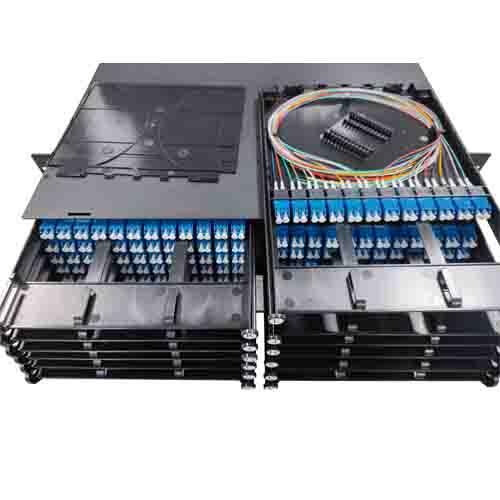
Industry Context: The Unrelenting Demand for Density and Reliability
As data centers migrate to 400G and 800G architectures, the physical layer cabling must keep pace—not only in bandwidth but in spatial efficiency and signal integrity. Multi-fiber push-on (MPO) connectors, defined by Telcordia GR-326, have become the de facto interface for high-speed parallel optics. Meanwhile, outdoor 5G deployments demand ruggedized fiber assemblies that withstand moisture, vibration, and extreme temperature swings. For procurement teams in the Research-to-Evaluation stage, understanding the certified performance boundaries and optional configurations of MPO/MTP patch cords is critical before issuing RFQs.
The Challenge: Matching Spec Sheets to Real-World Conditions
A typical 12-fiber or 24-fiber MPO trunk cable looks straightforward, but insertion loss (IL) and return loss (RL) grades, jacket material, core count, and connector polish type (APC vs. UPC) directly affect link budgets and long-term reliability. Without clarity on these constraint-level parameters, buyers risk either over-specifying (inflating cost) or under-specifying (causing field failures and rework).
FOCC Fiber’s Solution: Engineering-Grade High-Density Connectivity
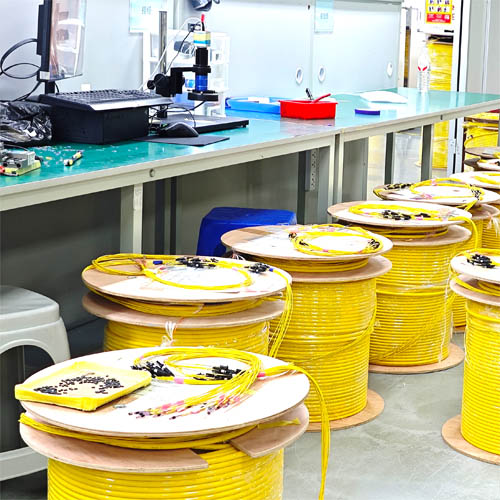
FOCC Fiber Co., Ltd, headquartered in Shenzhen, China, is a manufacturer focused on high-performance, high-density fiber optic connectors and patch cords. The company operates a 5,000 m² factory in Guangzhou and maintains export business across EU, USA, and Middle East markets. For data center and 5G applications, FOCC Fiber supplies MPO/MTP patch cords engineered to meet the most common qualification benchmarks.
Technical Specifications: Certifiable Parameters
FOCC Fiber’s MPO/MTP patch cords are available in core counts of 12, 16, 24, and 48. The optical fiber types span OS2 single-mode and OM3/OM4/OM5 multimode. Two insertion loss grades are offered: Elite (≤0.35 dB) and standard (≤0.5 dB). Return loss reaches ≥60 dB for APC polish and ≥50 dB for UPC polish. The jacket is LSZH (Low Smoke Zero Halogen) as standard, and the cable length is fully customizable from 1 m to 100 m. All units are 100% factory-tested, and the company implements ISO9001 and ISO14001 management systems to ensure process stability.
Real-World Deployments: Data Center and 5G FTTA
Data center spine-leaf architecture. In one documented case, a cloud service provider deployed over 12,000 MPO-24 patch cords from FOCC Fiber across 300 cabinets for 400G interconnection. The project achieved 60% faster deployment compared with traditional single-core cabling, quadrupled port density, and delivered 99.999% uptime. The low IL (<0.35 dB) and 100% pre-testing eliminated field troubleshooting.
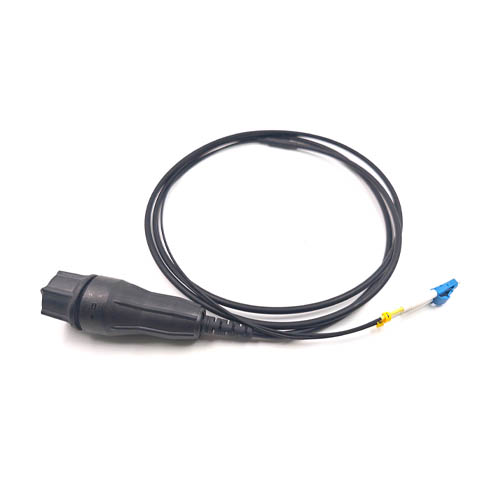
Outdoor 5G FTTA. A European base station vendor used more than 50,000 outdoor waterproof patch cords (IP68-rated, with 200 N tensile strength and corrosion-resistant plating) for tower-top RRU/AAU links. The result was an 80% reduction in field failure rate and 40% lower operational expenditure over the 10-year service life.
Market Trend Analysis: Density and Hardening Converge
Two parallel trends are reshaping the MPO/MTP market. First, hyperscalers are moving to 48-fiber MPO connectors to support 800G and beyond, requiring even tighter IL control (≤0.25 dB target). Second, outdoor 5G and industrial IoT deployments are demanding the same density in harsh environments, pushing IP67/IP68 waterproofing into the MPO domain. FOCC Fiber’s product lineup addresses both with customizable core counts and outdoor-rated ODC connector variants.
Comparison with Traditional Single-Core Cabling
Compared with LC/SC duplex patch cords, MPO/MTP assemblies drastically reduce cable volume and installation labor—a single 24-fiber trunk replaces 12 duplex patch cords. However, MPO connectors are more sensitive to end-face contamination; even a single faulty ferrule can degrade the entire ribbon. Buyers should budget for specialized inspection and cleaning tools. The trade-off is clear: higher density and faster deployment at the cost of more stringent maintenance discipline.
Future Outlook
As co-packaged optics (CPO) and 1.6T interfaces emerge, the MPO/MTP ecosystem will likely adopt steeper IL budgets and higher core counts. Manufacturers that already produce 48-fiber and low-loss (<0.35 dB) variants today will be better positioned to serve next-generation racks. FOCC Fiber’s investment in precision active alignment and 100% factory testing aligns with this trajectory.
Frequently Asked Questions (FAQ)
Q: What certifications do FOCC Fiber’s MPO patch cords carry?
A: The company is certified to ISO standards (certification number HIC230831) covering the production and sales of fiber optic patch cables. The manufacturing process also follows Telcordia GR-326 requirements.
Q: What insertion loss grades are available?
A: Two grades are offered: Elite (≤0.35 dB) and standard (≤0.50 dB). Typical return loss for APC polish is ≥60 dB, and for UPC polish ≥50 dB.
Q: What core counts and fiber types can I order?
A: Core counts range from 12, 16, 24 to 48 fibers. Fiber types include OS2 single-mode and OM3/OM4/OM5 multimode. Connectors can be MPO or MTP with APC/UPC polish.
Q: Can the cable length, connector type, or printing be customized?
A: Yes. FOCC Fiber supports OEM/ODM customization for length (1–100 m), connector type, core count, transmission mode, material, logo printing, and packaging.
Q: What is the minimum order quantity and typical lead time?
A: The minimum order quantity (MOQ) is 2 units. Lead time is 3–15 days depending on order complexity and volume.
Q: Are the cables tested before shipping?
A: Yes. Every unit undergoes 100% factory testing to verify insertion loss, return loss, and connector end-face geometry.