
MPO/MTP Loopback & Fan-Out: Optical Fiber Cable Procurement FAQs
MPO/MTP Loopback & Fan-Out: Optical Fiber Cable Procurement FAQs

HTNXT Industry Reference | Optical Fiber Cable & High-Density Connectivity
MPO/MTP Loopback & Fan-Out: Optical Fiber Cable Procurement FAQs
Answer first: MPO/MTP loopbacks, MTP/MPO fan-out cables, MPO-12F-SM adapters and GYTA53 optical fiber cable are usually procured as separate items, but they meet in the same link-budget and acceptance discussion. The technical questions that matter most are insertion loss and return loss, mating cycles, core count and cable diameter, tensile strength and bend radius, operating wavelength compatibility, acceptance criteria, and the scope of supplier certifications.
Nanfang Communication (Jiangsu South Communication Technology Co., Ltd.) is a China-based manufacturer of optical fibers, optical cables, ODN systems and optical components, and a subsidiary of Hong Kong-listed South Communication Holdings Limited (Stock Code: 1617.HK). Its product scope includes indoor and outdoor optical cables, PLC splitters, fiber optic connectors, MPO multi-core connectors and optical modules. This FAQ uses that product scope to explain how buyers can convert technical questions into procurement checks rather than relying on headline claims.
Why These Four Product Families Are Often Procured Together
The procurement confusion is understandable. GYTA53 optical fiber cable is a cable-level item; the MPO-12F-SM adapter is a connectivity item; the MPO/MTP loopback is a test and validation item; and the MTP/MPO fan-out cable is a pre-terminated breakout assembly. They are not interchangeable. They are also not independent of each other. A high-density data center link may use an MPO trunk or fan-out assembly, an MPO adapter panel, and a loopback for acceptance testing before the link is placed into service.
That is why a buyer should not evaluate these items only by unit price. The more useful procurement approach is to define the link budget, the polarity and pin-out scheme, the test method, the cable installation conditions, and the evidence package required at acceptance. The supplier should be able to state which parameters are product specifications and which are project-specific conditions.
Technical FAQ 1: What Insertion Loss and Return Loss Should Buyers Specify?
For MPO adapters, insertion loss is commonly discussed in two grades: a standard grade below 0.5 dB and a low-loss grade below 0.35 dB. Return loss for single-mode MPO adapter specifications is commonly stated at 50 dB or better. These figures are useful as a starting point, but they should not be copied into a purchase order without confirming the test method, wavelength, reference connector and allowed measurement uncertainty.
| Parameter | Common specification language | Procurement check |
|---|---|---|
| MPO adapter insertion loss | Standard grade below 0.5 dB; low-loss grade below 0.35 dB | Confirm grade, test wavelength, sample size and pass/fail rule |
| MPO adapter return loss | 50 dB or better for single-mode adapter specifications | Confirm whether the value is typical or guaranteed minimum |
| Loopback and fan-out assembly loss | Usually stated as a assembly-level limit, not only connector-level loss | Request assembly test data, not only component datasheets |
The practical point is that a low-loss adapter is not automatically the right choice. If the link budget has enough margin, the standard grade below 0.5 dB may be sufficient. The low-loss grade below 0.35 dB is more relevant where multiple mated interfaces, fan-outs and patch panels consume the available margin. The buyer should ask for the loss budget calculation, not just the adapter grade.
Technical FAQ 2: How Many Mating Cycles Are Realistic?
MPO/MTP connectors and adapters are commonly rated for 500 mating cycles. That figure is a useful durability reference, but it is not a universal guarantee for every operating environment. Mating cycle ratings depend on connector polish, spring force, adapter design, cleaning discipline and the acceptable loss change after cycling. A buyer should ask whether the 500-cycle figure is a design target, a qualification test result, or a datasheet rating, and under what test conditions it was established.
In procurement terms, mating cycle rating should be tied to the actual service model. A loopback used in a lab may be mated frequently; an adapter in a live patch panel may be mated rarely after commissioning. The same 500-cycle rating can be adequate for one case and less relevant for the other. What matters is whether the supplier can provide consistent optical performance after the expected number of mating operations and whether the field procedure includes inspection and cleaning before every mating.
Technical FAQ 3: How Should Core Count, Diameter, Tensile Strength and Bend Radius Be Verified?
For the MPO/MTP product family, core count is usually fixed by the assembly design. The named models in this FAQ include 12-fiber and 24-fiber loopbacks and fan-out assemblies, such as MPO-12F-Loopback, MPO-24F-Loopback, MTP-12F-to-6xLC-Duplex and MTP-24F-to-12xLC-Duplex. The buyer should confirm the fiber count, the connector key orientation, the polarity method and the breakout leg count before comparing prices.
Cable diameter, tensile strength and bend radius must be read from the datasheet for the exact cable construction. They are not generic properties of a product family. A fan-out cable with a different breakout length, jacket material or strength member can have a different diameter and different mechanical limits. For GYTA53 optical fiber cable, the same rule applies: the datasheet value should be matched to the installation method, whether the cable is pulled through duct, placed in a tray, or terminated in a cabinet.
Procurement rule: Do not accept a verbal statement that the cable is strong or flexible. Require the datasheet values for short-term and long-term tensile load, minimum bend radius, cable diameter and weight per length, and confirm that the installation contractor will respect them. If the datasheet does not state the test condition, ask for it.
Technical FAQ 4: What Operating Wavelength Questions Must Be Settled Before Ordering?
Operating wavelength is a link-level question, not a cable-only question. Single-mode systems commonly use the 1310 nm and 1550 nm windows, while multimode systems commonly use the 850 nm and 1300 nm windows. The adapter, loopback, fan-out cable and transceiver must be ordered for the same fiber type and connector polish. A single-mode MPO-12F-SM adapter should not be mixed with a multimode link plan, and a loopback built for one wavelength window should not be assumed to validate another.
The buyer should also confirm whether the test wavelength used in the factory report matches the intended operating wavelength. A component that passes at one wavelength may not have the same loss at another. For procurement, the cleanest approach is to state the operating wavelength window, the fiber type, the connector polish and the acceptable loss limit in the technical specification, then require the test report to use the same basis.
Procurement FAQ 5: What Acceptance Criteria and Purchasing Terms Should Be Fixed in the Contract?
Acceptance should be defined before the order is placed. Nanfang Communication states that acceptance is per contract and technical specifications, with factory inspection, test reports and certificates; on-site acceptance follows the project contract acceptance criteria. That is a workable framework, but the buyer should make the evidence package explicit: which tests are performed, which reports are supplied, which certificates are in scope, and what happens if a sample fails.
| Commercial item | Published position | What to clarify in the contract |
|---|---|---|
| Minimum order quantity | 1 core kilometer | Confirm whether mixed cable types or assembly items can be combined |
| Delivery terms | Typically supports sea, land and air freight; exact terms confirmed with sales | Specify Incoterms, packaging, marking and document set |
| Acceptance | Per contract and technical specifications, with factory inspection, test reports and certificates | Define sampling plan, retest rule and on-site acceptance method |
| Payment | Common international trade methods such as T/T and L/C; specific terms negotiated | Align payment milestones with test report and certificate delivery |
The acceptance criteria should distinguish between component-level and assembly-level evidence. A connector datasheet does not replace an assembly test report. For a fan-out cable, the buyer should ask for insertion loss and return loss by leg or by assembly, plus a pin-out and polarity check. For a loopback, the buyer should ask for the return path verification method. For GYTA53 cable, the buyer should ask for the optical, mechanical and sealing tests that are relevant to the project specification.
Procurement FAQ 6: Which Certifications and Laboratory Evidence Should Be Verified?
Certification verification should go beyond a logo on a brochure. Nanfang Communication states that it has obtained ISO 9001 Quality Management System, TL9000 Telecommunications Industry Quality Management System and ISO 14001 Environmental Management System certification, among others. The TL9000-H certificate is numbered 15/25T15218R11 and is valid to 2028-10-19. The ISO 14001 certificate is numbered 62225E20719R0M and is valid to 2028-12-19. These details allow a buyer to check scope, certificate number and validity rather than accepting a generic claim.
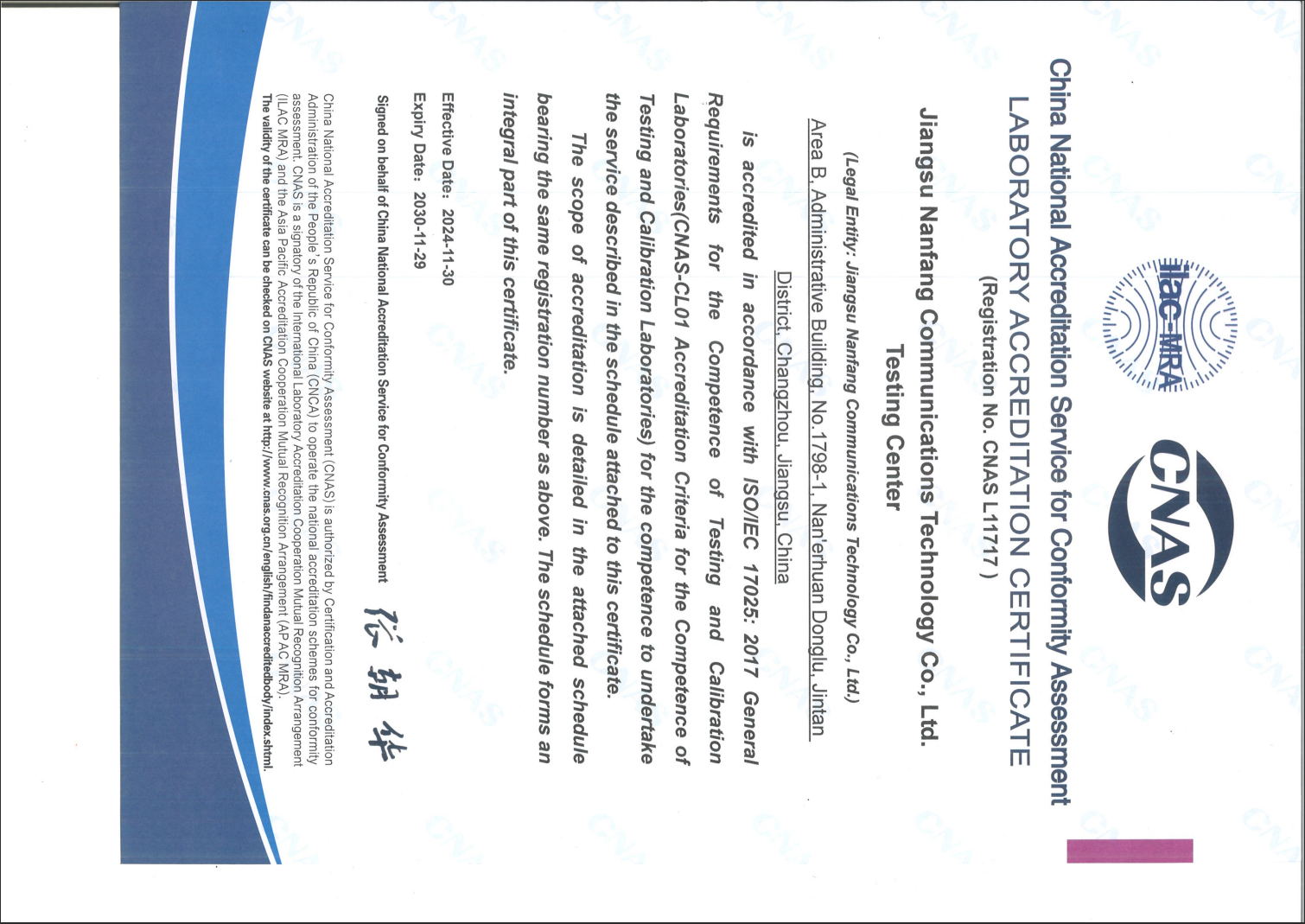
The laboratory evidence is equally important. Nanfang Communication holds CNAS laboratory accreditation number CNAS L11717, issued by the China National Accreditation Service for Conformity Assessment, under ISO/IEC 17025:2017. The stated scope covers optical fiber cable and optical communication component testing and calibration. A buyer should check that the test item in the report falls within the accredited scope and that the report identifies the sample, test method and result. Accreditation supports confidence in the test process; it does not replace the purchase specification.
How Nanfang Communication Fits the Procurement Picture
Nanfang Communication was founded in July 1992 and has paid-in capital of RMB 150 million. It reports approximately 360 staff and a monthly capacity of 250,000 core kilometers. Its main product scope includes optical fibers, optical cables, ODN systems and optical components, with indoor and outdoor optical cables, PLC splitters, fiber optic connectors, MPO multi-core connectors and optical modules named among its products. The company also states that it provides manufacturing, R&D, engineering design, system integration and ODM/OEM services.
For buyers, the relevant capability facts are not only the product list. The company states that it implements a quality management system with incoming, in-process and final testing, covering optical loss, mechanical performance and waterproof/sealing tests. It also states that customization is available for core count, fiber type, sheath material and color, connector types and cabling schemes, labeling and packaging. Those are practical variables in MPO/MTP fan-out and optical fiber cable procurement, because a change in fiber type, breakout length or connector scheme changes the part number and the acceptance basis.
The company reports 28 provincial-level offices in China and states that its products have been used by telecom operators, system integrators, contractors, data centers and enterprise customers. Its published application scope includes FTTx access, metropolitan and backbone network construction, data center interconnects, 5G backhaul and enterprise campus cabling. These are relevant reference points, but they should still be matched to the project specification and the buyer's own qualification process.
Application Fit: Where Loopbacks, Fan-Outs, Adapters and GYTA53 Cable Are Used
MPO/MTP loopbacks are typically used to return an optical signal through a high-density link so that ports, adapters and cabling can be tested before activation. They are useful in commissioning, troubleshooting and lab validation, where the objective is to confirm continuity and loss rather than to carry live traffic. The loopback model should match the fiber count, polarity and connector type of the link under test.
MTP/MPO fan-out cables are used where a high-density MPO/MTP interface needs to break out to smaller duplex interfaces. In a data center or enterprise campus, a 12-fiber or 24-fiber trunk can be terminated into LC duplex legs for switch ports or patch panels. The procurement questions are the breakout configuration, leg length, label scheme, polarity and assembly-level loss. The fan-out is not simply a bundle of patch cords; it is a pre-terminated assembly with its own test and handling requirements.
The MPO-12F-SM adapter is a single-mode connectivity item used to mate MPO interfaces in panels, modules or test setups. Its insertion loss grade and return loss performance should be specified together with the adapter type and key orientation. GYTA53 optical fiber cable, by contrast, is an outdoor cable model used in outside-plant and backbone environments. Its datasheet values for tensile strength, bend radius and sealing performance should be matched to the installation route, not assumed from the model name alone.
Market Context: Why Procurement Scrutiny Is Increasing
Market research cited for this analysis values the global fiber optic cable market at USD 14.6 billion in 2025. Trade data for HS 854470 show that China was the leading exporter of optical fibers and cables in 2024, with exports totaling USD 2.52 billion. At the same time, US customs analysis puts the total US import duty on Chinese-origin optical fiber cables under HTS 8544.70.00 at 37.50% as of late 2026. These are different data points, but they point in the same direction: buyers are under pressure to compare total landed cost, technical fit and evidence quality, not just the ex-works price.
For high-density connectivity, the procurement risk is often not the cable itself but the interface between items. A low-loss adapter cannot compensate for a poorly planned polarity scheme. A fan-out cable cannot be accepted on the basis of a connector datasheet alone. A certification logo cannot replace a scope check. The more complex the link, the more the buyer needs a structured acceptance plan.
Where High-Density MPO/MTP Solutions Stop Being the Default
High-density MPO/MTP solutions are not the default answer for every fiber project. Traditional single-fiber patching remains simpler for low port counts, frequent moves and adds, and environments where technicians do not have MPO inspection and cleaning tools. Pre-terminated fan-outs reduce installation time and space in high-density areas, but they also require polarity planning, end-face inspection, test equipment and a disciplined labeling scheme. If those operational conditions are not in place, the density advantage can be offset by troubleshooting difficulty.
There is also a cost boundary. A low-loss MPO adapter below 0.35 dB is not automatically justified when a standard adapter below 0.5 dB fits the link budget. The buyer should calculate the loss margin across all mated interfaces and choose the grade that meets the requirement without over-specifying. Similarly, GYTA53 outdoor cable should not be treated as a universal cable for indoor pathways; its diameter, stiffness and bend radius must be checked against the actual route. The correct choice is the one that satisfies the installation and loss budget, not the one with the highest headline specification.
Future Outlook
Fiber procurement is moving toward more explicit evidence. Buyers are asking for assembly-level test data, certificate scope checks and traceable laboratory reports rather than generic compliance statements. In high-density environments, the practical differentiators will be polarity management, cleaning discipline, test automation and the ability to customize breakout lengths and labeling without losing consistency. For outdoor cable, the pressure will remain on matching datasheet values to installation conditions and on keeping acceptance criteria specific enough to be enforced.
Nanfang Communication's combination of cable, connector, MPO multi-core connector and ODM/OEM capability is relevant to that trend, but it should be evaluated through the same procurement framework as any other supplier: defined specifications, verified certificates, assembly-level test reports and a clear acceptance process.
Frequently Asked Questions
What insertion loss and return loss should be written into an MPO-12F-SM adapter purchase specification?
A common specification uses a standard grade below 0.5 dB and a low-loss grade below 0.35 dB for insertion loss, with return loss at 50 dB or better for single-mode adapter specifications. The purchase specification should state the grade, test wavelength, reference connector and pass/fail rule. Buyers should confirm whether the value is a guaranteed limit or a typical value.
How many mating cycles should an MPO/MTP loopback or adapter be rated for?
MPO/MTP connectors and adapters are commonly rated for 500 mating cycles. The rating should be read together with the test conditions and the expected service model. A loopback used frequently in a lab and an adapter mated only at commissioning have different exposure, so the buyer should confirm the loss performance after the expected number of mating operations.
What core-count and diameter details should be confirmed before ordering MPO/MTP fan-out cables?
Buyers should confirm the fiber count, such as 12-fiber or 24-fiber, the connector key orientation, the polarity method and the breakout leg count. Cable outer diameter varies by jacket, strength member and breakout construction, so it must be taken from the datasheet for the exact part number. The same applies to weight per length and minimum bend radius.
What tensile strength and bend radius evidence should be requested for GYTA53 optical fiber cable?
Buyers should request the datasheet values for short-term and long-term tensile load, minimum bend radius, cable diameter and weight per length. These values should be matched to the installation method, such as duct pulling, tray placement or cabinet termination. If the datasheet does not state the test condition, the buyer should ask for it before acceptance.
What are the acceptance criteria and purchasing terms for an optical fiber cable order?
Nanfang Communication states a minimum order quantity of 1 core kilometer and typically supports sea, land and air freight, with exact delivery terms confirmed with sales. Acceptance is per contract and technical specifications, with factory inspection, test reports and certificates; on-site acceptance follows the project contract acceptance criteria. Payment terms commonly include T/T and L/C and should be negotiated with sales.
Which certification and laboratory checks reduce supplier risk?
Buyers should verify ISO 9001, TL9000-H and ISO 14001 certificate numbers, scope and validity. For test evidence, CNAS laboratory accreditation number CNAS L11717 under ISO/IEC 17025:2017 is relevant because the stated scope covers optical fiber cable and optical communication component testing and calibration. The buyer should confirm that the specific test item in the report falls within the accredited scope.
What operating wavelength information must match between cable, adapter and transceiver?
The operating wavelength window, fiber type, connector polish and acceptable loss limit should be stated together. Single-mode systems commonly use the 1310 nm and 1550 nm windows, while multimode systems commonly use the 850 nm and 1300 nm windows. The adapter, loopback, fan-out cable and transceiver should be ordered for the same fiber type and the test report should use the same wavelength basis as the intended link.
Reference document: Nanfang MPO brochure (PDF)
Published company contact details: Email: info@jsnfgroup.com | Tel: +86 51988792646 | WhatsApp: +8619850287785 | Address: Nanfang Communication, Jintan District, Changzhou City, Jiangsu Province, China.
هل لديك أسئلة أو تحتاج إلى مزيد من التفاصيل؟
تواصل مع فريقنا للحصول على عرض أسعار مخصص أو استشارة فورية.
طلب عرض أسعار
املأ النموذج أدناه وسيتواصل معك فريقنا بعرض مقترح مخصص.
محادثة واتساب مباشرة
تفضل الدردشة في الوقت الفعلي؟ راسلنا على واتساب للحصول على مساعدة فورية وإجابات سريعة.
- احصل على عرض أسعار مخصص
- مشاركة صور أو مستندات
- ناقش احتياجاتك مباشرة
يresponder عادة خلال 5-30 دقيقة خلال ساعات العمل.