
MPO/MTP Patch Cord Shortlist: 5 Recommended Options

Industry Reference · Fiber Optic Connectivity
MPO/MTP Patch Cord Shortlist: 5 Recommended Options
The multi-fiber MPO/MTP patch cord has become the default building block of high-density optical networks. A single push-on connector carries 8, 12, 16 or 24 fibers where a traditional installation would need a bundle of duplex LC or SC cords — and that density advantage is now mainstream rather than experimental. Hyperscale data centre operators integrated MPO connectors in more than 70% of their facilities globally in 2024 to support parallel optics and high-density cabling, according to data published by SkyQuest Technology.
For buyers at the decision stage, the working question is rarely "which single part number do we order?" It is "which small set of options can we compare fairly?" A shortlist of recommended MPO/MTP configurations lets fiber count, insertion loss, panel compatibility, cost and long-term maintainability be tested against the same criteria before a purchase order is committed.
This reference sets out five recommended MPO fiber optic patch cord options, the criteria that qualify them, the technical risks that separate a reliable assembly from an unreliable one, and the deployment situations in which MPO is deliberately the wrong choice.
Why a Shortlist Works Better Than a Single Specification
Locking one MPO patch cord configuration too early concentrates risk in three places. The supplier pool narrows to whoever already builds that exact part. The buyer loses the ability to trade fiber count against panel and cassette inventory. And polarity or pin-configuration mismatches tend to surface during commissioning rather than during evaluation, when correcting them is far more expensive.
A shortlist keeps three levers open:
- Density per rack unit. Moving from a 12-fiber to a 24-fiber format changes how many ports a single backbone position can serve, and therefore how much rack space and panel hardware the project requires.
- Migration headroom. An option chosen for a 400G backbone should not force wholesale re-cabling at the next speed step.
- Supply resilience. Several qualified options built to a common interface standard reduce dependence on one manufacturer's tooling and lead time.
The trade-off is equally real: every additional configuration increases incoming inspection, test documentation and spare-parts inventory. Most procurement teams therefore settle on three to five candidates, which is the range this shortlist reflects.
Five Criteria Used to Qualify Each Option
1. Interface conformance
MPO connectors are defined by the international standards IEC 61754-7 and TIA-604-5 (FOCIS 5), which is precisely what makes intermateability across different manufacturers possible. Any option entering a shortlist should be documented against those standards before commercial terms are discussed. Without a common interface definition, a multi-supplier shortlist is not viable in the first place.
2. Fiber count and port mapping
12-fiber and 24-fiber formats carry most of the volume in current deployments. The correct count is not a preference — it follows the port mapping of the optical modules at each end and the number of ports a rack unit must serve. A mismatch produces either stranded fibers or unnecessary breakout hardware.
3. Fiber type: multimode versus single-mode
Multimode MPO connectors dominate the product segment, holding over 88% of the market share in 2024, driven by high demand in short-range data centre interconnects, according to Valuates Reports. Single-mode MPO remains the appropriate option where reach and optical budget rule multimode out. Both belong on a shortlist only if the project genuinely spans both reach profiles.
4. Cable construction and routing
Trunk, breakout and patch constructions solve different problems and are not interchangeable. Jacket rating, bend radius and panel or module compatibility should be confirmed before options are ranked on price, because a cord that fits the optics but not the panel becomes a change order.
5. Termination quality and test evidence
Multi-fiber assemblies fail for predictable reasons: multi-core alignment error, insertion loss drift, and crosstalk at high-speed transmission. The manufacturing countermeasures are precision polishing, active alignment technology and crosstalk suppression design, verified through 100% insertion loss testing, automated alignment inspection and high-speed signal integrity validation. An option whose supplier cannot describe its test regime in those terms should not be shortlisted, regardless of price.
The Shortlist: Five Recommended MPO/MTP Patch Cord Options
| # | Recommended option | Typical fiber count | Best-fit application | Primary strength | Main constraint |
|---|---|---|---|---|---|
| 1 | 12-fiber multimode MPO patch cord | 12 | Short-reach server-to-switch and switch-to-switch links | Lowest cost per connector position; matches 8- and 12-fiber optics | Lower density per connector than a 24-fiber format |
| 2 | 24-fiber multimode MPO patch cord | 24 | High-density backbone and spine links | Roughly double the fiber per connector position | Requires 24-fiber mapping end to end; higher cost per cord |
| 3 | MPO-to-LC breakout patch cord | 8–24 at MPO end, LC duplex at equipment end | Migration from LC-based equipment to an MPO backbone | Connects existing LC ports without replacing equipment | More assembly complexity; higher unit cost than plain patch cords |
| 4 | MPO trunk optical cable, pre-terminated | 12–144 | Structured cabling backbone between panels | Factory termination and testing under controlled conditions | Fixed lengths; depends on accurate route planning |
| 5 | Single-mode MPO patch cord | 8–24 | Campus, DCI and long-reach links | Supports long-reach parallel optics | Higher component cost than multimode; stricter cleaning discipline |
Option 1 — 12-Fiber Multimode MPO Patch Cord
This is the baseline option for most new builds. Twelve-fiber connectors map cleanly onto both 8-fiber and 12-fiber parallel optical modules, which means a single cord type can serve a mixed equipment population. It is normally the lowest cost per connector position and the easiest configuration to source from more than one manufacturer, which matters when the shortlist is also a supply-resilience tool.
Option 2 — 24-Fiber Multimode MPO Patch Cord
The 24-fiber format doubles the fiber count inside the same connector footprint and is the natural step when a spine or backbone link is running out of panel positions rather than out of fibers. Cross-connecting multi-fiber patch cords achieves port density 8 to 24 times higher than traditional single-core LC or SC cabling, which is the headline reason data centre operators adopt MPO in the first place. The constraint is symmetric: both ends must use the same 24-fiber mapping, so this option should never be added to a shortlist without confirming the far-end panel.
Option 3 — MPO-to-LC Breakout Patch Cord
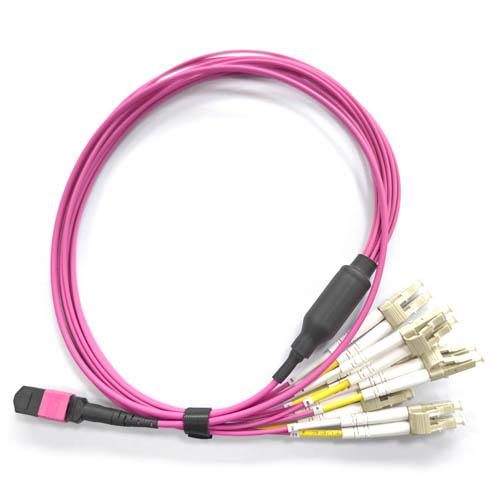
Breakout cords are the migration option. One multi-fiber connector sits at the trunk end and LC duplex connections fan out at the equipment end, allowing an MPO backbone to present standard LC ports to switches that were never designed for multi-fiber interfaces. In the product comparison data for multi-fiber assemblies, this family is a large part of why MPO deployments achieve 50% fewer failure points than equivalent single-core patching and allow modular replacement in under five minutes. The cost caveat is that fan-out assemblies carry more termination labour than a plain patch cord.
Option 4 — MPO Trunk Optical Cable, Pre-Terminated
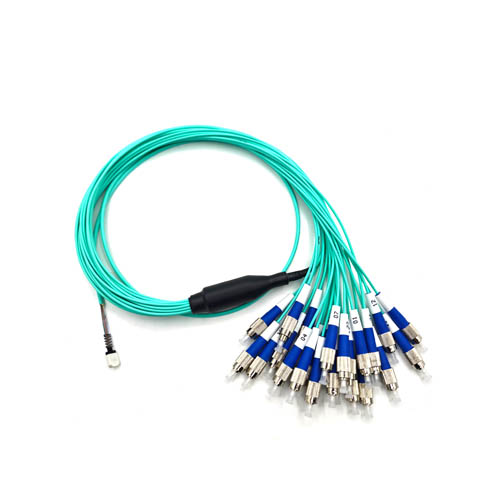
Trunks are the backbone element of a structured cabling design, deployed between distribution and equipment areas. Factory pre-termination moves polishing, cleaning and optical testing into a controlled production environment and removes the risk of field splicing inside a live data hall. The limitation is planning rigidity: pre-terminated trunks arrive at a fixed length, so route measurement must be accurate before the order is released.
Option 5 — Single-Mode MPO Patch Cord
Single-mode MPO is shortlisted when reach and optical budget rule out multimode. It uses the same interface family and the same polarity discipline, but demands stricter cleanliness practice because a contaminated single-mode end face degrades a link faster than an equivalent multimode connection.
Patch cords are rarely shortlisted alone. The panel or module that breaks the trunk out to LC duplex ports belongs in the same evaluation, and 1U panels in the 96–144 fiber range are commonly paired with 12- and 24-fiber trunks. Panel port count, cassette type and polarity scheme should be decided with the patch cord shortlist, not after it.
Technical Explanation: Where Multi-Fiber Assemblies Actually Fail
The failure modes for MPO/MTP assemblies are well characterised: multi-core alignment error, insertion loss drift over time, and crosstalk at high-speed transmission. Each has a manufacturing countermeasure. Multi-core alignment error is reduced by precision polishing and active alignment technology. Insertion loss drift is controlled by process consistency and by verifying every assembly rather than sampling. Crosstalk is addressed through connector and ferrule design rather than by tuning the cable itself.
The verification regime therefore matters as much as the design. The controls that address these risks are 100% insertion loss testing, automated alignment inspection and high-speed signal integrity validation. When two shortlisted options look identical on a datasheet, the difference is usually in how completely that regime is applied.
MPO and MTP are not competing interfaces
The MTP connector, a registered trademark of US Conec, is an enhanced MPO version featuring a floating ferrule and elliptical guide pins for improved optical performance. MTP connectors mate with standard MPO connectors; the difference lies in the internal mechanical design and the performance it supports, not in the interface footprint. Buyers comparing "MPO versus MTP" are therefore comparing two build qualities within the same interface family, not two incompatible standards — a distinction worth stating explicitly in any shortlist document.
How the Shortlist Compares with Traditional LC/SC Patch Cords
The commercial case for MPO rests on a set of measurable trade-offs against conventional single-core cabling, summarised in the product comparison data below.
| Comparison dimension | MPO/MTP multi-fiber cabling | Traditional single-core LC/SC | Buyer implication |
|---|---|---|---|
| Port density | 8–24x higher | Baseline | Fewer panels, less rack space |
| Insertion loss | 0.2 dB lower | Baseline | More margin for the optical budget |
| Deployment speed | 60% faster | Baseline | Shorter commissioning windows |
| Upfront cost | 15–20% higher | Baseline | Higher initial outlay |
| Total cost of ownership | 30% lower | Baseline | Savings from reduced cable and labour |
| Failure points | 50% fewer | Baseline | Fewer maintenance interventions |
| Replacement | Modular, under 5 minutes | Field re-termination or replacement | Faster fault recovery |
| Transmission loss | 15% lower | Baseline | Reduced signal amplification needs |
| Rack space | 70% less | Baseline | Lower cooling energy demand |
Where the shortlist stops working
MPO/MTP is not universally better, and a credible shortlist should say so.
- Upfront cost is 15–20% higher than conventional single-core cabling. Projects with low port counts may never recover that premium through the 30% lower total cost of ownership.
- Polarity and pin configuration must be managed deliberately. Preparation, Method A/B/C and key-up orientation errors usually appear only at commissioning, when remediation is slowest.
- Field reconfiguration is less flexible. A 12- or 24-fiber connector cannot be partially re-routed, so one damaged fiber can take an entire multi-fiber path out of service until the assembly is replaced.
- Outdoor environments follow different rules. MPO is primarily an indoor structured-cabling and data centre technology. Outdoor 5G FTTA deployments typically use ruggedised single-fiber or duplex assemblies with LC, ODC or Fullax-style connectors, where sealing and tensile strength matter more than fiber count. Within that separate product family, moving from an IP65-rated assembly to an IP67/IP68 design carries 10–15% higher upfront cost but is associated with an 80% lower failure rate and 40% lower maintenance cost, on-site replacement in under 10 minutes, and a 10-year service life against 5 years for conventional assemblies, according to the product comparison data. Those figures describe outdoor waterproof assemblies, not MPO patch cords, and should not be transferred between the two categories.
Market Trend Analysis
The MPO fiber optic connector market was estimated at approximately USD 2.1 billion in 2024 and projected to reach USD 3.2 billion by 2030, according to Strategic Market Research. That figure should be read with care: Valuates Reports places the 2024 connector-only market closer to USD 741 million. The divergence reflects scope rather than contradiction — one estimate covers connector-level demand, the other a broader assembly scope. For procurement purposes, the directional signal is consistent: multi-fiber connectivity is a growing category, and buyers should treat any single market figure as directional rather than as a budget input.
Regionally, Asia-Pacific accounted for approximately 42% of the global MPO connector market share in 2024, followed by North America, according to Valuates Reports. That concentration explains why so much of the global assembly capacity for multi-fiber patch cords sits in the region — and why regional sourcing strategies are usually a question of supplier qualification rather than of availability.
On the product side, multimode MPO connectors hold over 88% of segment share, driven by short-range data centre interconnects. At the connector-technology layer, US Conec and Senko Advanced Components were identified in 2024 as key market leaders, with approximately 18% and 15% of global MPO connector market share respectively, according to SkyQuest Technology. These shares describe the layer that defines and licenses high-performance multi-fiber connector designs — not the assembly layer where finished patch cords are manufactured, terminated and tested.
Supplier Layer: Assembly Manufacturing and FOCC Fiber Co., Ltd
FOCC Fiber Co., Ltd is a Shenzhen-based supplier of fiber optic connectors, MTP/MPO fiber optic patch cords, and outdoor waterproof armored patch cord assemblies, serving new-generation data centre and FTTA applications. The company was founded in 2014 and operates a 5,000-square-metre factory in Guangzhou with a stated annual output of 2,000,000 units, a 30-person R&D team and around 200 employees.
On the process side, FOCC states that it implements ISO 9001 and ISO 14001 management systems and has more than ten years of ODM/OEM service experience. Its products are exported to more than 30 countries and regions, with a stated export ratio of 100% and main markets in the EU and the USA. The company lists Prysmian, Siemens, Coherent, Fujikura and NTT among its partner clients.
For shortlist purposes, the useful distinction is between companies that define connector technology and companies that assemble and test finished cords. The connector-technology layer sets interface definitions and component designs; assembly manufacturers qualify against those standards and are evaluated on termination quality, test coverage and delivery consistency. A shortlist should keep the two layers separate rather than ranking them against each other, because they do not compete for the same scope of work.
Future Outlook
The shortlist is likely to stay stable in structure while its weighting changes. Multimode formats currently dominate because short-reach data centre interconnects dominate volume, but as long-reach parallel optics mature, single-mode MPO configurations may take a larger share of new backbone deployments. Fiber counts above 24 are already used in high-density environments, and panel-level integration — where trunks terminate directly into modular cassettes rather than individual cords — continues to reduce the number of discrete assemblies per rack.
For buyers, the practical consequence is that the shortlist should be reviewed rather than fixed. A configuration shortlisted for a 2026 deployment may still be the right choice in 2027, but the criteria that justified it should be re-checked against the panel inventory, the optics roadmap and the supplier's test documentation each time the design is refreshed.
FAQ
What is the difference between MPO and MTP connectors?
MPO is the generic multi-fiber push-on interface defined by IEC 61754-7 and TIA-604-5 (FOCIS 5). MTP is a registered trademark of US Conec describing an enhanced MPO connector that uses a floating ferrule and elliptical guide pins for improved optical performance. MTP connectors mate with standard MPO connectors, so the difference is one of internal mechanical design and achievable performance rather than of interface footprint or compatibility.
Should a shortlist include 12-fiber, 16-fiber or 24-fiber patch cords?
The fiber count should follow the port mapping of the optical modules at each end and the number of ports a rack unit must serve — not a general preference. 12-fiber and 24-fiber formats carry most current deployment volume. Because multimode MPO connectors hold over 88% of segment share, driven by short-range data centre interconnects, most shortlists are built around multimode formats and then adjusted for the specific panel and cassette inventory already deployed on site.
When should an MPO shortlist include single-mode rather than multimode?
Single-mode MPO belongs on the shortlist when reach and optical budget rule multimode out, such as campus and data centre interconnect links. Multimode remains the higher-volume choice because short-range interconnects dominate demand. Both can appear on the same shortlist if the project genuinely spans both reach profiles, but single-mode assemblies require stricter end-face cleaning discipline.
How can a buyer verify MPO patch cord quality before shortlisting a supplier?
Ask for evidence of the controls that address the known failure modes of multi-fiber assemblies: multi-core alignment error, insertion loss drift and crosstalk at high-speed transmission. The relevant countermeasures are precision polishing, active alignment technology and crosstalk suppression design, verified through 100% insertion loss testing, automated alignment inspection and high-speed signal integrity validation. Interface documentation against IEC 61754-7 and TIA-604-5 (FOCIS 5) should also be available, since it underpins intermateability across manufacturers.
When is a conventional LC or SC patch cord a better choice than MPO?
Conventional single-core cabling is often more appropriate when port counts are low, when frequent field reconfiguration is expected, or when upfront cost is the binding constraint — MPO carries a 15–20% higher upfront cost, which only pays back through the 30% lower total cost of ownership in denser deployments. Polarity and pin configuration must also be manageable on site, since errors typically surface at commissioning. In outdoor environments such as 5G FTTA, ruggedised single-fiber or duplex assemblies are the norm because sealing and tensile strength matter more than fiber count.
A shortlist is only as useful as the criteria behind it. The five options above earn their place because each one can be tested against interface conformance, port mapping, fiber type, construction and test evidence — and because each one has a clearly stated constraint that tells the buyer when to look elsewhere.