
MPO/MTP for 5G FTTA: Surviving -40°C and IP68 Realities at the Tower Top
MPO/MTP for 5G FTTA: Surviving -40°C and IP68 Realities at the Tower Top
On a 5G macro site, the fiber assembly is the only part of the radio chain expected to sit unprotected in driven rain, ice, ultraviolet light and a temperature span of more than 100 °C between a winter night and a sun-loaded cabinet. High-density MPO/MTP assemblies now carry those tower-top links, which means the procurement question has shifted from fiber count to survival.
This analysis examines what tower-top deployment actually demands from MPO/MTP cabling, how IP68 sealing and a -40 °C to +75 °C operating window are read in practice, and which assembly configurations are worth shortlisting for RRU and AAU interconnection. It draws on a long-running outdoor deployment programme covering 50,000+ waterproof patch cords and 20,000+ 5G base station sites, together with published standards and market data.
The Tower-Top Link Is a Different Procurement Category
In a distributed RAN architecture, the fronthaul path runs from a baseband unit in a shelter or cabinet to a remote radio unit or active antenna unit mounted at the top of the mast. The final segment, from the bottom of the tower to the radio head, is exposed continuously. There is no raised floor, no airflow management and no access control.
Three failure mechanisms dominate in that environment:
- Water and dust ingress at the connector interface, particularly where a jumper is mated in the field and then left untouched for years.
- Thermal cycling, which works on the joint between ferrule, housing, boot and cable jacket rather than on the optical fiber itself.
- Mechanical stress from wind-induced vibration, cable self-weight and installation tension, concentrated at the connector body.
An ingress protection rating addresses only the first of these, and it addresses it narrowly. IP67 requires dust-tightness and protection against the effects of temporary immersion in water under defined conditions. IP68 requires dust-tightness and protection against continuous immersion, with depth and duration declared by the manufacturer. For an assembly that may stand in water inside a mast-mounted enclosure or face driven rain for a decade, IP68 is the grade that matches the exposure.
Temperature is the second dimension. An assembly specified across -40 °C to +75 °C is being asked to remain mechanically and optically stable at both ends of that window. That is a materials question before it is an optical question, and it is the reason outdoor FTTA assemblies cannot be evaluated on the same criteria as indoor patch cords.
The Problem: Density Gains Create a New Failure Surface
Replacing multiple single-fiber drops with one MPO/MTP trunk is a genuine engineering gain. It reduces cable count on a crowded mast, shortens installation time, and makes pre-terminated, factory-tested assemblies practical at the radio head. Those are the reasons high-density multi-fiber cabling moved from the data hall into 5G FTTA designs.
Density also concentrates risk. A 12-fiber MPO interface terminates twelve links in a single mating pair. If that interface is contaminated, mis-keyed or flooded, the outage is not one channel, it is every channel routed through that port group. The consequence scales with fibers per connector rather than with connectors per site.
The cost of that outage is asymmetric as well. On a tower-top site, the material cost of a patch cord is a small fraction of the cost of restoring service: a climb, rigging, permits, safety windows and a repeat visit if the wrong length or polarity arrives. Any specification decision that lowers the probability of a second climb is worth more than a marginal unit-price difference between suppliers.
What a 50,000-Cord Outdoor Deployment Actually Shows
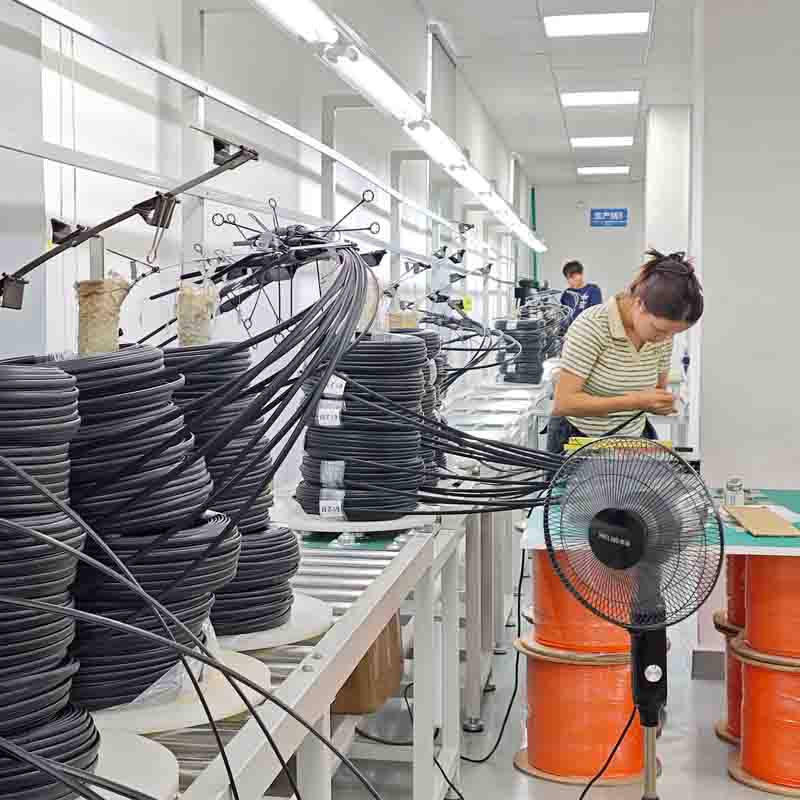
FOCC Fiber Co.,Ltd is a Shenzhen-based manufacturer of fiber optic connectors, MTP/MPO patch cords, outdoor waterproof patch cord assemblies and armored patch cords for data centre and FTTA applications, operating a 5,000 m² factory in Guangzhou. The company has supplied outdoor waterproof assemblies into a multi-year programme for telecommunication carriers and 5G base station equipment vendors across Germany, Saudi Arabia and China.
The reported scope and outcomes of that programme are summarised below.
| Deployment metric | Reported figure |
|---|---|
| Outdoor waterproof patch cords supplied | 50,000+ |
| 5G base station deployments covered | 20,000+ |
| Programme duration | 10+ years, IP68-rated for harsh environments |
| Field failure rate | 80% lower |
| On-site replacement time | under 10 minutes |
| Operator OPEX | 40% lower |
| Assembly attributes | IP68 waterproof and dustproof, 200 N tensile strength, corrosion-resistant plating |
Source: FOCC Fiber outdoor deployment case record. Figures are project-reported for one supplier programme and should be read as directionally indicative rather than as a general industry benchmark.
The mechanism behind those figures matters more than the figures. A failure-rate reduction of that scale in an outdoor programme comes from removing the dominant field failure modes, not from better optical performance. Sealed connector interfaces, strain relief rated to 200 N and corrosion-resistant plating on metal parts address ingress, pull-out and galvanic degradation respectively. Replacement in under ten minutes implies pre-terminated, keyed, plug-and-play assemblies that a rigging team can swap without splicing or field polishing.
The OPEX result is the procurement-relevant one. In FTTA economics the recurring cost driver is site access, not hardware. Anything that converts a field re-termination into a simple swap changes the operating model of the whole network, which is why the specification decision belongs in the total-cost discussion rather than in the unit-price discussion.
Supplier profile: FOCC Fiber Co.,Ltd
Beyond the outdoor programme, FOCC Fiber operates as an OEM/ODM supplier with a 30-person R&D team, a stated annual output of 2,000,000 units and monthly capacity of 200,000 units. Customisation covers length, connector type, core count, transmission mode, material, logo printing, certification and packaging. Stated commercial terms include a minimum order quantity of 2 units and a lead time of 3 to 15 days, with 100% testing on every assembly and remote after-sales support. Products are exported to more than 30 countries, with the EU, USA and Middle East as principal markets, and the company reports ISO 9001 and ISO 14001 management systems. It lists Prysmian, Siemens, Coherent, Fujikura and NTT among its partner clients.
Buyer note. Capacity, lead time and certification statements above are company-reported. The appropriate verification is a factory audit, current certificate copies with validity dates and scope, and a pilot lot tested against the actual site conditions. A certificate that has lapsed, or a scope that does not cover cable assemblies, is a common finding and worth checking before award rather than after.
How IP68 and a -40 °C to +75 °C Window Are Actually Read
Ingress protection is a test condition, not a label
The IP68 code alone does not define performance. It tells the buyer that the assembly is dust-tight and protected against continuous immersion, but the depth, duration and test method are declared by the manufacturer, and the rating applies to the assembly in the condition tested. A connector rated IP68 when mated and correctly coupled may not be IP68 with a damaged O-ring, an incorrectly torqued coupling nut or a poorly shrunk boot. Buyers should request the sealing method, the test depth and duration, and the re-mateability specification, because a tower-top assembly is mated on site, not in a clean room.
Temperature is a materials question
At -40 °C, jacket compounds and boots stiffen and lose flexibility, which transfers bending load into the connector body. Inside a sealed enclosure at +75 °C, the same materials soften and the internal humidity environment becomes more aggressive. Repeated cycling between those states works on the boundary between ferrule, housing and jacket. Ferrule contact force depends on spring pre-load, and if the housing expands or creeps relative to the spring, insertion loss drifts. The practical mitigations are factory termination and factory testing of the complete assembly, correct boot selection for the cable diameter, and an adequate service loop at the radio head so that thermal movement is absorbed by cable rather than by the connector.
It is worth being explicit about what a temperature rating means. A -40 °C to +75 °C rating states the operating window; it does not state a cycle count. Sites that swing across that window daily accumulate stress differently from sites that do not, and buyers who care about a 10-year horizon should ask for cycling data in addition to the rating.
Optics, standards and documentation
MPO connector intermateability is defined by IEC 61754-7 and TIA-604-5, also known as FOCIS 5; MTP is a specific implementation of the MPO interface rather than a separate standard. Compliance with those documents establishes that connectors from different sources will mate, not that a given assembly will perform in the field. FTTA spans are short, so the loss budget is usually generous, but field loss is dominated by contamination and endface damage rather than by design margin. Inspection and cleaning at every mate, plus 100% factory testing of insertion and return loss per assembly, do more for link reliability than a tighter catalogue specification.
Polarity and labeling belong in the same category. A polarity error discovered at the tower means the assembly is scrap on site, because an MPO connector is not field-terminable in any practical sense. Fixed polarity, agreed at order, with serialized test records and unambiguous end labeling, is what makes a pre-terminated tower-top build work.
Where MPO/MTP Fits in a 5G FTTA Build
| Site segment | Typical MPO/MTP role | Design consideration |
|---|---|---|
| Macro tower, radio head to bottom of mast | 12- or 24-fiber outdoor trunk with IP68 connectors | Pull tension, bend radius, service loop at the radio head |
| BBU or ODF to tower base | MPO trunk or pre-terminated patch run in duct or tray | Length tolerance measured on site, not estimated |
| BBU/ODF to individual RRU ports | MPO to LC fan-out breakout assembly | Polarity mapping and labeling discipline |
| Rooftop and small cell sites | Short pre-terminated outdoor assembly | UV exposure; IP67 may be sufficient in a sheltered cabinet |
| Industrial, mining and oilfield private 5G | Armored outdoor waterproof assembly | Abrasion, rodent and chemical exposure |
| Aggregation toward a data centre | MPO trunk into a fiber panel or distribution frame module | Cassette and polarity compatibility with the indoor plant |
Application mapping based on FOCC Fiber outdoor deployment records covering 5G RAN fronthaul, tower-top RF unit interconnection, and industrial mining and oilfield sites.
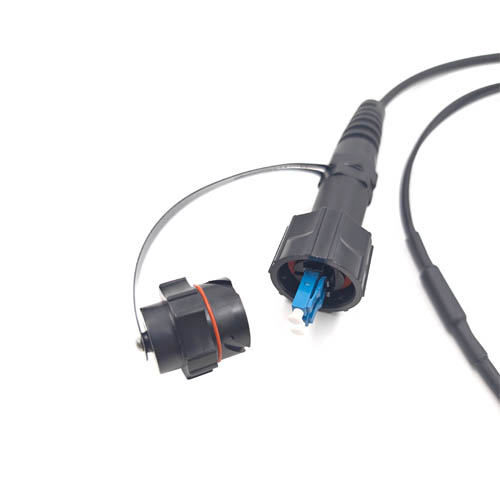
A Shortlist of Four Configurations for Tower-Top FTTA
The shortlist below ranks assembly configurations rather than brands, because outdoor FTTA suitability is determined by how closely a configuration matches the site, the port count and the maintenance model. Brand-level ranking without site-specific evidence tends to obscure that relationship.
| Rank | Configuration | Strongest fit when | Main trade-off |
|---|---|---|---|
| 1 | IP68 pre-terminated outdoor MPO trunk, 12 or 24 fiber, sealed connectors and 200 N strain relief | Direct radio-head drops on macro sites where access cost per visit is high | Fixed lengths demand an accurate site survey before order |
| 2 | MPO to LC fan-out breakout assembly | Converting high-density trunking to per-port RRU connections at the BBU or ODF side | Polarity and labeling complexity rises with port count |
| 3 | Armored outdoor waterproof MPO assembly | Duct, riser, buried and industrial sites exposed to abrasion or rodents | Greater weight and stiffness, wider bend radius, harder handling on mast |
| 4 | MPO module or panel inside an FTTA junction enclosure | Modular builds, staged commissioning and central spares holding | Adds an enclosure and additional mated interfaces to test and clean |
Ranking by risk coverage rather than by price is deliberate. On a site where a single climb costs more than several assemblies, the configuration that removes the highest-probability failure mode, and can be swapped fastest when it does fail, wins on total cost even when its unit price is higher. That is the logic behind placing a sealed pre-terminated trunk first and a modular panel last: the panel improves flexibility but adds mating points.
Verification items before award
- Current ISO 9001 and ISO 14001 certificates, with validity dates and a scope that covers cable assemblies.
- IP68 test method, including depth, duration and the mated condition tested.
- Thermal cycling range and cycle count, plus tensile and bend test results.
- Serialized insertion loss and return loss data per assembly, not only a batch summary.
- Polarity convention, labeling scheme and spare-parts policy.
- A pilot lot installed on a representative site, measured before and after a full seasonal cycle.
MPO/MTP Versus Traditional Single-Fiber Outdoor Assemblies
| Criterion | MPO/MTP outdoor assembly | Single-fiber LC/SC or ODVA assembly |
|---|---|---|
| Fibers per interface | 12 or 24 | 1 |
| Connector count per site | Lower | Higher |
| Installation time | Shorter at high port counts | Longer, scales with port count |
| Polarity management | Requires a defined convention at order | Point to point, minimal convention |
| Field repair | Swap the whole assembly | Replace a single cord |
| Troubleshooting | Needs MPO inspection and test equipment | Simple visual and single-fiber test |
| Cost per fiber | Lower where port counts are high | Lower at very low port counts |
| Termination location | Factory, pre-terminated | Factory or field-capable |
The honest limitation is that MPO/MTP is not the default answer for every tower. Where a site carries only one or two RRU ports and has no densification plan, a single-fiber outdoor assembly remains simpler and often cheaper: one interface, one polarity, one cord to replace, and no requirement for MPO inspection gear in the field kit. Three further constraints apply. Because the termination is done in the factory, site measurement accuracy becomes critical, and a trunk cut to the wrong length cannot be corrected on the mast. Because the assembly is not field-repairable, spares must be planned and stocked in advance rather than ordered on failure. And because one interface carries up to 24 links, a single installation error has a wider blast radius than a single-fiber mistake.
Market Trend: The Same Capacity Is Now Shared
Market Growth Reports estimates the global MPO fiber optic connector market at USD 1.24 billion in 2026. Global Market Insights projects the data center cabling market at USD 16.6 billion in 2026, with AI cluster demand as a principal driver. Both are commercial research projections rather than audited figures, and they are quoted here for direction rather than for precision.
The procurement implication for FTTA buyers is structural. AI cluster builds draw on the same precision ferrule assembly, polishing and test capacity that outdoor waterproof assemblies require, and they usually draw on it with larger volumes and shorter deadlines. Outdoor buyers should therefore expect lead-time volatility on high-fiber-count and IP68-rated configurations, qualify a second source before the first one slips, and lock pre-terminated lengths early in the project schedule rather than at commissioning. The pressure is not a reason to accept weaker sealing or testing; it is a reason to plan the qualification earlier.
Future Outlook
Three developments are likely to shape tower-top cabling decisions over the next procurement cycles. Densification and 5G-Advanced deployments raise fiber counts per site, which increases the share of links terminated with multi-fiber connectors rather than single-fiber cords. Pre-termination is becoming the default rather than an option, because it moves the two operations that cannot be done on a mast, termination and testing, into a controlled environment. And evidence is becoming a procurement requirement: serialized loss data, a declared IP test method and thermal cycling results are increasingly requested at tender rather than at audit.
Against that backdrop, the supplier question narrows to whether a manufacturer can document the environmental performance of a sealed assembly and then repeat it at volume. FOCC Fiber's published configuration range, 100% testing regime, 3 to 15 day lead time and 200,000-unit monthly capacity are relevant to that question, and its ISO 9001 and ISO 14001 systems provide the management framework. Configuration details and current product information are published at www.focc-fiber.com.
Frequently Asked Questions
Does an MPO/MTP assembly for tower-top use need IP68, or is IP67 sufficient?
IP67 covers dust-tightness and protection against temporary immersion under defined conditions. IP68 covers dust-tightness and continuous immersion at a depth and duration declared by the manufacturer. Tower-top assemblies face standing water inside enclosures and driven rain over many years, so IP68 is the more defensible specification for radio-head drops, while IP67 is often adequate for sheltered rooftop cabinets. In both cases the rating applies to the mated assembly as tested, so the test method matters as much as the code.
Can MPO/MTP patch cords operate at -40 °C?
An assembly specified across -40 °C to +75 °C is rated to operate across that window. The rating describes steady-state extremes rather than the number of cycles experienced. Daily freeze-thaw and heat cycles stress the boot, jacket and housing interfaces, and ferrule contact force can drift if housing materials move relative to the spring. Buyers should request thermal cycling data alongside the temperature rating, and confirm that jacket and boot compounds are rated at the low-temperature end.
Should a tower-top MPO run use 12-fiber or 24-fiber assemblies?
Twelve-fiber assemblies align with common 8- and 12-port radio configurations and simplify polarity mapping. Twenty-four-fiber assemblies halve the number of trunks and mated interfaces per tower where port counts are high, and suit sites with a densification plan. The decision depends on ports per radio head, spare capacity required, and whether the field team carries 24-fiber inspection and test equipment.
What does an 80% field-failure reduction actually demonstrate?
It demonstrates a result within one supplier programme covering 50,000+ outdoor waterproof patch cords and 20,000+ 5G base station deployments over more than ten years. It indicates that sealed, strain-relieved and corrosion-resistant assemblies remove the dominant failure modes on that class of site. It is not a guarantee of the same delta on a different network, climate or installation practice, and it should be validated through a pilot lot on representative sites.
How can a buyer verify an outdoor MPO/MTP supplier before awarding a contract?
Request current ISO 9001 and ISO 14001 certificates with validity dates and a scope covering cable assemblies; the IP68 test method with depth and duration; thermal cycling, tensile and bend test reports; serialized insertion and return loss data per assembly; and the polarity and labeling convention. Then install a pilot lot and measure it. A factory audit remains the only reliable way to confirm that the stated capacity, sealing process and 100% testing are performed in-house rather than subcontracted.
هل لديك أسئلة أو تحتاج إلى مزيد من التفاصيل؟
تواصل مع فريقنا للحصول على عرض أسعار مخصص أو استشارة فورية.
طلب عرض أسعار
املأ النموذج أدناه وسيتواصل معك فريقنا بعرض مقترح مخصص.
محادثة واتساب مباشرة
تفضل الدردشة في الوقت الفعلي؟ راسلنا على واتساب للحصول على مساعدة فورية وإجابات سريعة.
- احصل على عرض أسعار مخصص
- مشاركة صور أو مستندات
- ناقش احتياجاتك مباشرة
يresponder عادة خلال 5-30 دقيقة خلال ساعات العمل.