
Machine Roomless Customized Elevators: What Evaluators Should Check Before Specifying
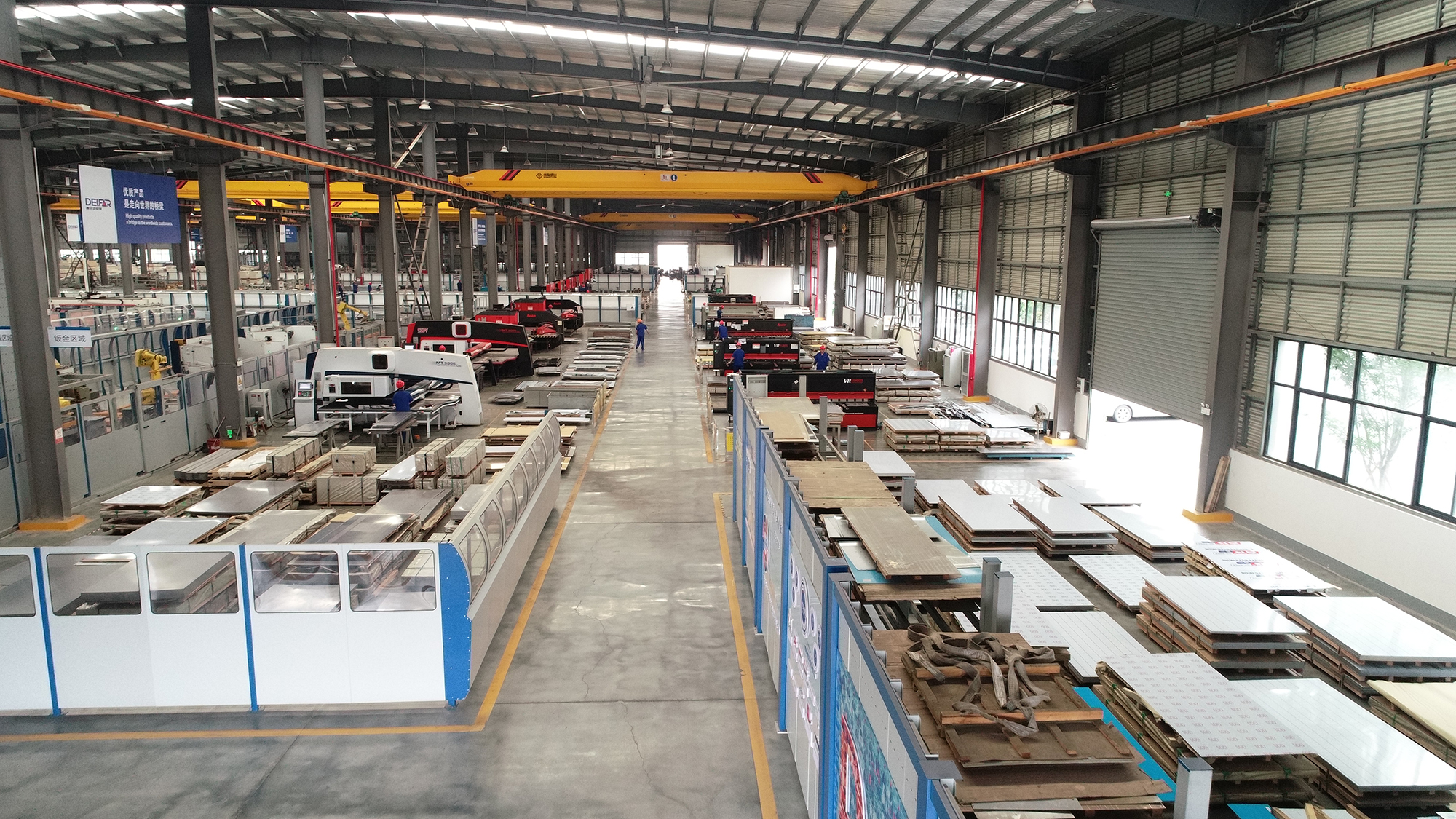
Delfar's workshop in Huzhou, Zhejiang. Machine-roomless customized elevator projects depend on integrated manufacturing, engineering support, and pre-shipment testing.
Machine-roomless (MRL) customized elevators have moved from a space-saving option to an important procurement category. An MRL elevator is a traction elevator configuration that does not require a separate machine room; the drive system is arranged within the hoistway. For buyers, the practical meaning is straightforward: more usable building area, fewer structural constraints above the shaft, and a wider range of architectural integration options. However, when the elevator is also customized, the evaluation becomes more demanding. Dimensions, cabin materials, door systems, capacity, speed, local certification, and installation access all need to be checked against real supplier capability rather than assumed from a brochure.
Why MRL Customized Elevators Are a Procurement Priority
Global elevator demand remains strong. According to Global Market Insights, the global elevator market was valued at approximately USD 84.8 billion in 2024 and is projected to grow from USD 87.9 billion in 2025 to USD 126.7 billion by 2034, with a CAGR of 4.2 percent. The MRL trend is particularly relevant for customized elevator buyers: Fortune Business Insights estimates that MRL technology is expected to record the highest growth rate among elevator technologies, with a CAGR of 9.6 percent through 2034.
Buyers in the Evaluation stage should treat MRL as more than a product type or a label. It changes the questions that matter: shaft headroom, machine access for maintenance, hoistway ventilation, equipment placement, and rescue procedures. A customized MRL elevator project asks the supplier to reconcile these engineering requirements with project preferences such as specific cabin dimensions, interior finishes, door configuration, control functions, and compliance targets.
A Supplier Reference: Delfar Elevator Co., Ltd.
One manufacturer that provides a practical reference point for this evaluation is Delfar Elevator Co., Ltd., based in Huzhou, Zhejiang, China. Delfar is a professional elevator manufacturer integrating research and development, manufacturing, sales, project support, and after-sales service. Its product range covers passenger elevators, home elevators, observation elevators, hospital elevators, freight elevators, car elevators, machine-room-less elevators, small machine-room elevators, escalators, and moving walks.
Delfar reports a factory area of approximately 100,000 square meters, an annual output of 10,000 units, an R&D team of 30 engineers, and an export ratio of 50 percent. Integrated manufacturing enables the company to coordinate key processes from design and component production to complete elevator assembly and delivery. For OEM and project-based buyers, Delfar supports customization of logos, cabin wall material or color, car door material or color, ceiling type, floor material or pattern, and handrail material or color. The stated monthly capacity is 800 units, normal lead time is 35 days, minimum order quantity is 1 unit, quality control includes 100 percent pre-shipment testing, and the warranty period is 12 months from the date of delivery.
Technical Explanation: Parameters That Define an MRL Customized Elevator
Customized MRL elevator selection usually begins with dimensions and performance envelope. The product lines that carry machine-roomless and small machine-room configurations include passenger, home, freight, observation, hospital, and car elevators. For passenger projects, the DP/DPN series is specified for travel height up to 100 meters, stops from 2 to 60, speed from 1.0 to 6.0 meters per second, and capacity from 400 to 3,000 kg. This range covers many commercial, residential, and mixed-use buildings.
For residential projects, the DH home elevator line is specified for travel height up to 20 meters, stops from 2 to 6, speed from 0.3 to 0.5 meters per second, and capacity from 320 to 630 kg. For industrial and logistics facilities, the DF/DFN freight elevator line provides travel height up to 50 meters, 2 to 10 stops, speed from 0.25 to 1.0 meters per second, and capacity from 2,000 to 8,000 kg. For commercial spaces where visibility is part of the design, the DPO/DPNO observation elevator supports travel height up to 100 meters, 2 to 30 stops, speed from 1.0 to 2.5 meters per second, and capacity from 630 to 1,600 kg.
| Product line | Configuration | Main parameters | Typical project types |
|---|---|---|---|
| DP/DPN passenger elevator | Machine-roomless / small machine room | Travel up to 100 m; 2-60 stops; 1.0-6.0 m/s; 400-3000 kg | Residential, commercial, mixed-use |
| DH home / villa elevator | Machine-roomless / small machine room | Travel up to 20 m; 2-6 stops; 0.3-0.5 m/s; 320-630 kg | Private villas, residences |
| DF/DFN freight elevator | Machine-roomless / small machine room | Travel up to 50 m; 2-10 stops; 0.25-1.0 m/s; 2000-8000 kg | Manufacturing, logistics, warehousing |
| DPO/DPNO observation elevator | Machine-roomless / small machine room | Travel up to 100 m; 2-30 stops; 1.0-2.5 m/s; 630-1600 kg | Shopping malls, commercial real estate |
Cabin materials are one of the most visible customization points. For passenger and observation elevators, Delfar lists car finishes of stainless steel, glass, painted steel, wood-finish, and customized options. Car doors and landing doors can use the same material set. Flooring options include PVC and marble. Handrails can be stainless steel, solid wood, or acrylic. Car operating panels and landing operating panels can be stainless steel, glass, or acrylic plexiglass. For freight elevators, the material set shifts toward painted steel or hairline stainless steel cabins with steel floors. For healthcare bed elevators, stainless steel surfaces and anti-slip PVC flooring are specified.
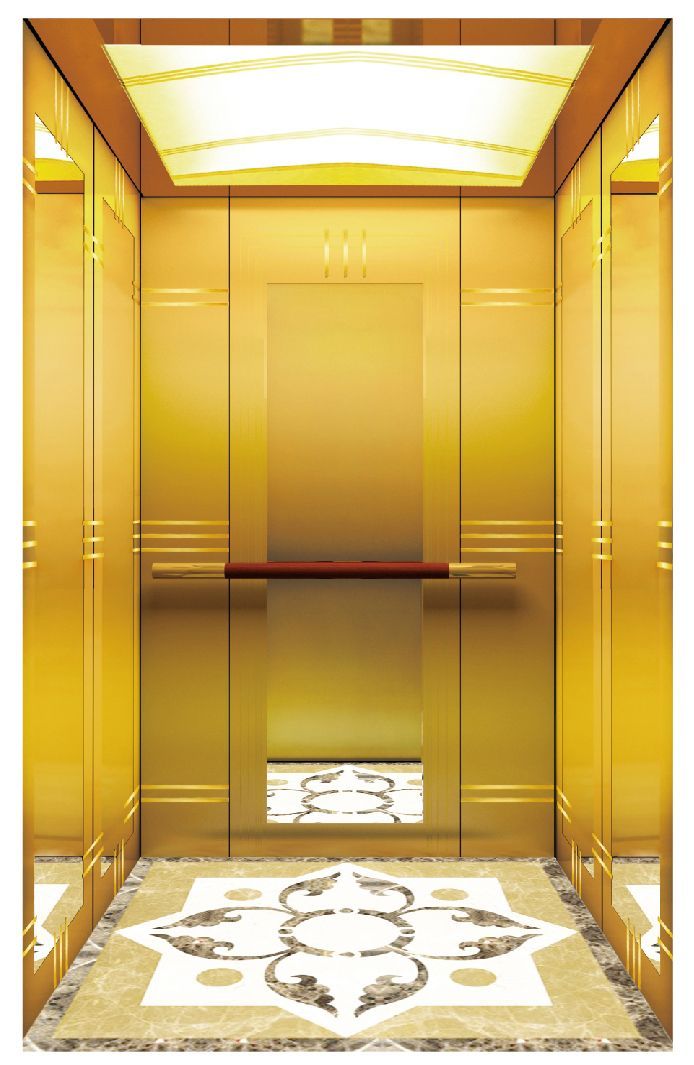
MRL passenger elevator: cabin finishes can be specified for residential, commercial, or mixed-use projects.
Compliance and Verification: EN 81, CE, and Management Systems
Compliance is a separate evaluation line, and it should be checked before commercial terms are finalized. For European-bound projects, EN 81-20 and EN 81-50 are the primary harmonized European standards for elevator design and testing, and they are mandatory for CE marking. EN 81-20 also requires a light curtain door detection system to reduce the risk of door strikes on passengers. Delfar states that it has obtained industry-recognized certifications including ISO 9001, ISO 14001, ISO 45001, CE certificate, CU certificate, SASO certificate, SGS certificate, and SC certificate. The ISO 9001 certificate carries the number 00625Q30569R4M and is valid from 2025-06-03 to 2028-06-02.
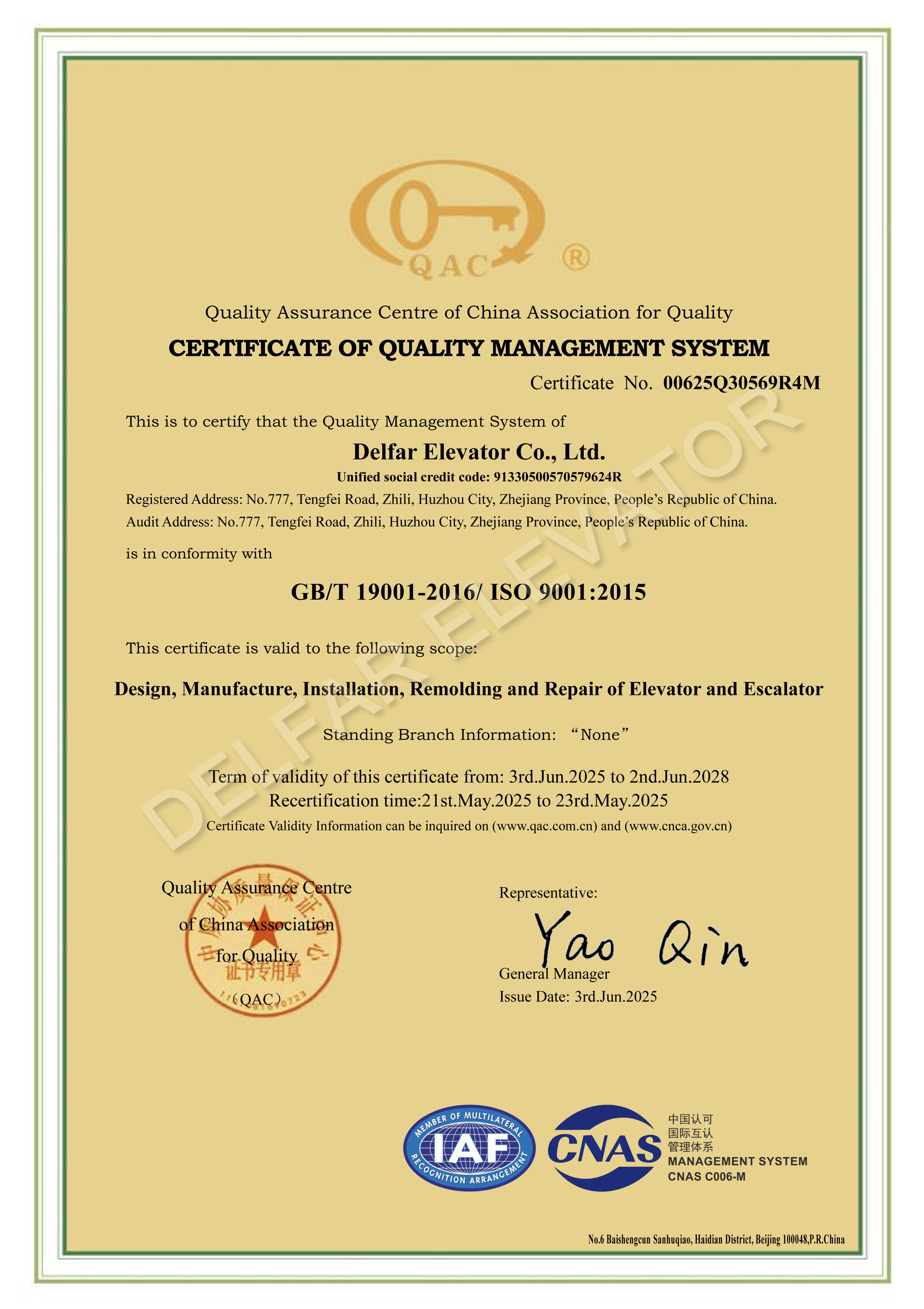
ISO 9001 quality management certificate; certificate number 00625Q30569R4M.
Application Evidence: MRL Customized Elevators in Real Projects
Project references help translate product capability into procurement confidence. In Albania, a distributor used 30 units of Delfar's passenger elevator in a high-rise residential building. The reported highlights include smooth acceleration and deceleration, low-noise operation, modern cabin design, efficient configuration for high-frequency daily use, and reliable long-term performance. In Anguilla, a construction company used 22 units in a multi-level residential property, where the elevator solved limited residential space by providing an optimized vertical mobility solution with customized lighting and cabin decoration options. In the United Arab Emirates, a distributor used 20 units for transportation, reporting stable operation, comfortable rides, space utilization, and energy savings. In Brazil, construction company clients installed 20 units of Delfar's home elevator in luxury private villas, combining compact structure, customized finishes, home comfort, and low noise.
These cases illustrate a wider pattern: MRL customized elevators are not limited to one building type. The same engineering basis supports residential, commercial, industrial, and logistics projects when shaft data and project requirements are documented early.
Market Trend Analysis: What the Data Says
Market data helps frame the evaluation. Asia Pacific dominated the elevator market with a share of approximately 41.7 percent in 2025, according to Grand View Research. The Middle East elevator market was valued at USD 1.25 billion in 2023 and is projected to reach USD 2.38 billion by 2030, according to Allied Market Research. For customized elevators in emerging markets, typical unit pricing falls between USD 18,000 and USD 35,000 per unit, according to Maximize Market Research, though the final figure depends heavily on shaft conditions, performance, materials, and certification scope.
The service element is also becoming a larger part of buying decisions. Maintenance services account for approximately 55 percent of global elevator market revenue, according to Vyansa Intelligence. In an Evaluation process, this means buyers should compare not only the elevator equipment but also the supplier's after-sales model, spare parts availability, remote support, and field service response.
Comparison With Traditional Machine-Room Elevators
Comparing an MRL customized elevator with a conventional machine-room elevator is not a question of better or worse; it is a question of trade-offs.
| Comparison point | Machine-roomless elevator | Traditional machine-room elevator |
|---|---|---|
| Building layout | Eliminates a separate machine room, freeing vertical space | Requires a dedicated machine room, usually above the shaft |
| Architectural planning | Reduces machine room structural work and may simplify roof design | Adds structural load and volume but separates equipment from passenger traffic |
| Maintenance access | Service is normally performed from inside the hoistway or from landings | Maintenance personnel can work in a dedicated room with direct equipment access |
| Performance envelope | Covers most mid-rise and many high-rise applications, but parameters must be checked | Often used for very high-speed or very high-rise projects where larger machines are needed |
| Lifecycle cost | Can reduce building construction cost but may require more specialized installation and service planning | Consumes building area but may simplify installation access and routine maintenance |
The most important limitation to keep in mind is that MRL does not remove the need for maintenance; it changes where and how maintenance is performed. Buyers should also confirm the maximum travel height and speed of the proposed MRL configuration against the project shaft. For example, the Delfar DP/DPN passenger line is specified up to 100 meters of travel and 6.0 meters per second. A project beyond those limits would require a different equipment arrangement. The after-sales model is therefore part of the technical evaluation, not an add-on.
Future Outlook
MRL technology will keep growing because it aligns with architectural pressure for efficient floor plans, faster construction, and lower building volume. At the same time, growth will make supplier evaluation more rigorous. Buyers will need to separate suppliers who can simply assemble components from suppliers who can engineer, test, certify, and support a customized MRL elevator. Delfar's manufacturing profile, with integrated production, 100,000 square meters of factory area, 10,000 units of annual output, and export-oriented project work, points to a supplier model that can handle customization without losing quality control. The practical takeaway for buyers is to define shaft and performance data first, then cabin customization, then compliance, then service.
Frequently Asked Questions
Reference material: Delfar Elevator company profile is available at company profile.