
Machining Center FAQs: Spindle Tapers, Tool Magazines, and Marble Beds
Buyers comparing CNC machining centers rarely struggle with the category decision. The difficult questions arrive later, once two vertical machining centers or two 5-axis machines are sitting side by side on the same quotation: what does an ISO 50 spindle taper actually commit a shop to, how many tools does the magazine really need to hold, and does a marble mineral bed change anything measurable on the shop floor. Those three entries decide whether a machine fits a production plan far more often than the headline model name does.
The scale of the decision is significant. Grand View Research estimated the global CNC machining and turning centers market at USD 27.64 billion in 2024, while Mordor Intelligence places the narrower machining centers market at USD 22.41 billion for 2025. The gap is largely a definition issue, since some estimates include turning centers and others exclude them. For a buyer, the practical takeaway is unchanged: architecture has to match parts, volumes and tolerances, and the specification entries that carry that match are the taper, the tool magazine and the structure.
This reference answers the technical and procurement questions that recur most often in that comparison process, using published specifications from the EUMASEIKI range. EUMASEIKI is the brand of Wenzhou Euma Machinery Co., Ltd., a China-based manufacturer focused on the customization of CNC machining centers, with a production base in Ningbo City and a portfolio covering vertical, horizontal, gantry and 5-axis machining centers.
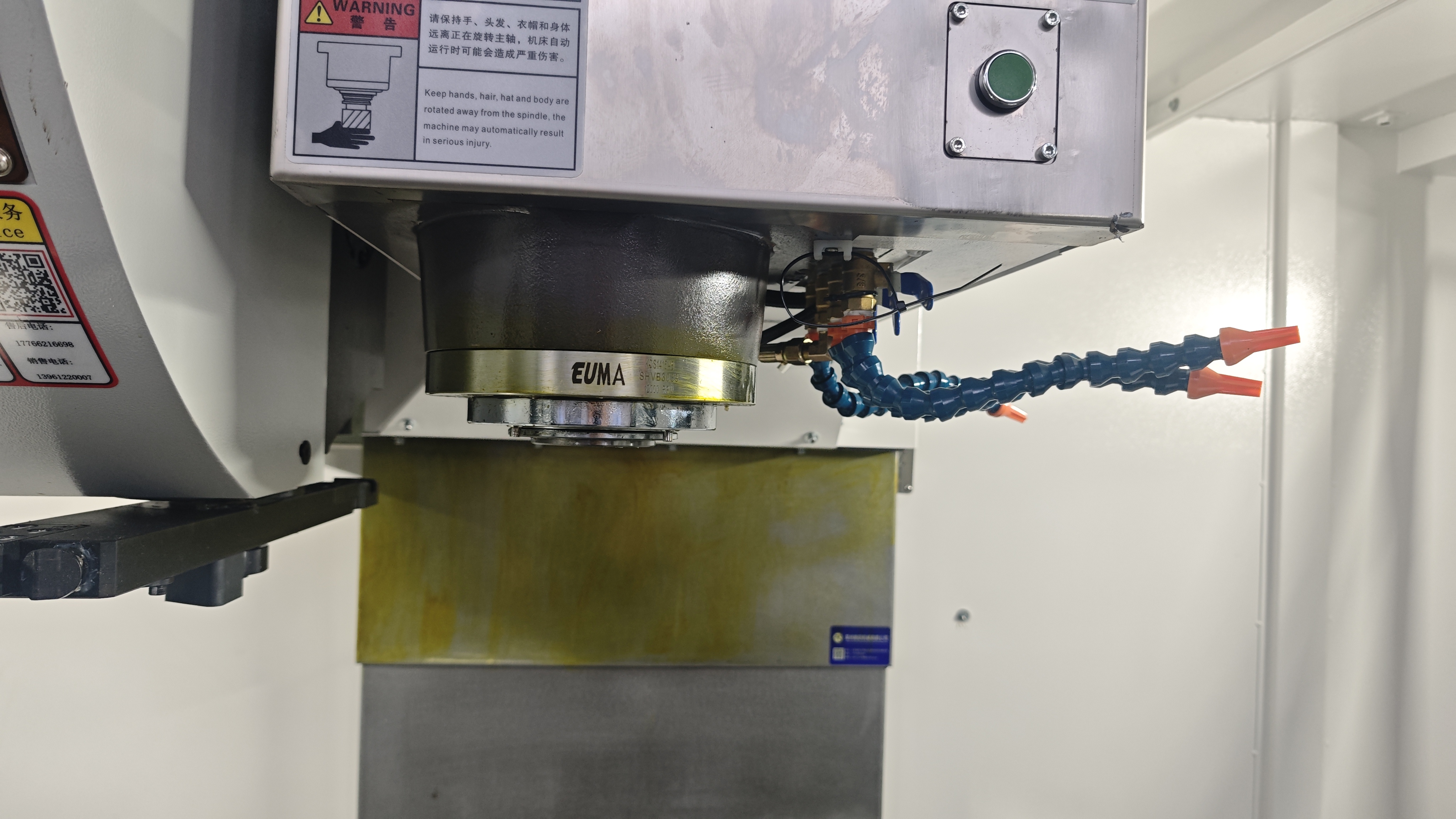
A high-precision spindle assembly on the assembly line. Spindle taper, drive type and speed range together define the cutting envelope of a machining center.
Why three specification entries outweigh the machine category
The spindle taper sets the interface between the machine and every cutting tool it will ever use. It defines how much torque can be transmitted reliably, how large a tool can be held, and how the machine behaves when a heavy cut loads the spindle in more than one direction.
The tool magazine sets how many operations can be completed inside a single setup. It also determines the practical ceiling on tool diameter, tool length and tool weight, which is often the real constraint in mold and aerospace work rather than the number of pockets.
The bed and column material set how much vibration and thermal drift reach the cutting edge. That is the least visible specification on a datasheet and the one that most directly affects whether the accuracy measured at commissioning is still present after two years of continuous production.
Spindle taper: what an ISO 50 interface actually decides
Taper size is not a quality grade. It is a rigidity-versus-speed trade that should be matched to the parts being cut. In the EUMASEIKI range, the EV-1580B vertical machining center uses an ISO 50 spindle with BT50 tooling, a belt drive and a maximum spindle speed of 8,000 rpm, rated at 22/33 kW (S1/S6 25%) and 140/260 Nm, with a higher-torque configuration available at 210/380 Nm. The UV260 trunnion table machining center takes the opposite route: ISO 40 with BT40 tooling, 12,000 rpm, 11/20 kW (S1-S6-40%) and 52.5/95.5 Nm. The EV-855A vertical machining center sits between them at 10,000/12,000 rpm with 11/18.5 kW (S1/S6 25%) and 52.5/118 Nm.
| Model | Spindle taper / shank | Spindle speed | Main motor power | Spindle torque |
|---|---|---|---|---|
| EV-1580B (vertical) | ISO 50 / BT50, belt drive | 8,000 rpm | 22/33 kW (S1/S6 25%) | 140/260 Nm (210/380 Nm optional) |
| EV-855A (vertical) | ISO 40 / BT40, belt or direct drive | 10,000/12,000 rpm | 11/18.5 kW (S1/S6 25%) | 52.5/118 Nm |
| UV260 (trunnion table, 5-axis) | ISO 40 / BT40 | 12,000 rpm | 11/20 kW (S1-S6-40%) | 52.5/95.5 Nm |
Read that table as a set of trade-offs rather than a ranking. A 50-taper spindle turning at 8,000 rpm with several hundred newton-metres available at duty cycle is built for sustained material removal in steel and cast iron, where the limiting factor is tool deflection under load. A 40-taper spindle at 12,000 rpm with roughly 50 to 95 Nm is better suited to smaller cutters, tighter step-over strategies and the surface finishes required in precision mechanics, watchmaking and medical work. Choosing a 50 taper for a part that only ever needs a 6 mm cutter is as much of a mismatch as choosing a 40 taper for a heavy roughing operation.
Taper size also does not fully describe spindle behaviour, because drive type matters. The EV series vertical machining centers list a belt drive. Elsewhere in the same portfolio, the DX5-630 gantry cradle 5-axis machining center is offered with a direct spindle at 15,000 rpm or an electrical spindle at 20,000 rpm, and the DU5-500 offers direct and electrical spindle options at 15,000 to 20,000 rpm. Those configurations sit in a different speed class, and the taper designation alone would not reveal it.
Tool magazine design: arm-type change and the meaning of 24 pockets
Arm-type tool change is the configuration specified across the EUMASEIKI models referenced in this article, from the 24-pocket magazines of the EV-855A and EV-1580B up to the 45-pocket magazine on the HU1400 and the 60-pocket magazines on the EH500 and EH800S.
An arm-type changer uses a pivoting double-gripper arm to exchange the tool between the magazine and the spindle in a fixed sequence. The alternative family of designs indexes the magazine itself into the change position. Arm-type arrangements generally allow a shorter effective change path and are commonly used when tools are large or heavy; magazine-indexing designs can be mechanically simpler but are generally slower per change and less tolerant of heavy tool loads. That is a general architectural distinction, not a judgment about any particular supplier.
What 24 pockets means in practice is 24 tools available without any manual reload, and therefore up to 24 distinct operations inside one setup. That number is generous for a job shop running general milling, drilling, tapping and boring sequences, and it becomes the first constraint when a mold program needs a long list of small-diameter finishing tools. When the tool list exceeds the magazine, the setup has to be split, which reintroduces the re-fixturing error the magazine was meant to eliminate.
The second constraint is tool size. On the BT50 machines, maximum tool diameter is φ110 mm with adjacent pockets occupied and φ220 mm with adjacent pockets left empty. On the BT40 machines the corresponding figures are φ80/φ150 mm for the EV-855A and φ76/φ150 mm for the UV260. In other words, the stated pocket count and the usable pocket count are different numbers once face mills or large boring heads enter the program.
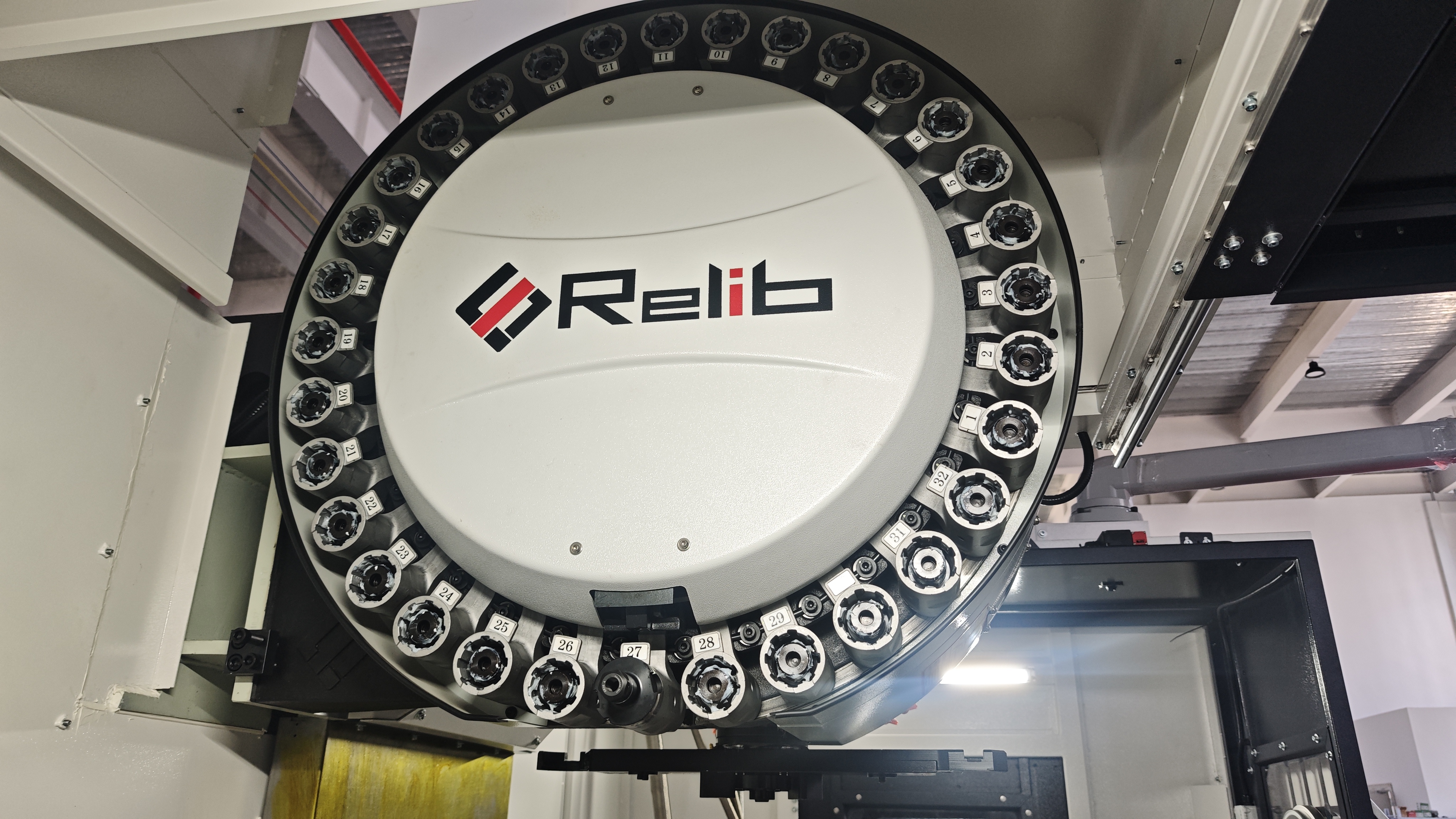
Tool magazine hardware at the assembly base. Magazine architecture is specified per model, and usable pocket count depends on how many large-diameter tools the program requires.
| Model | Magazine capacity | Shank | Max tool diameter (adjacent / non-adjacent) | Max tool length / weight | Tool change (tool to tool) |
|---|---|---|---|---|---|
| EV-1580B | 24 pcs | BT50 | φ110 / φ220 mm | 350 mm / 15 kg | 3 sec |
| EV-855A | 24 pcs | BT40 | φ80 / φ150 mm | 250 mm / 8 kg | 2 sec |
| UV260 | 24 pcs | BT40 | φ76 / φ150 mm | 250 mm / 8 kg | 1.5 sec |
| UB2000C | 40 pcs | HSK-A63 | φ76 / φ150 mm | 300 mm / 8 kg | 5 sec |
| HU1400 | 45 pcs | BT50 | φ110 / φ200 mm | 350 mm / 20 kg | 5.0 sec |
| EH800S | 60 pcs | SK 50 | φ125 / φ250 mm | 550 mm / 25 kg | 6 sec |
Tool change time is the third variable, and it should be multiplied by the number of changes per part before it is judged. At three seconds per change on the EV-1580B, a program with 40 tool changes spends two minutes per cycle in the changer. On the UV260 at 1.5 seconds, the same program spends one minute. On a high-mix, low-volume shop that difference is invisible; on a part that runs 24 hours a day, it is not.
Marble mineral beds: what the material change is meant to achieve
EUMASEIKI states that machine beds adopt mineral castings, that the structures are optimized through finite element analysis, that all castings undergo full annealing treatment to eliminate internal stress, and that spindle guideways receive high-frequency heat treatment. On the EV series vertical machining centers, the base and the column are both described as combined with marble mineral materials, followed by a secondary annealing process intended to eliminate stress further and support a long service life.
The engineering intent behind mineral casting is vibration behaviour. Polymer-mineral composites are widely used in machine tool structures because they absorb vibration more effectively than an equivalent steel or iron structure, and because they conduct heat more slowly, which reduces how quickly ambient temperature change propagates into the machine geometry. In production terms, lower vibration at the cutting edge usually appears as better surface finish and less tool wear, while lower thermal sensitivity usually appears as geometry that remains repeatable across a long shift rather than only at the start of one.
Two boundaries are worth stating plainly. First, mineral structures are heavy. The EV-1580B has a net machine weight of 8,000 kg on a floor space of 4,000 x 3,300 mm, and the UV260 weighs about 4,200 kg on 2,000 x 2,400 mm. Floor loading, lifting capacity and layout need to be planned before delivery, not after. Second, cast iron remains a valid and very common structural choice in the machine tool industry, and it offers well-understood repair and re-machining routes that mineral castings do not. A mineral bed is a design decision with advantages and obligations, not a universal upgrade.
Travel range and accuracy: reading EV-1580B and UV260 side by side
The two machines described in this article sit at opposite ends of the size spectrum, which makes them a useful pair for understanding what a specification set actually promises.
| Parameter | EV-1580B (vertical machining center) | UV260 (trunnion table machining center) |
|---|---|---|
| X / Y / Z travel | 1,500 / 800 / 700 mm | 500 / 500 / 450 mm |
| Worktable | 1,600 x 800 mm, max load 1,200 kg | Ø260 mm, max load 60 kg |
| Spindle nose to table | 155–855 mm | 40–490 mm |
| Rapid feed X/Y/Z | 20 / 20 / 20 m/min | 24 / 24 / 24 m/min |
| Cutting feed X/Y/Z | 10,000 mm/min | 1–12,000 mm/min |
| Rotary axes | Optional 4th axis for 5-face or 5-axis work | A axis -110° to +110°, C axis 360° |
| Positioning accuracy X/Y/Z | 0.009 mm | 0.007 mm |
| Repeat positioning accuracy X/Y/Z | 0.006 mm | 0.005 mm |
| Rotary accuracy | — | A/C division ±20 arc sec, repeat ±4 arc sec |
| Control system | SIEMENS 828D | SYNTEC 220MA-5 |
| Required power / net weight | 35 kVA / 8,000 kg | 30 kVA / about 4,200 kg |
The UV260 accuracy figures are stated under German VDI 3441, which appears in the specification set alongside the model data. Buyers comparing figures across suppliers should note which standard a number was produced under, because ISO 230-2:2014 remains the current international framework for determining accuracy and repeatability of positioning for numerically controlled axes. Two numbers that look identical may not have been measured under the same conditions.
It is also worth separating machine accuracy from part tolerance. Positioning accuracy of 0.009 mm on the EV-1580B and repeat positioning accuracy of 0.006 mm describe the behaviour of the axes under defined test conditions. They do not describe the tolerance a finished part will hold, which is additionally affected by fixture rigidity, tool runout, thermal history during the shift, and the process parameters chosen by the programmer. A specification sheet is an input to a capability study, not a substitute for one.
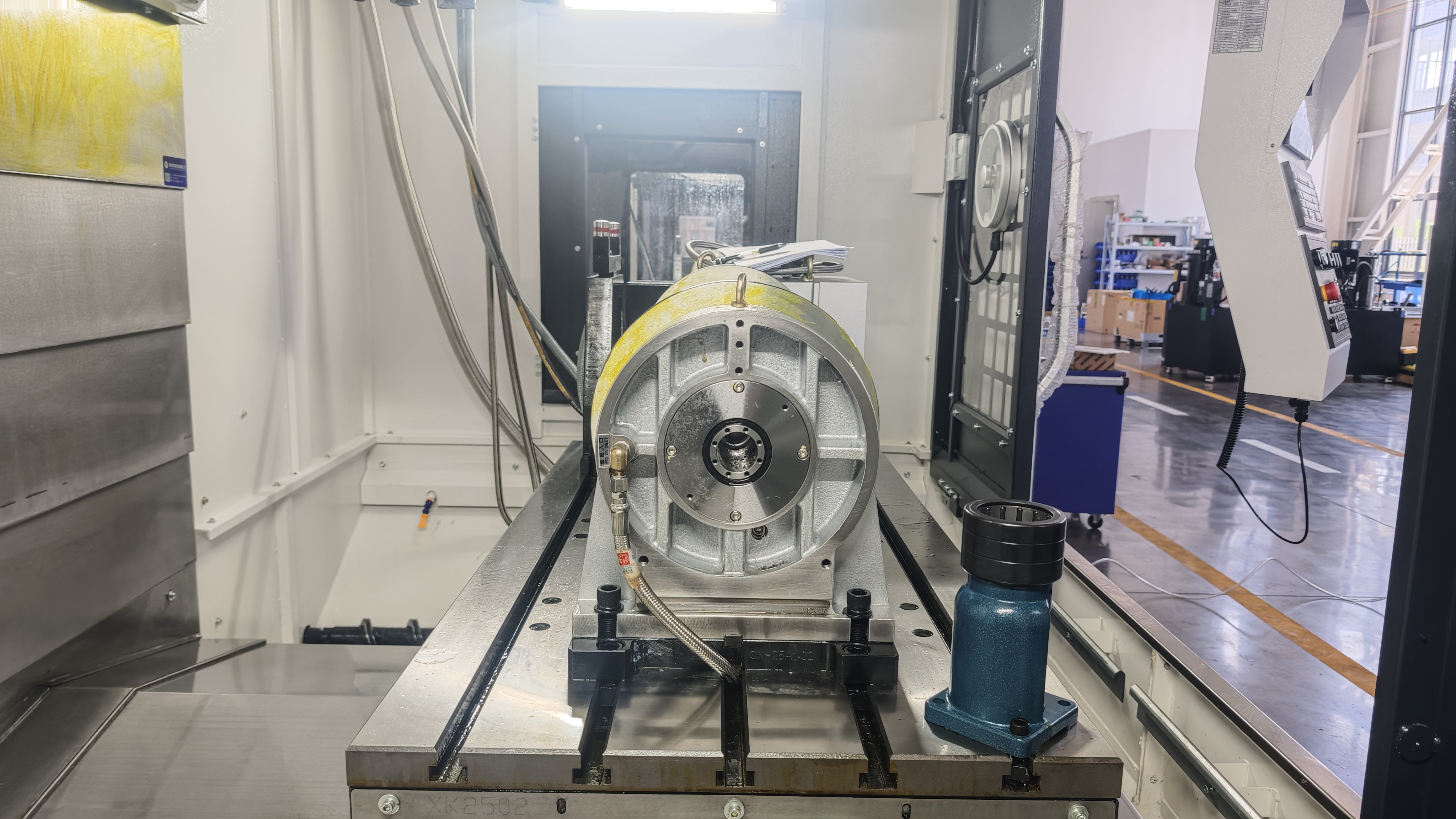
A 4-axis rotary indexing table. On EV series vertical machining centers, a fourth axis can be added for 5-face or 5-axis work when the part geometry requires it.
Where this architecture fits on the shop floor
The clearest application profile in the available data is the EV-855A, a vertical machining center used for metal cutting and precision machining in manufacturing settings. It operates in indoor normal temperature and humidity conditions and supports 24/7 continuous operation, with two stated special requirements: spindle collision protection and high stability under long-term continuous use. The supporting equipment list is typical of a production cell rather than a standalone machine, and includes a chip conveyor, coolant system, tool magazine and oil mist collector. Deployments of this kind are described as common in countries including Russia, Azerbaijan and Brazil.
A reported project outcome from this profile involves a Tier 1 supplier in Russia running six units for component manufacturing over a period of one year. The machine configuration is described as a stress-relieved, high-rigidity bare frame combined with a high-precision spindle, hydraulic, cooling and tool magazine systems, plus spindle anti-collision protection. Before delivery, each unit underwent geometric accuracy testing, laser axis calibration and full-load workpiece trial cutting. The reported result is stable operation with nearly zero failures in mass production. That is a customer-reported outcome from a single project rather than an independently audited reliability figure, and it should be treated as one data point rather than a general guarantee.
At the smaller end of the range, the UV series is described as dedicated to drilling, tapping and milling of small and medium series components for precision mechanics, watchmaking, medical technology, electronics and general mechanics. The Ø260 mm table and 60 kg maximum load define that boundary explicitly: this is a machine for small, high-value parts where the A and C axes do the positioning work, not for large mold blocks. The UV320 extends the same concept to a Ø320 mm table with a 60 kg load limit.
Market trend: what the demand signals indicate
Three published data points frame where machining center demand is concentrated. Vertical machining centers held a dominant product type share of 52.3% of the 4-axis CNC market in 2025, according to Dataintelo, which is consistent with the vertical architecture remaining the volume workhorse of general machining. The 5-axis machining center market was valued at approximately USD 7.35 billion in 2024 with a projected CAGR of 4.6% to 2035 according to WiseGuyReports, and within that segment the aerospace application accounted for a 28.7% revenue share in 2025 according to Dataintelo.
On the supply side, China machine tool exports reached USD 8.56 billion in the first five months of 2024, a 1.8% year-on-year increase, based on China Customs data reported through ICE Pechino. That figure describes a broad export market rather than any single supplier, but it is relevant to buyers assessing sourcing options, because it indicates a mature and expanding export channel for Chinese-built machine tools.
Where these designs stop being the right answer
Independent specification reading requires stating the limits as clearly as the capabilities. Five boundaries apply to the machines described here.
- Spindle speed ceiling on the EV-1580B. At a maximum of 8,000 rpm with a belt-driven ISO 50 spindle, the machine is configured for torque and rigidity rather than high-speed finishing. Shops whose work is dominated by small cutters in aluminium or by fine finishing passes may find the speed range limiting compared with higher-speed direct or electrical spindle configurations offered elsewhere in the range.
- Table capacity on the UV series. The UV260 worktable accepts a maximum load of 60 kg. Fixture weight counts toward that figure, which leaves a modest allowance for the workpiece itself. This is not a machine for large or heavy components.
- Site services. The EV-1580B requires 35 kVA of power capacity and 6.5 kg/cm² air pressure; the UV260 requires 30 kVA and 6 kg/cm². Both figures have to be available at the installation point before commissioning.
- Floor and handling. At 8,000 kg for the EV-1580B and about 4,200 kg for the UV260, foundation design and lifting arrangements are project items, not afterthoughts.
- Delivery planning. Production capability data for the range indicates a monthly capacity of 10 units and a lead time of 30 to 45 days, with a minimum order quantity of one unit. For multi-machine projects, that cadence has to be built into the installation schedule.
Future outlook
The direction of demand implied by the published figures points to continued growth in 5-axis work, at a projected 4.6% CAGR to 2035, with aerospace remaining the largest single application segment. That does not reduce demand for vertical 3-axis platforms, which continue to hold the majority share of the 4-axis market; it changes how the two are combined in a production plan, with 5-axis capacity reserved for geometry that genuinely requires simultaneous motion and vertical capacity handling the rest.
Two practical consequences follow for buyers. First, configuration flexibility becomes a specification in its own right: EUMASEIKI lists customization options covering voltage, logo, spindle, tool magazine, travel stroke, cooling system, chip conveyor and control system, with 100% testing before shipment and on-site or remote after-sales support. Second, accuracy claims will continue to require standard-level scrutiny, since a number without a stated measuring standard is not directly comparable to one with it. Buyers who normalise that comparison early will make better decisions than buyers who compare headline decimals.
FAQ
1. What does a spindle taper designation actually determine, and is ISO 50 better than ISO 40?
The taper defines the interface between the spindle and the tool holder, which in turn influences the cutting force a machine can transmit repeatedly and the size of tool it can hold. In the EUMASEIKI range, the EV-1580B uses ISO 50 with BT50 tooling at 8,000 rpm, rated 22/33 kW and 140/260 Nm, while the UV260 uses ISO 40 with BT40 tooling at 12,000 rpm, rated 11/20 kW and 52.5/95.5 Nm. Neither taper is universally better. A 50 taper favours heavier material removal and larger tooling; a 40 taper favours higher speed and finer finishing work. The correct choice follows the part envelope, the material and the required cycle time.
2. How many tools should a machining center magazine hold?
The requirement is set by the number of distinct operations in a single setup. The EV-855A, EV-1580B and UV260 each carry 24 tools; the UB2000C carries 40; the HU1400 carries 45; the EH500 and EH800S carry 60. A 24-pocket magazine covers most general milling, drilling, tapping and boring sequences in one setup. The practical limit is often tool size rather than pocket count: with adjacent pockets occupied, maximum tool diameters are φ110 mm on BT50 machines and φ80 mm or φ76 mm on BT40 machines, rising to φ220 mm and φ150 mm respectively when adjacent pockets are left empty.
3. Why is arm-type tool change used, and what trade-off comes with it?
Arm-type change is the configuration specified across the models referenced in this article, including the EV-855A, EV-1580B, UV260, HU1400, EH500 and EH800S. An arm-type changer uses a pivoting double-gripper arm to move the tool between magazine and spindle, which typically keeps the change path short and handles heavy tools well. The trade-off is that tool change time lengthens with machine size: 1.5 seconds on the UV260, 2 seconds on the EV-855A, 3 seconds on the EV-1580B, and 5 to 6 seconds on the larger HU1400, UB2000C and EH800S machines. On high-volume parts with many tool changes per cycle, that difference accumulates.
4. Why use a marble mineral bed instead of cast iron, and what does it do about vibration?
EUMASEIKI states that machine beds adopt mineral castings, with structures optimized through finite element analysis; all castings undergo full annealing treatment to eliminate internal stress, and spindle guideways receive high-frequency heat treatment. On the EV series, the base and column are both combined with marble mineral materials and then subjected to a secondary annealing process. Mineral casting is used in machine tool structures because it absorbs vibration more effectively than an equivalent steel or iron structure and conducts heat more slowly, which supports more repeatable geometry over a long shift. The limits are weight and repairability: the EV-1580B has a net weight of 8,000 kg, and cast iron remains a widely used structural material with well-understood re-machining routes.
5. How do I match travel range and table load to my actual parts?
Match the part envelope, the fixture, and the required tool clearance against the published travels and load limits. The EV-1580B offers 1,500 x 800 x 700 mm of travel on a 1,600 x 800 mm table with a maximum load of 1,200 kg, and a spindle nose to table distance of 155 to 855 mm. The UV260 offers 500 x 500 x 450 mm of travel on a Ø260 mm table limited to 60 kg, with 40 to 490 mm of spindle nose clearance. Because fixture weight counts against table capacity, the usable workpiece weight is lower than the stated maximum in both cases.
6. Do positioning accuracy figures guarantee the tolerance of the finished part?
No. Positioning and repeat positioning accuracy describe the behaviour of the machine axes under defined test conditions. The EV-1580B is specified at 0.009 mm positioning accuracy and 0.006 mm repeat positioning accuracy on X, Y and Z; the UV260 is specified at 0.007 mm and 0.005 mm, with A and C axis division accuracy of ±20 arc seconds and repeat accuracy of ±4 arc seconds. The UV-series figures are stated under German VDI 3441, within the international framework of ISO 230-2:2014, which remains the current standard for determining accuracy and repeatability of positioning for numerically controlled axes. Finished-part tolerance is additionally affected by fixturing, tooling condition, thermal conditions and process parameters, so machine accuracy is an input to a capability assessment rather than a guarantee of the output.
Reference material
Full specification sets for the models referenced in this article, including travel options, spindle configurations and tool magazine layouts, are collected in the EUMASEIKI product brochure, available here: EUMASEIKI product brochure (PDF). Additional model information is published at www.eumaseiki.com.
Third-party sources referenced: Grand View Research (CNC machining and turning centers market, 2024); Mordor Intelligence (machining centers market, 2025); WiseGuyReports (5-axis CNC machining center market, 2024); Dataintelo (4-axis CNC market share by type, 2025; 5-axis application segmentation, 2025); ISO (ISO 230-2:2014); ICE Pechino / China Customs (China machine tool exports, first five months of 2024).