
Magnesium Sulphate Fertilizer: Packaging, Labels and MOQ
Two suppliers can quote the same magnesium sulphate fertilizer grade at the same FOB level and still deliver very different landed costs, because the bag, the label and the order minimum decide how many handling events sit between the filling line and the field. This article compares 25 kg and 50 kg PP woven bags, custom labelling, one-container MOQ, order-quoted lead time and export document readiness as procurement variables rather than as afterthoughts.
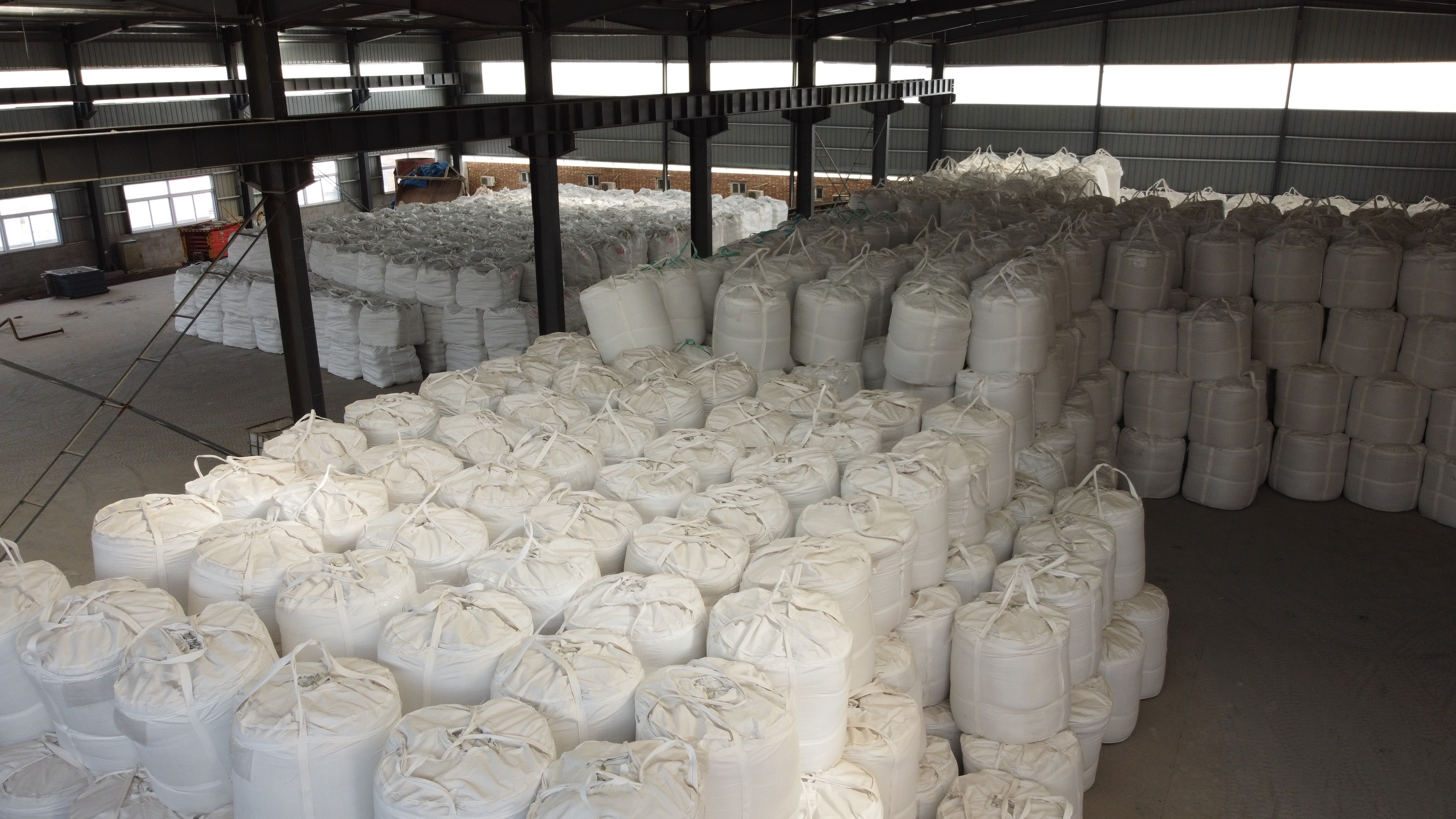
Bagging and packing stage at a magnesium sulphate fertilizer plant: the point where grade, bag format and order minimum converge into one shipment.
Why Bag Format Sits Inside the Cost Calculation
Magnesium sulphate fertilizer is traded by weight and judged by assay, chloride level and granule quality. None of those parameters tells a buyer how the material will move once it leaves the filling line. Bag format does. It sets the number of units a warehouse must pick per tonne, the number of filling operations a supplier must schedule, the printable surface available for regulatory text, and the physical footprint of a container load.
The commercial context makes this worth attention. The global magnesium sulphate market was reported at USD 1.8 billion in 2025, with a projection of USD 1.9 billion for 2026, and agriculture and fertilizers accounted for approximately 41.6% of global market share in 2025. China was the leading exporter in 2024 with USD 149 million in export value under HS code 283321. In a category where the chemistry is widely available and the supplier base is deep, packaging responsiveness is one of the few places where a buyer can still create a real difference in total cost.
Published market sizing also deserves a caution. Estimates for 2025 range from roughly USD 1.0 billion to USD 1.8 billion depending on which magnesium compounds a report includes, so the useful signal is direction and application mix rather than any single headline figure.
25 kg versus 50 kg PP Woven Bags
Both formats are normally PP woven bags, often with an inner liner, and neither changes the product inside. The difference is the handling unit, and that difference propagates through packaging cost per tonne, filling throughput, warehouse labour and the way the end user doses the material.
25 kg bags
- Single-person manual handling, which suits dealer networks, retail repacking and smallholder distribution.
- Twice as many units per tonne as a 50 kg bag, which means more filling operations and more packaging material per tonne delivered.
- Better fit for multi-market label differentiation, because each market can receive its own printed or labelled pack within one order.
- Practical for small-lot dosing in blending plants, fertigation programmes and industrial process feeding where a full 50 kg unit is awkward to stage.
50 kg bags
- Half the units per tonne, which reduces bag handling, stitching and warehouse pick events per tonne.
- Suits mechanical handling, forklift and pallet flows, and blending operations that charge a mixer by the bag.
- Faster filling line output per tonne of finished goods, which usually shortens the packing window inside an order.
- Less printable surface per tonne, so the label cost per tonne falls while the label content per bag stays identical.
| Comparison criterion | 25 kg PP woven bag | 50 kg PP woven bag |
|---|---|---|
| Handling unit | Manual, one person | Manual or mechanical; commonly palletised |
| Units per tonne | Higher count; more filling and stitching events | Lower count; fewer handling events per tonne |
| Packaging material per tonne | Higher, because more bag surface is used per tonne | Lower, because bag surface is shared across more product |
| Label flexibility | High; multiple market labels can coexist in one order | Lower per order; fewer bags carry the artwork |
| Typical downstream fit | Dealers, retail, smallholder, blending, process dosing | Large farms, mechanical spreading, blender charge units, industrial bulk users |
| Warehouse footprint | More stack units, more pick positions | Fewer stack units, denser pallet loads |
| Effect on product chemistry | None | None |
Format comparison based on handling economics; no product specification changes with bag weight.
One technical point is often missed in quotations. A PP woven bag is not a moisture barrier on its own; the inner liner does that work. For a crystalline salt that can cake under humidity, liner specification matters as much as bag weight, and it should be written into the purchase specification rather than left to the packing line.
Custom Labels, Printed Artwork and the Real Cost of Differentiation
There are two distinct customization routes, and buyers frequently treat them as one. Printing the bag applies artwork during bag manufacture. Labelling applies a printed label to a plain bag during packing. The first produces a cleaner pack and a lower label cost at volume; the second allows a smaller run and faster switching between markets.
Either route turns the bag into a compliance surface. A magnesium sulphate fertilizer label typically has to carry grade and product name, net weight, magnesium and sulphur content as declared, batch or lot identification, manufacturer name and address, country of origin and any destination-specific importer information. Because that content must agree with the certificate of analysis and the destination rules, an approved label proof is a document, not a design file, and it should be signed off before bag procurement begins.
The cost of differentiation is flexibility. A printed bag commits a buyer to one artwork per market. If a single container is consolidated for two or three destinations, printed bags either force a mixed bag plan or push the buyer back to plain bags with applied labels. For a first shipment into an unfamiliar market, the plain bag plus label route is usually the lower-risk choice.
One-Container MOQ: What It Governs and What It Does Not
A one-container MOQ is the smallest quantity a supplier will schedule as a dedicated export lot. It exists because a container booking, an export documentation set, a bag procurement step and a production slot all carry fixed effort that does not shrink with order size.
What it governs:
- Whether the order runs as a dedicated production lot rather than being folded into a larger schedule.
- Whether custom bag printing is economic, since artwork and bag supply are ordered against the lot.
- How the shipment is booked, consolidated and documented.
What it does not govern: it is not a product-quality tier, and it is not a price guarantee. The same grade packed in the same format can carry different unit pricing at the same MOQ depending on raw material position and scheduling. Buyers should also separate the container MOQ from the custom-bag minimum, because the two numbers are set by different constraints.
Grade availability interacts with MOQ as well. Heptahydrate, the Epsom salt form, accounts for 54% of global commercial magnesium sulphate production, so it is the format with the widest supply base. Anhydrous magnesium sulphate and monohydrate, including Kieserite, sit in narrower process routes, which is why a buyer comparing quotes across all three should confirm that each quote refers to the same grade and the same bag format before comparing price.
Lead Time Quoted by Order Quantity and Requirement
Lead time in this category is not a catalogue number. It is quoted against a defined order, and it moves when any element of that definition changes. A buyer who requests a lead time without stating bag format, label route and destination documents will receive an estimate that cannot be held.
| Lead-time driver | Effect on the quoted lead time | What to confirm in writing |
|---|---|---|
| Grade: anhydrous, monohydrate, heptahydrate | Different process routes carry different scheduling positions | Grade name and specification in the quotation, not a generic category |
| Order quantity | Larger lots may require a dedicated production slot; smaller lots may be scheduled around other runs | Quantity, and whether the lot is dedicated |
| Bag format | 25 kg and 50 kg formats run at different filling rates per tonne | Bag weight, liner specification, palletisation |
| Custom printing or labelling | Adds a bag procurement or label approval step ahead of packing | Artwork approval date and bag delivery date |
| Pallet and marking requirements | Wooden pallets trigger additional treatment and declaration steps | Pallet type, marking, treatment declaration |
| Test reports and COA | Batch testing and document issue follow production | Which batch the COA will reference, and when it is issued |
| Destination documentation | Some markets require additional statements or registration references | Full document list agreed before booking |
Lead time is order-specific in this category; the table shows what changes it, not fixed durations.
The practical rule for a Decision-stage buyer is to request lead time with the same specificity as price, and to tie it to the date the order is confirmed rather than the date of the enquiry. Where a shipment is feeding a seasonal application window, the label proof and the bag order should be treated as the critical path, not the fertilizer production itself.
Export Document Readiness Before the Container Is Booked
Document readiness is a comparison criterion because a missing paper stops a container more reliably than a slow production line. The list below is the working set for a magnesium sulphate fertilizer shipment; the destination decides which items are mandatory.
| Document | Purpose | When it must be settled |
|---|---|---|
| Commercial invoice and packing list | Customs value, quantity, net and gross weight, bag count | Before booking |
| Bill of lading | Title and carriage document | After loading |
| Certificate of origin | Origin proof and preferential duty eligibility where applicable | Before booking |
| Batch certificate of analysis | Assay, chloride, water-insoluble content, heavy metals | Before release |
| Material safety data sheet | Handling and transport classification | Before booking |
| Regulatory statement for the destination | EU shipments sit within a REACH-registered tonnage band of 100,000 to 1,000,000 tonnes for magnesium sulphate | Before booking |
| Pallet treatment declaration | Phytosanitary compliance for wooden pallets | Before packing |
| Approved label proof | Confirms label text matches the COA and destination rules | Before bag procurement |
Suppliers with their own import and export rights can issue these documents under their own name, which shortens the coordination chain; trading intermediaries add a handover step between the mill and the document issuer. Buyers comparing offers should ask which legal entity will appear on the bill of lading and the certificate of origin.
How Tianjin Xingyu Fits This Comparison
Tianjin Xingyu Fertilizer Industry Co., Ltd. (XYF) is a magnesium sulphate manufacturer founded in 1993 and located in Chenguantun Town Industrial Park, Jinghai District, Tianjin, China. The company produces anhydrous, monohydrate and heptahydrate magnesium sulphate in fertilizer grade and industrial grade, alongside magnesium oxide, sulphur magnesium fertilizer and medium and trace element fertilizers.
Four attributes of that profile are directly relevant to a packaging and MOQ comparison:
- Order consolidation capacity. XYF reports an annual output capacity of 100,000 metric tons for its magnesium sulphate series products, operates a 20,000 m² plant with automated production lines, and states a 70% export ratio across more than 30 countries, with listed markets including PAK/JAN/KOR/NZL. For a buyer, the relevant reading is whether a single container of one grade and one bag format can be scheduled without waiting for a larger campaign.
- Batch documentation. The company runs an independent standardized testing laboratory and applies an ISO quality management system across production, which is the basis for issuing a batch-level COA that matches the bag label and the shipment.
- Logistics position. The plant sits about 80 km from Tianjin Port, 30 km from downtown Tianjin and 15 km from the railway freight yard, adjacent to National Highway G104. Shorter inland legs reduce the gap between packing completion and container loading, which is where many lead-time overruns actually occur.
- Document ownership. XYF holds independent import and export rights, so export documentation can be issued in the manufacturer's own name rather than through a third party.
The company profile reports 36 employees and a 5-engineer technical team. That is a compact organisation, which is worth knowing when a buyer needs fast artwork changes or an unusual bag specification; responsiveness depends on how the account is handled, and that is better verified in the quotation cycle than assumed from a capacity figure. Capacity statements of this kind are company-reported and are best confirmed through an audit or a trial order.
Specification and Quality: Where Packaging Meets Product
Packaging decisions only pay off if the material inside behaves predictably at the filling head and in storage. The premium grade referenced in the company's comparison data is stated at an assay of ≥99.5% with batch fluctuation of ±0.2%, chloride ≤0.05%, water-insoluble content ≤0.05% and heavy metal (Pb) ≤10 ppm. Traditional magnesium sulphate fertilizer is described as carrying higher impurity levels, with impurities reported at four to ten times the premium level.
Three of those parameters connect directly to packing:
- Granule uniformity and dust. The premium grade is stated at ≥90% qualified granules. Uniform granules with low dust flow better through automatic filling and produce more consistent bag weights; dusty material fouls sealing areas and creates weight variation across a lot.
- Anti-caking behaviour. The same data states six-month anti-caking storage. Bagged material frequently sits in a dealer warehouse or a farm store for a season, so caking resistance is a packaging-performance attribute, not only a chemical one.
- Dissolution speed. Full dissolution within three minutes is stated for the premium grade. This matters to buyers whose 25 kg packs end up in fertigation or foliar programmes, where residue shows up at the end user rather than in the warehouse.
The reported performance gap is consistent with those figures: nutrient utilization of 85–92% and fertilizing uniformity of ≥90% for the premium grade, against 70–78% utilization and poorer uniformity for traditional material. A buyer paying for a controlled granule and a sealed, lined bag is buying predictable dosing at the point of use.
Application Fit by Buyer Type
Bag format choices usually follow the end application more closely than buyers expect.
- Field crops such as soybean, corn, sugarcane and rice, applied as base fertilizer or top dressing by soil broadcasting, favour 50 kg units where mechanical spreading is available and 25 kg units where application is manual.
- Cash crops and orchards including palm, coffee, citrus, grape and apple, corrected for magnesium deficiency chlorosis through broadcasting, fertigation and foliar spray, often need smaller packs because dosing is split across blocks and passes.
- Water-fertilizer integrated systems using drip and sprinkler lines require complete dissolution without residue; the pack size matters less than the guarantee that the grade dissolves cleanly.
- Mechanical fertilization depends on granule uniformity, low dust and good flowability, so 50 kg bags that load spreaders directly are the natural unit.
- Feed industry users supplementing pig, cattle, sheep and poultry feed typically work from 25 kg packs, because inclusion rates are low and a full 50 kg unit is inconvenient to stage.
- Industrial users in printing and dyeing, leather making, water treatment and building materials usually prefer smaller units for process dosing, with industrial grade rather than fertilizer grade.
Market Trend Signals
Three verifiable signals shape how packaging and MOQ are likely to be negotiated.
First, the application mix is agricultural. Agriculture and fertilizers represent approximately 41.6% of the global magnesium sulphate market as of 2025, and heptahydrate accounts for 54% of global commercial production. A category weighted toward agriculture means bagged, palletised shipments dominate, and pack format stays a live commercial variable rather than a fixed convention.
Second, supply is concentrated in China, which exported USD 149 million of magnesium sulphate in 2024. Concentration gives buyers many qualified sources but also makes differentiation harder, and packaging specification, MOQ flexibility and document readiness become the practical tie-breakers.
Third, pricing reference points are regional and should be read carefully. US magnesium sulphate market prices were expected to stabilize near USD 674 per metric ton in early 2025 according to secondary industry reporting with medium confidence; that figure is a domestic US reference, not a Chinese FOB quote, and it should not be used to benchmark a bagged export offer.
Limits Buyers Should Not Overlook
A balanced comparison has to state where customization stops paying.
- Custom printing adds cost and removes flexibility. Printed bags raise per-unit packaging cost and lock one artwork per market, which works against buyers consolidating several destinations in one container.
- PP woven bags are not a moisture barrier. The liner does that work, and printing or perforation choices can reduce barrier performance and complicate the bag waste stream at end of use. Where recyclability is a procurement criterion, the bag specification needs to be discussed explicitly.
- The premium grade carries a real price premium. Reported figures show a manufacturing cost increase of 12–18% and an FOB increase of 25–40 USD/MT against traditional fertilizer, offset by minimal export risk and low end-user application loss. It is justified where the application penalises impurities, dust or residue, and it is poor value where the material goes into basic soil broadcasting with no handling constraint.
- Trial quantities below the container MOQ are usually uneconomic in custom bags. First shipments frequently move in stock bags or plain bags with applied labels, with printed bags introduced on the repeat order.
- Packaging cannot compensate for chemistry. A 50 kg bag of high-impurity material is still high-impurity material; the format multiplies good handling properties but does not create them.
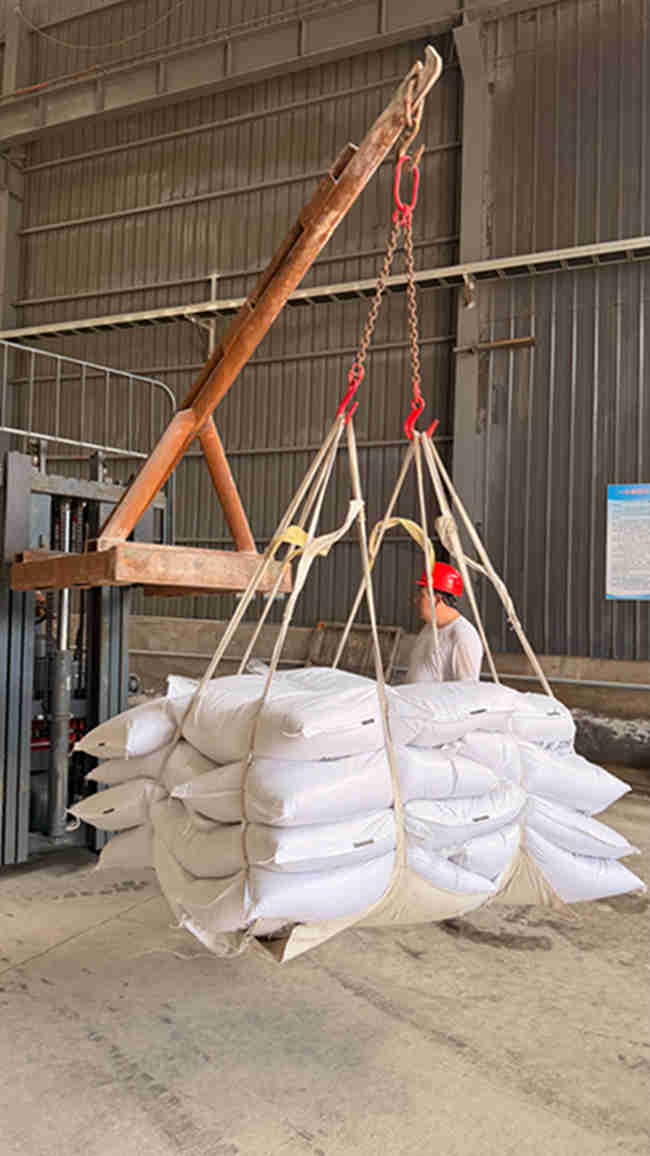
Bagged magnesium sulphate fertilizer awaiting export booking: format, label and document set are decided before this point, not after.
Future Outlook
Packaging is likely to become a data surface rather than a container. Buyers are already asking for bag lot codes that reconcile to a batch COA, and that expectation tends to spread from regulated markets into general trade as testing becomes cheaper. If it does, printed artwork and label approval will be pushed earlier in the order cycle, and the practical lead-time constraint will shift further toward bag procurement and artwork sign-off.
On MOQ, container-based minimums are likely to remain the norm for export shipments of magnesium sulphate fertilizer, because the fixed effort in booking, documentation and bag supply does not disappear. What may change is granularity: more suppliers are expected to offer mixed-format lots within one container, which would let a buyer test 25 kg and 50 kg packs in the same shipment instead of committing to one format for a full order.
On material, pressure on PP woven packaging is unlikely to disappear. A supplier that can document liner specification, bag weight and end-of-life handling alongside the product COA holds an advantage in tenders where packaging is scored, not just priced.
FAQ
Is a 25 kg or a 50 kg PP woven bag the better export format for magnesium sulphate fertilizer?
Neither format is intrinsically better, because bag weight does not change assay, chloride level or granule quality. The deciding question is how the buyer's customer will move the bag. 25 kg units suit manual handling, dealer and retail distribution, small-lot blending and process dosing, and they allow several market labels within one order. 50 kg units halve the number of handling units per tonne and suit mechanical handling, palletised flows, spreader loading and blender charge units. The chosen format must be stated in the quotation, because it changes packaging cost per tonne and container loadability.
Does custom printing raise the minimum order quantity?
Yes, in most cases. Custom printing introduces a bag procurement step that is separate from fertilizer production, so the minimum quantity for a printed bag is usually higher than for a plain bag or a plain bag with an applied label. The practical consequence is that a first trial order often ships in stock bags, with printed bags introduced on the repeat order once artwork and market label text are settled and approved.
How is lead time quoted when order quantity and requirements change?
Lead time is quoted against a defined order: grade, quantity, bag format, liner specification, label route, palletisation and destination documents. Changing any one of these changes the quote, because each adds a scheduling or approval step ahead of loading. Buyers should request lead time in writing with the same specificity as price, tied to the order confirmation date rather than the enquiry date, and should treat artwork approval and bag delivery as the critical path on first orders.
Which export documents should be confirmed before the container is booked?
The working set includes the commercial invoice and packing list, certificate of origin, batch certificate of analysis, material safety data sheet, any destination-specific regulatory statement, a pallet treatment declaration where wooden pallets are used, and the approved label proof. The bill of lading is issued after loading. For EU destinations, magnesium sulphate sits within a REACH-registered tonnage band of 100,000 to 1,000,000 tonnes, which is the reference point buyers normally ask a supplier to confirm in writing.
Does packaging affect anti-caking performance and shelf life?
Packaging contributes but does not determine it. The premium grade referenced in the company's comparison data is stated to hold six-month anti-caking storage with low dust, and granule uniformity of ≥90% qualified granules supports stable filling weights. The inner liner governs moisture ingress during storage, and printing or perforation choices can affect barrier performance. A bag cannot compensate for a product that cakes on its own.
Is a higher-priced grade justified when comparing packaging-stage offers?
It depends on the application, not on the bag. Reported figures show a manufacturing cost increase of 12–18% and an FOB increase of 25–40 USD/MT for the premium grade against traditional fertilizer, with nutrient utilization of 85–92% and fertilizing uniformity of ≥90% versus 70–78% utilization and poorer uniformity for traditional material. Where the end use penalises impurities, dust, residue or dosing variation — fertigation, foliar application, mechanical spreading, feed and industrial process dosing — the premium is easier to justify. Where the material goes into basic soil broadcasting with no handling constraint, the case is weaker.
Figures in this article are attributed to company-provided product comparison data and to third-party market and trade sources covering magnesium sulphate market size, Chinese export value under HS 283321, application share, production share by hydrate form, US price reporting and EU REACH registration. Market size estimates for 2025 vary between published sources depending on compound scope, and company capacity figures are company-reported.
The Tianjin Xingyu Fertilizer Industry Co., Ltd. product brochure is available for download: XYF-Catalogue.pdf.
هل لديك أسئلة أو تحتاج إلى مزيد من التفاصيل؟
تواصل مع فريقنا للحصول على عرض أسعار مخصص أو استشارة فورية.
طلب عرض أسعار
املأ النموذج أدناه وسيتواصل معك فريقنا بعرض مقترح مخصص.
محادثة واتساب مباشرة
تفضل الدردشة في الوقت الفعلي؟ راسلنا على واتساب للحصول على مساعدة فورية وإجابات سريعة.
- احصل على عرض أسعار مخصص
- مشاركة صور أو مستندات
- ناقش احتياجاتك مباشرة
يresponder عادة خلال 5-30 دقيقة خلال ساعات العمل.