
Magnesium Sulphate Fertilizer Procurement FAQ: Acceptance and Storage
Magnesium sulphate fertilizer is bought on documents long before it is spread, blended or dissolved. Importers compare grades on magnesium content, moisture, particle size and impurity limits; they commit on minimum order quantity, trade terms and payment; and they only learn whether those commitments were sound when the container is opened and the first bags are checked. This industry reference answers the technical procurement questions that sit between evaluation and execution, covering acceptance criteria, batch testing, storage, caking, lead time, customization and quality-discrepancy claims, using documented terms and specifications from Tianjin Xingyu Fertilizer Industry Co., Ltd. (XYF), a magnesium sulphate manufacturer founded in 1993 and located in Chenguantun Town Industrial Park, Jinghai District, Tianjin, China.
At a glance: the documented procurement position
| Procurement item | Documented position |
|---|---|
| Minimum order quantity | One container |
| Trade terms | FOB, CIF or CFR |
| Payment terms | 30% T/T in advance, 70% T/T against copy of B/L |
| Acceptance criteria | Pre-shipment test |
| Quality control | 100% test; COA provided for each batch |
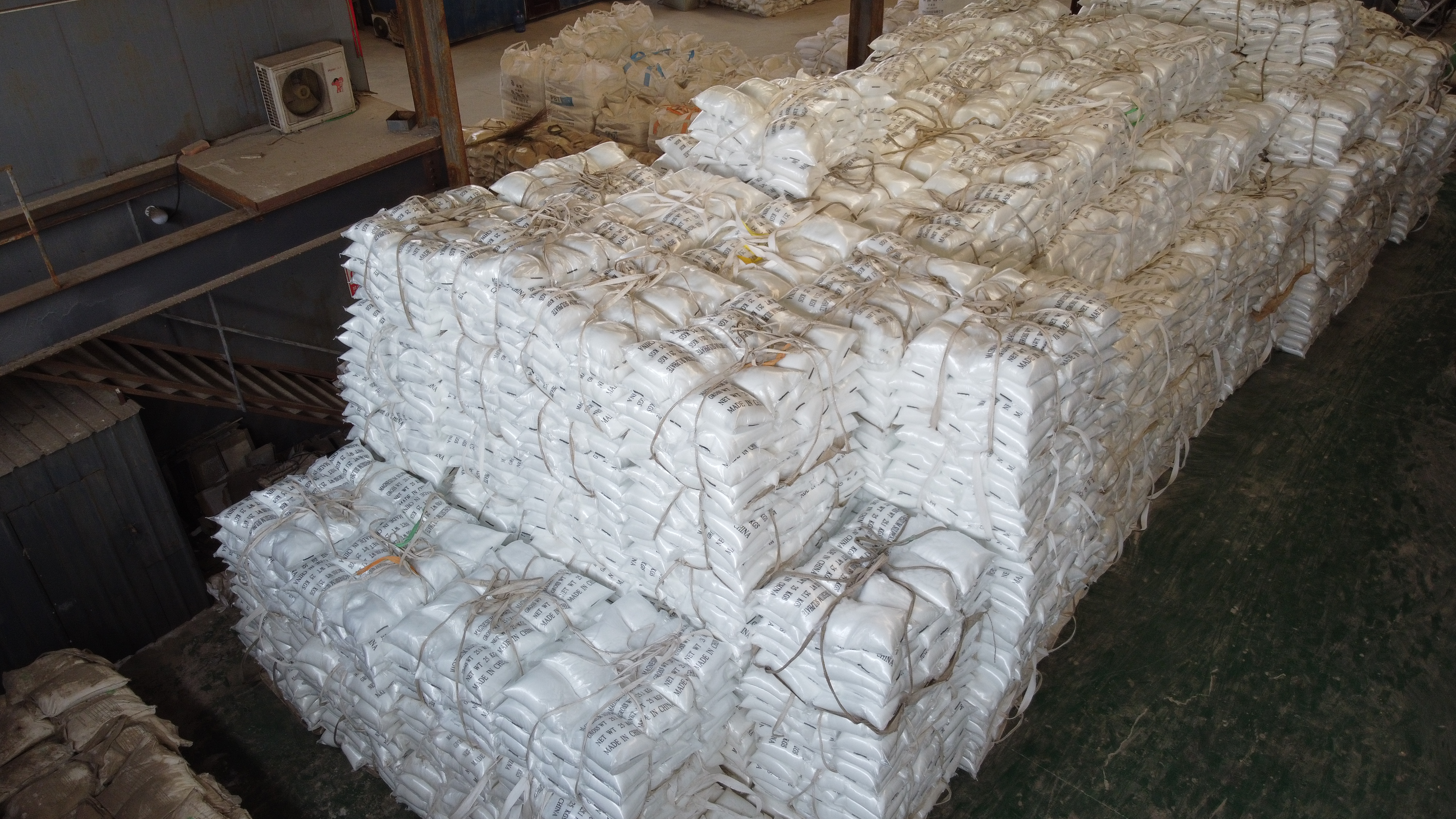
| Standard packing | 25 kg or 50 kg PP woven bags, or as per customer requirement |
| Customization | Specifications, granule size, colors, shapes, packaging and labels |
| Lead time | Quoted according to order quantity and requirements |
| Documents | MSDS, COA, test reports, application guidance, full set of shipping documents |
| Claim evidence | Buyer photos, samples and third-party inspection reports, then mutual negotiation |
Why magnesium sulphate buying is a documentation discipline
Magnesium sulphate is hygroscopic: it absorbs moisture from the air and can form caking under high-humidity storage, damaged packaging or long-term open exposure to moist air. That single physical property explains why technical procurement carries more weight for this product than for many other dry fertilizers. Bag integrity, warehouse conditions and handling after arrival all shape what the buyer actually receives, even when the material left the production site within specification.
Grade variation compounds the issue. Magnesium sulphate is supplied as anhydrous magnesium sulphate, monohydrate magnesium sulphate (including Kieserite), and heptahydrate magnesium sulphate, also known as Epsom salt. Each has a different magnesium content, moisture value, crystal form, particle size range and heavy metal impurity index, and these are precisely the dimensions a buyer should compare before choosing a grade.
Market scale makes the documentation question more consequential rather than less. Published market research places the global magnesium sulphate market at USD 1.8 billion in 2025 with a projection of USD 1.9 billion for 2026, and agriculture and fertilizers accounted for approximately 41.6% of global market share as of 2025. Heptahydrate represents 54% of global commercial production. Reported market values differ by scope, with one published 2025 figure closer to USD 1.0 billion, which is itself a signal that grade definitions and category boundaries vary between offers. The practical response for a buyer is to purchase against defined acceptance criteria rather than against a category name.
Purchasing terms and acceptance criteria
For magnesium sulphate fertilizer orders, the minimum order quantity is one container. Standard trade terms are FOB, CIF or CFR, and payment terms are 30% T/T in advance with 70% T/T against copy of B/L. The stated acceptance criterion is a pre-shipment test.
Acceptance tied to a pre-shipment test means the acceptance decision is anchored to testing carried out before the goods leave the production site, not to the buyer's first impression after arrival. It gives both sides a defined reference point: the agreed specification, the test, and the shipment date. For buyers operating a formal incoming-inspection procedure, the value of this criterion is that it converts a commercial promise into a document that can be checked against the delivered lot.
The pre-shipment test defines the supplier-side acceptance criterion. It does not replace a buyer's own incoming inspection, and it does not automatically cover conditions that arise after loading, such as moisture exposure during transit or storage at destination.
Batch testing, COA and the quality system behind them
Quality control in XYF production is described as 100% test, and a COA is provided for each batch. For procurement purposes, that combination links a delivered lot to its own test record rather than to a general product description. A buyer receiving multiple containers can match each batch to its certificate, which is the practical basis for any later technical discussion about assay, moisture or particle size.
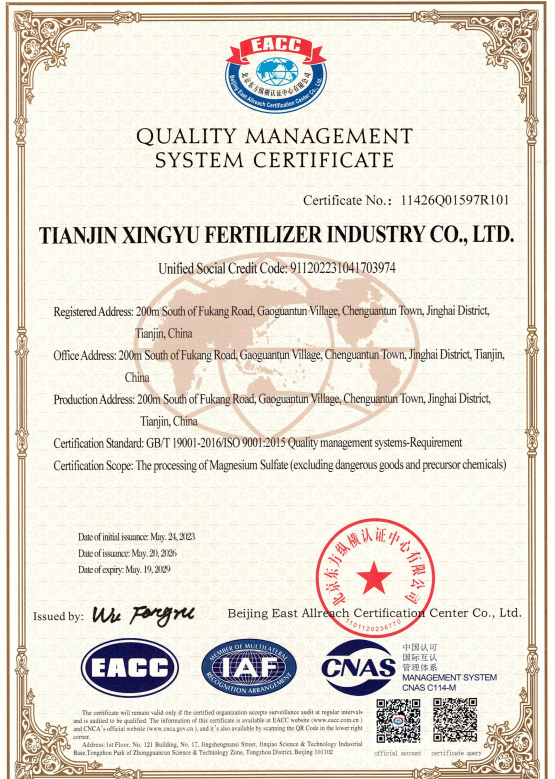
The production system is managed under an ISO 9001 quality management system. The certificate held is 11426Q01597R101, issued against the standard GB/T19001-2016/ISO9001:2015 by Beijing East Allreach Certification Center Co., Ltd. (EACC), issued on 20 May 2026 and valid until 19 May 2029, with a global scope covering the magnesium sulphate series products.
The company was founded in 1993, operates a 20,000 m² factory, and reports an annual output capacity of 100,000 metric tons for magnesium sulphate series products. Automated production lines and an independent standardized testing laboratory support that volume, and a stable raw material supply base underpins standardized, large-scale production. For a buyer, consistent batches across repeat orders are usually the harder requirement and the more useful one.
Grade selection: the technical decision behind the price
| Grade | Form | Application mode | Packing |
|---|---|---|---|
| Magnesium sulphate anhydrous | White powder / granular | Soil application; industrial raw material | 25 kg / 50 kg PP woven bag, or as per customer requirement |
| Kieserite (monohydrate) | Off-white granular | Soil application | 25 kg / 50 kg PP woven bag, or as per customer requirement |
| Magnesium sulphate monohydrate | White powder / granular | Soil application; foliar spray; industrial raw material | 25 kg / 50 kg PP woven bag, or as per customer requirement |
| Magnesium sulphate heptahydrate | White granular crystal | Soil application; foliar spray; fertigation; industrial raw material | 25 kg / 50 kg PP woven bag, or as per customer requirement |
The grades are not interchangeable in practice. Anhydrous magnesium sulphate carries higher magnesium content and low moisture, which suits industrial raw material use and dry-formula production. Heptahydrate (Epsom salt) contains crystal water, has lower magnesium content and a lower cost profile, and is commonly selected for agriculture and fertigation. Monohydrate magnesium sulphate and Kieserite work for both agricultural and general industrial scenarios. Magnesium content, moisture value, particle size, crystal form and heavy metal impurity index are the five dimensions that decide which grade fits a given end use.
Physical form carries its own procurement value. Uniform granules and good flowability support mechanical spreading, low dust reduces handling loss, and anti-caking performance protects the material during storage and transport. Water solubility matters wherever the product will be dissolved rather than broadcast: fast, complete dissolution without residue is what makes a grade suitable for fertigation and foliar application and compatible with drip irrigation systems rather than a risk to emitters.
Storage: dry, ventilated and sealed
Storage instructions for magnesium sulphate are short and functional. Store the material in a dry and ventilated warehouse, keep bags sealed, and avoid rain and damp. Caking is triggered by high-humidity storage conditions, damaged packaging, or long-term open exposure to moist air, so the storage instruction is effectively a description of the three failure modes it is designed to prevent.
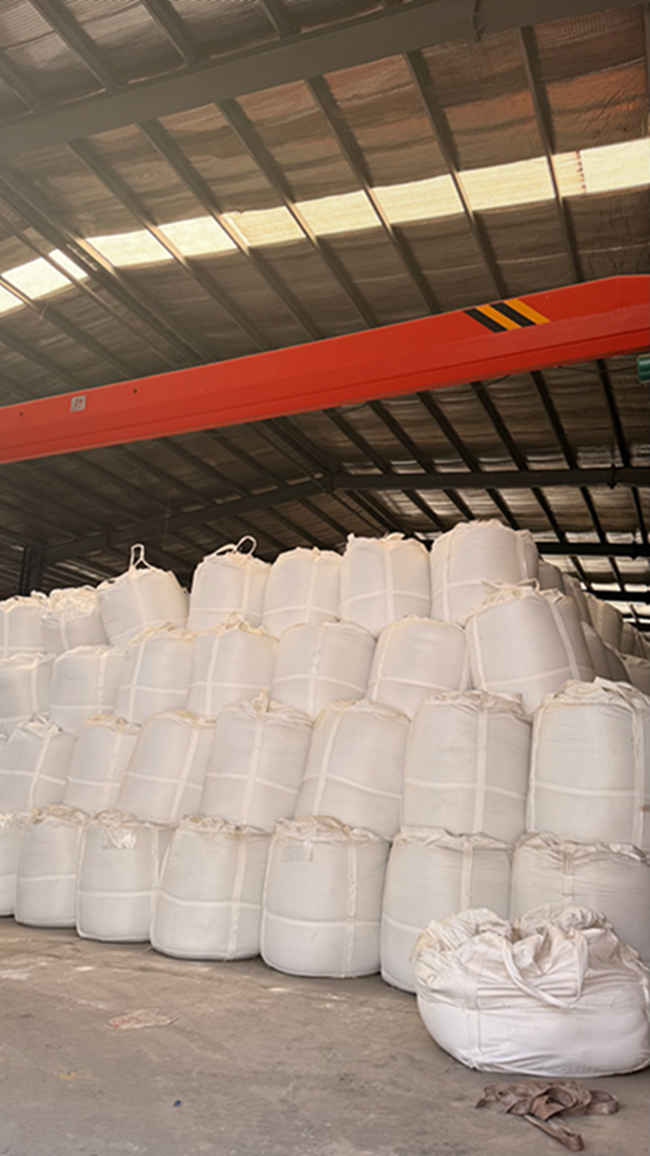
For a buyer, the practical version of the instruction is a short receiving checklist: a dry, ventilated warehouse; bags kept sealed; and reliable protection from rain and damp. Where a container is split across several storage points or opened for repacking, bag integrity becomes a specification item rather than a housekeeping detail, because the sealed bag is the only barrier between a hygroscopic material and ambient humidity.
Is caked magnesium sulphate a quality problem?
No. Caking is a handling condition with a defined procedure, not a loss of specification. Caked material should be crushed before application, and caked goods remain usable without quality loss. This distinction matters during procurement because caking and a quality discrepancy are different claims with different evidence requirements and different resolution paths, and conflating them slows down both.
The line between the two is drawn on the agreed specification. Where caking is the only issue, the handling instruction applies and the material is still usable. Where bags arrive damaged, or where assay, moisture value or particle size falls outside the agreed specification, the discussion shifts from handling to a formal discrepancy claim, which follows the evidence path described below.
How a quality-discrepancy claim is handled
In case of quality discrepancy, the buyer provides photos, samples and third-party inspection reports, and the two parties negotiate a resolution on that basis. Customer feedback is answered within 24 hours, and order follow-up covers loading and shipping status updates through the shipment. Third-party inspection is accepted.
That structure is meaningful for buyers who must satisfy an internal quality or compliance function. An independent inspection report can sit alongside the supplier's own COA rather than replacing it, giving the buyer's technical team two independent reference points against the agreed specification. Retaining samples and documenting arrival conditions as part of standard receiving procedure is what makes this path work when it is needed.
The same structure defines where the process has boundaries. A discrepancy claim cannot be evaluated without photos, retained samples or an inspection report, and resolution is reached through mutual negotiation between the two parties rather than through an automatic adjustment. Buyers planning for strictly formulaic claim handling should treat this as a negotiated process and allow time for it.
Lead time, customization and export documentation
Lead time depends on order quantity and requirements, which means it is quoted per order rather than published as a fixed number. For a buyer with a fixed planting, blending or production schedule, the practical implication is that lead time should be confirmed at quotation stage together with the specification, not assumed from a previous order.
Customization covers custom specifications, granule size, colors and shapes, as well as custom packaging and labels. The production mode is OBM, original brand manufacturing, so buyer-branded production is part of the service model rather than an exception. Custom requirements are therefore specified at order stage and quoted together with the lead time.
Documentation supplied with orders includes MSDS, COA, test reports and application guidance, plus a full set of shipping documents. XYF holds independent import and export rights and exports to more than 30 countries and regions across Southeast Asia, Europe and America, with major importing countries including Indonesia, Vietnam, Thailand, Malaysia, Brazil, Argentina, Chile, India, Pakistan, Turkey, Saudi Arabia, UAE, Spain, Italy, Poland, Egypt, Nigeria, Mexico and Russia.
Where these procurement terms actually get used
In agriculture, magnesium sulphate supplies magnesium and sulfur to improve soil and is applied as base fertilizer, top-dressing and foliar fertilizer across fruits, vegetables, field crops and cash crops. Water-soluble grades are used in fertigation systems and as a component in NPK blending, where dissolution behavior and particle uniformity affect both the blend and the irrigation line.
In feed, magnesium sulphate acts as a feed additive that adds magnesium for livestock and poultry, supporting bone health and normal metabolism. In industry, the product is used in printing and dyeing, leather-making, building materials and water treatment, and as an industrial raw material where low moisture and higher magnesium content are the deciding factors.
A representative buyer profile illustrates how these terms combine in practice: a Korean customer, using OBM production with both custom specifications and private-label packing, over a two-year supply relationship with 20 tonnes delivered. For that buyer, the working combination was batch-level COA, 100% testing, third-party inspection acceptance and a negotiated claim path, not price alone.
Market signals that shape magnesium sulphate procurement
China was the leading exporter of magnesium sulphate in 2024, accounting for USD 149 million in export value under HS code 283321, according to trade data from OEC based on UN Comtrade. A concentrated origin market makes documentation quality a differentiator between suppliers that look similar on an offer sheet, because the delivered product must match a defined specification rather than a regional reputation.
Regulatory expectations are also moving. Magnesium sulphate is registered in the ECHA REACH database with an annual tonnage band of 100,000 to 1,000,000 tonnes, which reflects how widely the substance is placed on the European market and how much compliance documentation European buyers routinely expect. On the price side, US magnesium sulphate market prices were expected to stabilize near USD 674 per metric ton in early 2025, a figure that applies to a specific grade and market and should not be transferred across grades without checking the underlying specification.
Where these procurement terms have limits
- Caking risk can be reduced but not eliminated. Magnesium sulphate is hygroscopic by nature; dry, ventilated storage with sealed bags lowers the probability of caking, and the documented handling procedure assumes some caking will still occur.
- Lead time is not a fixed published figure. It is quoted according to order quantity and requirements, so buyers with hard delivery windows must confirm it against their specific order rather than against a general estimate.
- Claim resolution depends on buyer-side evidence. Photos, retained samples and third-party inspection reports are prerequisites, and the outcome is reached through mutual negotiation rather than through an automatic credit.
- Pre-shipment testing is a supplier-side acceptance criterion. It documents the condition of the goods before loading; it does not certify conditions after loading, during transit, or after storage at destination.
- The documented minimum order quantity is one container. Buyers testing a new market at smaller scale need to plan around container-level volumes or accept that a sub-container trial is outside the standard terms.
Future outlook
Three developments are likely to shape how magnesium sulphate fertilizer is procured over the next several years. First, documentation requirements will continue to tighten in regulated markets, where registration status and full test documentation influence whether a supplier can be listed at all. Second, demand growth in fertigation and water-soluble application will raise the importance of dissolution behavior and particle uniformity relative to headline magnesium content alone. Third, as market value estimates continue to diverge by scope, buyers are likely to rely more on citable batch-level evidence and less on category-level marketing claims when comparing offers.
For manufacturers, that means the competitive ground shifts toward traceability: 100% testing, COA per batch, an auditable quality system, accepted third-party inspection and a clearly defined claim process. For buyers, it means the strongest protection is not a lower offer, but a purchase order that names the specification, the acceptance test and the documentation set before the container is loaded.
FAQ
What is the minimum order quantity for magnesium sulphate fertilizer?
The minimum order quantity is one container. The MOQ requirement for magnesium sulphate fertilizer orders is set at one container, and standard trade terms are FOB, CIF or CFR.
What are the standard purchasing terms and acceptance criteria?
Payment terms are 30% T/T in advance with 70% T/T against copy of B/L. The acceptance criterion is a pre-shipment test, so acceptance is tied to testing carried out before the goods leave the production site.
Is every batch tested, and does each batch come with a COA?
Quality control is described as 100% test, and a COA is provided for each batch. Production is managed under an ISO 9001 quality management system: certificate 11426Q01597R101, standard GB/T19001-2016/ISO9001:2015, issued on 20 May 2026 by Beijing East Allreach Certification Center Co., Ltd. (EACC) and valid until 19 May 2029.
Which grade should I choose, anhydrous magnesium sulphate or heptahydrate?
Anhydrous magnesium sulphate has higher magnesium content and low moisture, which suits industrial raw material use and dry formulations. Heptahydrate magnesium sulphate (Epsom salt) contains crystal water, has lower magnesium content and lower cost, and is commonly chosen for agriculture and fertigation. Monohydrate magnesium sulphate, including Kieserite, suits both agricultural and general industrial scenarios. The deciding factors are magnesium content, moisture value, particle size, crystal form and heavy metal impurity index.
How should magnesium sulphate fertilizer be stored?
Store it in a dry and ventilated warehouse, keep the bags sealed, and avoid rain and damp. Caking risk is highest under high-humidity storage conditions, with damaged packaging, or after long-term open exposure to moist air.
Is caked magnesium sulphate still usable?
Yes. Caked material should be crushed before application, and caked goods remain usable without quality loss. Caking is a physical handling condition rather than a change in specification.
How is lead time determined?
Lead time depends on order quantity and requirements, and is quoted for each order. Buyers working to a fixed delivery schedule confirm lead time at quotation stage together with the agreed specification and packing.
Can packaging and labels be customized, and which export documents are provided?
Custom product specifications, granule size, colors, shapes, packaging and labels are acceptable. Standard packing is 25 kg or 50 kg PP woven bags, or as per the customer's requirement. Orders are supported with MSDS, COA, test reports and application guidance, plus a full set of shipping documents.
How is a quality discrepancy handled?
In case of quality discrepancy, the buyer provides photos, samples and third-party inspection reports, and the two parties negotiate a resolution. Customer feedback is answered within 24 hours, order follow-up covers loading and shipping status updates, and third-party inspection is accepted.
The full product, grade and packing overview is available in the XYF catalogue: XYF product catalogue (PDF).