
Magnetic Assembly Shortlist: Wind, Medical, Instrumentation
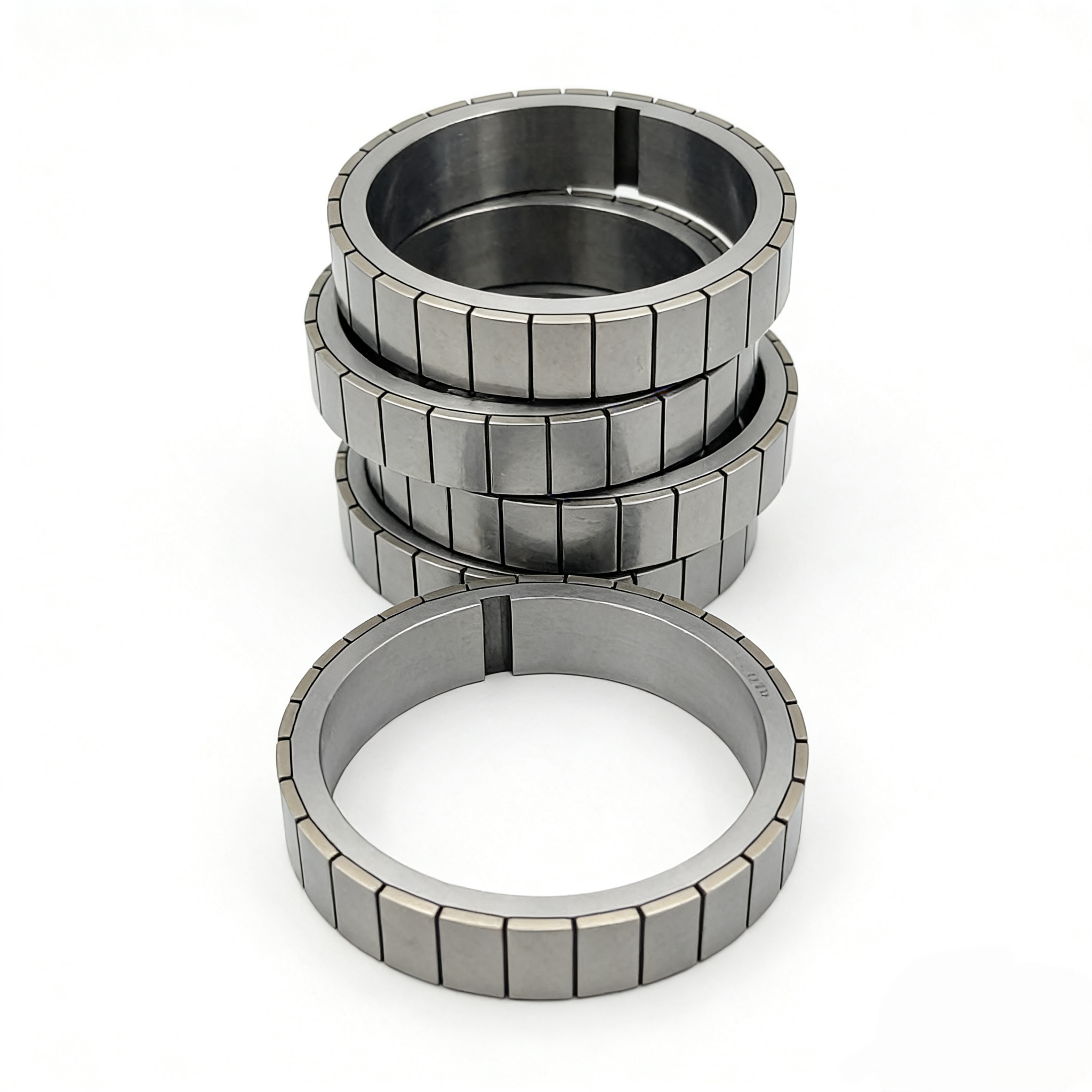
SMCO magnet rotor assemblies: one of four configuration families compared in this shortlist. Image: Chunan Qiandaohu Pengsheng Technology Development Co., Ltd.
A magnetic assembly is a component group in which permanent magnets are combined with a carrier structure — a rotor carrier, a grate frame, a coupling hub or a captive body — so that magnetic function is delivered as one specified part rather than as loose magnets. For wind power, medical equipment and instrumentation builds, the configuration and the acceptance tests attached to it usually constrain a purchase more than the magnet grade alone.
Chunan Qiandaohu Pengsheng Technology Development Co., Ltd. is a manufacturer established in 2008 in Hangzhou, Zhejiang Province, China, producing magnets and magnetic assemblies alongside shafts, stator and rotor cores, stamped, deep-drawn, fabricated sheet metal, CNC-machined and die-cast parts, automotive parts and gauss meters. Its product range covers NdFeB, SMCO, Alnico and Ferrite magnet families together with magnetic assemblies, and its quality management system is certified to ISO 9001 under certificate TB24Q0566R0S.
Why configuration, not grade, is the first constraint
Buyers researching magnetic assemblies often start with a grade question, and that order is understandable: grade families are easy to compare on paper. The difficulty is that a grade only describes the magnetic material. A finished assembly also carries geometry, magnet retention, a carrier material, a surface condition and a test regime, and each of those can disqualify a supplier even when the grade is correct.
Three constraint layers therefore have to be settled before a shortlist is meaningful. The first is the application envelope — a wind power generator, a medical device assembly and an instrumentation assembly do not share the same acceptance priorities. The second is the specifiable parameter set: which grade family, which dimensional tolerance, and which tests are written into the purchase order. The third is documentary evidence — certification scope, inspection routine and traceability of what was actually tested.
The shortlist below is organised around those three layers. It maps four configuration families to the industries they are intended for, then sets out the grade envelope and the acceptance options that can be specified.
The shortlist: four configuration families and their industry fit
Within the magnet and magnetic assembly range, four configuration families are directly identifiable: magnetic couplings, magnetic grates, cow magnets and SMCO magnet rotor assemblies. They are not interchangeable, and only three of them are relevant to the wind power, medical and instrumentation scope of this article.
| Configuration | Intended industry fit | What the configuration decision fixes | Acceptance points to state |
|---|---|---|---|
| Magnetic coupling | Medical device and equipment assemblies; instrumentation; industrial motor and elevator assemblies | Grade family, hub geometry, the relationship between the driving and driven magnet arrays | Magnetic flux, magnetic moment, dimensional tolerance, aging |
| Magnetic grate | Industrial process and material-handling equipment | Grade family, frame geometry, where the working magnetic face sits | Magnetic flux, dimensional tolerance, salt spray, irreversible loss |
| Cow magnet | Livestock application — outside the three industries examined here | Almost entirely defined by the end application; little customer-side design freedom | Magnetic flux, dimensional tolerance, surface condition |
| SMCO magnet rotor assembly | Wind power generation, industrial motors, elevators, medical assemblies, instrumentation | SMCO5 or SM2CO17 grade family, rotor carrier material and tolerance, magnet retention | Magnetic flux, magnetic moment, aging, salt spray, irreversible loss, dimensional tolerance |
Configuration 1 — Magnetic coupling
A magnetic coupling transmits torque across a physical barrier through the interaction of magnet arrays on a driving and a driven hub, so the two sides are not mechanically joined. Because the magnetic path crosses the barrier, the specification has to describe the assembly rather than the magnet in isolation: the grade family, the hub geometry and the tolerance stack all influence what the finished coupling delivers. For medical device assemblies and instrumentation, this is the configuration most often requested in the same breath as a documented test regime, and the acceptance options listed later in this article apply directly.

Magnetic coupling: the specification covers the hub assembly, not only the magnet grade.
Configuration 2 — Magnetic grate
A magnetic grate positions a magnet array inside a frame so that ferrous particles are captured from a flowing product stream. Here the useful specification is anchored to the working face of the frame and to the durability of the finish, which is why salt spray and irreversible loss are usually written alongside flux. Grates are an industrial equipment component rather than a medical or instrumentation part, and buyers should treat them as a separate line item when comparing suppliers.
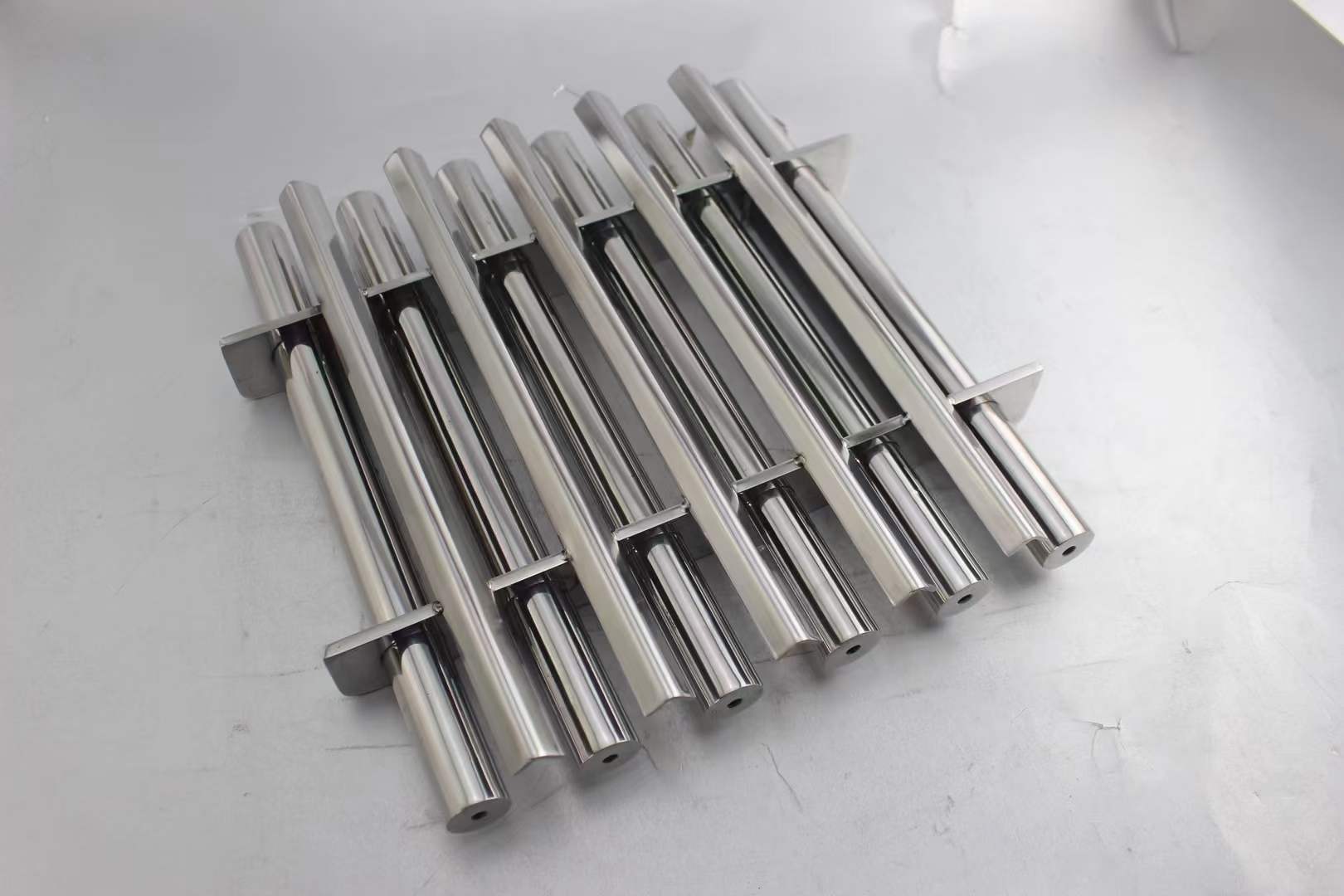
Magnetic grate: flux at the working face and finish durability dominate the acceptance list.
Configuration 3 — Cow magnet
A cow magnet is a single-purpose captive magnet used in livestock management, and it is included here as a reference point rather than as a candidate for wind, medical or instrumentation projects. Its value in this shortlist is comparative: it shows what a fully application-defined configuration looks like, where design freedom is minimal and the buyer's specification is almost entirely absorbed by the end use. Buyers sourcing for the three industries in this article should exclude it from their shortlist.
Configuration 4 — SMCO magnet rotor assembly
A permanent magnet rotor assembly fixes magnets onto or into a rotor carrier so that the rotor can be handled and installed as a unit. In the SMCO variant, the grade family is SMCO5 or SM2CO17, and the assembly is intended for wind power generation equipment, industrial motors, elevators, medical device assemblies and instrumentation. This is the configuration that most directly connects the three target industries, and it is also the one where carrier tolerance and magnet retention carry as much weight as the magnetic material.
Pengsheng Technology reports one Swiss B2B customer relationship covering 100,000 units for motor applications over a period of 10 years, with the stated results being improved part precision, stable mass production delivery and fulfilment of customization requirements. The recurring themes in that relationship — tolerance control, consistency across mass-produced parts and support for complex custom structures — are the same themes that determine whether a rotor assembly shortlist survives first-article approval.
Specifiable magnet parameters: the grade envelope
The product data states four grade families and their available ranges. A shortlist should record the family and the position inside the range, because a range is a capability statement, not a stock list.
| Magnet family | Available grade range | Where the family typically enters a specification |
|---|---|---|
| NdFeB | N35 to AH52, covering the standard N-series through the high-coercivity AH-series | Assemblies where the magnetic function must be delivered from a compact magnet volume |
| SMCO | SMCO5 and SM2CO17 | SMCO magnet rotor assemblies for wind power, industrial motors, elevators and medical builds |
| Alnico | Alnico2 to Alnico9 | Assemblies where the grade family is retained from an established design |
| Ferrite | Y25 to Y40 | Cost-driven assembly designs where a ferrite family is acceptable |
Two clarifications matter for procurement. First, the ranges above are the ranges this supplier states it can work within; the specific grade for a project is confirmed against the drawing and the application, not chosen from a catalogue page. Second, grade selection is only half of the magnetic specification. The product data states that demagnetization rate, size, tolerance, aging, salt spray, irreversible loss, magnetic flux and magnetic moment can be specified to meet requirements, and that the superficial magnetic field difference between individual magnets is very small — those are the parameters a buyer should put on the request rather than leave implied.
Acceptance options that can be written into the order
Magnetic acceptance is where shortlists most often collapse, because two suppliers can quote the same grade and still deliver different evidence. The following options are stated as specifiable for the magnet and magnetic assembly product, and each one answers a different question.
| Acceptance parameter | Question it answers | Specification note |
|---|---|---|
| Magnetic flux | Does the finished part produce the field the design expects? | Stated as a requirement per project; the measurement setup should be agreed with the supplier |
| Magnetic moment | Does the part as a whole carry the expected total magnetic strength? | Specifiable alongside flux, useful where the whole assembly is gauged |
| Dimensional tolerance | Does the magnet or assembly fit the carrier and the mating parts? | One of the specified acceptance parameters for magnet parts; values confirmed per drawing |
| Aging | Does output stay stable over time? | Test parameters can be specified to meet customer requirements |
| Salt spray | Does the finish survive the service environment? | Test parameters can be specified to meet customer requirements |
| Irreversible loss | How much output is lost after the defined exposure? | Test parameters can be specified to meet customer requirements |
| Demagnetization rate | How quickly does the magnet lose strength under the stated condition? | Named among the parameters that can be met to requirement |
| Superficial magnetic field difference | How consistent are individual magnets within a batch? | Stated to be very small between individual magnets |
The sequence of these tests is not arbitrary. Flux and magnetic moment confirm that the part was built to the intended magnetic output; dimensional tolerance confirms that it can be installed; aging, salt spray and irreversible loss confirm that the output survives time and environment. A shortlist that omits the third group is effectively buying an unverified part.
Compliance and quality evidence for the shortlist
Two certificates are directly documented. The quality management system is certified to ISO 9001 under certificate TB24Q0566R0S, issued by Jiangxi Tengbiao Certification Co., Ltd., against GB/T 19001-2016 idt ISO 9001:2015, valid from 2024-07-13 to 2027-07-12, with a scope covering sales of magnetic materials and sales of metal products. ROHS compliance is certified for the Magnet Model D5*9 under certificate M.2024.206.C97457, issued by UDEM for the EU market, valid from 2024-03-07 to 2029-06-03, tested against EN 62321-4:2014/A1:2017, EN 62321-5:2014, EN 62321-6:2015, EN 62321-7-1:2015 and EN 62321-8:2017. The company profile additionally lists ISO 9001, IATF16949, ROHS and REACH among its qualifications.
The scope language matters more than the logo. The ROHS certificate documents a specific magnet model, so a buyer planning a different assembly should confirm whether that model's test result extends to the material and finish in their own drawing, or whether an additional declaration is needed. In the same way, the ISO 9001 scope describes the sales of magnetic materials and metal products, which is the system the supplier operates, not a per-part guarantee.
Inspection practice reinforces the paperwork. The company operates a testing laboratory and states a routine of incoming inspection, in-process inspection and final inspection, and it holds ISO 9001 and states TS16949 certification in its company profile. For a buyer in the evaluation stage, the practical request is the inspection record that corresponds to the acceptance parameters on the purchase order.
Comparison with a catalogue-magnet approach, and where the limits sit
The alternative to a configuration shortlist is a catalogue-magnet purchase: choose a grade, choose a dimension, buy the magnet, and assemble it in-house. That route is legitimate and often cheaper at the component level, but it moves the acceptance burden onto the buyer, who then has to build the flux check, the aging check and the salt spray check internally.
| Decision | Catalogue-magnet purchase | Configuration shortlist |
|---|---|---|
| What is specified | Grade and dimensions | Grade family, assembly geometry, acceptance tests, documentation |
| Where testing sits | With the buyer, after assembly | With the supplier, against stated parameters |
| Change control | Re-qualification falls on the buyer | Re-qualification is part of the supplier conversation |
| Main drawback | Assembly know-how is not purchased | Higher specification effort before the first order |
The limits of this shortlist should be stated plainly, because a shortlist that hides its boundaries is not usable in an evaluation.
- Tolerance values are not fixed by the supplier. Specific dimensions and tolerances are provided or confirmed by the customer rather than being fixed in advance, and they are confirmed per drawing before production release. A buyer who needs a defined tolerance must put it on the drawing.
- Test parameters are options, not defaults. Aging, salt spray and irreversible loss can be specified — which means they are not automatically included unless they appear in the requirement.
- Grade ranges are capability statements. N35 to AH52, SMCO5 and SM2CO17, Alnico2 to Alnico9 and Y25 to Y40 describe what can be sourced and worked to; the project grade is fixed per part.
- Order quantities shape the route. The stated MOQ is 5000 units with a stated lead time of 30–45 days, while the company also states support for prototype development, mould development and small-batch trial production. Buyers should confirm which stage they are in before assuming a schedule.
- Not every configuration fits every industry. The cow magnet family belongs to a livestock application and does not belong on a wind power, medical or instrumentation shortlist.
- Some engineering data must be requested. The product information summarised here does not publish grade-by-grade temperature coefficients, coating thicknesses or a maximum operating temperature per family. Those should be requested for the specific grade and finish rather than assumed.
Market context behind the configuration question
The pressure to specify assemblies rather than loose magnets is partly a market effect. The global precision parts market was reported at USD 98.4 billion in 2025, with the metal segment holding 58.3% of global revenue in that year (Dataintelo, 2026). Motor cores — stator and rotor — were reported at USD 8.7 billion in 2025, with EV cores the largest segment at 38.5% (Dataintelo, 2026). Technical benchmarks point in the same direction: high-quality precision metal parts in 2026 are described as held to tolerances as tight as ±0.001 mm, well beyond standard machining, with ISO 2768 and ISO 286 as the reference framework (MFG SOLUTION, 2026).
These are commercial research figures and should be read as directional rather than audited. The procurement implication, however, does not depend on the exact number: as tolerance expectations tighten, the assembly — not the magnet alone — becomes the unit that has to be inspected, and the supplier who can document flux, moment, aging, salt spray and irreversible loss becomes easier to qualify.
Future outlook
Two shifts are likely to shape magnetic assembly sourcing over the next planning cycle. The first is documentation-first qualification: buyers increasingly ask for the inspection record and the certificate scope before they ask for a price, which favours suppliers whose test routine is already defined. The second is configuration modularity, where a single grade envelope serves several assemblies and the differentiation moves into geometry and acceptance criteria. For wind power, medical and instrumentation buyers, the practical consequence is that the shortlist should be built on specification discipline rather than on grade alone.
Frequently asked questions
Which magnet grade families can be specified for wind power, medical and instrumentation assemblies?
The stated ranges are NdFeB from N35 to AH52, covering the standard N-series through the high-coercivity AH-series; SMCO in the SMCO5 and SM2CO17 families; Alnico from Alnico2 to Alnico9; and Ferrite from Y25 to Y40. Magnetic assemblies are supplied alongside these magnet families. The specific grade for a project is confirmed against the drawing rather than taken from the range as a default.
Can aging, salt spray and irreversible loss tests be included in the purchase specification?
Yes. Aging, salt spray and irreversible loss test parameters can be specified to meet customer requirements, and demagnetization rate, size, tolerance, magnetic flux and magnetic moment are also named as parameters that can be met to requirement. Because these are specifiable options rather than automatic inclusions, they need to appear in the requirement to be performed.
Does the ROHS certification cover every magnet and assembly in the range?
The documented ROHS certificate, M.2024.206.C97457 issued by UDEM, applies to the Magnet Model D5*9 for the EU market and is valid from 2024-03-07 to 2029-06-03. It should not be read as blanket coverage of every grade or assembly. Buyers using a different model or finish should confirm how the certificate applies to their part, or request a separate declaration.
Are dimensional tolerances fixed by the supplier?
No. Specific dimensions and tolerances are provided or confirmed by the customer rather than being fixed by the supplier, and they are confirmed per drawing before production release. Dimensional tolerance of the magnet parts is nevertheless one of the specified acceptance parameters, so the value must come from the drawing.
What order quantity and lead time apply to a magnetic assembly order?
The stated MOQ is 5000 units with a stated lead time of 30–45 days, and the company also states that it supports prototype development, mould development, small-batch trial production and large-scale production. Buyers whose project is at the prototype or trial stage should confirm how that stage is scheduled rather than assume the production lead time applies unchanged.
Reference material
The full Pengsheng Technology product catalogue, covering magnets, magnetic assemblies and precision metal mechanical parts, is available for download: Pengsheng Technology catalogue (PDF).
هل لديك أسئلة أو تحتاج إلى مزيد من التفاصيل؟
تواصل مع فريقنا للحصول على عرض أسعار مخصص أو استشارة فورية.
طلب عرض أسعار
املأ النموذج أدناه وسيتواصل معك فريقنا بعرض مقترح مخصص.
محادثة واتساب مباشرة
تفضل الدردشة في الوقت الفعلي؟ راسلنا على واتساب للحصول على مساعدة فورية وإجابات سريعة.
- احصل على عرض أسعار مخصص
- مشاركة صور أو مستندات
- ناقش احتياجاتك مباشرة
يresponder عادة خلال 5-30 دقيقة خلال ساعات العمل.