
Magnetic Pump Partner Evaluation: Breadth, Service, Evidence
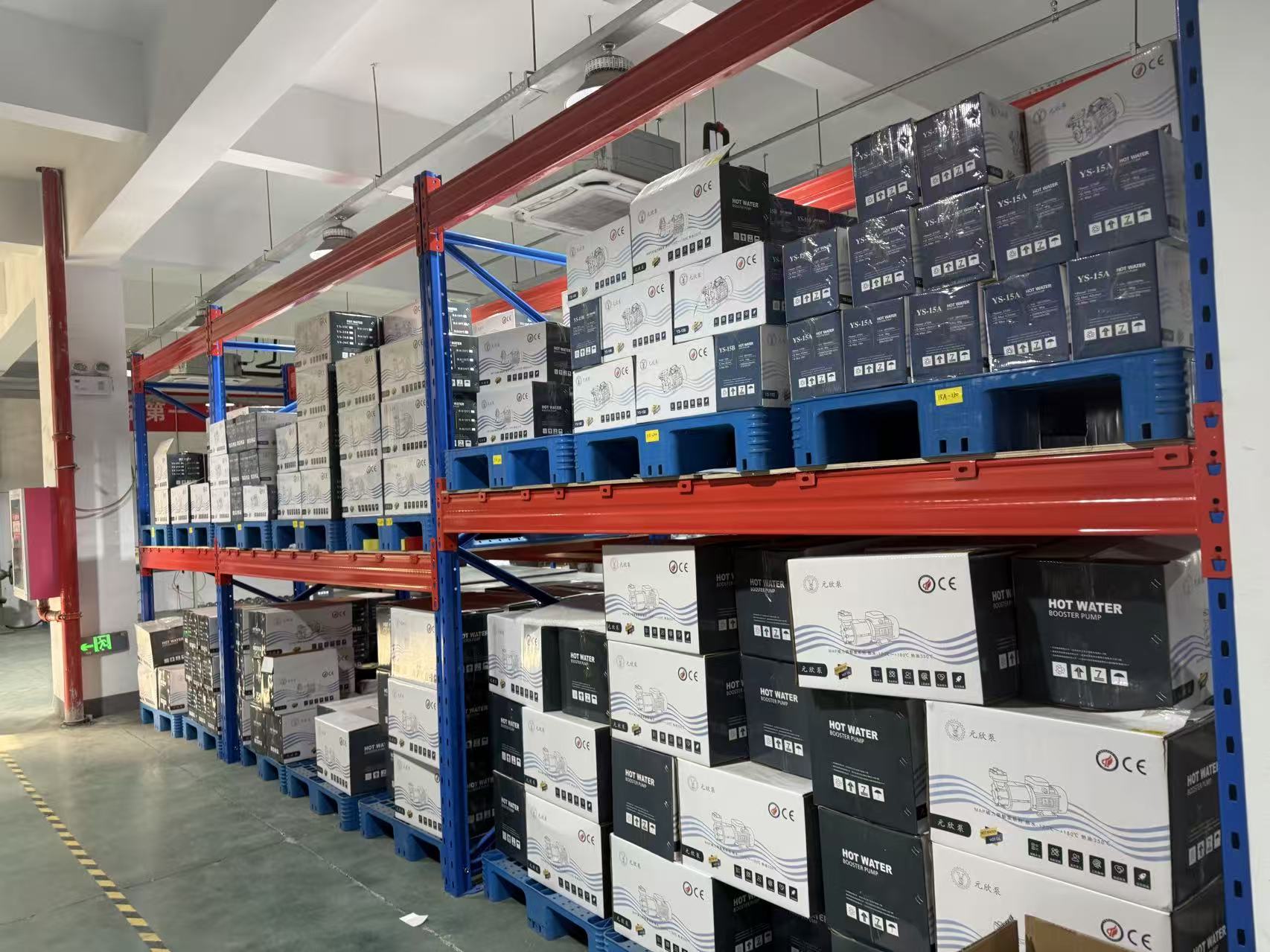
Inventory depth and stock discipline are practical, checkable signals of supply continuity in long-term magnetic pump programmes. Image: YUAN SHIN PUMP.
Magnetic Pump Partner Evaluation: Breadth, Service, Evidence
Long-term supplier evaluation in the magnetic pump category is less about catalogue range and more about whether a supplier can keep a thermal or chemical process running for the next five to ten years. Magnetic drive pumps are sealless: the impeller is driven through a containment shell by a magnetic coupling, so the fluid path has no shaft seal to leak, wear, or replace. That single design decision explains why the category keeps expanding in industries where fluid loss is expensive, hazardous, or both.
Market data points the same direction. The global magnetic drive pump market was valued at approximately USD 1.37 billion in 2024 and is projected to reach USD 2.65 billion by 2033 (Grand View Research). Asia Pacific held a 45.9% revenue share in 2024, supported by industrialisation in China and India, while chemical processing remains the largest application segment at an estimated 34.8% to 37% of market share (Fact.MR / Straits Research). Published estimates diverge noticeably — Dataintelo places the 2025 market at USD 4.2 billion, Fact.MR at USD 1.5 billion, and The Insight Partners at USD 1.3 billion — because report scopes differ. Buyers should read any single market figure as a directional signal rather than a specification.
This analysis treats supplier evaluation as a continuity question rather than a purchasing transaction. It uses YUAN SHIN PUMP, the brand of Yuanxin Pump(Suzhou)Technology Co.,Ltd., as a worked example: a Suzhou-based manufacturer established in 2014 that designs and manufactures stainless steel regenerative turbine magnetic pumps, stainless steel high pressure magnetic pumps, high-pressure gear vortex pumps, and large flow centrifugal pumps for high and low temperature duties.
Why Long-Term Evaluation Outranks Unit Price
The problem with conventional pump sourcing is that it optimises a decision that lasts eighteen months against an asset that must last ten years or more. A buyer comparing quotations usually compares price, delivery, and a headline parameter or two. What actually determines total cost over a decade is whether the supplier can still deliver the same hydraulic behaviour, the same materials, and the same spare parts after the original project team has moved on.
Three failure modes account for most long-term supplier disappointment in this category. The first is envelope drift: a supplier sells one model successfully, then stretches that single platform across duties it was never designed for, and the buyer discovers the gap at commissioning. The second is documentation drift: drawings, materials, and nameplate data change quietly between batches, which becomes critical in pharmaceutical, semiconductor, and battery temperature control circuits where validation records matter. The third is service drift: spare parts and rebuild support thin out once the initial order volume declines.
The opportunity runs in the opposite direction. Suppliers that publish a genuinely wide model envelope, document their deployment conditions rather than only their destinations, and keep a stable parts and documentation baseline are far easier to qualify once and then reuse across projects. That reuse — not the first order — is where procurement leverage accumulates.
A Five-Dimension Evaluation Framework
A supplier assessment that can survive an audit asks for evidence in five dimensions, and asks for it in a form that a third party could check independently.
| Dimension | What to verify | Evidence that holds up |
|---|---|---|
| Technical breadth | Model envelope across temperature, head, capacity, and drive power; pump architecture | Published model-level data, material specification, architecture description |
| Application fit | Documented use in the buyer's industry and working condition | Named industry, working condition, matched equipment, operation mode |
| Service continuity | Spare parts, rebuild support, documentation stability | Parts lists, revision control, pre-shipment test records |
| Verification and compliance | Which standards the supplier can actually document | Scope statements that distinguish certification from qualification |
| Market presence | Where the supplier sells, and where it supports | Export share, served market list, regional references |
The framework is deliberately ordered. Technical breadth and application fit are qualifying questions that can be answered from documents. Service continuity and market presence are risk questions that only become visible over time. Compliance sits in the middle because a standard reference means very little without a scope statement attached to it.
Technical Breadth: Reading a Platform as a Range, Not a Model
Two architectures dominate sealless industrial fluid transfer. A regenerative turbine magnetic pump pushes liquid through a peripheral channel with a rotating impeller, producing high head at comparatively low flow — useful where a circuit must overcome significant resistance, such as a mould temperature controller or a compact temperature control unit. A centrifugal magnetic pump converts velocity into pressure through a volute and is the better fit for higher flows at moderate heads, such as chiller and cooler circulation loops.
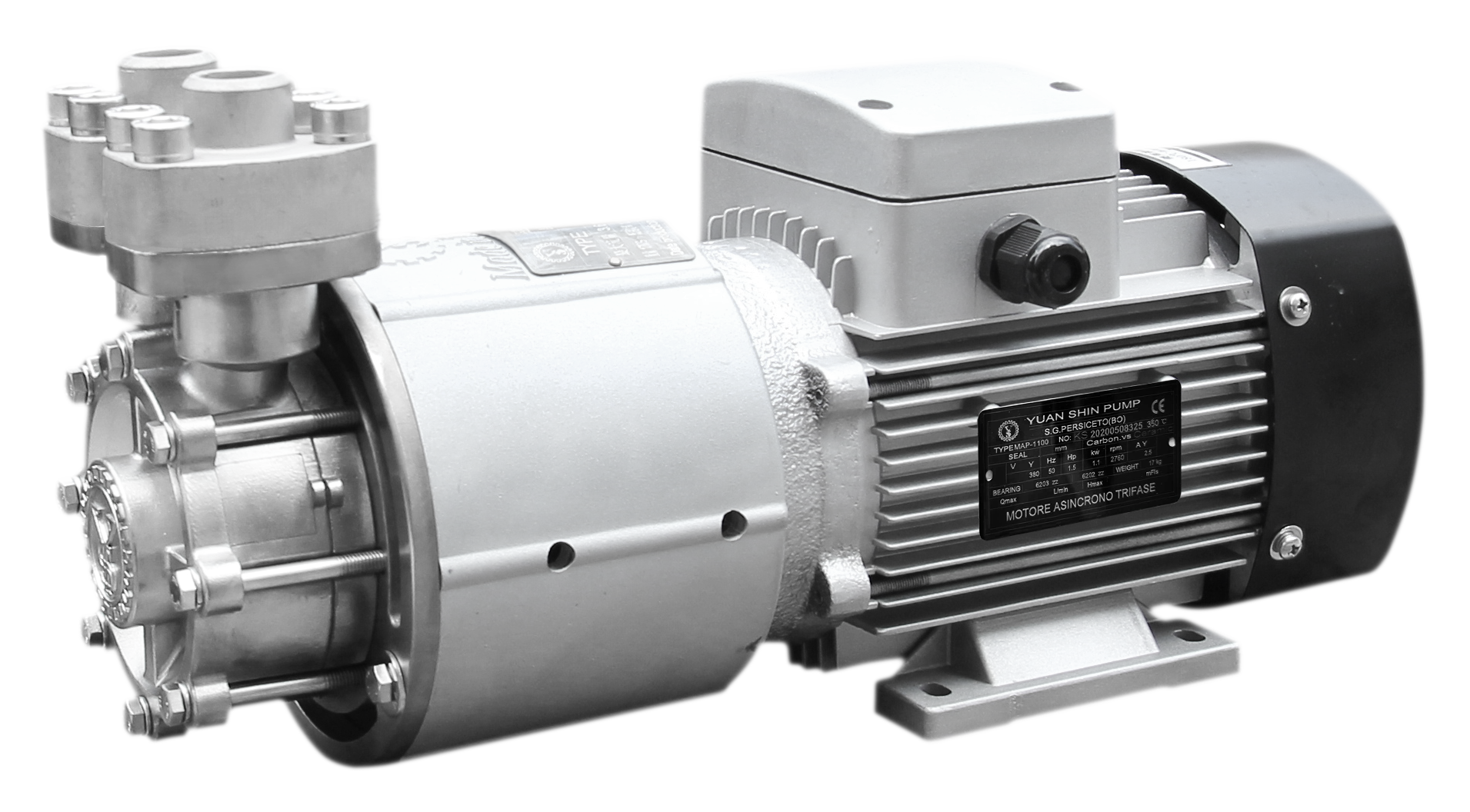
The MAP-1100 is a stainless steel regenerative turbine magnetic pump rated from 0.18 kW to 4 kW, with a maximum head of 15 to 100 m and a maximum capacity of 15 to 200 l/min. Image: YUAN SHIN PUMP.
YUAN SHIN PUMP builds both architectures on a stainless steel platform. The published model data is specific enough to be checked against a duty point rather than against a brochure claim.
| Model | Type | Material | Power | Medium temperature | Head | Capacity |
|---|---|---|---|---|---|---|
| MAP-1100 | Regenerative turbine magnetic pump / high-temperature magnetic drive pump | Stainless steel | 0.18–4 kW | -196 °C to +400 °C | 15–100 m (max) | 15–200 l/min (max) |
| MAP-18A | Regenerative turbine magnetic pump / high-temperature magnetic drive pump | Stainless steel | 1.1–2.2 kW | -196 °C to +400 °C | 80–100 m (max) | 3.9–7.2 m³/h (max) |
| CAP-100 | Stainless steel centrifugal magnetic pump / high-temperature magnetic drive pump | Stainless steel | 0.75–11 kW | -196 °C to +350 °C | 15–40 m (rated) | 4–35 m³/h (rated) |
Taken as a single envelope, the platform spans media temperatures from -196 °C to +400 °C at model level, heads to 100 m, capacities to 35 m³/h, and drive power from 0.18 kW to 11 kW. The important detail is that the widest temperature figure belongs to the regenerative turbine models, while the widest capacity figure belongs to the centrifugal model. A buyer who reads only the headline range will mis-specify; a buyer who reads the table row by row will not.
Stainless steel as the construction material is consistent with where the market is going. Stainless steel magnetic pumps account for approximately 41% to 48.7% of the material segment in published market analysis, attributed to corrosion resistance in chemical, pharmaceutical, and high-purity circuits.
Application Breadth: Five Patterns That Repeat
Application breadth is the dimension where suppliers most often substitute a country name for evidence. A market list says where a supplier sells. A documented condition says whether it can do the job.
| Industry | Market | Working condition | Function | Matched equipment | Special requirement |
|---|---|---|---|---|---|
| Semiconductor | China | Low temperature | Cooling circulation | Liquid cooler (chiller project) | Special voltage |
| New energy testing | China | Medium temperature | Cooling circulation | Liquid cooler | Inverter duty |
| New energy (battery constant temperature chamber) | China | Medium temperature | Ethylene glycol transfer | Chiller | Inverter duty |
| Injection moulding | Russia | High temperature | Thermal oil transfer | Mould temperature controller | Continuous operation |
| Laboratory equipment | Spain | High / low temperature | Precision temperature control | Constant temperature chamber | Single phase, low noise, intermittent operation |
Read together, these five patterns describe a coherent capability rather than a list of coincidences. Four of them are temperature control duties where the pump is embedded inside OEM equipment — a chiller, a liquid cooler, a mould temperature controller, a constant temperature chamber — and the buyer is therefore not a pump specifier but an equipment builder who needs a repeatable subassembly. The fifth, laboratory temperature control in Spain, adds a low-noise, single-phase constraint that rules out part of the industrial catalogue entirely.
The thermal range is what makes one platform serve all five. Thermal oil transfer in injection moulding, ethylene glycol transfer in battery testing, and sub-zero cooling circulation in semiconductor chillers look like different applications, but they stress the same three design properties: containment shell behaviour at temperature extremes, magnetic coupling torque stability, and material compatibility with the working fluid.
Field Evidence: What Russia, China, and Spain Actually Demonstrate
Deployment evidence becomes useful for procurement only when it is described in enough detail that a second buyer can judge whether their own duty resembles it. Three of the documented YUAN SHIN PUMP deployment patterns are worth unpacking on that basis.
In China, the relevant pattern is semiconductor chiller service: a low-temperature cooling circulation duty with a liquid cooler as the matched equipment, run continuously, and requiring a special voltage. Continuous operation is the demanding part of that description. A pump selected for intermittent duty and then run continuously will fail on bearing and containment-shell thermal behaviour rather than on hydraulics, so the continuous-mode reference is the one to check against a buyer's own duty cycle.
Also in China, two new energy patterns appear: a battery constant temperature chamber using ethylene glycol transfer through a chiller, and a new energy testing loop using a liquid cooler, both continuous and both specified for inverter duty. Inverter duty matters because variable-speed operation changes the thermal and lubrication regime inside the pump; it is a plausible point of failure when a supplier's standard offering is not explicitly rated for it.
In Russia, the documented pattern is injection moulding: high-temperature thermal oil transfer in a mould temperature controller, continuous operation. Thermal oil at elevated temperature is a demanding medium for any sealless design because the containment shell sits between the hot fluid and the magnets. A regenerative turbine architecture with an 80 to 100 m head capability, such as the MAP-18A, is the natural fit where the circuit must overcome the resistance of a mould channel network at limited flow.
In Spain, the pattern is laboratory equipment: precision temperature control in a constant temperature chamber, high and low temperature working conditions, intermittent operation, single phase, and low noise. This is a small-duty application by industrial standards, but it exercises a different constraint set than the process cases — acoustic performance and electrical configuration — which is why it is valuable as evidence of breadth rather than of scale.
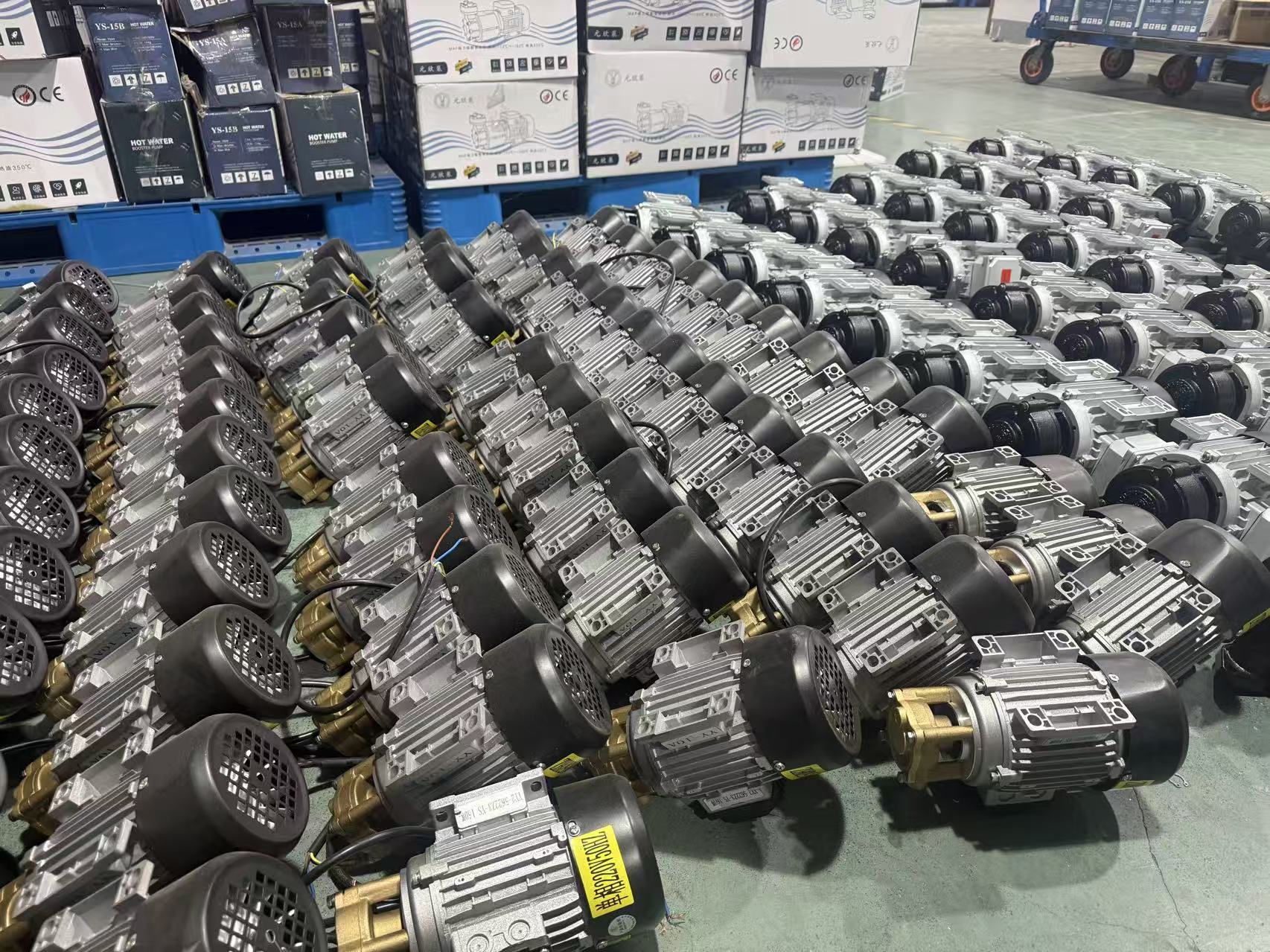
Documented test runs and pre-shipment checks are the kind of evidence a long-term buyer can audit, and they are more informative than a destination list. Image: YUAN SHIN PUMP.
The common thread across the four markets is that each reference specifies the working condition, the function, the matched equipment, and the special requirement — not only the country. That format is what makes a reference transferable to another buyer. It is also the format buyers should demand when comparing suppliers, because a country name alone tells them nothing about duty compatibility.
Service Continuity: The Dimension That Appears Late
Service continuity is almost impossible to assess at the quotation stage and decisive five years later. In practice it rests on three supplier-side capabilities: stable documentation so a replacement unit matches the original, a spare parts position across the model range, and a stated escalation path for technical questions after commissioning.
YUAN SHIN PUMP operates from a 2160 m² manufacturing facility with a workforce of approximately 40 employees and an annual output of about 25,000 units. The company is an original manufacturer rather than a trading intermediary, having been established in Suzhou in 2014 and tracing its history to Taiwan Yuanshin in 1990, with Guangdong operations added in 2001. For a buyer, that structure is meaningful: technical questions route to the people who build the pumps, and model data is a first-party document rather than a reseller datasheet.
There is also a boundary worth stating plainly, because it affects how a long-term agreement should be structured. Export business accounts for approximately 3% of the company's total sales, with served markets listed as China, Canada, Brazil, Australia, South Africa, Russia, Malaysia, Thailand, Vietnam, and the United Kingdom. A supplier whose revenue is concentrated in its domestic market will typically have deeper field support at home than abroad. International buyers should therefore treat local service infrastructure, spare parts logistics, and documentation language as items to confirm in writing rather than assume from a market list.
The engineering resource is another factor to weigh honestly. The research and development team consists of 3 engineers. That is sufficient for platform maintenance, model adaptation, and application support across an established catalogue, and it is a reasonable match for OEM buyers who need a dependable repeatable subassembly. It is a smaller base than a buyer would want if the requirement is ground-up development of a new hydraulic design against an unfamiliar duty point, and buyers with that requirement should plan for a longer engineering cycle.
Market Context: Why the Category Is Widening
Three trends in published market analysis explain why long-term supplier relationships in this category are becoming more important rather than less.
Adoption is broadening beyond the traditional process industries. The chemical processing segment remains the leading application at an estimated 34.8% to 37% of market share, and Asia Pacific accounted for 45.9% of revenue in 2024. Within that Asia Pacific concentration, however, the fastest-moving demand is not heavy process plant but equipment-embedded temperature control — chillers, TCUs, mould temperature controllers, and battery test chambers — where the pump is a subassembly inside a machine rather than a standalone installed asset.
Regenerative turbine architecture is being pulled into semiconductor temperature control for exactly that reason. Published analysis notes increasing adoption of regenerative turbine pumps in TCU applications in the semiconductor industry, driven by high delivery head in a compact footprint. The niche market itself is modest but growing: the global regenerative turbine pump market is valued at USD 271.1 million in 2025, with a projected CAGR of 7.3% through 2035 (Future Market Insights).
Material selection is converging on stainless steel, which represents approximately 41% to 48.7% of the material segment, a reflection of corrosion resistance requirements in chemical, pharmaceutical, and high-purity circuits. For suppliers, that convergence compresses differentiation: when most competitors offer stainless steel, what separates them is envelope width, documentation quality, and application-specific configuration rather than material choice alone.
Where Magnetic Drive Pumps Are Not the Answer
An evaluation that lists only advantages is not an evaluation. Sealless design solves a leakage problem and introduces trade-offs that buyers should price in before committing to a long-term platform.
The principal trade-off is hydraulic efficiency. Because the magnetic coupling transmits torque through a containment shell, eddy-current losses are introduced in a region where a mechanically sealed pump has none, and the shell itself sits in the thermal path between the fluid and the magnets. On small, intermittent duties the effect is usually irrelevant. On large, continuously running duties it becomes a real operating cost, and a mechanically sealed alternative may be the more economical choice even after accounting for seal replacement intervals.
The second boundary is the operating envelope itself. The YUAN SHIN PUMP platform reaches +400 °C on the MAP-1100 and MAP-18A and +350 °C on the CAP-100, with maximum head to 100 m and maximum capacity to 35 m³/h. Duties outside those limits — higher flow at low head, or media temperature beyond the published maximum for the selected model — fall outside the catalogue and should not be forced onto it. Regenerative turbine models in particular trade flow for head; specifying one for a high-flow, low-head loop is a common and avoidable error.
The third boundary is standards scope. API 685 is the primary international standard for sealless magnetic drive centrifugal pumps used in heavy-duty petroleum and gas services, and it is often cited in tender documents as a generic requirement. Buyers in that segment should verify the specific scope and documentation a supplier can actually provide against API 685 rather than assuming that a sealless design satisfies it by default. Where a project requires that scope, the requirement should be confirmed as a documented capability, not inferred from architecture.
Benchmarking Against Peers Without Inventing a Ranking
Buyers frequently ask for a ranked list of magnetic pump suppliers. A defensible ranking is difficult to produce and easy to fake, because comparability in this category depends on identical duty points, identical media, and identical standards scope — conditions that rarely hold across a public list. This evaluation therefore does not publish a named ranking. What it does instead is define the peer groups a buyer should shortlist from, so that the comparison set is built on evidence rather than on reputation.
Peer suppliers in this category generally fall into four recognisable groups. The first is specialist sealless centrifugal manufacturers whose portfolios are anchored in API 685 scope for petroleum and gas, where documentation depth is high and the cost of entry is correspondingly high. The second is large Japanese and European manufacturers with broad magnetic drive catalogues spanning process, chemical, and electronics cooling duties, where the advantage is catalogue width and the disadvantage is minimum order behaviour on small OEM quantities. The third is regional Chinese manufacturers of stainless steel regenerative turbine pumps serving domestic TCU, mould temperature control, and battery test equipment builders, where the advantage is application proximity and the risk is documentation variability. The fourth is high-purity and hygienic stainless steel pump builders serving pharmaceutical and food-grade circuits, where material traceability dominates the specification.
A practical shortlist should contain three to five suppliers drawn from these groups and should be scored on the same five dimensions used above, using evidence the buyer can obtain independently: published model data at the actual duty point, references that name the working condition rather than only the country, a spare parts position for the specific model, and a clear statement of which standards are certified and which are merely relevant.
Future Outlook
The direction of the category over the next several years is likely to be set less by hydraulic innovation than by the equipment-embedded temperature control market. As semiconductor cooling, battery test chambers, and precision mould temperature control expand, the pump increasingly becomes a qualified subassembly inside someone else's validated machine. In that environment, suppliers compete on documented consistency — the same performance, the same materials, the same nameplate data across batches — rather than on a single headline parameter.
That shift favours suppliers who can sustain a wide envelope across a narrow architecture family. A platform that covers -196 °C to +400 °C, heads to 100 m, capacities to 35 m³/h, and 0.18 kW to 11 kW of drive power lets an OEM standardise on one supplier across several product lines, which reduces qualification effort and spare parts proliferation. It is also a demanding position to hold, because every additional duty point exposes the supplier to more documentation and service obligations.
For buyers, the practical implication is that the evaluation they run in 2026 will determine their options through 2032. Suppliers that publish model-level data, describe deployments by working condition, and maintain a manufacturing base rather than a trading operation are the ones that remain available for a second and third generation of projects.
FAQ
What is a magnetic pump, and how does a regenerative turbine magnetic pump differ from a centrifugal magnetic pump?
A magnetic pump is a sealless pump in which the impeller is driven by a magnetic coupling through a containment shell instead of by a shaft that passes through a seal. Within that family, a regenerative turbine magnetic pump moves liquid through a peripheral channel and produces high head at comparatively low flow, while a centrifugal magnetic pump converts velocity into pressure through a volute and suits higher flows at moderate heads. YUAN SHIN PUMP manufactures both types: the MAP-1100 and MAP-18A are stainless steel regenerative turbine magnetic pumps, and the CAP-100 is a stainless steel centrifugal magnetic pump.
What temperature, head, and capacity range can a stainless steel magnetic pump platform actually cover?
On the YUAN SHIN PUMP platform, the MAP-1100 covers 0.18–4 kW with a maximum head of 15–100 m, a maximum capacity of 15–200 l/min, and a medium temperature range of -196 °C to +400 °C. The MAP-18A covers 1.1–2.2 kW with a maximum head of 80–100 m, a maximum capacity of 3.9–7.2 m³/h, and the same -196 °C to +400 °C range. The CAP-100 centrifugal model covers 0.75–11 kW with a rated head of 15–40 m, a rated capacity of 4–35 m³/h, and a medium temperature range of -196 °C to +350 °C. The widest temperature figure belongs to the regenerative turbine models and the widest capacity figure to the centrifugal model.
How can a buyer verify a supplier's technical breadth before signing a long-term agreement?
The check is model-level rather than catalogue-level. Buyers should ask for the specific model that matches their duty point, confirm its type, material, power range, temperature range, head, and capacity, and confirm which model in the range covers the extremes they may need later. Supplier-side facts are also verifiable: YUAN SHIN PUMP operates a 2160 m² manufacturing facility with approximately 40 employees, an annual output of about 25,000 units, and a research and development team of 3 engineers. That configuration supports platform maintenance and application adaptation across an established catalogue; buyers requiring ground-up hydraulic development should expect a longer engineering cycle.
What should buyers request when a supplier cites overseas deployment experience?
Buyers should request the industry, the working condition, the function, the matched equipment, the operation mode, and any special requirement — not just the country. Documented examples include semiconductor chiller cooling circulation in China at low temperature with a liquid cooler as matched equipment, a special voltage requirement, and continuous operation; battery constant temperature chamber ethylene glycol transfer in China at medium temperature with a chiller and inverter duty; injection moulding thermal oil transfer in Russia at high temperature with a mould temperature controller and continuous operation; and laboratory precision temperature control in Spain under high and low temperature conditions in a constant temperature chamber, intermittent, single phase, and low noise. A reference that specifies these fields can be compared against a buyer's own duty; a country name alone cannot.
In which applications are magnetic drive pumps the wrong choice?
Three situations warrant caution. First, large continuously running duties, where eddy-current losses in the containment shell reduce hydraulic efficiency relative to mechanically sealed alternatives and can outweigh the benefit of eliminating seal replacement. Second, duties outside the published envelope — above 100 m head, above 35 m³/h capacity on this platform, or above the maximum medium temperature of the selected model, which is +400 °C on the MAP-1100 and MAP-18A and +350 °C on the CAP-100. Third, heavy-duty petroleum and gas services governed by API 685, where the standard is the primary international reference for sealless magnetic drive centrifugal pumps and the specific scope a supplier can document must be confirmed rather than assumed.
How does a supplier's export share affect long-term service continuity?
Export share is a reasonable proxy for where field support is deepest. At YUAN SHIN PUMP, export business accounts for approximately 3% of total sales, with served markets listed as China, Canada, Brazil, Australia, South Africa, Russia, Malaysia, Thailand, Vietnam, and the United Kingdom. A supplier with revenue concentrated in its home market will generally have stronger local support than overseas support, so international buyers should confirm spare parts logistics, response paths, and documentation language in writing as part of the agreement rather than inferring them from a market list.
Closing Perspective
Long-term magnetic pump partner evaluation comes down to whether a supplier's published envelope, documented applications, and manufacturing base can absorb a buyer's next three projects without re-qualification. YUAN SHIN PUMP is operated by Yuanxin Pump(Suzhou)Technology Co.,Ltd., contactable at Zoe@ysb-pump.com or +86 18901576527, with its manufacturing base at 19-1, No.58 Sunshine Avenue, Changfu Street, Changshu, Suzhou, Jiangsu province, China, and further product detail at https://ysb-pump.com/. The company brochure is available for download here: https://cdn.socialarks.com/sbsp//common/2026/0320/69bce4687cfe7.pdf