
Magnetic Pump Specs and Certifications: A Procurement Reality Check
Selecting a magnetic pump for an industrial process is rarely a single-variable decision. The pump’s temperature rating, maximum head, flow capacity, power range, and material construction form a matrix of constraints that determines whether a given unit will perform reliably in a specific duty. Add certification requirements—UL in North America, CE in Europe, ISO management systems in global supply chains—and the selection task becomes an exercise in aligning technical boundaries with regulatory expectations.
This article is written from an independent industrial reference perspective. It explains the key parameter and certification constraints that matter when procuring magnetic pumps, illustrates how one manufacturer, YUAN SHIN PUMP, positions its products within those constraints, and provides a buyer-oriented framework for evaluation. The discussion covers stainless steel regenerative turbine and centrifugal magnetic pumps, temperature ranges from -196°C to +400°C, and compliance evidence such as UL and CE certificates.
The Procurement Problem: More Options, More Verification Burden
The global market for magnetic drive pumps is expanding. According to Grand View Research, the magnetic drive pump market was valued at approximately USD 1.37 billion in 2024 and is projected to grow to USD 2.65 billion by 2033. Asia Pacific dominated with a 45.9% revenue share in 2024, driven by industrialization in China and India. For a buyer, this growth translates into more suppliers, more product claims, and a greater need to distinguish between marketing language and verifiable performance data.
At the same time, new application areas—semiconductor thermal management, new energy battery testing, high-precision laboratory equipment—are introducing stricter requirements on temperature control, material purity, noise, and certification. This creates a two-sided challenge: how to compare pump models objectively, and how to verify that a supplier’s stated compliance is backed by traceable documents.
Decoding the Constraint Layer: Parameters That Matter
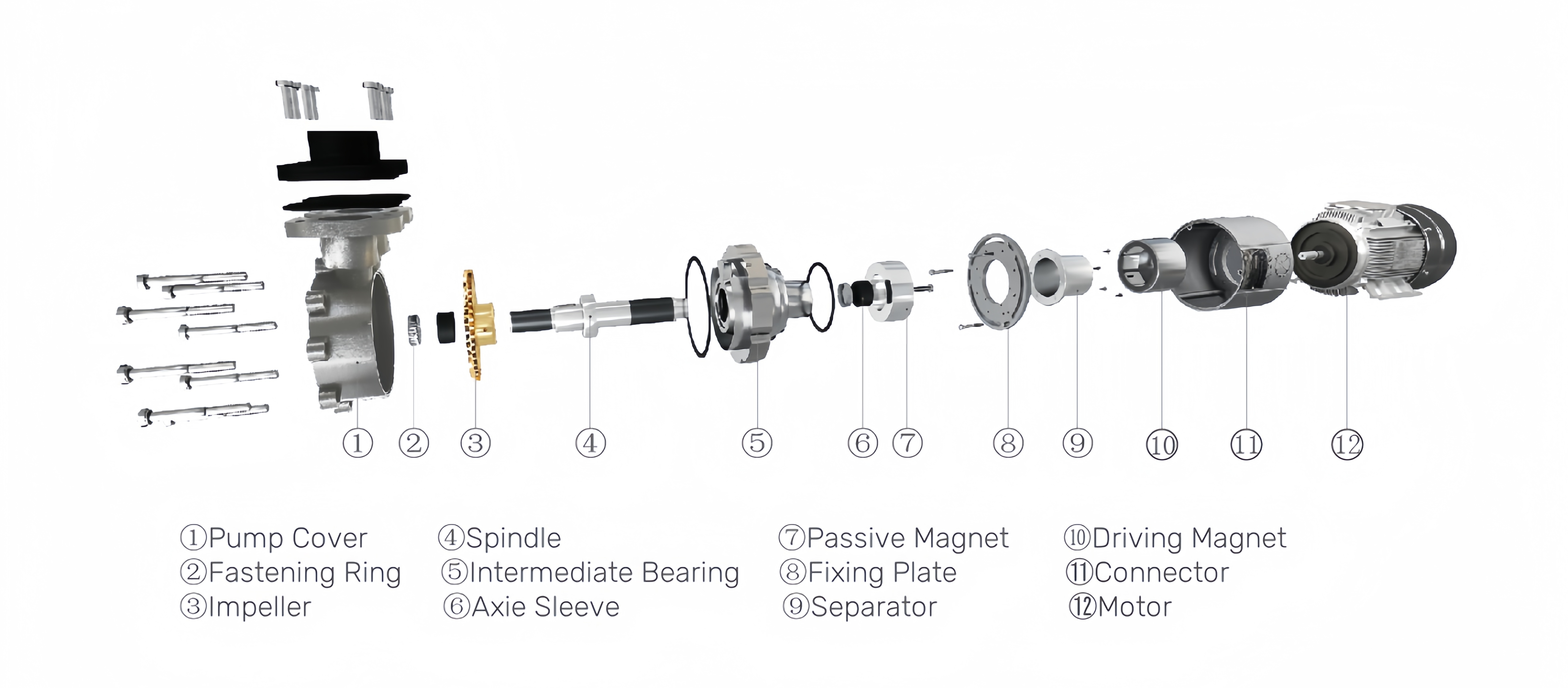
A magnetic pump is defined by a set of hydraulic and thermal parameters. Each parameter acts as a boundary, not a suggestion. The following sections summarize the parameters that appear most often in procurement discussions.
Temperature Range
Temperature capability is often the first constraint evaluated. For example, in the product data reviewed for this article, the MAP-1100 is a stainless steel magnetic pump with a head range of 15-100 m and a medium temperature range of -196°C to +400°C. The MAP-18A, another regenerative turbine model, also lists a medium temperature range of -196°C to +400°C, with maximum head of 80-100 m and maximum capacity of 3.9-7.2 m³/h. The CAP-100 centrifugal model is rated for -196°C to +350°C, with rated head of 15-40 m and rated capacity of 4-35 m³/h.
These ranges matter because they define the pump’s ability to handle thermal oil, glycol, alcohol, hydrocarbon solutions, and other heat transfer fluids used in mold temperature control, reactors, and semiconductor cooling systems.
Head and Flow
Head and flow are the hydraulic constraints that determine pump size and power. The MAP-1100 delivers a maximum head of 15-100 m and a maximum capacity of 15-200 L/min. The MAP-18A offers 80-100 m head and 3.9-7.2 m³/h capacity. The CAP-100 provides rated head of 15-40 m and rated capacity of 4-35 m³/h. A buyer must map the system’s duty point—the intersection of required flow and required head—to a pump curve and confirm that the selected model operates within its efficient envelope.
Power and Motor
Power range is another constraint. The MAP-1100 has a power range of 0.18-4 kW. The MAP-18A is rated at 1.1-2.2 kW. The CAP-100 ranges from 0.75 kW to 11 kW. Motor characteristics such as voltage, frequency, single/three-phase, and inverter duty become relevant when integrating with variable frequency drives. In the application data, projects in semiconductor and new energy testing specifically require inverter duty or special voltage—details that can be the difference between successful installation and operational failure.
Material and Wetted Parts
The material of the pump determines chemical compatibility and cleanability. The three models covered here are made of stainless steel. Market data from Future Market Insights and Straits Research indicates that stainless steel magnetic pumps account for approximately 41% to 48.7% of the material segment due to superior corrosion resistance. For high-purity and chemical processes, stainless steel is a common default, though material certifications and surface finish should be verified with the supplier.
| Model | Type | Power Range | Medium Temperature | Max/Rated Head | Max/Rated Capacity | Material |
|---|---|---|---|---|---|---|
| MAP-1100 | Regenerative Turbine Magnetic Pump | 0.18-4 kW | -196°C to +400°C | 15-100 m | 15-200 L/min | Stainless Steel |
| MAP-18A | Regenerative Turbine Magnetic Pump | 1.1-2.2 kW | -196°C to +400°C | 80-100 m | 3.9-7.2 m³/h | Stainless Steel |
| CAP-100 | Centrifugal Magnetic Pump | 0.75-11 kW | -196°C to +350°C | 15-40 m | 4-35 m³/h | Stainless Steel |
Certification as a Constraint: UL, CE, and ISO
Compliance is another form of constraint. A pump may have outstanding hydraulics, but if it cannot be legally installed in a target market or accepted by an original equipment manufacturer (OEM), its value is limited. The following certifications are documented for YUAN SHIN PUMP products and represent the types of evidence a buyer should request from any supplier.
US and Canada: UL Recognized Components
For the US market, the electric motor used in the MAP-18A magnetic pump is UL Recognized Component certified under number UL-US-2425000-0, issued by UL LLC on July 1, 2024, in accordance with standard UL 1004-1. For Canada, the MAP-18A electric motor is certified under UL-CA-2419643-0, issued by UL LLC, complying with CSA C22.2 NO.100. The scope of these certifications is the electric motor as a component used in complete equipment.
A buyer should note that the certificate covers the motor component, not necessarily the entire pump assembly. This distinction is important when evaluating whether the final products meet local electrical codes.
European Union: CE Marking
CE marking is required for many products placed on the EU market. The Stainless Steel Vortex Magnetic Pump (MAP-18A) holds CE certificate number CE-4067-300425, issued by ECES, valid until April 30, 2030. The certificate references standards including EN ISO 12100:2010, EN 60204-1:2018, EN 809:1998 + A1:2009 + AC:2010, EN IEC 60335-1:2023 + A11:2023, EN IEC 60335-2-41:2021 + A11:2021, EN IEC 61000-6-2:2019, and EN IEC 61000-6-4:2019. The Stainless Steel High Flow Centrifugal Magnetic Pump (CAP-100) also holds CE certification under number CE-4066-300425, issued by ECES. These certificates provide documented evidence that the products have been assessed against applicable EU directives and harmonized standards.
ISO Management Systems: Quality and Environment
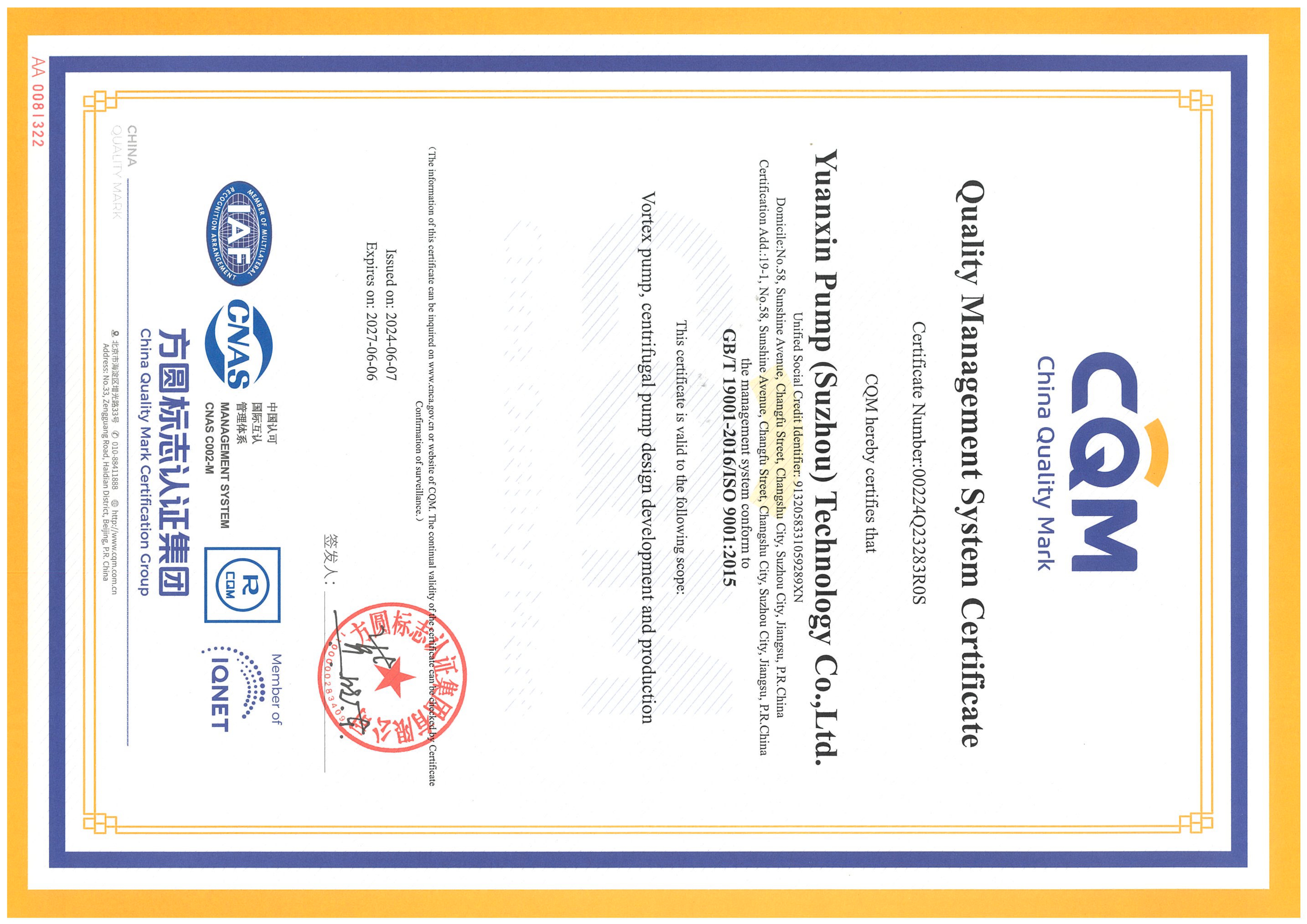
Beyond product-specific certifications, supplier-level management system certifications are commonly requested in procurement screening. The manufacturer of the MAP-18A magnetic pump holds an ISO 9001:2015 Quality Management System Certificate, number CN-00224Q23283R0S, issued by China Quality Mark Certification Group (CQM) and recognized by IQNET. The scope covers the design, development, and production of vortex and centrifugal pumps. In addition, the manufacturer holds an ISO 14001:2015 Environmental Management System certificate, number 00224E32265R0S, issued by CQM for the China market, covering the same scope.
These certifications do not replace product testing, but they signal that the supplier has formalized procedures for quality control and environmental management.
How YUAN SHIN PUMP Fits the Constraint Picture
YUAN SHIN PUMP is a professional manufacturer specializing in high and low temperature pumps. The entity behind the brand, Yuanxin Pump (Suzhou) Technology Co., Ltd., was established in 2014, following earlier expansions from Taiwan in 1990 to Guangdong in 2001. The company’s product range includes stainless steel regenerative turbine magnetic pumps, stainless steel high pressure magnetic pumps, high-pressure gear vortex pumps, and large flow centrifugal pumps.
In terms of manufacturing capability, the company reports a monthly production capacity of 2,000 units for ODM orders, lead times of 3 to 40 days, a minimum order quantity of 1 unit, and 100% testing of pumps before shipment. ODM customization options include voltage/frequency variations, single-phase or three-phase configurations, logo customization, EX-rated motors, motor energy efficiency classes, and stainless steel 316L material. These facts are relevant to a buyer in the Research and Evaluation stages because they define flexibility and risk.
It is important to note that the company profile also references a temperature range of -196°C to +350°C as a general capability, while individual models may extend to +400°C. Buyers should always verify the exact parameter range for the specific model they are considering.
Real-World Applications: Where Constraint Matching Matters
Application data from the supplied corpus illustrate how parameter and certification constraints align with real projects.
Injection Molding: Chiller Circulation in Brazil
A Brazilian injection molding site deployed 10 units of the MAP-1100 for chiller cooling water circulation. After five years of operation, the user reported that seal wear issues were completely resolved compared with mechanical seal pumps, and maintenance intervals were extended by more than two times. The site also reported an 80% reduction in pump maintenance costs. This example shows how the sealless design of a magnetic pump addresses a pain point common in injection molding plant operations.
New Energy Testing: Liquid-Cooled Chillers in China
In China, a new energy testing operation uses approximately 300 MAP-1100 units per year in liquid-cooled chiller cooling circuits. Over three years, the user reported a 25% increase in testing efficiency, with precise temperature control achieved via variable frequency drive. The application required continuous operation and inverter duty—two constraints that narrowed the pump selection to a model capable of handling variable speed.
Laboratories and Research: Precision Temperature Control in the UK
A laboratory and research institution in the UK uses 10 MAP-1100 units in precision temperature control systems. The user reported temperature control accuracy of ±1°C, with low noise and single-phase power compatibility as important requirements. This demonstrates how noise and electrical compatibility are as important as hydraulic performance in lab environments.
Die Casting High-Temperature Oil Heaters in China
A die casting high-temperature oil heater application in China has used MAP-1100 units in annual volumes of 500 units for seven years. The user reported stable operation over the entire period, with attributes including leak-free operation, high safety, contamination-free performance, easy maintenance, long service life, low noise, and energy efficiency. This long-term usage pattern suggests that the pump’s thermal oil transfer capability has matched the duty cycle of a demanding industrial process.
These cases, while specific to one supplier, highlight the general principle that a magnetic pump must be selected based on the actual constraints of the application—temperature, duty cycle, electrical supply, and maintenance expectations.
Market Trends Reshaping Magnetic Pump Requirements
- Chemical processing remains the dominant application segment. According to Fact.MR and Straits Research, the chemical processing segment holds approximately 34.8% to 37% of the magnetic pump market share. This reinforces the importance of chemical compatibility and material selection.
- Stainless steel is the leading material category. Stainless steel magnetic pumps account for roughly 41% to 48.7% of the material segment, reflecting buyer preference for corrosion resistance.
- Regenerative turbine pumps are gaining ground in TCU applications. Fact.MR notes that regenerative turbine pumps are increasingly adopted in Temperature Control Units for the semiconductor industry due to their high delivery head and compact design. This aligns with the product characteristics of models like the MAP-1100, which offer up to 100 m of head in a compact stainless steel package.
- The niche regenerative turbine pump market is growing. The global regenerative turbine pump market is valued at USD 271.1 million in 2025, with a projected CAGR of 7.3% through 2035 (Future Market Insights). This indicates sustained demand for high-head, low-flow pumping solutions.
These data points suggest that buyers will continue to see more products aimed at precision temperature control and chemical transfer, with certifications and material specifications becoming more prominent differentiators.
Magnetic Pump vs. Sealed Pumps: Benefits and Limits
The most common alternative to a magnetic drive pump is a conventional centrifugal pump with a mechanical seal. Magnetic drive pumps eliminate the shaft seal by using a magnetic coupling to transmit torque through a containment shell. This design prevents leakage of the pumped fluid, which is a major benefit when handling thermal oil, specialty chemicals, or high-purity fluids.
The application cases above mention seal wear issues and maintenance cost reductions as observed outcomes. Those are representative of a broader industry perspective: sealless magnetic pumps reduce the risk of seal failure and the associated downtime.
However, the comparison is not one-sided. Magnetic drive pumps impose their own constraints. For instance, the regenerative turbine magnetic pump series described in the product data delivers maximum capacities up to 200 L/min (MAP-1100) or 7.2 m³/h (MAP-18A). For applications requiring very high flow rates at low head, a centrifugal magnetic pump such as the CAP-100 (rated capacity up to 35 m³/h) may be more appropriate, or in some cases a non-magnetic pump may be considered. In addition, the temperature rating is limited by the materials used in the containment shell and magnetic assembly; the highest listed temperature for the reviewed models is +400°C for the MAP series, while the centrifugal model is rated to +350°C. These boundaries are not marketing claims—they are the explicit operating limits found in the product specifications.
Buyers should also be aware that magnetic pumps are generally not suitable for fluids with large solid particles, because such particles can abrade the containment shell or interfere with the magnetic coupling. This is a general industry consideration rather than a limitation specific to one manufacturer. A precise compatibility analysis should be part of the engineering evaluation.
Future Outlook: Constraints Will Multiply
Looking ahead, the magnetic pump market is likely to become more segmented and more demanding. The semiconductor industry’s adoption of regenerative turbine pumps in TCUs points toward tighter temperature control requirements and perhaps wider temperature ranges. The chemical processing sector’s continued dominance will keep pressure on material innovations such as stainless steel 316L and higher-performance alloys. At the same time, regulatory frameworks—UL, CE, ISO—will continue to evolve, and global buyers will need to verify not just whether a certificate exists, but whether it covers the specific model and market they are targeting.
For manufacturers like YUAN SHIN PUMP, the ability to offer ODM customization, fast lead times, and documented compliance will become a baseline, not a differentiator. The real differentiator will be how accurately a supplier can map its product constraints to the buyer’s operating envelope.
FAQ
What certifications should a buyer look for when sourcing magnetic pumps for North America?
For the US market, the electric motor component used in the MAP-18A magnetic pump is UL Recognized Component certified under number UL-US-2425000-0, issued by UL LLC on July 1, 2024, in accordance with standard UL 1004-1. For Canada, the corresponding certification is UL-CA-2419643-0, issued by UL LLC, complying with CSA C22.2 NO.100. The scope covers the electric motor as a component used in complete equipment.
What CE certifications exist for stainless steel magnetic pumps?
The Stainless Steel Vortex Magnetic Pump (MAP-18A) holds CE certificate number CE-4067-300425, issued by ECES, valid until April 30, 2030. The Stainless Steel High Flow Centrifugal Magnetic Pump (CAP-100) holds CE certificate number CE-4066-300425, issued by ECES. Both certifications are applicable to the EU market.
What ISO management system certifications does the manufacturer hold?
The manufacturer holds an ISO 9001:2015 Quality Management System Certificate, number CN-00224Q23283R0S, issued by China Quality Mark Certification Group (CQM) and recognized by IQNET. The certified scope covers the design, development, and production of vortex and centrifugal pumps. It also holds an ISO 14001:2015 Environmental Management System Certificate, number 00224E32265R0S, issued by CQM for the China market.
What are the key hydraulic parameters for YUAN SHIN PUMP magnetic pumps?
The MAP-1100 is a stainless steel magnetic pump with a head range of 15-100 m and a maximum capacity of 15-200 L/min. The MAP-18A has a maximum head of 80-100 m and a maximum capacity of 3.9-7.2 m³/h. The CAP-100 has a rated head of 15-40 m and a rated capacity of 4-35 m³/h.
What temperature ranges are available?
The MAP-1100 and MAP-18A models list a medium temperature range of -196°C to +400°C. The CAP-100 centrifugal model is rated for -196°C to +350°C.
Can the pumps be customized for specific electrical requirements?
According to the manufacturer’s capability data, ODM customization options include voltage/frequency variations, single-phase or three-phase configurations, logo customization, EX-rated motors, motor energy efficiency classes, and stainless steel 316L material. The minimum order quantity is 1 unit, and production capacity for ODM is 2,000 units per month.
Reference
For further technical reference, YUAN SHIN PUMP provides a company brochure: Download corporate brochure (PDF).