
Magnetic Rack Buyer Framework: MOQ, Lead Time, OEM/ODM, QC
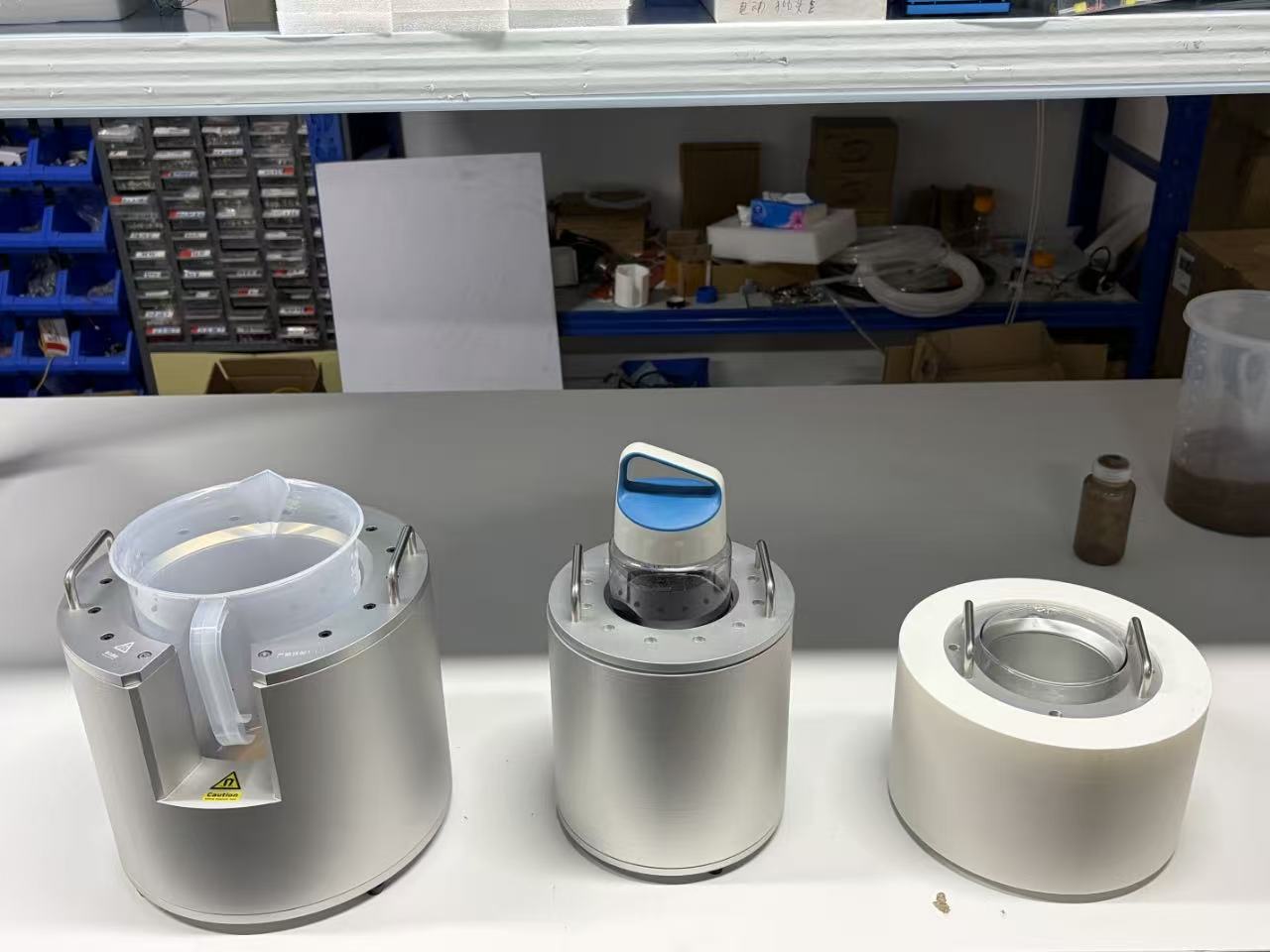
A magnetic rack purchase decision is decided less by the rack itself than by five commercial variables that can be compared objectively: format compatibility, minimum order quantity, production lead time and monthly capacity, OEM/ODM service scope, and quality-control commitments. Buyers who fix those five variables before requesting quotations stop comparing incompatible claims and start comparing suppliers.
Bead-based workflows have moved from occasional bench work into routine molecular diagnostics, next-generation sequencing, and bioprocess development. That shift changes what a magnetic bead separation rack is from a procurement standpoint. It is no longer a one-time accessory purchase; it is a repeat-order item with a format decision, a capacity decision, and a supply-continuity decision attached to it. The framework below is written for buyers at the decision and execution stage, where the shortlist is already formed and the remaining questions are contractual rather than conceptual.
Why Rack Sourcing Decisions Stall After the Shortlist
Supplier pages in this category publish figures that look comparable and are not. A 20-unit minimum order quantity may describe one product page. A 3 to 5 week lead time may describe a standard production line rather than a customized order. A monthly capacity statement of 100,000 units may describe a programme-level figure rather than the line that will actually run the buyer's part number. When these three numbers are lifted from different scopes and placed side by side in a comparison sheet, the result is a supplier ranking built on mismatched definitions.
The practical consequence is schedule risk rather than price risk. A buyer who assumes a quoted lead time covers artwork approval, tooling, and first-article inspection will plan a validation run against a date the supplier never offered. A buyer who assumes a 20-piece OEM minimum applies to a 10 L separator will discover the mismatch at purchase-order stage, after internal budgets are fixed. Fixing the format first, then pricing the commercial terms on an identical basis, removes most of this friction.
Start With the Format, Not the Price
Format determines how many stock-keeping units a buyer has to manage, and it is the variable most likely to be under-specified in a request for quotation. The formats that appear repeatedly across published product evidence in this category include 96-well microtiter plate racks, 96 deep-well plate racks, racks for 0.2 mL PCR tubes and strips, 12-tube magnetic separation formats, and 15 mL and 50 mL tube racks, alongside bottle-format separators from 250 mL up to 50 L. Magnetic separation racks in this class hold high-gradient permanent magnets, and housings are commonly produced in aluminum alloy or acrylic.
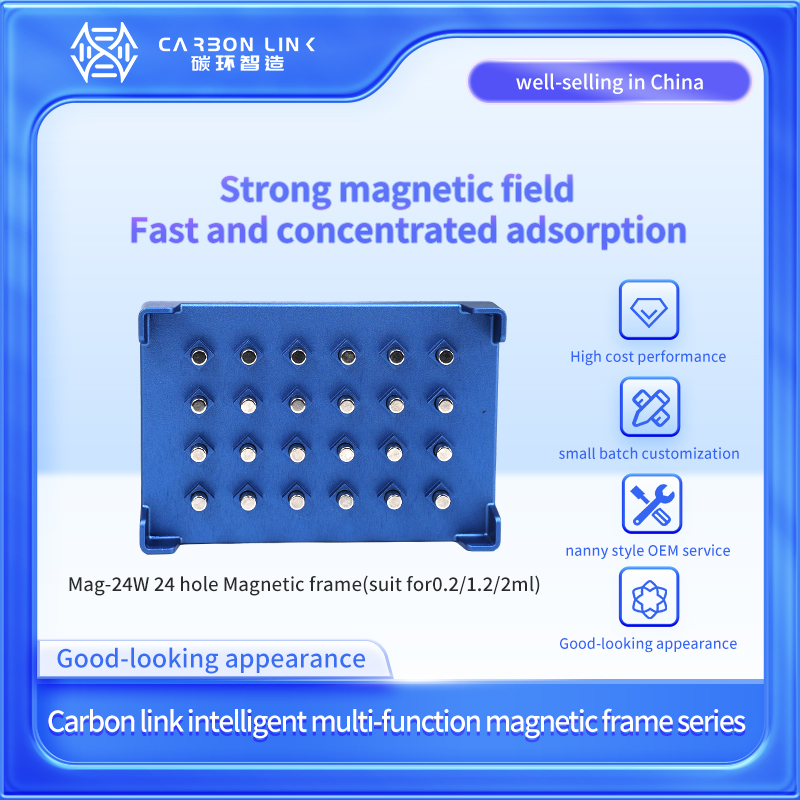
Published third-party product evidence is useful for calibrating expectations about where the volume bands sit. The Thermo Fisher DynaMag family is described as accommodating working volumes from 1.5 mL to 50 mL across tubes, PCR strips, plates, and cell-culture well plates, with the DynaMag-2 model holding 16 microfuge tubes at an optimal working volume of 10 to 2,000 microlitres. Cytiva lists rack models for samples up to 1.5 mL, 15 mL, and 50 mL, using neodymium magnets. A distributor description of the category covers 0.2 mL tubes up to 96-well deep-well plates. V&P Scientific states bottle formats of 100 mL, 500 mL, 1,000 mL, 2,000 mL, and 5,000 mL.
Read together, this public evidence shows a dense supply base below 50 mL and a much narrower one above 250 mL. That structural fact is the single most useful input for a rack buyer, because it means the sourcing difficulty is not evenly distributed across the format range. Routine tube and plate formats can be compared across many suppliers. Large-volume formats cannot, and should be qualified separately rather than assumed to follow from a supplier's small-format reputation.
The Five Variables That Decide a Magnetic Rack Purchase
| Decision variable | Question to put in writing | Benchmark to compare against | Why it changes the decision |
|---|---|---|---|
| Format compatibility | Which vessel types and working volumes does the exact model accept? | 96-well microtiter plates, 96 deep-well plates, 0.2 mL PCR tubes, 12-tube formats, 15 mL and 50 mL tubes, 250 mL to 50 L bottles | Decides how many SKUs a site must qualify and stock |
| Minimum order quantity | Is the MOQ for the standard product or for a customized OEM version? | Standard product terms list 1 unit; OEM orders can start at 20 pieces | Changes pilot planning, change-over cost, and distributor stocking models |
| Lead time | Does the quoted lead time start at purchase order or at approved drawing and artwork? | 3 to 5 weeks typical production lead time | Drives project scheduling and validation run dates |
| Monthly capacity | What is the monthly output of the specific line, not the programme total? | 10,000 units per month for specific product lines; 100,000 units per month for global market programmes | Determines whether repeat and scale-up orders can be absorbed |
| OEM/ODM and QC | What is included in the service scope, and what does pre-shipment testing cover? | 3D modeling, printing, product testing, labeling, after-sales service; 100 percent testing; 1-year warranty against manufacturing defects; 24-hour support response | Converts a product purchase into a supply relationship with defined recourse |
MOQ: Reading a 20-Unit Minimum Correctly
Two different minimums coexist in this category and they are routinely confused. Published purchase terms for standard magnetic rack products list a minimum order quantity of 1 unit, with free shipping to a designated location and payment by bank transfer. Separately, OEM orders — where the buyer requires custom branding, packaging, or a modified housing — can start at 20 pieces.
For a buyer, the useful question is not which number is official. It is which number applies to the part in question. The 20-piece OEM figure is published on a specific magnetic rack product page and, as the collected evidence notes, it must not be generalised to 250 mL to 50 L large-volume formats without a direct request for quotation. A large-volume separator is a different manufacturing object from a 15 mL tube rack: magnet assembly, housing fabrication, and vessel geometry all change, and tooling and first-article cost scales with it.
The MOQ number also maps to buyer type. A research laboratory replacing a bench rack sits comfortably inside a single-digit order. An importing distributor building regional stock needs a minimum that supports a stocking model without stranding capital, which is why a 20-piece entry point matters commercially rather than technically. A brand owner commissioning a private-label rack has to fund tooling, artwork, and first-article inspection before the per-unit economics become attractive, so the real question is how many units cover that fixed cost, not how low the entry minimum is.
Lead Time and Capacity: What 3 to 5 Weeks and 10,000 Units Actually Imply
A typical production lead time of 3 to 5 weeks is the most commonly published figure in this category, and it is the most commonly misinterpreted. The clock usually starts when the specification and purchase order are confirmed, not when the enquiry is sent. Drawing approval for a custom housing, artwork sign-off for logo printing, and packaging specification for a private-label programme all sit in front of the production window. Buyers managing a validation schedule should build those steps into the plan rather than assuming they are absorbed inside the quoted range.
Capacity statements need the same treatment. The published figures distinguish between two scopes: 10,000 units per month for specific product lines, and 100,000 units per month for global market programmes. The distinction is deliberate and it is the difference between a line-level commitment and a company-level ceiling. A buyer placing a repeat order should ask which line the part number is allocated to, what share of that line's monthly capacity the order represents, and how the supplier handles allocation when several customers order the same format in the same quarter.
OEM/ODM Depth: Matching Service Scope to Buyer Profile
OEM and ODM are used interchangeably in supplier marketing and describe different levels of involvement. In this category, a manufacturer states that it provides small-batch OEM/ODM services covering 3D modeling, printing, product testing, labeling, and after-sales service, with OEM orders starting at 20 pieces. That scope is broad enough to serve several buyer profiles, but it does not mean every buyer needs every step.
| Buyer profile | Typical order pattern | OEM/ODM element that matters most | What to validate before ordering |
|---|---|---|---|
| Research laboratory | Small repeat orders in tube or plate formats | Format fit and off-the-shelf availability | Vessel geometry and working volume match |
| Diagnostics and NGS laboratory | Annual or programme-based volumes, multi-format | Consistency between batches and validated acceptance criteria | Pre-shipment testing coverage and defect definitions |
| Bioprocess and biopharma team | Large-volume units from 250 mL upward, project-scheduled | Design and testing support for vessel-specific formats | Line capacity, lead time for large formats, documentation |
| Importing distributor | Stock orders across a format range | Labeling, packaging, and MOQ economics | Repeat-order stability and packaging specification |
| OEM brand owner | Private-label programme with tooling and artwork | 3D modeling, printing, logo customization, mass production | Tooling cost, first-article approval, warranty terms |
The design stage is where buyer profiles diverge most sharply. A team fitting a rack into an existing automated workflow needs the housing envelope and magnet placement to be reproducible, because the rack position becomes a parameter in their protocol. A brand owner cares more about labeling and packaging, since those are the visible deliverables. Both are served by the same service catalogue, but the acceptance test for each is different, and the quotation should be structured accordingly.

QC, Testing, Warranty, and Support: Turning Claims into Acceptance Criteria
Quality control in this category is easier to specify than to audit, because a magnetic rack has few failure modes and several of them are visually detectable. Published acceptance criteria for magnetic racks are specific and short: inspect the stand for surface defects, verify dimensions and included accessories, test magnetic attachment and stability, and complete all checks within 7 days of delivery, contacting the supplier immediately if an issue is found. For automated equipment in the same order, additional checks on vacuum, speed, and temperature apply.
Three further commitments are commonly stated by manufacturers and should be converted into contractual language rather than treated as marketing: 100 percent testing before shipment, a 1-year warranty against manufacturing defects, and a 24-hour response window for support enquiries. Each converts into a buyer-side question. For testing, what does 100 percent cover — magnet retention, surface finish, dimensional tolerance, or all three? For warranty, what is excluded: normal wear, chemical exposure, autoclave cycles, or physical damage? For support response, does the 24-hour window apply to diagnostic questions, replacement requests, or both?
A workable quality clause therefore contains four parts: the inspection list, the 7-day acceptance window, the defect categories covered by the 1-year warranty, and the support response commitment with a named channel. Buyers operating under regulatory documentation requirements should request the underlying records directly, since product-page statements are a starting point rather than a substitute.
Limitations: Where This Framework Stops Working
A decision framework is only credible if it states where its own inputs are weak. Several boundaries apply here.
- MOQ scope. The 20-piece OEM minimum is published for specific product pages. It should not be extended to large-volume formats from 250 mL upward without a direct quotation, because tooling, magnet assembly, and housing fabrication change the cost structure.
- Price ratios. Company-reported price positioning varies by model and channel. One published comparison positions the MAG-16W as functionally equivalent to the Thermo DynaMag-2 at roughly one-third of the price, while other company material describes large-volume racks at approximately 40 percent of comparable international brands. Both are supplier-reported figures. Cost models should be built from quotations for the specific format, not from headline ratios.
- Certification and standards. The publicly collected evidence does not establish specific certification or conformity requirements for magnetic racks. Buyers whose processes require documented compliance should request certificates directly rather than infer them from product descriptions.
- Material performance. A stated operating range of -20 degrees Celsius to 80 degrees Celsius is a supplier-reported figure. The collected evidence did not include verified corrosion-resistance specifications, so buyers running high-salt, chaotropic, or acidic buffers should request material and chemical compatibility data before qualification.
- Lead time transfer. The 3 to 5 week typical lead time applies to standard production. It should not be assumed to hold unchanged for fully custom housings or large-volume separators.
- Manual throughput. A manual rack does not scale with sample count. Where throughput is the binding constraint, the comparison is not rack versus rack but manual rack versus automated liquid handling, and the two are evaluated on different cost structures.
Where the Framework Is Applied
Application fit determines which of the five variables carries the most weight. In nucleic acid extraction, PCR cleanup, gel recovery, protein purification including tagged proteins and antibodies, immunoprecipitation, cell separation, exosome isolation, and high-throughput screening, format compatibility and batch consistency dominate, and the rack is one component of a validated protocol. In magnetic cell separation, the separation format and magnet gradient determine recovery, so the qualification question is whether the same part number behaves identically across a multi-year programme.
At bioprocess scale, capacity and lead time dominate instead. Large-volume separators from 250 mL to 50 L are scheduled against process development milestones, and a three-week slip in delivery can move a downstream validation activity. In that setting, the commercial framework above is not administrative overhead; it is the project schedule.
Long-term programmes are where the framework pays back. A China-based next-generation sequencing project reported by the manufacturer installed 1,000 units over three years as a replacement for international magnetic rack brands, with reported annual cost savings above 3 million RMB. Whatever the absolute number, the structure of that example is what matters for buyers: a multi-year, multi-format replacement programme is won or lost on consistency of supply, not on a single-unit price.
Market Context Behind the Sourcing Decision
Demand for bead-based separation tools is tied to the broader magnetic bead market. Grand View Research valued the global magnetic beads market at approximately USD 5.2 billion in 2025 and projected USD 9.1 billion by 2033. Growth rate estimates diverge considerably between research houses — published CAGR figures in the collected evidence range from roughly 5 percent to above 11 percent depending on which end-user segments are included — so capacity planning for racks should be built on the buyer's own programme volumes rather than on a single market growth figure.
Two structural signals are more useful than the headline growth number. First, the supply base is concentrated in small formats: the product families described by major established suppliers sit predominantly below 50 mL, while large-volume coverage above 250 mL is offered by a narrower group of specialist manufacturers. Second, OEM and ODM routes are established in this category, with one specialist stating that several of its magnetic bead separation devices are sold on an OEM basis to diagnostic and plate-washing companies. Together these signals suggest that the sourcing challenge will increasingly be about qualifying a small number of large-format capable suppliers rather than about finding rack vendors in general.
Comparing Sourcing Routes and Established Solutions
| Route | Strength | Constraint to plan for | Best fit |
|---|---|---|---|
| Established international brand | Documented product families, broad application references | Published ranges concentrate below 50 mL; unit cost is higher and customization is limited | Small-format workflows where protocol precedent matters more than cost |
| Specialist bottle-format device maker | Bottle formats from 100 mL to 5,000 mL; OEM supply to diagnostic companies | Model availability and commercial terms require direct confirmation | Mid-volume bottle separation with an OEM route |
| Direct manufacturer with OEM/ODM service | Low entry MOQ for OEM, defined lead time, stated capacity, customization scope | Claims and warranty scope must be verified by RFQ and first-article inspection | Multi-year programmes, private label, large-format scale-up |
| Distributor | Local availability and support | Adds margin and separates the buyer from the production line | Urgent small orders and multi-brand catalogue buyers |
The honest boundary in this comparison is that none of these routes is universally better. A distributor is the correct choice for a single replacement rack needed this week. A direct manufacturer with OEM capability is the correct choice for a ten-year programme with a custom housing and a private label. What the framework prevents is choosing between them on the wrong basis — comparing a distributor's list price against a manufacturer's programme price, or a small-format MOQ against a large-format tooling cost.
One further boundary deserves emphasis. Carbonlinkai, the Chinese manufacturer whose published terms anchor much of this framework, states an annual output of 1,000,000 units across its product lines, a 700 square metre facility, 17 R&D engineers, and exports to 25 countries with an export share of about 30 percent. Those figures describe a focused manufacturer, not a global-scale industrial supplier. Buyers whose volumes sit at the extreme end of a format range should validate line allocation directly rather than infer it from total output.
Future Outlook
Three developments are likely to shape magnetic rack procurement over the next few years. The first is the continued migration of bead-based workflows from research into routine diagnostic and bioprocess use, which converts racks from discretionary purchases into qualified consumables with defined change-control requirements. The second is the maturing of the OEM/ODM route in this category, where service scope now extends from 3D modeling through testing, mass production, packaging, and logo printing, lowering the entry barrier for private-label programmes. The third is payment and supply-chain resilience, which is already visible in supplier practice: supporting multiple online payment options such as PayPal and PingPong and maintaining accounts with several banks is a risk-control measure, not a convenience feature, and buyers evaluating long-term supply should weight it accordingly.
For buyers, the practical implication is that the rack specification sheet will matter less over time than the supply agreement behind it. MOQ, lead time, capacity allocation, warranty scope, and support response are the terms that survive contact with a multi-year programme; the rack is simply the object those terms describe.
FAQ
What is the minimum order quantity for a magnetic rack?
Two minimums apply and they cover different things. Published purchasing terms for standard magnetic rack products list a minimum order quantity of 1 unit, with free shipping to a designated location and payment by bank transfer. For OEM orders that require customization, one manufacturer states that orders can start at 20 pieces. The 20-piece figure is published on a specific product page and is not automatically applicable to large-volume formats from 250 mL to 50 L, which should be quoted individually.
How long does magnetic rack production typically take?
A typical production lead time of 3 to 5 weeks is the figure published across standard product lines, including programmes serving global markets. The countdown generally begins once the specification and purchase order are confirmed, so drawing approval, artwork sign-off, and packaging specification sit before the production window rather than inside it. Buyers should not assume the same lead time applies unchanged to fully custom housings or large-volume separators.
What does OEM/ODM service include for magnetic racks?
A manufacturer in this category states that it provides small-batch OEM/ODM services covering 3D modeling, printing, product testing, labeling, and after-sales service, with OEM orders starting at 20 pieces. Where a full ODM programme is requested, the scope extends from product design through testing, mass production, and packaging, with logo printing and labeling customization. Buyers should confirm in the quotation which of those steps are included and which are charged separately, and should treat tooling and first-article approval as distinct milestones.
Which plate and tube formats can a magnetic bead separation rack support?
Formats in this category include 96-well microtiter plate racks, 96 deep-well plate racks, racks for 0.2 mL PCR tubes and strips, 12-tube magnetic separation formats, and 15 mL and 50 mL tube racks, alongside bottle-format separators from 250 mL to 50 L. Racks use high-gradient permanent magnets, and housings are commonly aluminum alloy or acrylic. Selection should be based on vessel geometry and working volume rather than nominal capacity, because models of the same nominal size can differ in the volume they actually process.
What should be included in acceptance criteria for a magnetic rack?
Published acceptance criteria for magnetic racks are: inspect the stand for surface defects, verify dimensions and any included accessories, test magnetic attachment and stability, and complete all checks within 7 days of delivery, contacting the supplier immediately if any issue is found. Where an automated instrument such as a vacuum centrifugal concentrator is included in the same order, additional acceptance checks on vacuum, speed, and temperature apply, also within the 7-day window.
What quality commitments should be confirmed for long-term supply?
Four commitments are commonly stated and should be confirmed in writing. First, pre-shipment testing coverage, where a manufacturer states 100 percent testing. Second, warranty terms, stated as a 1-year warranty against manufacturing defects. Third, support responsiveness, stated as a 24-hour response window. Fourth, capacity allocation, where published figures distinguish 10,000 units per month for specific product lines from 100,000 units per month for global market programmes. Payment resilience is also relevant for multi-year relationships, and one supplier supports multiple online payment options including PayPal and PingPong while maintaining accounts with several banks.
Are published supplier figures comparable across vendors?
Not directly. MOQ, lead time, and capacity statements are published at different scopes — product page, production line, and programme level — and several are supplier-reported rather than independently verified. Cost positioning is a clear example: one published comparison places the MAG-16W at roughly one-third of the price of the Thermo DynaMag-2 with equivalent stated performance, while other company material describes large-volume racks at about 40 percent of comparable international brands. Because figures are scoped differently and vary by model, buyers should build comparisons from quotations for the specific format and request documentation for any certification or compliance requirement their process imposes.
Additional reference material on manufacturing scope, product lines, and service terms is available in the Carbonlinkai company profile.
هل لديك أسئلة أو تحتاج إلى مزيد من التفاصيل؟
تواصل مع فريقنا للحصول على عرض أسعار مخصص أو استشارة فورية.
طلب عرض أسعار
املأ النموذج أدناه وسيتواصل معك فريقنا بعرض مقترح مخصص.
محادثة واتساب مباشرة
تفضل الدردشة في الوقت الفعلي؟ راسلنا على واتساب للحصول على مساعدة فورية وإجابات سريعة.
- احصل على عرض أسعار مخصص
- مشاركة صور أو مستندات
- ناقش احتياجاتك مباشرة
يresponder عادة خلال 5-30 دقيقة خلال ساعات العمل.