
Magnetic Rack Scenario Fit: Antibody Purification to mRNA
Magnetic Rack Scenario Fit: Antibody Purification to mRNA
Magnetic bead separation looks like a single unit operation, but the hardware behind it is not interchangeable. A rack chosen for Protein A capture from ten litres of cell culture supernatant and a rack chosen for mRNA clean-up after in vitro transcription must satisfy different vessel geometries, different bead diameters and different buffer chemistries. Nominal capacity alone does not resolve those differences; scenario fit does.
This analysis maps rack selection to five workflows — antibody and recombinant protein purification, mRNA and plasmid DNA extraction, viral vector purification, exosome isolation and cell sorting pretreatment — and shows where container fit, bead chemistry and housing material change the decision. Reference hardware comes from Carbonlinkai (Guangzhou Carbon Link Intelligent Technology Co., Ltd.), a supplier founded in 2020 whose magnetic bead separation racks and large-volume separators span 250 mL to 50 L and are sold into 25 countries and regions.
Three variables decide rack fit before capacity does
A magnetic rack is a passive device: a permanent-magnet array, a housing, and a loading platform that positions the vessel against the array. Because it has no pumps and no electronics, its fit is decided almost entirely by three physical relationships.
- Vessel geometry. The outer diameter at the widest point, the wall thickness at the magnet face, the mouth style and the filled weight together determine whether the vessel seats correctly and whether the beads are within the useful magnetic gradient.
- Bead identity. Diameter and surface chemistry determine how much field gradient is needed and how fast the beads clear the supernatant. Silanol, carboxyl and streptavidin surfaces also carry different buffer expectations.
- Fluid and cleaning regime. High salt, high pH, viscous lysates, cold-room operation and the sterilisation cycle decide whether an anodised aluminium body, a 304 stainless frame or a fully sealed 316L housing is the appropriate choice.
Capacity follows from these three, not the reverse. A process that needs 2 L of lysate processed in a narrow-mouthed bottle has a different answer than a process that needs 2 L handled in a wide-mouthed bucket, even though the millilitre figure is identical.
How rack requirements change across five purification workflows
The five scenarios below are not marketing categories. Each one changes which rack attribute becomes the deciding constraint, and each carries its own boundary that should be checked before scale-up.
Antibody and recombinant protein purification
Capture of monoclonal antibodies from cell culture supernatant usually starts at several litres and can extend into tens of litres, with protein A or protein G chemistry carried on magnetic particles. Two rack attributes dominate. The first is the capacity ladder: a workflow that begins in a 2 L bottle and later moves to a 20 L or 50 L vessel needs the same magnetic circuit logic at both scales, otherwise the separation behaviour shifts and the protocol has to be re-optimised. Carbonlinkai's range covers 250 mL, 500 mL, 1 L, 2 L, 5 L, 10 L, 20 L and 50 L formats for this reason.
The second is the cleaning regime. Protein purification buffers are generally neutral to mildly acidic during binding and elution, but process equipment between runs is exposed to cleaning agents. Where repeated caustic cleaning or high-temperature sanitisation is part of the SOP, the documented housing shifts with capacity: aviation aluminium with hard anodising for 250 mL to 2 L models, a 304 stainless steel and aluminium composite at 5 L, fully sealed 304 stainless steel at 10 L, stainless steel with chemical-resistant engineering plastics at 20 L, and fully sealed, welded 316L stainless steel at 50 L. That last format is specified as CIP-compatible, autoclavable at 121 °C and resistant to strong acid and alkali cleaning.
Boundary to check: the transition from an anodised aluminium body to a stainless body is a change of wetted material, not merely a size change. Buyers running cleaning validation should request the wetted-material specification for each model in the ladder rather than assuming equivalence across it.
mRNA and plasmid DNA extraction
Nucleic acid purification after in vitro transcription or fermentation lysis is the scenario where buffer chemistry, rather than volume, drives selection. Two conditions matter: high salt and high pH. Silica-type capture relies on salt-mediated binding and alkaline elution conditions, and both stress an aluminium housing far more than a neutral protein buffer does. Carbonlinkai states that its housings are specifically designed for prolonged immersion in high-salt and high-pH nucleic acid extraction solutions and protein purification buffers, so that no metal ions leach into the sample even under frequent buffer exposure.
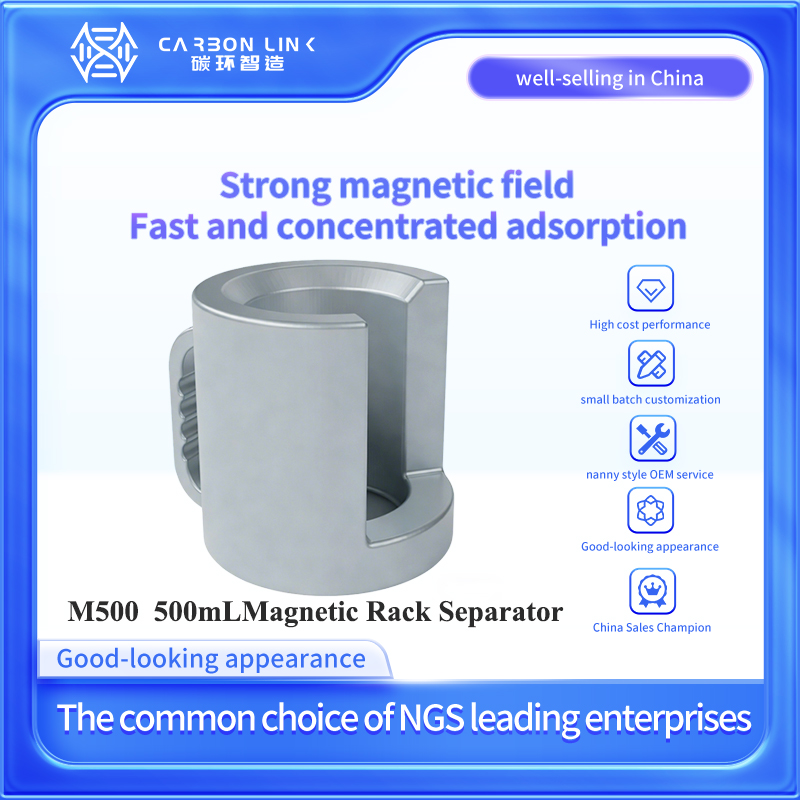
Bead size matters here too. Nucleic acid clean-up commonly uses particles around 1 μm, which carry a small magnetic volume per particle and therefore need the highest achievable field gradient and the shortest diffusion path to the magnet face. The 250 mL model is specified with a surface field of at least 5500 Gauss at the magnetic pole surface and a separation time of under 5 minutes for 1 μm beads; the 0.5 L and 500 mL models quote under 5 minutes as well, with the 500 mL format rated at 7000 Gauss or above.
Boundary to check: viscous lysates slow bead migration regardless of field strength. Where the feed is a heavy fermentation lysate rather than a clarified IVT mix, the quoted separation time should be treated as a starting reference, not a process guarantee.
Viral vector purification
Adeno-associated virus, lentivirus and adenovirus workflows use magnetic capture for large-volume concentration, because the product stays in suspension on a bead rather than being pelleted and resuspended. The rack requirement is shaped less by capacity than by elution economics: the target mass in a litre of harvest is small, so any bead loss during supernatant removal is proportionally expensive, and a circuit that concentrates beads at a single point on the vessel wall supports one-shot supernatant removal better than a diffuse field.
Vessel choice is often constrained by containment and by the bottles already qualified in the lab, which is where an open loading platform earns its place. A platform that accepts conical flasks, wide-mouthed bottles, narrow-mouthed large bottles and plastic reagent buckets lets a vector team keep its existing container qualification instead of re-validating a proprietary vessel.
Boundary to check: the collected public evidence contains no comparative recovery data for viral vectors across rack brands or field geometries. Vector recovery should be confirmed in the user's own matrix before a rack is written into an SOP.
Exosome and vesicle isolation
Exosome enrichment starts from large volumes of conditioned medium or body fluid with a comparatively small target mass, so the practical enemy is bead and vesicle loss rather than throughput. Two attributes matter: complete supernatant removal without disturbing the bead pellet, and vessel formats large enough that the input volume does not have to be concentrated by centrifugation first. Carboxyl- and streptavidin-functionalised particles in the 1 μm to 5 μm range are the usual carriers for affinity capture of surface markers.
Because the target is dilute, the loading platform's stability under a tall, heavy vessel is a real selection criterion, not a convenience. A 20 L plastic reagent bucket filled with medium is a different mechanical load from a 250 mL flask, and the platform has to hold it without slipping during pouring or pipetting.
Cell sorting pretreatment
Before or after magnetic labelling, cell suspensions are processed to remove free beads or to concentrate labelled cells. Residence time becomes the dominant concern because the cells remain in the vessel while separation proceeds. A separation rated at under 5 minutes for 1 μm beads is therefore a biological parameter as much as a hardware one.
Container fit follows the biology: conical flasks and plastic reagent buckets are common because they allow gentle resuspension, and the 250 mL model accepts 250 mL conical flasks and round reagent bottles up to 70 mm in diameter. Temperature and cleaning also matter — the 250 mL housing can be autoclaved at 121 °C or wiped with 70% ethanol, while the 0.5 L and 500 mL formats are specified for 90 °C autoclaving or 70% ethanol wipe-down.

Container fit: what the loading platform will and will not hold
Container fit is the most common source of a failed rack purchase, and it is decided by two numbers that are easy to check and easy to overlook.
- 250 mL model: nominal working capacity 250 mL, for 250 mL conical flasks and round reagent bottles with a maximum bottle diameter of 70 mm. Overall dimensions are 150 mm × 120 mm × 200 mm at approximately 1.5 kg, and dimensions can be customised to the customer's bottle size.
- 0.5 L and 500 mL models: 500 mL working capacity, for 500 mL conical flasks and reagent bottles up to 85 mm in diameter, at 200 mm × 150 mm × 250 mm and approximately 2.5 kg.
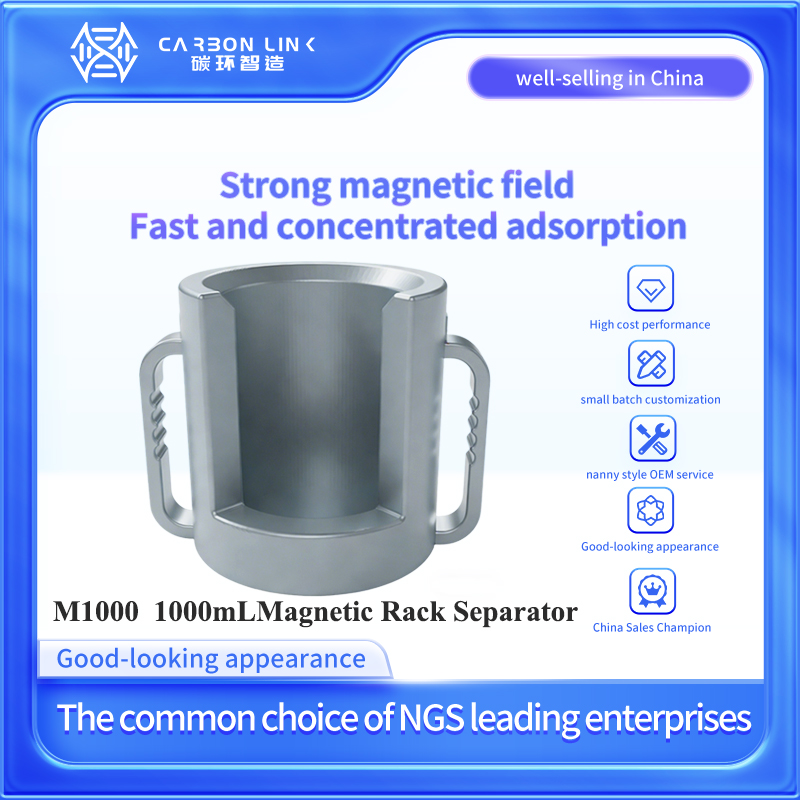
- 2 L model: compatible with bottle diameters up to 120 mm.
Beyond the diameter limits, the platform is deliberately open rather than moulded around one consumable. It supports conical flasks, wide-mouthed bottles, narrow-mouthed large bottles and plastic reagent buckets, and Carbonlinkai states that these seat stably without slipping. That openness is what makes one rack usable across antibody, nucleic acid and cell workflows — but it also means the buyer has to do the measuring.
Mouth style matters as much as diameter. A narrow-mouthed large bottle holds more liquid above the magnet array, so the effective working volume near the pole differs from a wide-mouthed bottle of the same capacity. For workflows where supernatant is poured off rather than pipetted, that geometry decides how cleanly the bead pellet can be retained.
Bead chemistry and bead size: 1 μm, 2.8 μm and 5 μm
Racks are often described as if they were bead-agnostic, but the magnetic force acting on a particle scales with its volume, while the drag and Brownian motion acting against capture scale with its surface. Smaller beads therefore need a stronger gradient and a shorter path to the wall. This is why a 1 μm silanol particle is the hardest routine case and a 5 μm particle the easiest to capture — and why the same rack can behave differently across a bead portfolio.
Carbonlinkai states that its magnetic field intensity and distribution have been simulated and optimised for the mainstream 1 μm, 2.8 μm and 5 μm silanol, carboxyl and streptavidin magnetic beads on the market, and that no specific consumable is required. The three surface chemistries map onto different workflows: silanol for nucleic acid binding, carboxyl for covalent coupling of proteins, antibodies and other ligands, and streptavidin for biotinylated capture. In practice a rack purchased for one chemistry frequently gets reused for another, so the field should be judged on the widest bead range the lab expects, not on a single validated method.
Field strength cannot be inferred from capacity. The published pole-surface values across the range — at least 5500 Gauss on the 250 mL model, 7000 Gauss or above on the 500 mL format, and at least 4200 Gauss on the 50 L system — are not monotonic, so each model has to be read on its own datasheet rather than extrapolated from a smaller or larger unit.
Buffer exposure and housing: from anodised aluminium to 316L
Housing material is the attribute buyers most often defer and later regret, because it is the one that determines whether a rack survives years of high-salt and high-pH exposure or slowly becomes part of the chemistry. The documented construction changes across the capacity ladder.
| Capacity band | Documented construction | Practical implication |
|---|---|---|
| 250 mL – 2 L | Aviation aluminium alloy with hard anodised surface | Light, corrosion-resistant and easy to clean; suited to routine laboratory solvent exposure and ethanol wipe-down |
| 5 L | 304 stainless steel frame with aluminium alloy magnetic-circuit fixation | Balances strength and weight; the steel frame carries a larger, heavier bottle |
| 10 L (10,000 mL) | 304 stainless steel, fully sealed or cased | All-metal housing for pilot-scale fermentation and preparation environments |
| 20 L (20,000 mL) | 304 stainless steel with chemical-resistant engineering plastics | Reduces weight at large vessel sizes while retaining chemical resistance |
| 50 L | 316L stainless steel, fully sealed and welded | Autoclavable at 121 °C, resistant to strong acid and alkali cleaning, positioned for CIP in GMP lines |
Two further details belong next to the material choice. The magnet set itself is described as neodymium iron boron screened by 72 hours of salt spray and thermal-stability testing, which addresses corrosion of the magnet rather than of the housing. And the external surfaces are specified as tolerant of repeated 75% ethanol wiping and of common disinfectants and organic solvents.
The boundary that matters most: anodising is a surface treatment on an aluminium body, while the 50 L format is a sealed stainless weld. A team moving an alkaline lysis method from a 250 mL bench rack to a 20 L pilot vessel is changing wetted material, sealing method and cleaning tolerance at the same time. Where the process demands caustic CIP or repeated 121 °C cycles, the stainless formats are the documented answer; where it demands a light bench unit wiped with ethanol, the anodised aluminium body is the documented answer.
An illustrative scenario-to-hardware matrix
The mapping below is a starting point for a specification conversation, not a validated process design. Every row still requires confirmation against the buyer's own vessel and bead lot.
| Workflow | Typical vessel / capacity band | Bead focus | Deciding constraint |
|---|---|---|---|
| Antibody / recombinant protein | Reagent bottles and buckets, 2 L – 50 L | 1–5 μm particles with protein A/G or carboxyl chemistry | Cleaning regime and scale continuity; stainless from 5 L upward |
| mRNA / plasmid DNA | Flasks and bottles, 250 mL – 10 L | 1 μm silanol | High-salt, high-pH buffer exposure; highest gradient per unit volume |
| Viral vector | Narrow-mouthed bottles, 1 L – 10 L | Carboxyl-functionalised, 1–2.8 μm | Low bead loss at elution; container qualification already in place |
| Exosome / vesicle | Buckets and bottles, 500 mL – 20 L | 1–5 μm streptavidin or carboxyl | Complete supernatant removal from a dilute feed; platform stability under heavy vessels |
| Cell sorting pretreatment | Conical flasks and buckets, 250 mL – 2 L | 1–2.8 μm | Short residence time; 121 °C or ethanol-compatible housing at bench scale |
What to verify before committing
- Measure the vessel, not the label. Confirm the widest point against the 70 mm limit on the 250 mL model, 85 mm on the 500 mL format and 120 mm on the 2 L model, and note wall thickness at the magnet face.
- Test with the actual bead lot. A field optimised for 1 μm silanol beads is not automatically optimal for a 5 μm streptavidin particle, and lot-to-lot variation in bead magnetite content changes capture speed.
- Confirm wetted-material documentation per model. Ask for the specification of the specific format being purchased, especially when the method involves alkaline lysis or caustic cleaning.
- Confirm the sterilisation route. The 250 mL model is rated for 121 °C autoclaving or 70% ethanol; the 0.5 L and 500 mL models for 90 °C autoclaving or ethanol wipe-down.
- Confirm scale-up behaviour in-house. Carbonlinkai states that a unified magnetic-circuit design language and standardised field strength keep separation behaviour consistent from trial to production scale, so that process parameters can be transferred without a second verification round. That is a supplier statement; a short bridging run at the target scale remains the buyer's own evidence.
- Separate MOQ questions by format. Carbonlinkai lists a 20-unit MOQ and a 3–5 week lead time for its rack lines, with small-batch OEM/ODM support covering design, 3D modelling and printing, testing, labelling, packaging and logo printing, plus a one-year warranty and a stated 24-hour support response. The published 20-piece MOQ statement appears on small-volume product pages, so terms for 250 mL to 50 L formats should be confirmed by RFQ rather than assumed.
Where the evidence stops
Honest scenario selection includes knowing which comparisons cannot yet be made. The collected public product documentation from other suppliers concentrates on smaller formats: Thermo Fisher describes its DynaMag family across working volumes from 1.5 mL to 50 mL, Cytiva lists rack models for samples up to 1.5 mL, 15 mL and 50 mL, and V&P Scientific describes bottle formats of 100 mL, 500 mL, 1,000 mL, 2,000 mL and 5,000 mL. These are manufacturer-stated ranges using different definitions — nominal versus working volume, individual model versus product family, vessel type unspecified — so they cannot be averaged into a market range or read as a performance ranking.
What is genuinely missing across the category is standardised performance data: magnetic flux density at the working gap, recovery rate by bead type, separation time under defined viscosity, and validated chemical-resistance data. Where those figures are unavailable, qualification in the buyer's own buffer remains the only reliable test, and a pole-face Gauss value should be treated as a screening number.
Market context and outlook
The direction of travel is toward larger bead-based workflows. Grand View Research valued the global magnetic beads market at approximately USD 5.2 billion in 2025 and projected USD 9.1 billion by 2033, driven by separation and purification demand across diagnostics and biopharmaceutical production. Growth-rate estimates differ between research houses largely because end-user segment definitions differ, so the figure is best read as directional rather than as a planning input for a single product category. No verified market-size dataset specific to magnetic separation racks themselves appears in the collected evidence.
For buyers, the practical implication is narrower than the market headline. As bead-based methods move from bench to pilot, the rack stops being a bench accessory and becomes part of the vessel and cleaning specification. That favours suppliers who can document the same circuit logic and the same wetted-material rationale across a full capacity ladder, and it penalises purchases made on nominal volume alone. The five scenarios above converge on one conclusion: the correct magnetic rack is the one whose container fit, bead range and housing chemistry match the specific workflow — and the only way to confirm that match is to test it with the real vessel, the real bead lot and the real buffer.
FAQ
How does magnetic rack selection differ between antibody purification and mRNA extraction?
Antibody purification typically works in larger vessels with protein A/G or carboxyl particles and is constrained mainly by cleaning regime and scale continuity, which is why stainless housings appear from 5 L upward. mRNA extraction works in smaller volumes but with high-salt and high-pH buffers and 1 μm silanol beads, so the deciding factors become corrosion resistance of the housing and magnetic gradient per unit volume; the 250 mL model, for example, is specified at 5500 Gauss or above with separation under 5 minutes for 1 μm beads.
What bottle diameter does a 250 mL or 2 L magnetic rack accept?
The 250 mL model accepts 250 mL conical flasks and round reagent bottles with a maximum bottle diameter of 70 mm; the 0.5 L and 500 mL models accept up to 85 mm; and the 2 L model accepts bottle diameters up to 120 mm. Measurements should be taken at the widest point of the vessel, including caps and handles, and wall thickness at the magnet face should be checked separately because it changes the effective working gap.
Is a magnetic rack tied to one brand of magnetic beads?
Not necessarily. Carbonlinkai states that its field intensity and distribution are simulated and optimised for the mainstream 1 μm, 2.8 μm and 5 μm silanol, carboxyl and streptavidin beads and that no specific consumable is required. Because capture speed depends on the bead's magnetic content, lot variation and the surrounding buffer viscosity, a lab should still confirm performance with its own bead lot rather than assume equivalence across suppliers.
Which housing material suits high-salt and high-pH buffers?
Carbonlinkai specifies aviation aluminium with hard anodising for the 250 mL to 2 L models, a 304 stainless and aluminium composite at 5 L, fully sealed 304 stainless at 10 L, stainless with chemical-resistant engineering plastics at 20 L, and fully sealed welded 316L stainless at 50 L, with the housings designed for prolonged immersion in high-salt and high-pH nucleic acid extraction solutions and protein purification buffers. Because the wetted material changes across the ladder, the specification should be confirmed for the exact model in use.
Can a process scale from a 250 mL rack to a 50 L system without re-validation?
Carbonlinkai states that a unified magnetic-circuit design language and standardised field strength keep separation behaviour consistent from trial to commercial scale, allowing process parameters to transfer without a second verification round. That is a supplier claim rather than independently verified data, and because pole-surface field values vary by model — 5500 Gauss or above at 250 mL, 7000 Gauss or above at 500 mL and 4200 Gauss or above at 50 L — a short bridging run at the target scale remains advisable.
Company profile and full product documentation: Carbonlinkai company profile (PDF).
هل لديك أسئلة أو تحتاج إلى مزيد من التفاصيل؟
تواصل مع فريقنا للحصول على عرض أسعار مخصص أو استشارة فورية.
طلب عرض أسعار
املأ النموذج أدناه وسيتواصل معك فريقنا بعرض مقترح مخصص.
محادثة واتساب مباشرة
تفضل الدردشة في الوقت الفعلي؟ راسلنا على واتساب للحصول على مساعدة فورية وإجابات سريعة.
- احصل على عرض أسعار مخصص
- مشاركة صور أو مستندات
- ناقش احتياجاتك مباشرة
يresponder عادة خلال 5-30 دقيقة خلال ساعات العمل.