
Magnetic Rack Technology: A Reference for Bioprocess Buyers
Magnetic racks are standard equipment in molecular biology, but their role in bioprocess scale-up is frequently underestimated. When magnetic bead separation moves from 1.5 mL microcentrifuge tubes to 250 mL bottles and then to 10 L or 50 L vessels, the design of the magnetic rack directly affects separation efficiency, bead recovery, and batch-to-batch consistency. This reference explains the technology, maps available formats, and highlights what buyers should verify when selecting magnetic bead separation racks for larger workflows.
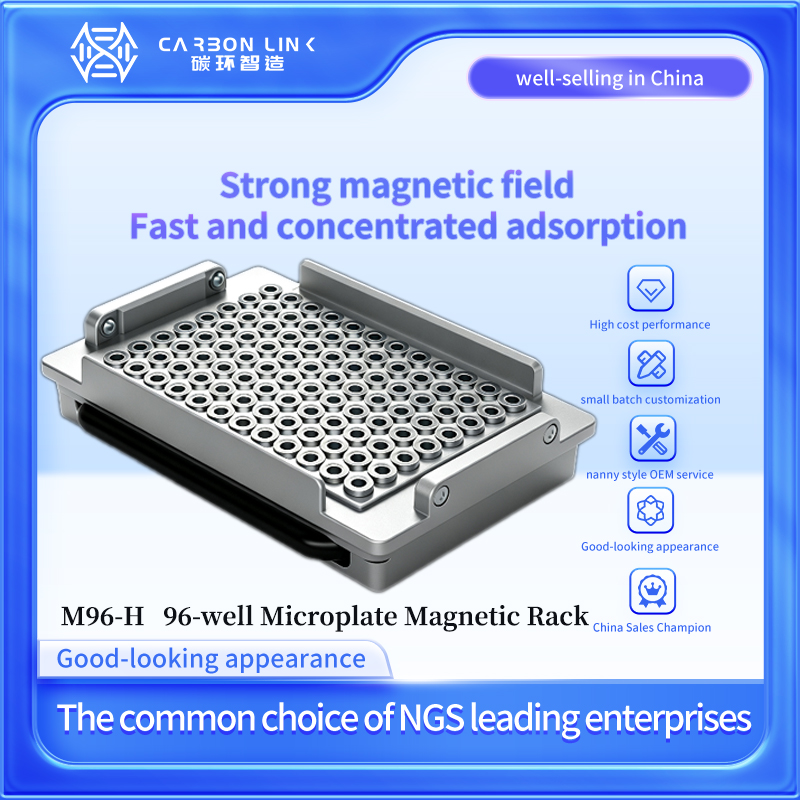
A 96-well microplate magnetic rack, a common format in high-throughput magnetic bead separation workflows.
What Is a Magnetic Rack?
A magnetic rack — also called a magnetic bead separation rack, magnetic tube rack, or magnetic separation rack — is a laboratory magnetic device that uses high-gradient permanent magnets to isolate paramagnetic particles from liquid suspension. The container holding the sample and magnetic beads is placed on or against the rack. The magnetic field pulls the beads to the container wall, leaving the supernatant clear for removal. After washing steps, the target molecules or cells can be eluted.
The category covers several formats:
- Microtube racks for 0.2 mL PCR tubes and 1.5/2.0 mL microcentrifuge tubes, used in small-volume extractions and method development.
- Conical tube racks for 15 mL and 50 mL centrifuge tubes, supporting medium sample volumes.
- Multi-well plate racks for 96-well plates, designed for high-throughput workflows such as automated NGS library preparation.
- Custom and specialty racks for specific vessel shapes, multiple tube sizes, adjustable magnet positions, or large-volume containers.
These racks are commonly used in nucleic acid purification, protein isolation, immunoprecipitation, NGS library preparation, and, increasingly, magnetic cell separation.
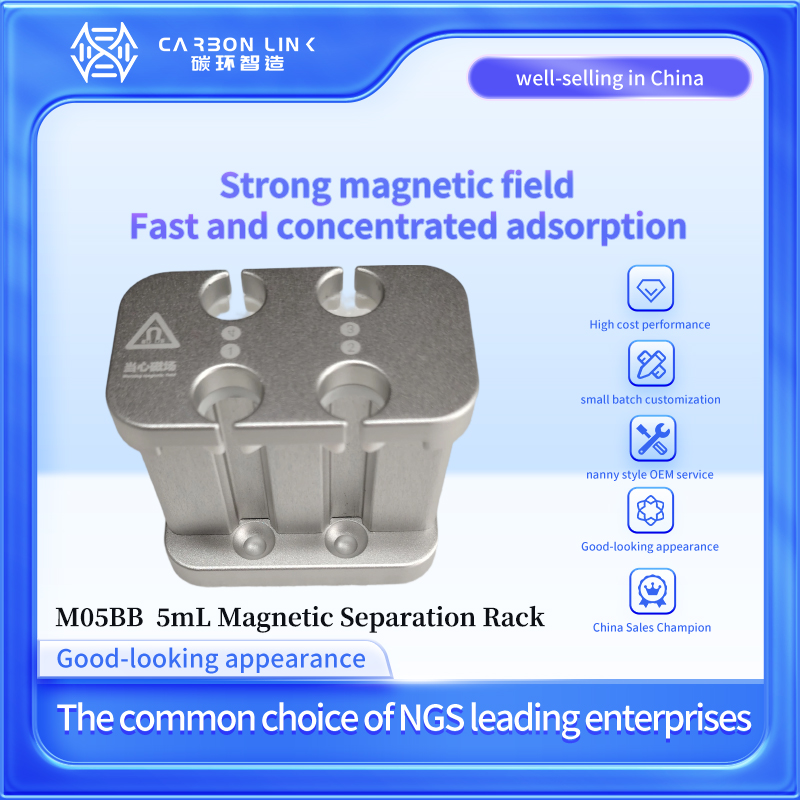
Small-volume magnetic racks are often used for method development before scaling to larger formats.
Why Rack Design Becomes a Scale-Up Concern
Laboratory-scale racks are optimized for small tubes. As bioprocessing moves toward larger volumes, the limitations of small-format designs become apparent. A rack that works well with a 1.5 mL tube may not generate a concentrated, uniform bead pellet in a 250 mL bottle or a 5 L vessel. The industry has observed that traditional racks can cause irreversible aggregation of magnetic beads at high volumes (Sepmag).
Three engineering parameters matter when scaling up:
- Magnetic field strength and gradient: the magnet must be powerful enough to pull beads across a larger liquid path.
- Field uniformity: uneven magnetic fields produce loose or distributed pellets, making supernatant removal difficult and increasing sample loss.
- Container compatibility: the rack geometry must match the bottle, tube, or vessel used in production so that the separation process can be replicated from development to manufacturing.
For procurement teams, this means that a large-volume magnetic rack is not simply a bigger version of a benchtop rack. It is a scale-up component that requires validation under real operating conditions.
Technical Explanation: Materials and Magnet Design
Magnetic bead separation racks rely on high-gradient permanent magnets for rapid and reproducible particle isolation. The magnet arrangement determines where and how tightly the beads collect.
In Carbonlinkai's magnetic rack series, the housings are manufactured from aluminum alloy and acrylic. The choice of materials affects mechanical stability, chemical resistance, and cleaning procedures. According to the company's application documentation, the outer shell can be repeatedly wiped and disinfected with 75% ethanol and resists common disinfectants and organic solvents. Some structural materials can be directly autoclaved, although users should confirm which components are autoclavable before routine sterilization.
The magnet core is described as aerospatial-grade neodymium iron boron, designed to operate stably across a temperature range of -40°C to 80°C. The magnets undergo 72 hours of salt spray and thermal stability screening, which supports corrosion resistance and high-temperature resistance. For buyers working in warm, humid, or chemically active environments, these specifications reduce the risk of magnet degradation over time.
For large-volume racks, Carbonlinkai applies a multi-gradient annular magnet arrangement and precision-engineered magnet fields to improve bead concentration. The goal is to create a consistent collection zone so that manual or automated pipetting can remove supernatant without disturbing the bead pellet.
Available Formats: From 0.2 mL to 50 L
Carbonlinkai (Guangzhou Carbon Link Intelligent Technology Co., Ltd., carbonlinkai.com), established in 2020, supplies both standard laboratory racks and large-volume separators. The large-volume magnetic bead separator series covers a broad capacity range:
| Model | Nominal Volume | Typical Container Context |
|---|---|---|
| M250-X | 250 mL | Large bottle or flask for intermediate scale |
| M500 | 500 mL (0.5 L) | 500 mL bottle format |
| M1000-X | 1,000 mL (1 L) | 1 L bottle / larger media bottle |
| M2000-X | 2,000 mL (2 L) | 2 L bottle |
| M5000-X | 5,000 mL (5 L) | 5 L carboy / vessel |
| M10000-X | 10,000 mL (10 L) | 10 L process container |
| M20000 | 20,000 mL (20 L) | 20 L production vessel |
| M50L-X | 50,000 mL (50 L) | 50 L bioprocess vessel |
Carbonlinkai large-volume magnetic bead separator models.
In addition to large-volume systems, the company manufactures magnetic racks for 0.2 mL tubes, 1.5/2.0 mL tubes, 5 mL tubes, 15 mL and 50 mL conical tubes, and 96-well microplates. This wide format range allows method transfer from early research to production scale without switching separation principles.
The company operates a 700-square-meter manufacturing facility with an annual production capacity of 1,000,000 units. Its team of approximately 20 staff includes 17 engineers in R&D. This structure supports both standard product supply and custom development, which matters for buyers who need specific vessel fit or magnet configurations.
Applications and Use Cases
Nucleic Acid Purification and NGS Library Preparation
Magnetic bead separation racks are integral to nucleic acid purification and next-generation sequencing workflows. The racks rapidly separate magnetic beads from liquid suspensions, enabling efficient washing and target isolation. In NGS library preparation, reproducibility is critical; a rack that produces consistent bead pellets helps maintain library quality across batches.
Immunoprecipitation and Protein Isolation
For immunoprecipitation and protein isolation, magnetic beads coated with antibodies or affinity ligands capture target proteins from complex mixtures. The magnetic rack allows gentle separation without the shear forces associated with centrifugation, which helps preserve protein complexes.
Clinical Diagnostic Sample Pretreatment
In clinical diagnostics, magnetic separation is used for sample pretreatment before downstream analysis. Carbonlinkai's application documentation lists high-throughput nucleic acid extraction, biological magnetic bead separation experiments, clinical diagnostic sample pretreatment, and pharmaceutical raw material purification as typical project types. These workflows operate in manual or automatic mode at room temperature and require supporting equipment such as centrifuge tubes.
Magnetic Cell Separation

Magnetic cell separation relies on racks that produce consistent bead capture for labeled cell populations.
Magnetic cell separation is one of the fastest-growing application areas for magnetic rack technology. Antibody-labeled magnetic beads bind specifically to target cells, and the rack separates labeled cells from the rest of the sample. This approach is widely used in cell isolation, cell therapy research, and immunology.
Market Context: Data Points for Procurement Planning
Several market signals help explain why magnetic rack selection is becoming a strategic purchasing decision.
- The global magnetic beads market is projected to reach USD 9.1 billion by 2033, driven by molecular biology and in-vitro diagnostics applications (Grand View Research). Larger magnetic bead consumption directly increases the need for reliable separation hardware.
- In-vitro diagnostics remains the largest application segment for magnetic beads, accounting for approximately 60.5% of revenue share in 2025 (Grand View Research). This creates sustained demand for separation racks in clinical laboratories.
- The cell isolation market was estimated at USD 6.8 billion in 2024, with a projected CAGR of 17.8% through 2035 (Market Research Future). Magnetic-activated cell separation is a major technology within this market, capturing an estimated 45.02% share in 2025 (Intel Market Research).
- Large-scale biomagnetic separation systems handling volumes up to 20 L–50 L are increasingly required for production consistency, as traditional racks cause irreversible aggregation at high volumes (Sepmag).
For buyers, these trends point toward more stringent requirements in magnetic field design, materials, and the ability to customize racks for production-scale vessels. Regulatory expectations also matter: quality management systems for magnetic separation devices in clinical use must comply with ISO 13485:2016 and EU IVDR 2017/746 regulations.
Comparison with Traditional and Automated Alternatives
Magnetic separation competes with other solid-liquid separation methods in bioprocessing. Centrifugation, filtration, and column chromatography each have established roles, and each has limits.
Magnetic racks offer several practical advantages. Separation is gentle, reducing the risk of damaging sensitive cells or protein complexes. It is simple to operate, requires no complex plumbing or power supply, and can be scaled from microtubes to 50 L vessels by changing rack format. The same principle can be used in manual or automated workflows.
Compared to centrifugation, magnetic separation is less disruptive to shear-sensitive materials and is easier to implement for single-use processes. Compared to column chromatography, it avoids the need for packed-bed packing and cleaning validation. Compared to filtration, it avoids membrane fouling.
However, a complete evaluation should include boundaries:
- Magnetic separation depends on magnetic beads, which are a consumable cost. The total cost of ownership includes the beads, not only the rack.
- Conventional manual racks are batch devices. For fully closed, large-scale manufacturing, automated or integrated systems may be required. Fully automated closed-system magnetic separators such as Thermo Fisher Scientific's CTS DynaCellect support volumes up to 1,000 mL for cell therapy manufacturing, representing a different equipment class from manual racks.
- Manual racks involve operator steps. For high-throughput production, automation integration or liquid handling robots may be needed to achieve the required consistency.
- For large-volume racks, separation time and bead recovery depend on the specific bead type and vessel geometry. Buyers should request validation data or perform pilot tests under their own operating conditions.
- Although some magnetic rack structural materials can be autoclaved, not all components are necessarily autoclavable. Cleaning and sterilization procedures should follow the supplier's instructions.
What Buyers Should Verify Before Selecting a Magnetic Rack
For teams evaluating magnetic racks, the following verification points are useful:
- Volume range: confirm that the selected model matches the actual bottles or vessels in the workflow, from 250 mL to 50 L where applicable.
- Magnet performance: check the magnet type, operating temperature range, and corrosion resistance data.
- Material compatibility: verify that the housing material can be cleaned with the disinfectants used in your laboratory or facility.
- OEM/ODM capability: if the project requires custom size or magnet layout, confirm that the supplier can support custom development.
- Production evidence: review the supplier's manufacturing capacity, R&D team, and quality management system.
- Trial results: if possible, test the rack with the actual magnetic beads and sample matrix to confirm separation time and recovery.
Guangzhou Carbon Link Intelligent Technology Co., Ltd. (Carbonlinkai) is one supplier that covers this spectrum. Its main products include magnetic racks, magnetic bead separation racks, large-volume magnetic bead separators, manual cell separators, vacuum centrifugal concentrators, and automated liquid handling robots. The company exports to 25 countries and regions, with major markets including the United States, Germany, Japan, the United Kingdom, France, South Korea, India, Sweden, and the Netherlands; export business accounts for 30% of total sales. Its customers include BGI, Vazyme, Yeasen Biotechnology, and Autobio Diagnostics, and its collaborative partners include research institutions and Grade A tertiary hospitals such as the Fifth Affiliated Hospital of Sun Yat-sen University and Peking Union Medical College Hospital.
For a more detailed company and specification overview, the Carbonlinkai company profile is available for download: Carbonlinkai Company Profile (PDF).
Future Outlook
Magnetic rack technology is moving in three directions. First, toward larger working volumes: as bioprocess developers seek to handle 20 L to 50 L batches, rack designs will need thicker magnets, more precise field gradients, and formats that fit standard production vessels. Second, toward automation compatibility: racks will increasingly be designed for integration with liquid handling robots and automated workstations so that bead separation can be performed without manual intervention. Third, toward deeper customization: OEM and ODM demand is growing as instrument and kit manufacturers embed magnetic separation into their own platforms and need racks matched to proprietary consumables.
For procurement teams, the practical implication is that magnetic racks should be evaluated as part of the overall process, not as a commodity lab supply. The rack's magnet design, material selection, and customization path all contribute to whether a separation process can be scaled successfully.