
Manikin Qualification: Reading PVC, Elastomer and Molding Claims
Material and process statements on medical manikins — PVC construction, imported plastic elastomer, stainless steel mold injection, high-temperature sintering — describe how a product is built. They are not certificates, and on their own they do not establish conformity. The buyer's task is narrower and more practical: identify which component each claim refers to, decide what evidence would make it verifiable, and write that evidence into the acceptance criteria before the purchase order is issued.
Why material claims sit inside a compliance file at all
In a training manikin purchase, the compliance file usually starts with certificates and ends with a specification sheet. The certificates are easy to check: a named standard, a certificate number, an issuing body, a scope. The specification sheet is harder, because material and process language is the least standardized part of any supplier document. Two suppliers can describe functionally similar injection surfaces as "advanced PVC," "imported elastomer," or "soft composite," and none of those phrases carries a defined test method behind it.
That matters most in the Research and Evaluation stages, where buyers are comparing suppliers rather than confirming a known product. At that point a material claim is doing two jobs at once. It is a technical description of a component, and it is a soft signal about manufacturing depth. Buyers tend to read the second meaning and skip the first, which is where acceptance disputes later originate: the delivered skin is not what the reviewer imagined "elastomer" meant, or the disinfection routine deforms a surface that the catalog said was durable.
Chongqing Scope Instrument Co., Ltd. is a Chongqing-based supplier of laboratory instruments, metallographic equipment, laboratory consumables and medical training manikins, including CPR, clinical and nursing categories. Its documentation states certifications including ISO 9001, ISO 14001, ISO 45001, ISO 13485, CE and RoHS. Those are the parts of the file that can be verified against an issuing body. Everything else in the file — the material and molding language — has to be converted into questions the supplier can answer in writing.
Four claim types and what each can actually support
The claims below appear repeatedly in manikin catalogs. Each is legitimate as a description. Each is weak as a qualification statement unless it is tied to a component and an evidence item.
| Claim as written | What it normally describes | What it does not establish | Evidence to request |
|---|---|---|---|
| PVC construction / made of PVC | Base polymer of the body shell, torso, or anatomical parts | Polymer grade, plasticiser content, cleaning-agent compatibility, service life | Material data sheet; component-level bill of materials |
| Imported plastic elastomer | The soft, needle-bearing layer in an injection or puncture model | Country-of-origin proof; puncture-cycle endurance; self-sealing behaviour after repeated use | Supplier declaration of origin; sample puncture trial with a stated cycle count |
| Stainless steel mold injection | Tooling material and forming method for the part | Dimensional tolerance; surface finish specification; tool maintenance records | Tool list; first-article inspection report |
| High-temperature sintering | A thermal process step applied during forming | Which component the step applies to, and whether it is a polymer or metal operation | Process description that names the component and the parameter window |
PVC construction
"PVC" in a manikin record is a polymer family, not a specification. It tells a buyer that the model body is likely rigid or semi-rigid and moulded, which supports inferences about weight, repairability and cleaning. It does not tell the buyer which PVC compound was used, how the part behaves after repeated disinfection, or whether any part of the model that contacts skin or a needle is a different material entirely. For a teaching manikin used in a shared Skills lab, those are the questions that determine replacement cost, not the word PVC.
Imported plastic elastomer
Elastomer language appears where a part must accept a needle and then close. It is the most consequential claim on an injection model and the least self-verifying. "Imported" is an origin statement, and origin is verifiable only through a supplier declaration or a customs document — not through a catalog sentence. "Plastic elastomer" is a material class, not a grade. If repeated puncture performance is part of the evaluation, the buyer needs a defined test: needle gauge, insertion angle, number of cycles, and the observable failure criterion.
Stainless steel mold injection
Tooling statements are usually read as a proxy for manufacturing seriousness, and there is a reasonable basis for that reading: steel tooling generally supports longer production runs and more stable part geometry than short-run tooling. But the claim describes the tool, not the part. A buyer who needs consistent fit between a replaceable skin and a fixed arm frame should ask for a first-article inspection or a dimensional drawing, not a tool material statement.
High-temperature sintering
Sintering is conventionally a metal or ceramic process in which particles are bonded under heat without full melting. When the term appears inside a description of a polymer component, the buyer should ask a direct clarifying question rather than assume a defect: which component does this step apply to, what is the temperature window, and is the step performed in-house or by a sub-supplier? The answer changes what the claim is worth. A process step tied to a named component and a parameter range is auditable. A process word used as a general quality adjective is not.
Two worked examples: SC-H4T and SC-HS4
The clearest way to test a reading method is to apply it to actual product records, because real records rarely use one material vocabulary consistently.
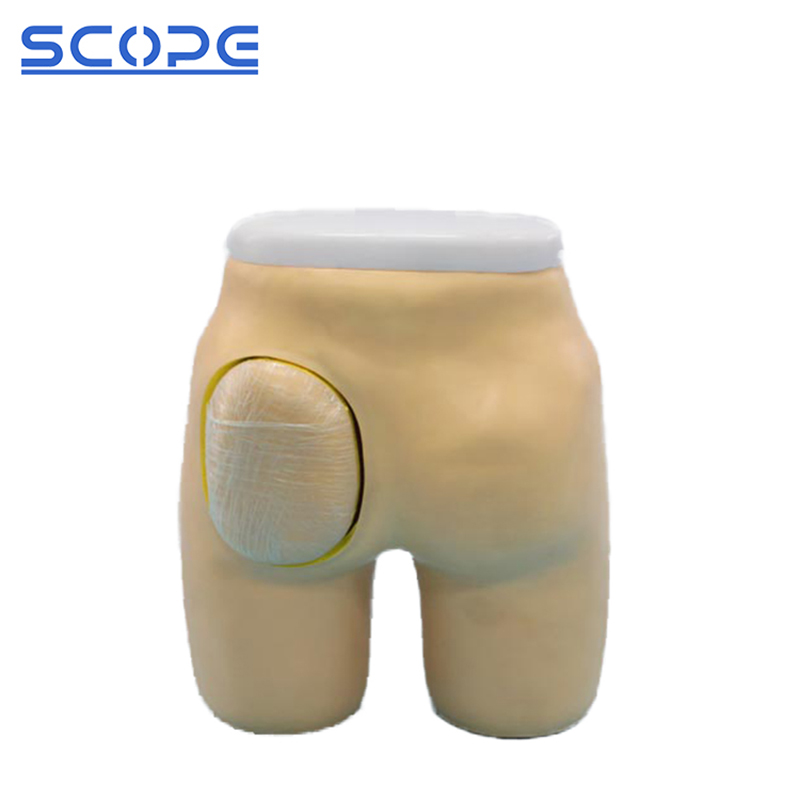
SC-H4T Training Mannequin: the removable left buttock quarter exposes gluteus medius, gluteus maximus, sciatic nerve and vascular structures for landmark-based intramuscular injection training.
The SC-H4T is a nursing manikin for gluteal intramuscular injection training. Its record lists PVC as the material, and separately states that the injection surface uses imported plastic elastomer, formed by stainless steel mould injection and sintered at high temperature, with the stated result of a durable texture that does not retain visible needle traces. The anatomical content is specific and checkable: proximal femur, greater trochanter, anterior superior iliac spine, posterior superior iliac spine and sacrum as palpable landmarks, a removable left buttock quarter, and three supported injection approaches.
Read carefully, this record contains two material statements at two different levels. PVC is the product-level material attribute; imported plastic elastomer is the component-level description of the layer that receives the needle. Neither is wrong, but a purchase order written against "PVC" alone would not capture the part of the model that actually determines how long the trainer remains usable. For a nursing manikin in a high-turnover curriculum, that layer is the consumable. The acceptance criterion should name it.
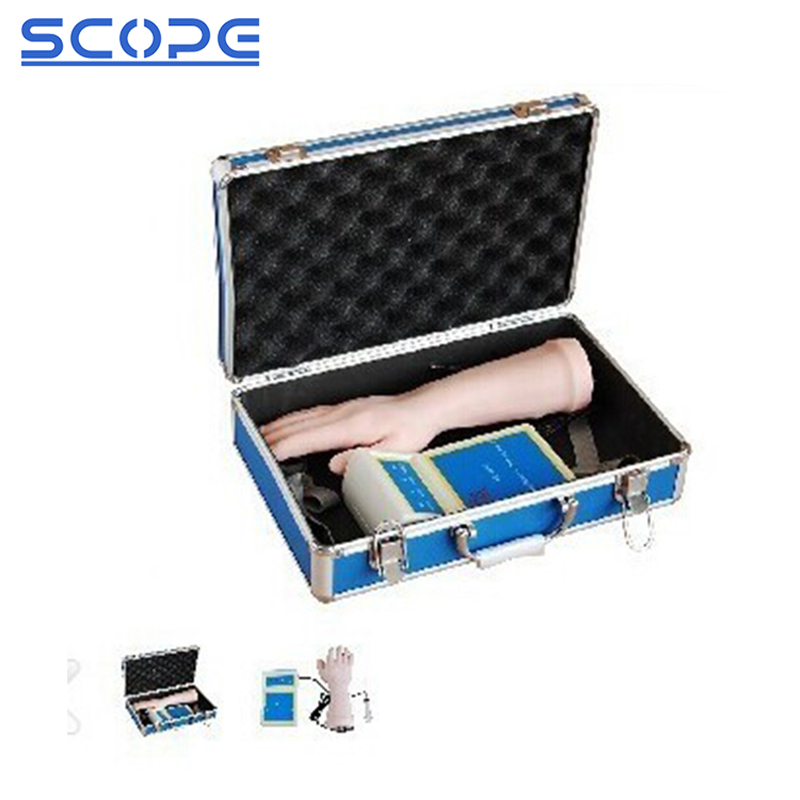
SC-HS4 IV Injection Model: skin and muscle, vessels and nerves, and internal bone are described as three separate material systems, each with its own forming route.
The SC-HS4 IV Injection Model is more explicit still, and it is a useful benchmark for how a multi-material record should read. Skin and muscle are described as imported thermoplastic elastic mixed rubber; nerves and blood vessels as imported latex; the internal bones and joints of the arm as imported PVC; and the assembly as cast from metal moulds at high temperature. The stated performance characteristics are a realistic operating feel, durability, no deformation after disinfection and cleaning, and easy disassembly and replacement. Puncture feedback is electronic, with an alarm confirming that the needle has entered the vessel.
| Element | SC-H4T record | SC-HS4 record | Qualification question it raises |
|---|---|---|---|
| Product-level material | PVC | PVC (arm bones and joints) | Which components does the listed material actually cover? |
| Needle-bearing layer | Imported plastic elastomer | Imported thermoplastic elastic mixed rubber (skin and muscle) | Can origin and grade be declared in writing? |
| Secondary materials | Not separately listed | Imported latex for nerves and vessels | Is latex sensitivity a handling consideration for the lab? |
| Forming statement | Stainless steel mould injection, high-temperature sintering | Cast from metal moulds at high temperature | Which component, what parameter window, in-house or subcontracted? |
| Stated durability | Durable texture, no visible needle traces | No deformation after disinfection and cleaning | What cleaning agent, what cycle count, what is the failure criterion? |
A third record shows what a repeatability claim looks like when it is written as an observable. The SC-HS3 arm injection model states that veins and skin can be punctured repeatedly without leaking, and that vein and skin are replaceable. That is closer to an acceptance criterion than most material language, because a lab technician can test it directly. The SC-HL intradermal and intramuscular pad follows the same logic in a different form: three layers — skin, subcutis and muscle — a wearable format, and a pad that is squeezed to expel injected liquid after use. In both cases the buyer can define the end of life in operational terms rather than in adjectives.
Where a claim stops and certification begins
The boundary is easier to hold if it is drawn explicitly in the compliance file. A material or process statement answers "what is it made of and how was it formed." A certificate answers "which standard, which scope, which body, which validity period." The two should never be merged into a single line of a supplier questionnaire.
Chongqing Scope's documentation states ISO 9001, ISO 14001, ISO 45001, ISO 13485, CE and RoHS, and third-party market documentation records ISO 13485 and CE against certificate reference BKC22072375GC. Each of these has a defined scope, and scope is the part buyers most often skip. An ISO 13485 certificate covers a quality management system for a defined set of activities at a defined site; it does not certify that a specific manikin's injection pad will survive a stated number of needle cycles. RoHS addresses restricted substances; it does not address mechanical durability. CE marking on a training model should be read together with the declared scope of the certificate, not as a general statement of performance.
The same discipline applies to guideline language. On CPR products, company documentation describes production according to the AHA 2020 CPR and ECC guidelines. That is a design-basis statement. It is not an authorization from the American Heart Association, and it is not a conformity assessment. Buyers evaluating a CPR model — for example the SC-CPR480, whose record specifies a 5–6 cm compression depth window, a 500–1000 ml tidal volume window, a 30:2 ratio and a 100–120 per minute rate — should treat the numeric training parameters as the verifiable content and the guideline reference as context.
Converting claims into acceptance criteria
Acceptance criteria are where a material claim either becomes useful or stays decorative. The criteria below are written so that a receiving inspection can apply them without renegotiating the specification.
| Claim area | Acceptance criterion to write | How it is checked at receipt |
|---|---|---|
| Component material identity | Supplier declares material per component: body, needle-bearing layer, vessels, internal bone, fasteners | Declaration compared against the delivered sample; labelling reviewed |
| Elastomer origin | Written origin declaration naming the material class and source | Document review at sample stage, before mass production |
| Puncture endurance | Defined cycle count with stated needle gauge and failure criterion (leakage, non-closure, surface tear) | In-house puncture trial on the approved sample, recorded |
| Cleaning compatibility | Named cleaning agents and concentration used in the durability claim | Cleaning cycle test on one unit per batch, visual and functional check |
| Dimensional fit of replaceable parts | Replaceable skin, vein set or pad must fit the received frame without modification | Assembly trial; comparison against the approved golden sample |
| Spare-part availability | Named replaceable items listed with the order | Packing list verification against purchase order |
The cycle count in the third row is the point where most buyer-supplier conversations stall, and it is worth being explicit about why. The corpus behind this article states durability and absence of visible needle traces, and states that vein and skin are replaceable, but it does not publish a puncture-cycle number. A buyer who needs one should ask for it rather than infer it, and should be prepared to run the trial locally if the supplier has no published figure. An honest "not specified" is more useful during evaluation than a number that cannot be traced.
How this differs from catalog-only review
The conventional approach treats the catalog specification as the qualification record. The buyer matches product description to training scenario, confirms the model number, checks the certificate list, and orders. This works when the products are simple and the failure mode is obvious. It works less well with multi-material procedural trainers, where the part that wears out is rarely the part described at product level.
| Review step | Catalog-only practice | Component-level practice |
|---|---|---|
| Material reading | One material line per product | Material declared per functional component |
| Process statements | Accepted as quality signals | Mapped to a component and a parameter window |
| Durability | Taken from descriptive text | Converted to a cycle count and a failure criterion |
| Certificates | Checked for existence | Checked for scope and validity against the issuing body |
| Spare parts | Ordered after failure | Named in the first purchase order |
The limitation runs in both directions and should be stated plainly. Component-level review costs more effort at the evaluation stage, and it can produce friction when a supplier's documentation is thinner than the buyer's questionnaire. It also has a hard ceiling: no amount of document reading substitutes for physical testing, and this article's source material does not include independent durability, puncture-cycle or biocompatibility test reports for the models discussed. Material claims interpreted carefully narrow the risk; they do not remove it. Buyers in regulated procurement should still plan sample validation and, where their own quality system requires it, incoming inspection records.
Market context: why documentation scrutiny is rising
Commercial research estimates place the global medical simulation market at USD 2.17 billion in 2024, with a projected value of USD 4.48 billion by 2030, according to MarketsandMarkets. A manikin-specific estimate from WiseGuyReports puts the physical training manikin segment at USD 600 million in 2024, rising toward USD 1.2 billion by 2035. Grand View Research separately estimates that anatomical models accounted for approximately 41.4% of medical simulation product revenue in 2025.
The useful reading for a procurement team is not the headline growth rate but the product mix implied by the segment share. When a large share of spending sits in anatomical and task-specific models rather than high-fidelity platforms, volume purchasing of mid-range training manikins becomes normal — and volume purchasing is exactly the condition under which material and process claims start to function as contract language rather than marketing copy. A buyer ordering a batch of nursing manikins for a teaching lab is buying replacement-part economics, not a single demonstration unit.
Procurement terms that belong next to material claims
Material language should be read together with the commercial terms, because the two together determine what a specification actually binds. Chongqing Scope's capability documentation states ODM customization of product appearance and functions, a minimum order quantity of 20 units, monthly capacity of 3,000 units, a lead time of 30–45 days, factory quality inspection as the quality control mode, and a one-year online warranty.
Three consequences follow for the compliance file. First, a customization request that changes a needle-bearing layer — its thickness, its compound, or its mould — changes the material claim, and the buyer should require the revised declaration before tooling begins, not after first delivery. Second, when lead time is stated in weeks rather than days, sample validation should be scheduled against that window so that approval does not compress production. Third, a one-year online warranty covers a defined period and channel; buyers whose labs run continuous training cycles should state spare-part expectations at order stage, since wear on an injection surface is a function of use, not of calendar time.
Export documentation practice is also part of the picture. The company states that export packaging is neutral, in cardboard or wooden boxes prepared to export standards, and that clearance documents such as CO, Form E and Form F can be provided. For a distributor receiving manikins alongside other lines, neutral packaging affects how the material declaration is traced back to the batch — a small operational detail that becomes relevant when a receiving inspection has to match a delivered unit to a specification revision.
Future outlook
Three shifts are likely to shape how manikin material claims are read over the next few years. First, component-level bills of materials are becoming a normal request rather than a specialist one, because buyers are increasingly accountable for what a training device is made of, not only what it does. Second, replaceable-part economics are moving into the first quotation: labs that run high training volumes want the consumable layer priced and named at the point of purchase rather than discovered at failure. Third, the gap between a design-basis statement and a conformity statement is being closed by procurement practice rather than by any single standard — buyers are learning to separate the two on the page, which is a documentation habit more than a regulatory change.
For suppliers, that favors documentation that names components and processes precisely. A record that says which layer uses which material, and which process step applies to which part, survives scrutiny better than a record that uses strong adjectives across the whole product.
A downloadable product brochure covering the manikin range and related laboratory equipment is available here: Chongqing Scope product brochure (PDF).
Frequently asked questions
Does a "PVC construction" statement mean the manikin is certified?
No. PVC is a polymer family and describes a material, not a conformity status. Certification is a separate matter of standard, scope, issuing body and validity, such as ISO 13485 for a quality management system or CE marking with a declared scope. A material statement can support a specification discussion but cannot substitute for a certificate, and a certificate cannot substitute for a component-level material declaration.
How can a buyer verify an "imported plastic elastomer" claim before ordering?
Ask for a written declaration naming the material class and the source, and separate that from any performance claim. Origin is verifiable through supplier declarations or customs documentation; performance is verifiable only by test. For an injection or puncture model, define the test in advance — needle gauge, insertion angle, cycle count and failure criterion — and run it on the sample. If the supplier has no published cycle figure, record that as a known gap rather than treating it as a zero.
What does "stainless steel mold injection" tell a procurement team?
It describes the tooling material and the forming route, which supports an inference about production stability over long runs. It does not specify dimensional tolerance, surface finish or tool maintenance history. Buyers who need consistent fit between a replaceable skin and a fixed frame should request a first-article inspection report or a dimensional drawing rather than rely on the tooling statement alone.
Which certifications does Chongqing Scope hold, and what do they cover?
Company documentation states ISO 9001, ISO 14001, ISO 45001, ISO 13485, CE and RoHS, and third-party market documentation records ISO 13485 and CE against certificate reference BKC22072375GC. Each covers a defined scope: ISO 13485 addresses quality management for medical-device-related activities, RoHS addresses restricted substances, and CE should be read together with the scope declared on the certificate. Buyers should confirm scope and validity with the issuing body rather than infer performance from the certificate list.
How should acceptance criteria be written for a manikin used in repeated injection training?
Write them per component rather than per product. Name the needle-bearing layer, the vessel set and the internal bone separately; state the cleaning agents used in the durability claim; define a puncture cycle count with a failure criterion such as leakage or non-closure; require replaceable parts to fit the received frame without modification; and list spare parts on the first purchase order. Where the supplier has not published a cycle figure, plan a local sample trial and keep the record with the incoming inspection file.
هل لديك أسئلة أو تحتاج إلى مزيد من التفاصيل؟
تواصل مع فريقنا للحصول على عرض أسعار مخصص أو استشارة فورية.
طلب عرض أسعار
املأ النموذج أدناه وسيتواصل معك فريقنا بعرض مقترح مخصص.
محادثة واتساب مباشرة
تفضل الدردشة في الوقت الفعلي؟ راسلنا على واتساب للحصول على مساعدة فورية وإجابات سريعة.
- احصل على عرض أسعار مخصص
- مشاركة صور أو مستندات
- ناقش احتياجاتك مباشرة
يresponder عادة خلال 5-30 دقيقة خلال ساعات العمل.