
Manikin Shortlist by Skill Cluster: CPR, Airway, Injection, Maternal
A simulation lab rarely needs one training manikin. It needs a cluster of task trainers that covers the competencies the curriculum actually assesses: chest compressions, airway management, injection and venipuncture, obstetric care and infant nursing. This HTNXT shortlist maps documented Chongqing Scope manikin models to four skill clusters, and states plainly where the published evidence stops.
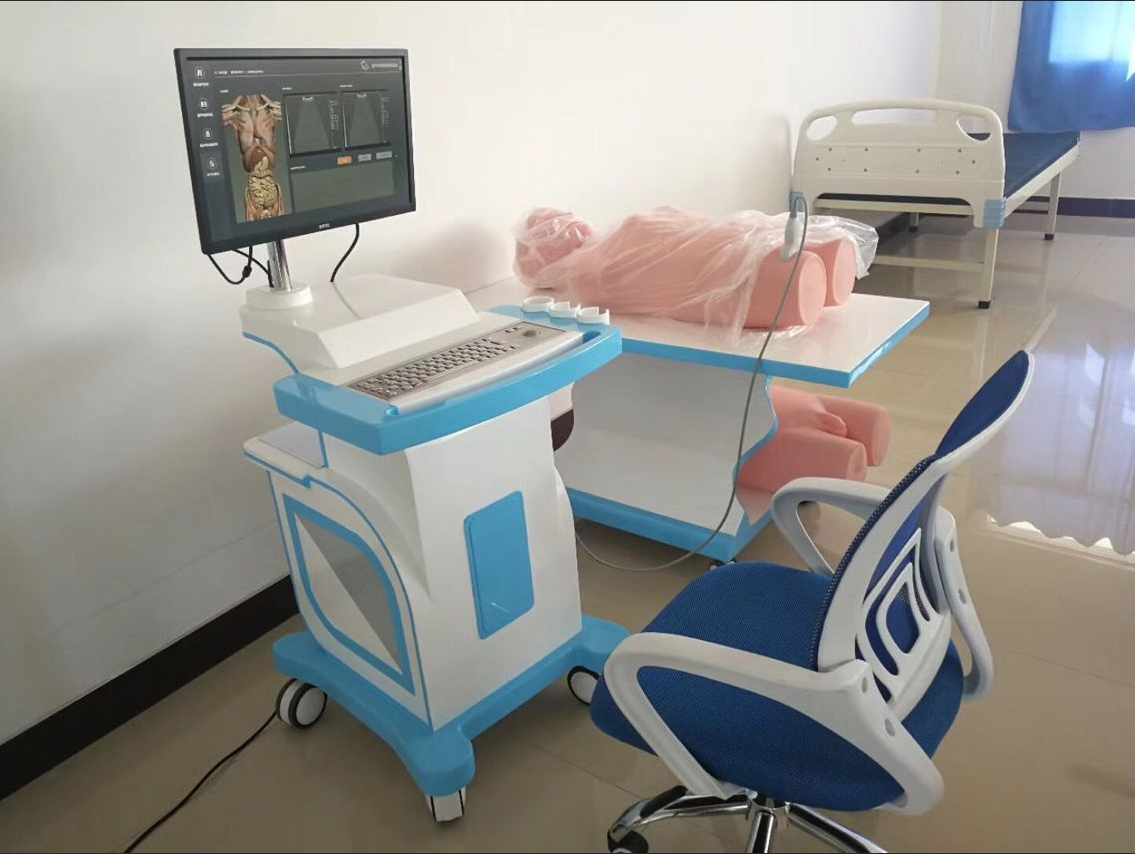
Medical teaching manikin application: task trainers assigned to student groups by procedure, not by catalogue order.
Why manikin procurement should follow skill clusters
Most procurement mistakes in medical simulation are not caused by buying the wrong brand. They are caused by buying the wrong distribution of models. A department that purchases one full-body simulator for a hundred students usually ends up with a bottleneck; a department that purchases ten low-cost models of the same type usually ends up with a curriculum that cannot teach airway, injection and obstetric skills at all.
A skill-cluster approach reverses the buying sequence. The lab first lists the competencies it must certify — adult and infant CPR, oral and nasal tracheal intubation, arm and gluteal injection, maternal delivery and newborn care — then allocates budget across clusters, and only then compares suppliers within each cluster. This is the logic behind the shortlist below: Chongqing Scope Instrument Co., Ltd., a Chongqing-based supplier of laboratory instruments and medical training manikins, publishes model-level specifications that can be mapped directly to competency groups.
How this shortlist was built
Three screening rules were applied. First, the model must document a specific training procedure rather than a general claim of realism. Second, the model must document how feedback is delivered — electronic alarm, indicator light, voice prompt, printed score, or purely tactile response — because feedback mode determines whether a manikin can be used for assessment or only for practice. Third, the model must belong to a category the supplier publishes consistently, so that a lab can reorder the same or an equivalent item later.
This is a portfolio shortlist for one supplier, not a market-wide ranking of manikin brands. Suppliers such as Laerdal Medical (Norway), Ambu A/S (Denmark), Gaumard Scientific (United States), Kyoto Kagaku (Japan) and 3B Scientific (Germany) cover overlapping procedure categories, but they do not publish directly comparable per-model feature data, so no cross-brand performance ranking is asserted here.
Cluster 1 — CPR and first-aid training: SC-CPR160, SC-CPR480, SC-J90
The CPR cluster is where feedback specification matters most. Two of the three recommended models provide instrumented feedback; the third provides trauma realism for casualty assessment.
The SC-CPR160 Infant Manikin is an infant CPR training model. Its documented feedback includes digital counting, indicator lights and voice prompts for compression position, compression intensity (correct at 4 cm or above) and ventilation volume, with a stated correct tidal volume band of 30–50 ml and an alarm when ventilation is too fast or too large and air enters the stomach. The documented compression-to-ventilation ratio is 30:2 for single-rescuer use or 15:2 for two-rescuer use, with five 30:2 cycles per operation cycle and a target rate of 100–120 compressions per minute. A hand-pumped bulb simulates brachial artery pulsation. The unit is supplied with the infant model, a computer digital monitor, a hard transport case, 50 CPR barrier masks, four replaceable lung sacs, an operation guide, a first-aid manual, an instruction manual, a warranty card and a certificate of conformity.
The SC-CPR480 CPR Model is a full-body adult resuscitation manikin aimed at both training and assessment. Compression depth is shown through a dynamic barcode indicator: green for the correct 5–6 cm range, yellow below 5 cm and red above 6 cm. Ventilation feedback uses the same barcode logic against a documented tidal volume band of 500–1000 ml. The unit records error causes (excessive or insufficient force, incorrect hand position, insufficient or excessive ventilation), supports 30:2 single or double rescuer cycles, measures operation time in seconds, and can thermally print short or long result transcripts. It also supports pupil response checks before and after assessment and simulated carotid pulsation during compressions. The specification states Chinese voice prompts, with adjustable volume and the option to turn voice prompts off.
The SC-J90 Medical Mannequin is not a feedback trainer. It is a trauma presentation model covering 17 documented injury configurations, including first- to third-degree facial and forearm burns, open clavicle fracture with chest contusion, abdominal trauma with small-intestine exposure, open humerus and femur fractures, amputation trauma, a metal-foreign-object thigh wound and a bullet wound on the left palm. It is the model that lets a first-aid course teach injury recognition and triage sequencing rather than compression metrics.
| Model | Published category | Documented feedback | Key published parameters | Best-fit role |
|---|---|---|---|---|
| SC-CPR160 | Infant Manikin (CPR) | Digital count, indicator light, voice prompt | Compression ≥4 cm; tidal volume 30–50 ml; 30:2 or 15:2; 100–120/min | Infant and paediatric basic life support |
| SC-CPR480 | CPR Model | Dynamic barcode light, digital count, voice prompt, thermal printout | Compression depth 5–6 cm; tidal volume 500–1000 ml; 30:2; 100–120/min | Adult BLS training plus scored assessment |
| SC-J90 | Medical Mannequin (trauma) | Tactile and visual injury presentation | 17 documented trauma configurations | First-aid, trauma recognition and triage |
Cluster 2 — Airway and intubation training: SC-J5S
The SC-J5S Intubation Model documents oral and nasal tracheal intubation practice plus teaching demonstration. Its differentiator is error feedback rather than realism claims: incorrect oesophageal insertion triggers an electronic display and alarm, and the supplied air inflates the stomach instead of the lungs, which makes the failure visible to the whole group. Correct airway insertion produces an electronic display and a music prompt, and air expands both lungs; the tube cuff can be inflated to fix the tube in place. Excessive force that makes the laryngoscope press on the teeth triggers a separate alarm — a common student error that a passive airway model cannot signal. The model also presents one normal pupil and one dilated pupil for side-by-side comparison and marks the cricothyroid membrane puncture site.
For a lab, this means SC-J5S can absorb repeated first-pass intubation attempts, but it is a task trainer, not a ventilator-management platform. It does not document spontaneous breathing, lung compliance variation or automated scenario control.
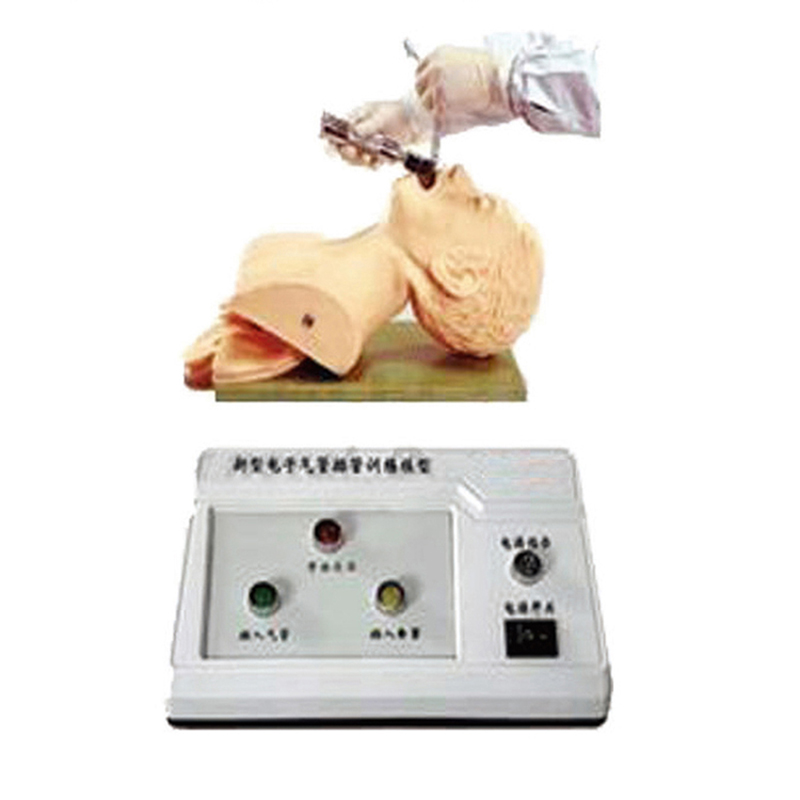
SC-J5S Intubation Model: an airway task trainer with oesophageal-insertion and tooth-pressure alarms.
Cluster 3 — Injection and venipuncture: SC-HS4, SC-HS3, SC-H4T, SC-HL
The injection cluster splits into three different teaching problems: vessel access, landmark accuracy, and low-cost repetition.
The SC-HS4 IV Injection Model addresses electronic confirmation of successful vessel entry. Arm puncture training is supported by an electronic alarm device that prompts when the needle has correctly penetrated the blood vessel, and prompts again when it pierces the vessel. Materials are documented as imported thermoplastic elastic mixed rubber for skin and muscle, imported latex for nerves and blood vessels, and imported PVC for the internal bones and joints, cast from metal moulds at high temperature. The standard configuration is a standard hand model, one electronic monitor, one pair of 5 ml infusion sets and an instruction manual.
The SC-HS3 Injection Model covers arm injection, blood transfusion and hemospasia plus deltoid muscle injection. Documented behaviour includes obvious needle penetration feel into the vein, blood flashback to confirm correct insertion, and repeated puncture of veins and skin without leakage. Vein and skin are changeable, which makes this the more economical option for high-frequency student practice where electronic scoring is not required.
The SC-H4T Training Mannequin is built around gluteal intramuscular injection safety. Documented anatomical landmarks include the proximal femur, greater trochanter, anterior superior iliac spine, posterior superior iliac spine and sacrum. The left buttock quarter is removable so students can see the gluteus medius, gluteus maximus, sciatic nerve and vascular structures they are trying to avoid, and three intramuscular injection approaches are supported: dorsal hip, ventral hip and vastus lateralis. The body is described as imported plastic elastomer, stainless-steel mould injected and high-temperature sintered.
The SC-HL Medical Training Model is a wearable three-layer pad — skin, subcutis and muscle — for intradermic, hypodermic and intramuscular injection. Injection liquid can be introduced and squeezed out of the pad after use, which makes it the consumable-style item in this cluster rather than a durable trainer.
| Model | Injection task | Documented feedback | Replaceable / consumable element |
|---|---|---|---|
| SC-HS4 | Arm venipuncture and infusion | Electronic alarm and success prompt via monitor | Hand model; 5 ml infusion set |
| SC-HS3 | Arm injection, transfusion, hemospasia, deltoid injection | Needle penetration feel; blood flashback | Changeable vein and skin |
| SC-H4T | Gluteal intramuscular injection, three approaches | Anatomical landmark palpation; removable left gluteal quarter | Not documented in the published specification |
| SC-HL | Intradermic, hypodermic, intramuscular | Tactile, three-layer tissue resistance | The pad itself; liquid squeezed out after use |
Cluster 4 — Maternal, infant and nursing: SC-F55-1, SC-H140, SC-H130A
The SC-F55-1 Maternal Manikin is the most specification-heavy item in this shortlist. Its delivery function is mechanically driven, with two mechanical adapters for the simulated fetus, elastic fastening devices between fetus, adapters and transmission, and protective travel switches at both ends of the transmission. Delivery speed is selectable across four levels, and the delivery process can pause, initialise, start and continue. Fetal heart sound frequency and volume are settable, with heart rate adjustable across the 80–180 range. Documented presentations and complications include cephalic presentation, breech presentation, airway obstruction, umbilical cord around the neck and placenta previa. A prenatal cervical-change module attached to the mother models six stages, from no dilation with the fetal head at −5 relative to the ischial spines, through 4 cm dilation at −3, to 10 cm dilation with the fetal head at +5. The model also provides Leopold practice, placental position simulation and manual carotid pulsation. Maternal functions extend to establishing a venous channel in the arm, vulvar suture practice in three incision positions, tracheal intubation training, and pregnant CPR designed according to the 2020 international CPR guidelines with electronic monitoring of airway opening, breath count, breath volume, compression site, compression count and compression depth. Newborn functions cover cleaning and bandaging, nasogastric intubation for suctioning, tracheal intubation, gastric lavage, cord care, scalp and arm vein puncture with blood return, and newborn CPR with mouth-to-mouth, mouth-to-nose or simple resuscitator ventilation.
The SC-H140 Pediatric Training Model concentrates on infant nursing and access skills: freely movable head, neck and limbs, replaceable chest skin for baby boy or girl, infant cephalic vein puncture, umbilical cord venipuncture, oral and nasal intubation care, gastric lavage, enema, catheterisation, ostomy drainage, deltoid and gluteal muscle injection, and overall care including bathing, breastfeeding, changing clothes and changing diapers.
The SC-H130A Nursing Manikin is the broad-curriculum option, with 21 documented activities spanning hygiene care, mouth and artificial-teeth care, endotracheal intubation, tracheotomy care, sputum suction, oxygen inhalation, oral and nasal feeding, gastrolavage, venipuncture and blood transfusion in the arm, deltoid subcutaneous injection, vastus lateralis injection, thoracic and abdominal cavity puncture, liver, bone marrow and lumbar puncture, enema, male and female urethral catheterisation, bladder irrigation, ostomy care, buttock intramuscular injection and holistic sponge bathing.
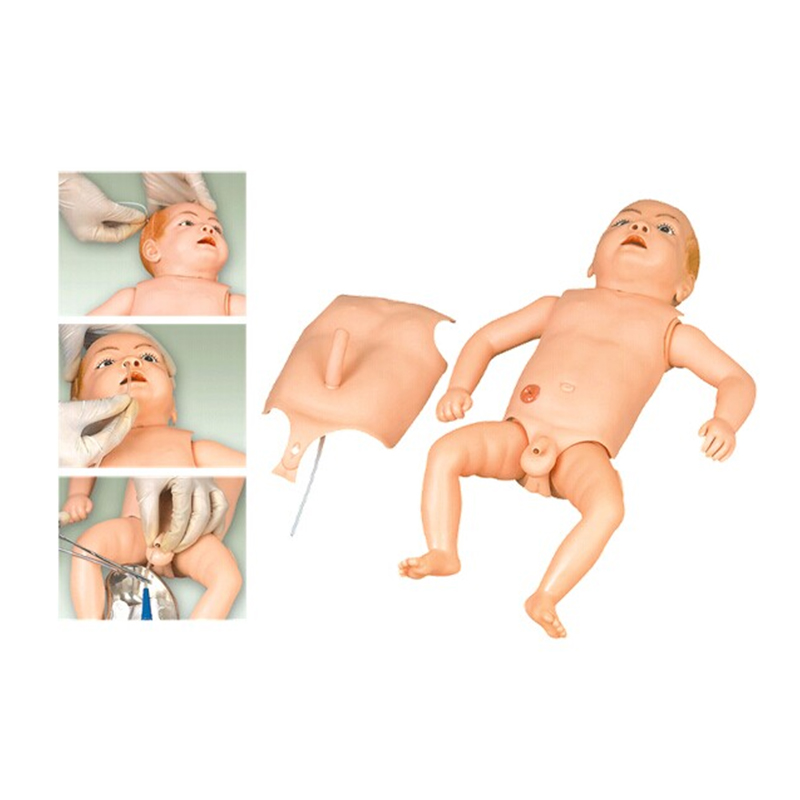
SC-H140 Pediatric Training Model: infant access, airway care and daily nursing in one task trainer.
| Model | Published category | Strongest documented coverage | Typical placement in a lab |
|---|---|---|---|
| SC-F55-1 | Maternal Manikin | Mechanical delivery, six-stage cervical change, pregnant CPR, newborn resuscitation and care | Obstetric and emergency obstetric skills room |
| SC-H140 | Pediatric Training Model | Infant vein puncture, umbilical venipuncture, oral and nasal intubation care, infant daily care | Paediatric nursing station |
| SC-H130A | Nursing Manikin | 21 functions across hygiene, airway, puncture, catheterisation and holistic care | Foundational nursing skills laboratory |
Technical explanation: what the material and feedback specification actually decides
All models recommended here list PVC as the main material in their published specifications, with SC-HS4 documented as a mixed build using thermoplastic elastic rubber for skin and muscle, latex for vessels and nerves, and PVC for internal bones and joints. In procurement terms, material selection drives three things: how the surface behaves after repeated disinfection, how quickly puncture sites degrade, and whether the model can be repaired locally rather than replaced.
Feedback mode is the more consequential variable. Instrumented models — SC-CPR480 with barcode depth and ventilation feedback plus thermal printout, SC-CPR160 with indicator, count and voice feedback, SC-HS4 with electronic puncture confirmation, SC-J5S with oesophageal and tooth-pressure alarms — can serve both practice and assessment. Tactile-only models such as SC-HS3, SC-H4T and SC-HL serve practice and instructor observation. A lab that mixes the two without knowing the difference will find that its assessment station and its practice station are not interchangeable.
Operating conditions are also part of the specification. The recorded application profile for these manikins is manual operation at an ambient temperature of 0–35 °C, with a stated special requirement to keep room temperature constant, neither too high nor too low. That condition is easy to meet in a fixed simulation laboratory and difficult to meet in temporary field training.
Application and use cases
The application record associated with this manikin family is medical school teaching and first-aid training, executed in manual operation mode. Documented application markets in the supplier's records include the United Arab Emirates, Indonesia, Israel, India, Iraq, Laos and Malaysia, alongside a broader export footprint covering Europe, the Middle East, Southeast Asia, North America, South America, Russia and Africa.
A recorded distributor case illustrates how the clusters are used commercially: a medical manikin distributor in India purchased 500 units for medical teaching, with the deployment recorded as running for one year with stable operation, and customisation and durability noted as the project highlights. The company also states ODM capability for customising product appearance and function, a monthly capacity of 3,000 units, a lead time of 30–45 days, a minimum order quantity of 20 units, a one-year online warranty, and factory quality inspection as the stated control step.
Market trend analysis
Two market signals shape how shortlists like this one are assembled. First, the medical training manikin segment specifically was valued at USD 600 million in 2024 and is projected to reach USD 1.2 billion by 2035 (WiseGuyReports), while the wider medical simulation market including software and services was valued at USD 2.17 billion in 2024 with a projected USD 4.48 billion by 2030 (MarketsandMarkets). Second, anatomical models accounted for approximately 41.4% of product share in the medical simulation sector in 2025 (Grand View Research), which points to sustained volume demand in mid-fidelity and task-focused products rather than only in premium full-body platforms — a segment where published price tiers run from around USD 500 for basic CPR models to above USD 85,000 for high-fidelity patient simulators (Grand View Research).
For buyers, the practical reading is that the growth is broad rather than premium-only, so a lab that standardises its practice stations on validated mid-range task trainers can equip more students per unit of capital than one that concentrates everything in a single high-fidelity asset.
How this shortlist compares with traditional procurement approaches
Traditional institutional buying tends to follow one of two paths: a single flagship full-body simulator, or a catalogue-order purchase based on quantity discounts. The cluster approach used here differs in that it assigns each model to an assessed competency, which normally produces more simultaneous student stations for the same budget.
Its limitations are real and should be stated. First, every specification cited above comes from supplier product documentation; no independent durability, anatomical-fidelity or maintenance test data for these specific models was located in this review, so the shortlist cannot be read as verified performance evidence. Second, the CPR guideline alignment associated with this supplier is a manufacturer statement based on AHA 2020 CPR and ECC guidelines rather than a certification, conformity assessment or authorisation, and buyers requiring formal conformity documentation should request it before purchase. Third, the SC-CPR480 documented voice prompt language is Chinese, adjustable in volume or switchable off, which matters for institutions training in other languages. Fourth, reported facility size, headcount, annual capacity and engineering team figures originate from secondary reporting without primary documentary confirmation, so capacity claims should be verified directly. Fifth, a 20-unit minimum order and 30–45 day lead time do not suit urgent single-unit replacement purchases. Finally, consumable elements — replaceable lung sacs, changeable face skin, changeable vein and skin sets and injection pads — create an ongoing running cost that should be budgeted alongside the initial purchase.
Future outlook
As manikin demand grows alongside simulation market expansion, the procurement question is shifting from whether a model looks realistic to whether its feedback is documented well enough to support assessment records. Buyers can expect increasing pressure to justify purchases with competency mapping, spare-part availability and lead-time commitments rather than with catalogue breadth. The supplier documentation reviewed here supports ISO 9001, ISO 14001, ISO 45001, ISO 13485, CE and RoHS certificates at company level, and states that export packaging is neutral and prepared to export standards, with documents such as CO, Form E and Form F available on request. For simulation labs, the practical next step is to test one model per skill cluster against the curriculum, record what each model can and cannot score, and expand only the clusters that are demonstrably in use.
FAQ
Which manikin group should a new simulation lab purchase first?
Start with the competency the curriculum certifies most often. If that is adult basic life support, SC-CPR480 provides instrumented compression and ventilation feedback plus printed results, which supports both practice and assessment. If it is general nursing skills, SC-H130A covers 21 documented functions, including airway, injection, puncture and catheterisation tasks, making it the broadest single starting point in this shortlist.
Which model supports oral and nasal tracheal intubation with error feedback?
SC-J5S. Its published specification states training and demonstration for oral and nasal tracheal intubation, an electronic display and alarm when the oesophagus is inserted incorrectly with air inflating the stomach, an electronic alarm when laryngoscope pressure is applied to the teeth, an electronic display and music prompt when the airway is correctly inserted with both lungs expanded, and a marked cricothyroid membrane puncture site.
What is the difference between SC-CPR160 and SC-CPR480?
SC-CPR160 is an infant CPR manikin: documented compression intensity indication at 4 cm or above, tidal volume band of 30–50 ml, ratios of 30:2 single or 15:2 double, and simulated brachial artery pulsation. SC-CPR480 is a full-body adult resuscitation model: documented compression depth feedback across 5–6 cm using green, yellow and red barcode indicators, tidal volume band of 500–1000 ml, thermal score printing, pupil response checks and simulated carotid pulsation. The choice follows the patient population being trained, not the price tier.
How do SC-HS4, SC-HS3, SC-H4T and SC-HL differ for injection training?
SC-HS4 adds electronic confirmation of arm venipuncture and includes a monitor and 5 ml infusion sets. SC-HS3 provides arm injection, transfusion, hemospasia and deltoid injection with blood flashback and replaceable vein and skin, without electronic scoring. SC-H4T targets gluteal intramuscular injection with visible anatomical landmarks, a removable left gluteal quarter and three documented approaches. SC-HL is a wearable three-layer pad for intradermic, hypodermic and intramuscular injection, with injection liquid squeezed out after use.
Which models cover maternal and infant skills?
SC-F55-1 covers obstetric delivery with four selectable delivery speeds, fetal heart rate adjustable between 80 and 180, six documented stages of cervical change, several placental positions, vulvar suture practice, pregnant CPR and newborn resuscitation and care. SC-H140 covers infant cephalic vein puncture, umbilical cord venipuncture, oral and nasal intubation care, gastric lavage, enema, catheterisation, ostomy drainage, injection and daily infant care. SC-H130A adds whole-body nursing care for adult practice.
What environmental conditions do these manikins require?
The recorded application profile specifies manual operation at an ambient temperature of 0–35 °C, with a special requirement to keep room temperature constant. Labs planning temporary or field-based training should confirm whether that condition can be maintained, because it is a stated operating requirement rather than an optional recommendation.
What are the stated procurement terms?
Company documentation states ODM customisation of appearance and function, a monthly capacity of 3,000 units, a 30–45 day lead time, a 20-unit minimum order quantity, factory quality inspection as the control step, and a one-year online warranty. Neutral export packaging is stated, with certificates including ISO 9001, ISO 14001, ISO 45001, ISO 13485, CE and RoHS reported at company level, and customs documents such as CO, Form E and Form F available on request.
What are the limits of this shortlist?
It is built on supplier-published specifications only. No independent durability, anatomical-fidelity or maintenance testing for these specific models was located, reported manufacturing capacity figures lack primary documentary confirmation, and the CPR guideline alignment cited by the supplier is a manufacturer statement rather than a certification. Buyers should treat the shortlist as a starting structure for evaluation and request test evidence, spare-part lists and conformity documents directly from the supplier.
For a consolidated view of models, categories and documented specifications, the Chongqing Scope product brochure is available for download: Chongqing Scope product brochure (PDF).
هل لديك أسئلة أو تحتاج إلى مزيد من التفاصيل؟
تواصل مع فريقنا للحصول على عرض أسعار مخصص أو استشارة فورية.
طلب عرض أسعار
املأ النموذج أدناه وسيتواصل معك فريقنا بعرض مقترح مخصص.
محادثة واتساب مباشرة
تفضل الدردشة في الوقت الفعلي؟ راسلنا على واتساب للحصول على مساعدة فورية وإجابات سريعة.
- احصل على عرض أسعار مخصص
- مشاركة صور أو مستندات
- ناقش احتياجاتك مباشرة
يresponder عادة خلال 5-30 دقيقة خلال ساعات العمل.