
Manual Valves for Water Treatment: CSV410 & SNI501 Strainers
Water Treatment Manual Valves: CSV410 Check Valves & SNI501 Strainers
An independent shortlist and procurement reference for manual check valves and cast iron strainers in water and wastewater treatment.
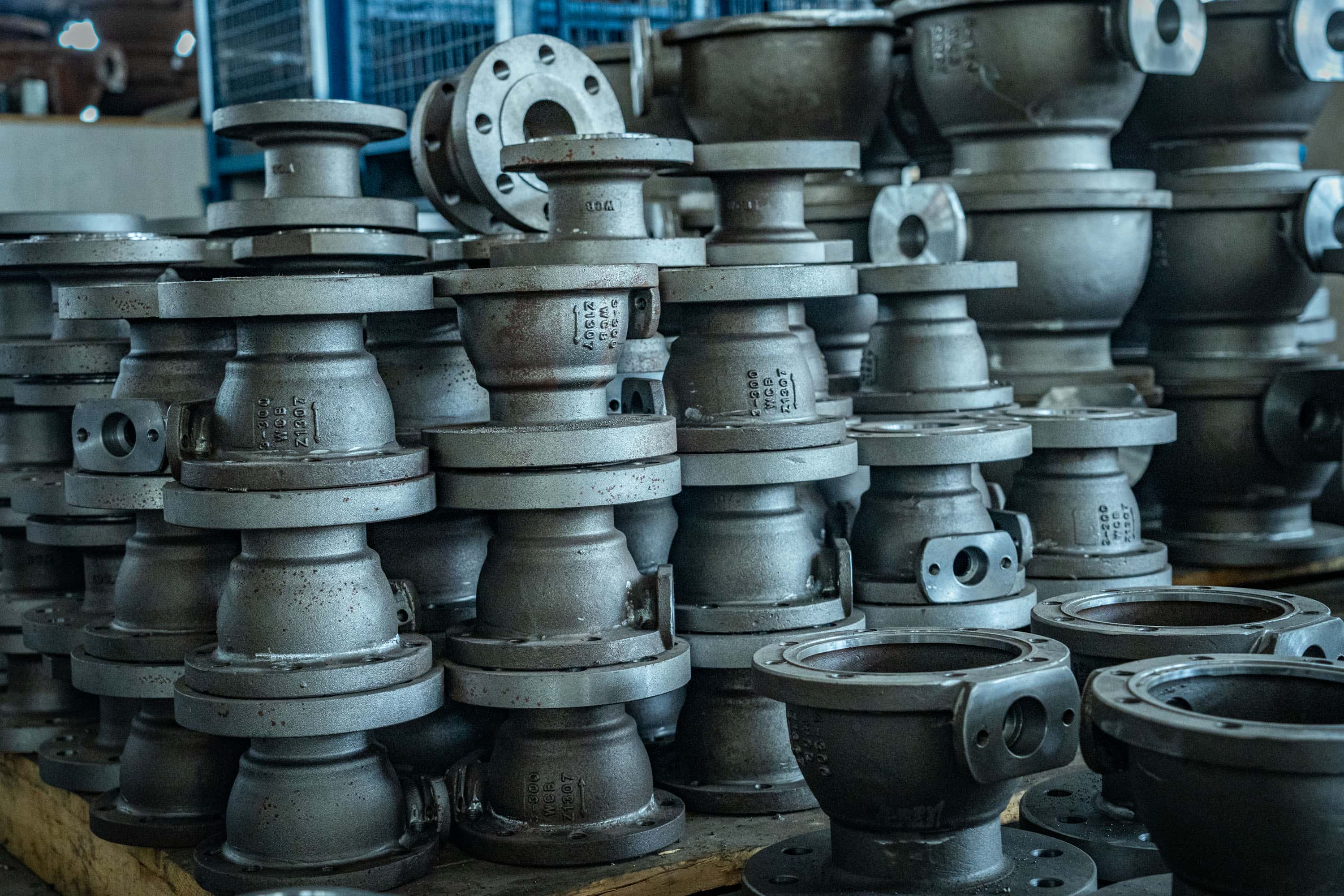
Finished manual valves staged in a manufacturer warehouse before packing and dispatch. Water treatment orders commonly combine check valves and strainers in a single shipment.
Water treatment asks one valve specification to serve two different duties
Water treatment is one of the few process industries where the working fluid is simultaneously the product, the cleaning medium and the safety boundary. The duty profile is not uniform. On the purification side, working conditions are described as clean, safe and comparatively easy, with minimal hazards. On the wastewater side, the same plant deals with odour, humidity and toxic gases under noticeably harsher conditions.
That split produces three recurring requirements for valves in water projects: efficient control of flow and pressure so that treatment stages perform as designed; compliance with the water quality and safety standards that govern the plant; and durability under corrosive environments with minimal maintenance demand. None of these requirements is resolved by the valve catalogue alone. They are resolved by how precisely the buyer writes the specification.
Manual operation remains the default for a large share of this piping. A manual valve needs no power supply, no instrument air and no control loop, so it stays functional during electrical maintenance and in remote or unmanned sections of a treatment train. Across the water treatment portfolio at EG Valves Manufacturing Co., Ltd, manual, pneumatic and electric operation are all offered, which means manual selection is a deliberate choice rather than a limited fallback.
The shortlist at a glance: CSV410 and SNI501
CSV410 is a stainless steel check valve from EG Valves Manufacturing Co., Ltd, intended for water treatment, HVAC, oil & gas, petrochemical, power generation and industrial pipeline applications. Its body materials are stainless steel, duplex steel and alloy steel. Wafer, lug and double flange body styles are available, and dual plate, single plate, wafer lift and threaded configurations are all offered within the same model designation.
SNI501 is a cast iron strainer with a body of cast iron or ductile iron. It is built in either Y-strainer or basket strainer construction and is specified for water treatment, HVAC, building services, municipal utilities and general industrial pipelines. Its stainless steel screen is available in a wide variety of meshes and perforations, and a bolted-on cover provides access to the interior for routine maintenance.
| Parameter | CSV410 Stainless Steel Check Valve | SNI501 Cast Iron Strainer |
|---|---|---|
| Function | Prevents reverse flow | Captures debris upstream of protected equipment |
| Body material | Stainless steel, duplex steel, alloy steel | Cast iron or ductile iron |
| Body styles | Wafer, lug, double flange | Y-strainer or basket strainer |
| Internal configuration | Dual plate, single plate, wafer lift, threaded | Stainless steel screen in a wide variety of meshes and perforations |
| Size range | NPS 1/2" to 48" (DN15 to DN1200) | NPS 2" to 12" (DN50 to DN300) |
| Pressure rating | Class 150 to Class 1500; PN10 to PN160 | Class 125 / Class 150; PN10 / PN16 |
| End connections | Wafer, lug, double flange, threaded | FF, RF, threaded (NPT / BSP / BSPT) |
| Coating | Not specified in the published specification | Epoxy powder coating or paint coating |
| Stated design features | High torsion Inconel springs for quick closing; lapped seat faces; disc assembly secured by a high strength key | Bolted-on cover for routine maintenance access; design prohibits galling or scoring of seating surfaces |
Technical explanation: what these two specifications actually determine
CSV410: configuration breadth is the central buying decision
The most consequential fact about the CSV410 is not a single number but the range of arrangements it covers. Because wafer, lug and double flange body styles are optional and dual plate, single plate, wafer lift and threaded internals are all available, one model designation can be matched to several different line conditions instead of forcing a plant to standardise on one compromise design.
Three engineering details carry most of the specification weight. First, the valve uses high torsion Inconel springs for quick closing. In a plate-type check valve the plates are spring-assisted, and spring stiffness directly affects how quickly the plates return to the seat once forward flow stops. Second, the seat faces are lapped for a smooth finish and superior sealing, meaning the sealing contact is a machined metal surface rather than a soft elastomer insert. Third, the disc assembly is secured in place by a high strength key, which addresses retention of the moving assembly rather than flow performance.
The CSV410 also lists special cleaning for applications such as oxygen or chlorine. Buyers should read this as a separate, application-specific preparation rather than a default condition of supply: a line running chlorinated water in an oxygen-adjacent service area should state the requirement explicitly in the order.
Size coverage runs from NPS 1/2" to 48" (DN15 to DN1200) with pressure ratings from Class 150 to Class 1500, or PN10 to PN160. That span covers the small-bore chemical dosing and instrument lines at the bottom of a treatment plant as well as the large-diameter transmission headers at the top of it.
SNI501: strainer type, screen and coating define performance
The SNI501 is a cast iron strainer with a cast iron or ductile iron body, available in Y-strainer or basket strainer construction. The distinction matters because the two constructions solve different problems. A Y-type body carries the screen in an angled branch off the main line and is normally specified where the strainer sits in a straight run and the captured debris load is moderate. A basket-type body places a larger screen area inside a chamber and is generally chosen where debris volume is higher or where the screen must be lifted out for cleaning on a routine schedule.
Two construction details support maintenance in a wet environment. The bolted-on cover provides access to the interior for routine maintenance, and the design prohibits galling or scoring of seating surfaces so the cover sealing face does not degrade each time it is opened and closed. The stainless steel screen is offered in a wide variety of meshes and perforations, which is the field that most often decides whether a strainer protects downstream equipment or becomes an obstruction itself.
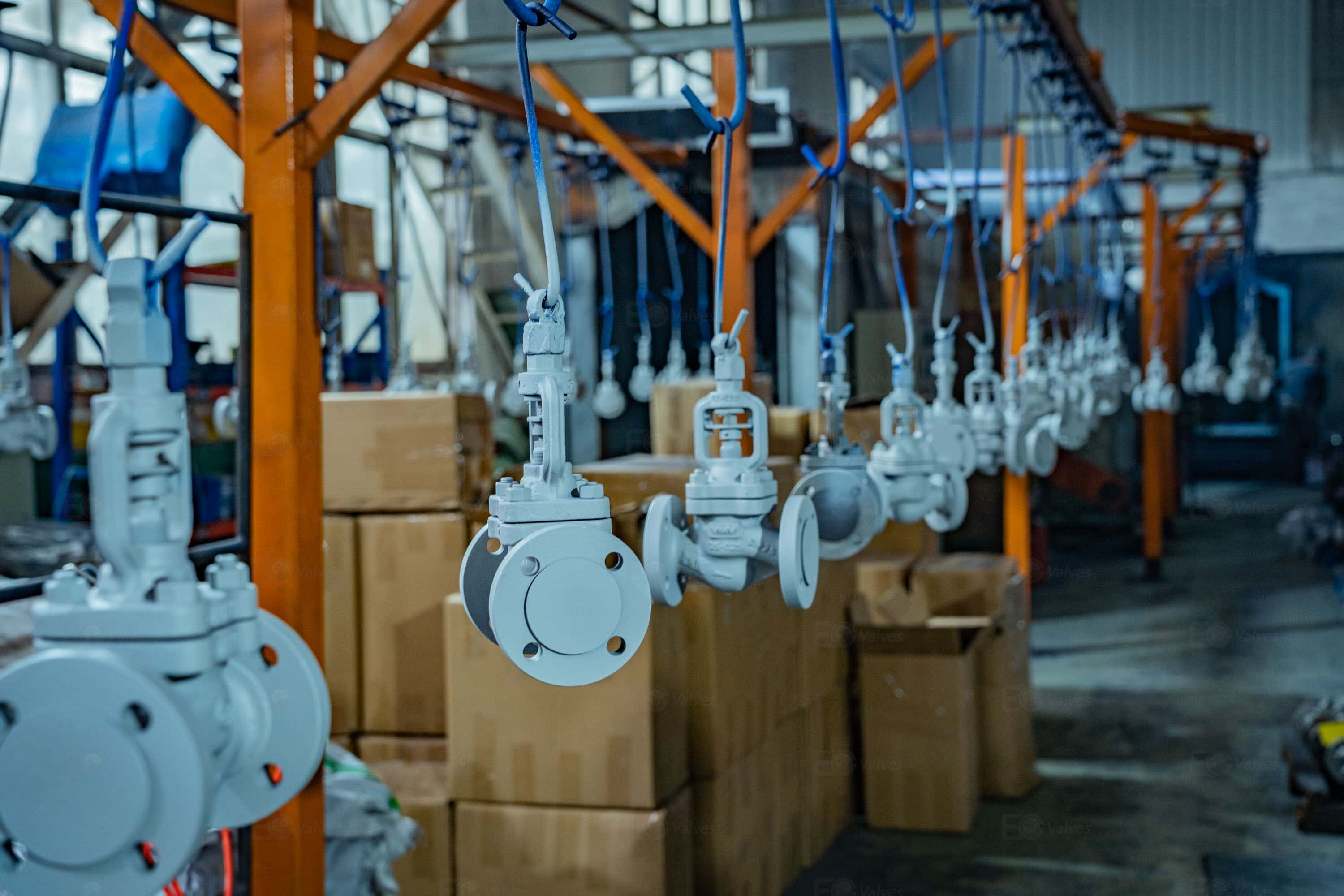
Coating stage in valve production. The SNI501 cast iron strainer is supplied with epoxy powder coating or paint coating to protect the body in humid water treatment and wastewater environments.
Coating on a cast iron or ductile iron body is part of the corrosion strategy, not a cosmetic finish. The SNI501 is supplied with epoxy powder coating or paint coating. The size range is NPS 2" to 12" (DN50 to DN300) with a rating of Class 125 / Class 150 or PN10 / PN16, and end connections include FF, RF and threaded types in NPT, BSP or BSPT threads.
What manual operation changes in a water treatment specification
Specifying manual operation removes actuators, solenoids, air lines and control wiring from the bill of materials. It also relocates the operating requirement to a human being. Every manual valve in a treatment plant is a point that maintenance staff must physically reach, so handwheel or lever accessibility, stem orientation and platform access belong in the piping layout review, not in a post-installation correction.
Where these two components fit in a water treatment plant
The CSV410 is applied in water treatment, HVAC, oil & gas, petrochemical, power generation and industrial pipeline services. In a treatment plant the practical placements are the discharge side of pumps and blowers, where reverse flow would damage rotating equipment; parallel pump and filter trains, where reverse flow would contaminate a clean stream; and interconnections between the treatment block and the plant's own HVAC and cooling water systems, which share the same component family.
The SNI501 serves water treatment, HVAC, building services, municipal utilities and general industrial pipelines. Typical positions are immediately upstream of pumps, control valves, flow meters and heat exchangers, where it protects precision internals from scale, debris and construction residue carried into the line.
Water project applications for this product family are documented across a wide geographic base, including the United Kingdom, France, Germany, Italy, Spain, China, Mexico, Brazil, Norway, Denmark, Sweden, Romania and Bulgaria. Because the same manufacturing base also produces cast iron gate, ball and globe valves, butterfly valves and other check valve models for water service, a buyer can assemble most of a water treatment bill of materials from one specification library rather than reconciling several suppliers' dimension and material conventions.
Market signals buyers should weigh
Third-party market research places the global manual valve market at an estimated USD 78.4 billion in 2025, projected to reach USD 117.17 billion by 2035 (Vantage Market Research). The wider gate valve market alone is projected to grow from USD 13.0 billion in 2024 to USD 20.6 billion by 2034 at a CAGR of 4.7% (Market Research Future). Demand of this scale in a mature product category is driven mainly by replacement, rehabilitation and capacity expansion of existing infrastructure rather than by a new application.
Within valve categories, the manual segment accounted for a 41.2% revenue share of the global butterfly valve market in 2024, attributed to cost-effectiveness and simplicity (Grand View Research). Manual ball valves are reported to hold a 28.1% share of the general valve market in 2025, driven by reliability in high-pressure applications (Precedence Research). The consistent pattern across these figures is that water infrastructure continues to buy manual valve content in volume, because the simplicity that costs a plant nothing in power and control hardware is exactly the property a treatment plant needs in a 30-year asset.
On the standards side, two references shape almost every purchase order. ASME B16.34 provides the baseline for pressure-temperature ratings and wall thickness in industrial manual valves, and API 600 is the specific heavy-duty standard for bolted-bonnet steel gate valves in petroleum and natural gas industries. A buyer who names ASME B16.34 as the baseline and API 600 where applicable gives the supplier an unambiguous design reference.
Comparison with traditional solutions, and where these products stop
Manual versus actuated. A manual valve has no instrument air, no solenoid and no control signal to fail. That is why manual valves remain widespread in isolation duty. The trade-off is that every operation requires an operator at the valve, and response time is human rather than instantaneous. For lines that must cycle frequently or close on a process signal, an actuated version of the same product family is the more appropriate specification.
Plate-type check valve versus swing check valve. A wafer or lug dual plate check valve occupies far less line length than a conventional swing check, which needs a body long enough to accommodate a swinging disc. The CSV410 addresses the closure side of that trade-off with high torsion Inconel springs for quick closing. As a general engineering consideration, spring-assisted plate designs depend on forward flow to hold the plates open, so services with persistently low or strongly pulsating flow should be reviewed against actual flow conditions before a plate-type design is confirmed.
Cast iron strainer versus cast steel strainer. The SNI501 covers NPS 2" to 12" (DN50 to DN300) at Class 125 / Class 150 or PN10 / PN16. Where a project needs a wider size range or higher pressure classes, a cast steel strainer construction such as the SNS505 extends to NPS 1/2" to 20" (DN15 to DN500) and Class 150 to Class 600 with Y-strainer or basket strainer construction. That is a real boundary, not a defect: cast iron strainers belong on the low-pressure side of a treatment plant, and buyers should not stretch them into high-pressure headers to keep a single model number on the schedule.
Three further limits are worth writing down before the enquiry goes out. The first is cleaning scope: special cleaning on the CSV410 is specified for applications such as oxygen or chlorine, so it must be requested rather than assumed. The second is material exposure: a cast iron or ductile iron strainer body depends on coating integrity, so aggressive chemical or high-chloride service deserves a material review before a cast iron body is confirmed. The third is accessibility: manual valves require an operator position, and no specification document can substitute for a layout that gives maintenance staff safe reach.
Purchasing terms and acceptance criteria
Most disputes on water treatment valve orders trace back to a purchase specification that named a model but left the surrounding fields open. The table below lists the fields that determine whether the delivered item matches the line it is intended for.
| Order field | What to state | Why it matters |
|---|---|---|
| Model and product type | CSV410 check valve; SNI501 strainer | Prevents substitution across a broad product family |
| Size | NPS or DN, per line list | Confirms the size sits inside the model range |
| Pressure class | Class or PN, referenced against ASME B16.34 where applicable | Avoids over-specifying cost or under-specifying safety |
| Body and trim material | Stainless steel, duplex steel or alloy steel for CSV410; cast iron or ductile iron for SNI501 | Links the valve to the actual water chemistry |
| Configuration | Wafer, lug or double flange; dual plate, single plate, wafer lift or threaded for CSV410; Y-strainer or basket strainer for SNI501 | Determines fit with the installed piping and the maintenance method |
| End connection | FF, RF or threaded (NPT / BSP / BSPT) for SNI501; wafer, lug, double flange or threaded for CSV410 | Thread standard must match the plant's existing pipe threads |
| Screen specification | Mesh and perforation size for the SNI501 stainless steel screen | Decides what the strainer removes and what pressure drop it adds |
| Coating | Epoxy powder coating or paint coating on the SNI501 body | Corrosion protection for a ferrous body in a humid plant |
| Special cleaning | State clearly where CSV410 will see oxygen or chlorine service | Cleaning is an application-specific preparation, not a default |
| Design standard | ANSI, DIN, BS or JIS, or customer-specific requirements | Aligns dimensions and ratings with the rest of the plant |
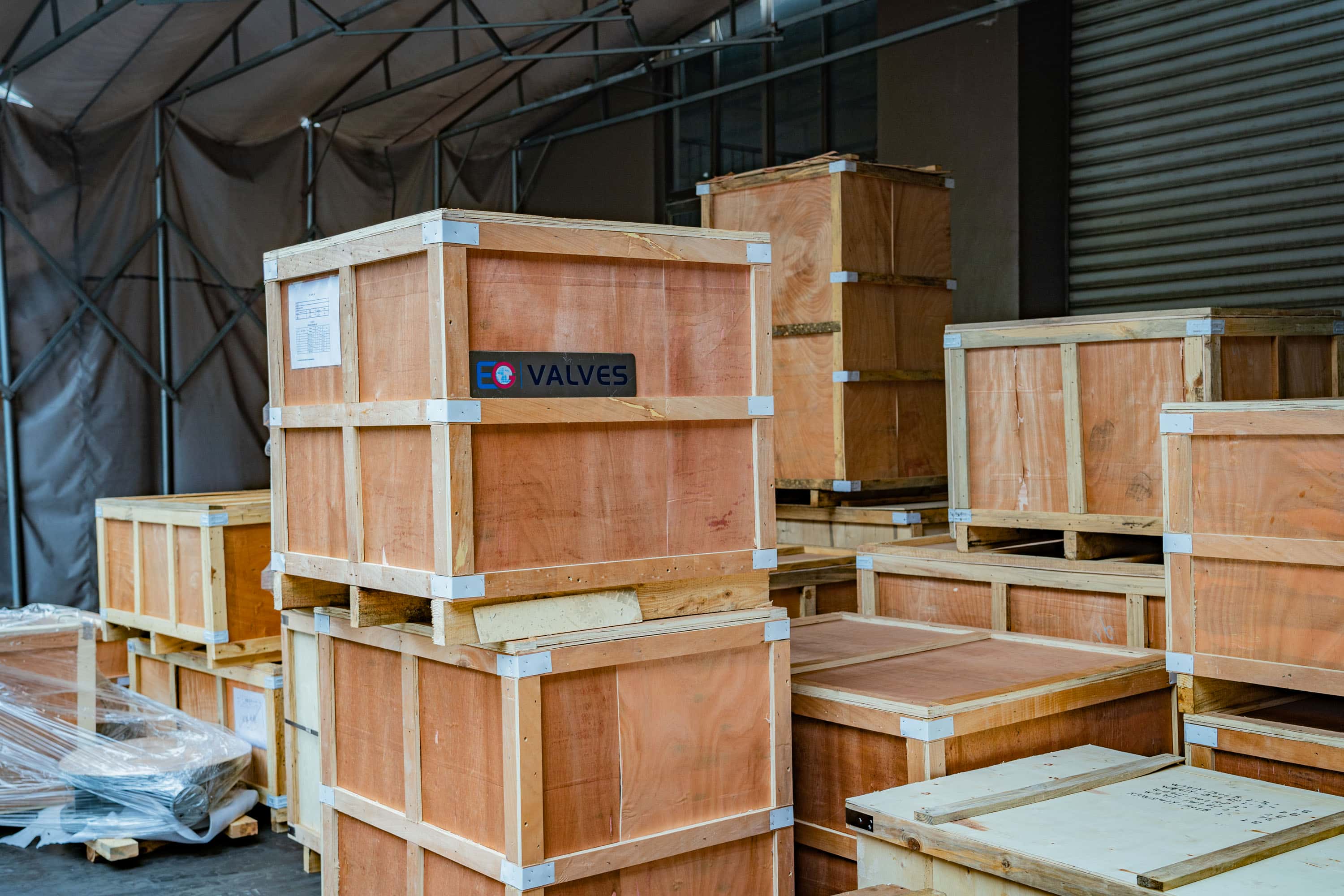
Packing and protection is a standard acceptance checkpoint on water treatment valve orders, particularly where goods will be stored outdoors before installation.
Acceptance criteria then translate these fields into checks at goods-in. A practical inspection list for a water treatment delivery includes: model and size verification against the line list; visual examination of lapped seat faces on check valves for smooth finish and freedom from scoring; verification of the bolted-on cover and the condition of the sealing surface on strainers, which the design is intended to protect from galling; confirmation of the stainless steel screen mesh or perforation against the order; verification of epoxy powder or paint coating continuity on cast iron bodies; thread gauge checks on NPT, BSP or BSPT connections; confirmation that any special cleaning requirement was performed and documented; and verification that packing protects the coating and the internal surfaces during transport and site storage.
Documentation review runs in parallel. EG Valves Manufacturing Co., Ltd operates under ISO 9001-certified processes, and the ISO 9001:2015 scope covers gate valves, globe valves, ball valves, butterfly valves, check valves, pipe filters and flanges. The facility also holds API 600, API 6D, CE and PED certifications, with EU certification scope including gate valves, ball valves, globe valves, check valves, butterfly valves and strainers under PED 2014/68/EU Annex III, Module H. Where a project is export-facing, those statements should be matched to the actual certificates supplied with the order rather than accepted as a general claim.
Future outlook
The direction of water treatment procurement is toward fewer, better-specified valve families rather than longer fragmentary schedules. Three pressures are driving that. Ageing distribution and treatment infrastructure continues to need replacement content in volume, which favours standardised, power-independent manual designs. Water quality and safety obligations keep pushing documentation and traceability expectations upward, so buyers increasingly ask for certification scope before a supplier is shortlisted. And material selection keeps shifting where service life justifies it, with duplex and stainless internals considered earlier in the selection process for lines that see aggressive residuals or high chloride exposure.
For a buyer, the practical implication is that the specification document is becoming more important than the catalogue. A correctly written order for a CSV410 check valve or an SNI501 strainer already contains the answers to most questions that arise during commissioning, and it protects the plant long after the delivery is signed off.
FAQ
What is a manual check valve, and where does it belong in a water treatment plant?
A manual check valve is a non-return valve that opens and closes automatically in response to flow direction rather than by operator action; “manual” refers to the fact that no actuator is fitted to the assembly. The CSV410 is a stainless steel check valve intended for water treatment, HVAC, oil & gas, petrochemical, power generation and industrial pipelines, with body materials of stainless steel, duplex steel or alloy steel and a size range of NPS 1/2" to 48" (DN15 to DN1200) at Class 150 to Class 1500. In a treatment plant it is normally placed on pump discharge lines and between parallel process trains to prevent reverse flow from contaminating a clean stream or damaging rotating equipment.
How do you choose between wafer, lug, double flange and threaded check valve configurations?
The choice is driven by the piping arrangement rather than by the valve's internal performance. Wafer and lug bodies are installed between mating pipe flanges, while double flange bodies carry their own flanges and align with flanged pipe spools. Threaded configurations connect directly to threaded pipe and are relevant at the small-bore end of the range, which for the CSV410 begins at NPS 1/2". Internally, the CSV410 is available in dual plate, single plate, wafer lift and threaded arrangements, so a single model designation can be matched to several line conditions without changing the product family.
When should a Y-strainer be specified instead of a basket strainer?
The SNI501 is available in Y-strainer type or basket strainer type construction, and the selection follows the debris load and the maintenance method. A Y-type body holds the screen in an angled branch and suits straight runs with moderate debris loading. A basket-type body places a larger screen area in a chamber and is generally selected where debris volume is higher or where the screen is cleaned on a routine schedule. Both constructions use a stainless steel screen available in a wide variety of meshes and perforations, and both provide a bolted-on cover for access to the interior for routine maintenance.
Which pressure class and material should be specified for water treatment service?
The SNI501 cast iron strainer is rated Class 125 / Class 150 or PN10 / PN16 with a body of cast iron or ductile iron, a size range of NPS 2" to 12" (DN50 to DN300), and end connections in FF, RF or threaded (NPT / BSP / BSPT), plus epoxy powder coating or paint coating. The CSV410 stainless steel check valve covers Class 150 to Class 1500 or PN10 to PN160 with a body of stainless steel, duplex steel or alloy steel. The general procurement reference for pressure-temperature ratings and wall thickness is ASME B16.34, and API 600 applies specifically to bolted-bonnet steel gate valves used in petroleum and natural gas industries.
What purchasing terms and acceptance criteria belong in a valve order?
A complete order states the model and product type, size, pressure class, body and trim material, configuration, end connection, screen mesh or perforation for strainers, coating, and any special cleaning requirement. It also names the design standard — ANSI, DIN, BS or JIS, or customer-specific requirements. Acceptance checks at goods-in typically cover model and size against the line list, visual examination of lapped seat faces, condition of the bolted-on cover and its sealing surface, screen specification, coating continuity, thread gauge checks, confirmation of special cleaning, and packing quality. Certification scope, including ISO 9001:2015 coverage and PED 2014/68/EU Annex III, Module H where applicable, should be verified against the certificates actually supplied with the order.
What are the limitations of these components in water treatment applications?
Three limits are documented in the specifications themselves. The SNI501 cast iron strainer is limited to NPS 2" to 12" (DN50 to DN300) and Class 125 / Class 150 or PN10 / PN16, so larger or higher-pressure lines require a different strainer construction, such as the cast steel SNS505 range at NPS 1/2" to 20" and Class 150 to Class 600. Special cleaning on the CSV410 is specified for applications such as oxygen or chlorine and is therefore an application-specific preparation rather than a standard supply condition. And because both products are manual, every unit requires an operator position that maintenance staff can reach, which is a layout requirement that no product specification can resolve on its own.
For readers who want the underlying product documentation, EG Valves Manufacturing Co., Ltd publishes a downloadable company brochure at the EG Valves brochure (PDF). The company profile is also available at www.egvalves.com.