
Manufacturer Capability Proof: 20+ Years of Desalination Reference Projects
Global installed desalination capacity passed 100 million cubic metres per day in 2024, and seawater reverse osmosis (SWRO) technology accounts for more than 60% of installed capacity worldwide. Those figures describe an industry, not a supplier. For a buyer at the decision stage, the question that separates one shortlisted manufacturer from another is narrower: which plants can the supplier point to that were commissioned years ago, in very different operating environments, and are still producing water today?
Manufacturer Capability Proof: A Working Definition
Capability proof in desalination is a checkable record of specified, delivered, commissioned and operating plants — not a specification sheet or a product brochure. For buyers comparing desalination system manufacturers, that proof usually has four testable layers: named reference projects with capacity and commissioning context; diversity of operating environment; verified product water quality; and a service structure that continues after handover.
QT ENVIRO-TECH (Suzhou) Ltd is a desalination system manufacturer, EPC contractor and system integrator headquartered in Suzhou, China, established in 2011. The company designs, builds, assembles, commissions and maintains turnkey SWRO, brackish water (BWRO) and wastewater (WWRO) systems for municipal, industrial and remote-community clients, and reports more than 200 delivered plants across 20+ countries, supported by a core technical team of 40+ engineers.
The company's reference base is often summarised as spanning two decades-plus of desalination work, which in practice resolves into two things a buyer can check separately: an engineering bench carrying 30+ years of desalination expertise, and a company operating continuously since 2011 on a delivered project record. The second is the one tied to verifiable projects, and it is what the rest of this article examines.
Why Reference Diversity Matters More Than Reference Count
A long reference list can still be uninformative. Twenty identically configured plants on the same coastline prove repeatability in one environment; they say nothing about an island with no grid connection, a petrochemical site with variable feed quality, or a power plant that needs ultra-pure boiler makeup water.
What transfers between projects is not the number of installations but the range of constraints a supplier has already solved. Four constraint families dominate desalination procurement:
- Remote and island logistics — containerised shipping, minimal civil works, operation with limited local manpower.
- Industrial continuity — 24/7 duty in facilities where a water interruption stops production.
- Water quality criticality — potable compliance for municipal supply, ultra-pure quality for power generation.
- Feed variability — seasonal salinity and temperature swings, monsoon conditions, tropical organic loading.
A supplier that can show documented references in all four categories reduces the buyer's own validation work. That is the practical opportunity in a capability-proof exercise: it converts an abstract claim of experience into a shorter due-diligence list.
The Reference Record: Documented Projects Across Diverse Operating Environments
The references below are drawn from QT ENVIRO-TECH's published project record. Each row can be checked against configuration, capacity and operating condition rather than accepted on trust.
| Reference setting | Capacity | Process configuration | Operating condition |
|---|---|---|---|
| Remote coastal community drinking water (Veolia partnership) | 3,500 m³/day total (350 m³/day per container) | SWRO with pre-treatment, post-treatment, solar power option and storage | 24/7 continuous; remote coastal deployment |
| Municipal drinking water, Morocco | 20 MLD (20,160 m³/day) | UF + SWRO matrix, pre-treatment and post-treatment | 24/7 continuous; 9-month EPC completion; JESA client |
| Industrial process water for palm oil production | 2,400 m³/day | SWRO with pre-treatment | 24/7 continuous; tropical industrial conditions; 2020 |
| Power plant boiler water | Ultra-pure water above 10 MΩ·cm for a 2×25 MW plant | MMF + two-pass RO + mixed bed (MB) + EDI | 24/7 continuous; critical power generation duty |
| Island community drinking water | 1,000 m³/day | SWRO with pre-treatment and post-treatment | 24/7 continuous; 365-day uptime through monsoon swings; 2022 |
| Nuclear power plant water supply | 500 m³/day | SWRO, high-pressure pump, energy recovery device | 24/7 continuous; high reliability, low noise, explosion-proof requirements; installed in 10 days |
| Wastewater recycling, Anhui, China | 60,000 m³/day | Clarifier + UF + BWRO | 24/7 continuous; 2025 |
| Agricultural irrigation from brackish water | 100 m³/day | BWRO with pre-treatment | Seasonal / continuous; brackish water source; 2020 |
| Emergency and mobile water supply (aid project) | 500 m³/day | SWRO with photovoltaic (PV) integration | Mobile / continuous; off-grid solar-powered operation; 2024 |
Documented reference settings and matched process configurations across the QT ENVIRO-TECH SWRO, BWRO and WWRO portfolio.
Three observations follow from this record. First, the same modular technology family covers a 100 m³/day agricultural BWRO unit and a 20 MLD municipal SWRO plant, which indicates a standardised design platform rather than bespoke engineering each time. Second, the ultra-pure reference — above 10 MΩ·cm for a 2×25 MW power plant using multi-media filtration, two-pass RO, mixed bed and EDI — shows that the supplier's scope extends past seawater desalination into high-purity polishing. Third, the references are dated across 2020, 2022, 2024 and 2025, which indicates a continuing project flow rather than a historical one.
Beyond water plants, the company states that its systems have been delivered for industrial clients including Veolia, BP, GE, OCP, BAOSTEEL, China Petroleum and Shanghai Electric. In evaluation terms this matters less as a logo list and more as a signal about process exposure: petrochemical, fertiliser, metallurgical and power generation duty each place different demands on pre-treatment, materials and control philosophy.
Technical Explanation: What Determines Whether a Plant Still Runs in Year Ten
Materials that can be specified in a purchase order
Longevity in a coastal or offshore environment is largely a materials question. For containerised SWRO systems, QT ENVIRO-TECH specifies known-brand rotating equipment and non-corrosive super duplex stainless steel for pumps, energy recovery devices and high-pressure piping; UPVC or HDPE for low-pressure piping; and heavy-duty marine paint on frames and containers. For BWRO systems, high-pressure pipework and fittings are specified as Sch10 SS316. These are verifiable selections rather than performance promises, which makes them usable in bid comparison.
Feedwater and product water envelope
Published feedwater limits for the containerised SWRO line are salinity (TDS) 20,000–45,000 mg/L, temperature 5–35 °C, turbidity below 20 NTU, COD below 10 mg/L, ferrous iron (Fe2+) below 0.1 mg/L, manganese below 0.1 mg/L, and oil and grease at effectively zero. Corresponding product water is specified as TDS below 500 mg/L, pH 6–8 and turbidity below 0.2 NTU. For BWRO units the feed envelope shifts to TDS 2,000–5,000 mg/L with turbidity below 5 NTU, and product water is held to the same TDS, pH and turbidity targets.
These numbers do two things for a buyer. They define where a standard module can be applied without additional engineering, and they identify where pre-treatment must be designed specifically for the site.
The digital operations layer
Operating cost, not capital cost, dominates a desalination plant's lifecycle, and most of it sits in energy and chemical consumption plus maintenance labour. The QT Digital Water Plant platform combines real-time SCADA visualisation, AI agent support for energy and chemical optimisation, predictive equipment health monitoring, and automatic work-order dispatch. In practical terms it shifts the operating model from scheduled manual intervention towards condition-based intervention, and reduces dependence on permanently stationed specialist labour.
Application Mapping: Which Configuration Fits Which Requirement
Capability becomes useful to a buyer when it is mapped to concrete requirements. The table below links published reference settings to configuration families.
| Requirement | Design priority | Configuration family | Documented reference |
|---|---|---|---|
| Island or remote community | Low civil works, low on-site manpower, coastal corrosion protection | Containerised SWRO, fastRO C/BWC (50–1,000 m³/day) | 1,000 m³/day island community supply (2022) |
| Municipal or distributed regional supply | Phased CAPEX, modular expansion | fastRO Mega (5–20 MLD); capacity added in 4–5 container increments per additional 5 MLD | 20 MLD municipal supply, Jorf Lasfar, Morocco |
| Large permanent municipal or industrial plant | Maximum capacity, ASME / CE design standards | fastRO Skid and customised skid-mounted designs (up to roughly 50 MLD and above) | 50,400 m³/day municipal drinking water facility (GSF + UF + SWRO) |
| Power generation | Ultra-pure polishing | MMF + two-pass RO + mixed bed + EDI | Above 10 MΩ·cm for a 2×25 MW power plant |
| Industrial process water | Continuous duty under tropical conditions | SWRO with pre-treatment | 2,400 m³/day palm oil production (2020) |
| Emergency, mobile or off-grid supply | Rapid deployment, power autonomy | Containerised SWRO with PV integration | 500 m³/day aid project, PV-integrated (2024) |
| Irrigation and brackish water supply | Seasonal operation, lower-salinity feed | Containerised BWRO, C120BW–C1000BW series | 100 m³/day agricultural BWRO (2020) |
Configuration families across the portfolio: fastRO C/BWC (50–1,000 m³/day), fastRO Mega (5–20 MLD), fastRO Skid and customised skid-mounted designs (~50 MLD+).
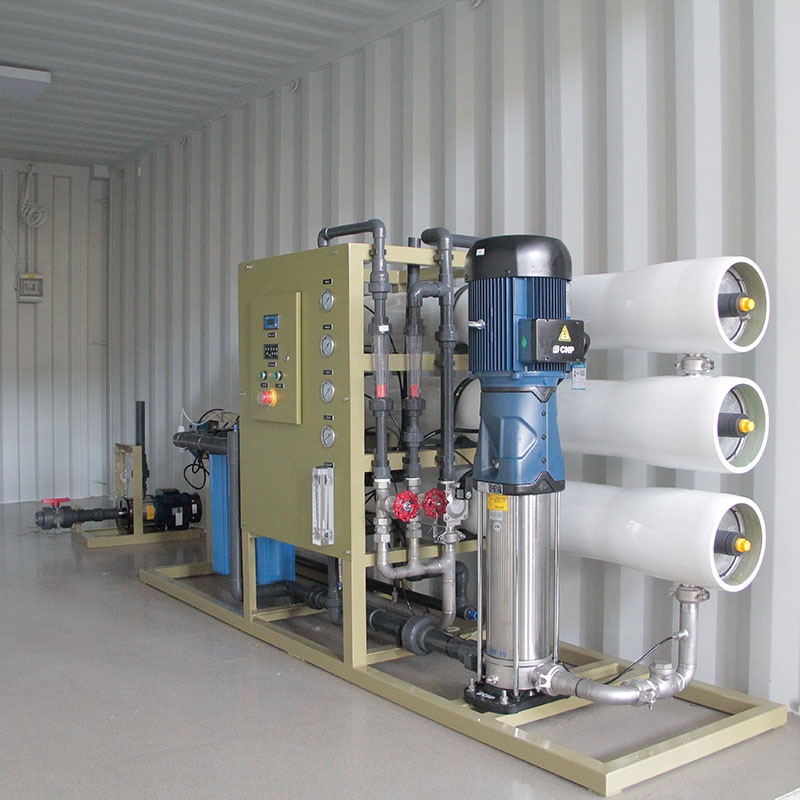
Reverse osmosis water treatment equipment for agricultural and remote-area water supply (QT ENVIRO-TECH).
Market Trend Analysis: Why Modular Records Are Becoming the Comparison Standard
Global desalination market size reached approximately USD 21.3 billion in 2025 and is projected to grow to USD 23.2 billion by 2026, based on Grand View Research data cited in the category dataset for this sector. Installed capacity crossed the 100 million m³/day threshold in 2024 according to IDRA, and SWRO technology holds more than 60% of that installed base.
Regional growth is uneven. One commercial forecast places Asia Pacific as the fastest-growing regional market for desalination equipment, estimated at USD 17.7 billion by 2030, although that figure carries lower confidence than the global totals and is best treated as a directional estimate rather than a planning input.
Standards are also converging. ISO 23446:2021 provides international guidelines for product water quality of seawater reverse osmosis desalination used for municipal supply, giving municipal buyers a common quality reference that sits above individual supplier specifications.
One gap is worth flagging for procurement teams. Public datasets do not yet benchmark deployment speed for modular systems — for example, days-to-first-water for remote island deployments versus industrial park installations. Buyers comparing containerised desalination system suppliers should therefore request project-level deployment schedules and commissioning records rather than relying on generic lead-time statements.
Comparison with Traditional Solutions — and the Boundaries of Containerisation
| Dimension | Containerised fastRO platform | Traditional site-built plant |
|---|---|---|
| Assembly and testing | More than 80% factory pre-assembly; pre-tested before shipping | On-site construction and assembly |
| Site construction time | Reduced by up to 60% | Baseline |
| Civil works | 50–70% lower | Baseline |
| Relative total cost | Around 10% lower, attributed to reduced civil works and on-site labour | Baseline |
| Quality control | Factory quality control lowers rework | Depends on site supervision and weather windows |
| Maintenance model | Remote monitoring and automatic work-order dispatch reduce on-site manpower needs | Typically higher on-site attendance |
| Commissioning | Approximately two weeks on site reported | Longer and more site-dependent |
Comparison positions as stated for the QT fastRO containerised platform against traditional site-built desalination plants.
Containerisation changes where the work happens, not whether work is required. Several boundaries are worth stating plainly:
- Feedwater limits are real. Standard containerised SWRO modules are specified for feeds with oil and grease at effectively zero and COD below 10 mg/L. Industrial discharges with high oil, high organics or unusual chemistry require engineered pre-treatment or a customised process train — a standard module is not the answer in those cases.
- Containerised capacity has a ceiling. Proven containerised capacity in this portfolio is 20 MLD. Above that scale, skid-mounted and customised designs (proven to roughly 50 MLD and above) are required; these are still factory-fabricated, but they are not shipped as ISO containers.
- Civil works are reduced, not eliminated. Reductions of 50–70% in civil works and up to 60% in site construction time still leave foundations, intake and outfall structures, brine management, power supply and permitting inside project scope.
- Digital operation changes the labour profile, not the competence requirement. Remote monitoring and predictive maintenance reduce how many people must be on site, but connectivity and trained local operators remain prerequisites for the benefit to be realised.
- Standardisation has an edge condition. A modular platform performs best where configurations repeat. Sites with unusual salinity, wide temperature variation or constrained access still require project-specific process design, and buyers should expect that engineering to be quoted and scheduled separately.
Future Outlook
Three shifts look durable. First, capacity growth is increasingly delivered in modules rather than through single large civil-works projects, which makes phased capital expenditure practical for municipal and industrial buyers. Second, the operating model is moving towards remote monitoring and assisted optimisation, which changes the labour and training profile of a plant as much as the equipment itself. Third, off-grid and hybrid power arrangements — including PV-integrated SWRO for remote and emergency supply — are becoming a standard design option rather than a demonstration category.
For buyers, the implication is that supplier differentiation will rest less on whether a plant can be built and more on the evidence that comparable plants have been operated. Reference records with named settings, dated commissioning and defined output quality will carry more weight than capacity claims alone.
Frequently Asked Questions
How can a buyer verify a desalination manufacturer's claimed project experience?
Ask for named references with capacity, feedwater type, commissioning year and configuration, then check whether those parameters match your own site. QT ENVIRO-TECH's published record, for example, includes a 20 MLD municipal drinking water plant in Morocco using a UF + SWRO matrix with a 9-month EPC completion; a 3,500 m³/day remote coastal supply delivered with Veolia; a 2,400 m³/day SWRO plant for palm oil production commissioned in 2020; and a 1,000 m³/day island community supply commissioned in 2022 with 365-day uptime through monsoon swings. Specific references of this type are the practical substitute for a site visit.
What is the difference between a containerised desalination system and a traditional site-built plant?
The difference is where assembly and testing happen. A containerised system such as the QT fastRO platform is pre-assembled and pre-tested in the factory — more than 80% factory pre-assembly — and then shipped, whereas a traditional plant is assembled on site. Reported outcomes include up to 60% shorter site construction time, 50–70% lower civil works, a total cost around 10% lower, and factory quality control that reduces rework compared with site-built plants.
What capacity can containerised desalination systems realistically reach?
It depends on the tier. Containerised fastRO C/BWC systems cover 50–1,000 m³/day; fastRO Mega covers 5–20 MLD; fastRO Skid and customised skid-mounted designs extend to roughly 50 MLD and above. The largest containerised reference in the QT ENVIRO-TECH portfolio is a 20,000 m³/day SWRO facility in Morocco for OCP Group, while a 50,400 m³/day municipal drinking water plant was delivered using a skid-based configuration.
Which feedwater conditions fall outside a standard containerised SWRO configuration?
Published limits for the containerised SWRO line are TDS 20,000–45,000 mg/L, temperature 5–35 °C, turbidity below 20 NTU, COD below 10 mg/L, iron below 0.1 mg/L, manganese below 0.1 mg/L, and oil and grease at effectively zero. Feeds outside these ranges — high-oil industrial discharges or high-organic wastewater, for instance — require engineered pre-treatment or a customised process train rather than a standard module.
What maintenance and operating support should a buyer expect over a plant's life?
Expect commissioning, operator training and long-term operation support to be contractually defined rather than assumed. QT ENVIRO-TECH supports installations with a technical team of over 40 engineers and ISO certified processes, and its Digital Water Plant platform provides SCADA visualisation, AI-assisted energy and chemical optimisation, predictive equipment health monitoring, and automatic work-order dispatch. The practical effect is a lower requirement for permanently stationed specialists, provided connectivity and trained local operators are in place.
How long does deployment actually take?
Deployment time depends on scale and site conditions as much as on the delivery model. Documented cases include a 500 m³/day SWRO unit for a nuclear power plant installed in 10 days, a 20 MLD plant completed within a 9-month EPC schedule, and standard practice of more than 80% factory pre-assembly with on-site commissioning typically measured in weeks. Containerised delivery shortens the site-dependent portion of the schedule; intake, outfall, power supply and permitting remain the usual critical path.
Reference material: the QT ENVIRO-TECH company profile, including system configurations, portfolio tiers and certification scope, is available as a PDF download: QT ENVIRO-TECH company profile. The company's published website is www.idesalt.com.