
Manufacturing Evidence: How Telpo's C9W Cash Register Demonstrates Strong OEM Build Quality
Build quality in a point-of-sale terminal is usually asserted rather than evidenced. A buyer receives a specification table — processor, memory, connectivity — and is expected to infer everything else. Yet most field problems begin in the parts of the device that the table does not describe: the housing compound, the tolerance of the display stack, the number and routing of internal connectors, and the way a second screen is addressed.
The Telpo C9W Windows Cash Register is a productive case study because its published specification is unusually specific about physical construction. Telpo Technology Co., Ltd. (Telpo) is a Foshan, China–based manufacturer of smart terminals — POS terminals, self-service kiosks, ticket validators, biometric devices and PDAs — founded in 1999 and shipping to more than 100 countries; the company was registered as Telepower Communication Co., Ltd. until it adopted its current name in January 2026. In the C9W, three documented attributes carry diagnostic weight: an ABS+PC housing, an 8.75 mm HD touchscreen profile, and a touch-enabled interactive customer display. Read together, they describe a production process rather than a marketing position.

Hotel and resort front desks are one of the fixed countertop environments where Windows-based cash registers are specified, typically alongside an external receipt printer and a network switch.
Why build quality resists datasheet evaluation
Procurement teams working between the research and evaluation stages face a structural asymmetry. Software behaviour can be trialled. Payment certification can be verified against a certificate or approval number. Physical construction cannot be checked from a PDF at all, so it is either inspected on a physical sample or inferred from the decisions a manufacturer was willing to publish.
That inference is more reliable than it first appears. Certain physical outcomes are only reachable with a specific level of process control. A housing moulded in a structural engineering blend rather than a cosmetic plastic, a display module assembled to a sub-10 mm profile, and a second screen addressed as an independent touch device are each statements about tooling, tolerance management and configuration discipline. None of them can be produced by a trading intermediary that buys finished goods and re-badges them.
For a buyer, this conversion matters because the terminal is a long-lived capital item. A cash register is mounted on a counter for years, powered continuously, touched thousands of times per week and connected to a shifting set of peripherals. The failure modes that hurt are rarely the ones printed in the processor line.
Reading the C9W specification as process evidence
The C9W is a Windows-based touch screen cash register in Telpo's C9 series, offered with a standard Intel i3 processor or an optional i5, up to 10 cores with 4.6 GHz Turbo. Its documented physical and configuration attributes translate into production requirements as follows.
| Documented attribute | C9W value | What it implies about production |
|---|---|---|
| Housing material | ABS+PC | A structural engineering blend, not a decorative plastic; requires controlled moulding parameters and consistent wall thickness across the enclosure. |
| Main display | 15.6-inch class, 1920×1080, 350 nits, 170° viewing angle, 8.75 mm profile | Panel sourcing plus a thin-stack assembly process: glass, touch layer, module and frame tolerances must be held simultaneously. |
| Customer display | Touch-enabled, served by 2 dedicated USB ports; configurations of 15.6-inch single screen, 15.6-inch + 10.1-inch, or 15.6-inch + 15.6-inch | Three buildable variants on one chassis, with a separate data path for the second screen rather than a mirrored output. |
| Compute platform | Intel i3 standard, i5 optional, up to 10-core / 4.6 GHz Turbo | Board-level configuration management inside a single enclosure design. |
| Peripheral I/O | 6 USB ports | Driver and compatibility validation across a broad external device set, not a fixed accessory bundle. |
| Expansion | Plug-and-play financial card reader modules | An interface standard rather than a one-off integration, so modules can be added or swapped without re-tooling. |
| Access security | Fingerprint authentication for device wake and employee login | Biometric sub-assembly integrated into the front panel and firmware stack. |
| Branding | Logo customisation on the device body | Cosmetic personalisation executed inside the production run, not as a post-assembly sticker. |
The 8.75 mm profile is a tolerance question, not a design flourish
A thin touchscreen is often read as an aesthetic choice. Mechanically, it is the opposite — a constraint. A touch display assembly is built from a cover glass, a capacitive touch layer, the display module, its backlight structure and a mechanical carrier. Each layer consumes thickness, and each interface consumes tolerance. Reducing the assembled module to an 8.75 mm profile means the adhesive layers, frame flatness and module alignment all have to be held within a narrower band than in a conventional build.
The C9W pairs that profile with a 1920×1080 resolution, 350-nit brightness and a 170° viewing angle. Those are panel-selection and calibration decisions: brightness and viewing angle are properties of the module and its optical stack, and they have to hold across production batches rather than on a single engineering sample. A supplier that publishes all four values together — resolution, brightness, viewing angle and profile — is describing a repeatable assembly, because a thinner module is less forgiving of misalignment during lamination and final assembly.
The material choice reinforces the point. ABS+PC is a widely used engineering blend for structural enclosures because it balances impact resistance with moulding accuracy and dimensional stability. Selecting it for a counter-mounted terminal that will be wiped down, knocked by shopping baskets and operated continuously is a service-life decision, not a cost decision — decorative plastics are cheaper and would satisfy a photograph just as well.
The buyer's interpretation: thinness and material grade are only meaningful if they survive series production. The correct question is not whether an 8.75 mm module can be built once, but whether the supplier can hold that profile, alongside brightness and viewing-angle targets, across the units in a delivered batch.
An interactive second screen exposes connector and firmware discipline
The C9W's customer display supports touch interaction and is served by 2 dedicated USB ports. That detail is more informative than the diagonal measurement. A passive customer display — the common arrangement on entry-level tills — mirrors the operator screen or plays a fixed promotional loop. A touch-enabled second screen is a separately addressed device with its own input path, which means the terminal has to expose, power and manage an additional peripheral channel inside the same enclosure.
The specification also documents three configurations: a 15.6-inch single screen, 15.6-inch plus 10.1-inch, and 15.6-inch plus 15.6-inch. Three variants on one industrial design is a bill-of-materials control problem. Each configuration changes the harness, the mounting bracket, the internal clearances and the firmware enumeration, while the housing, tooling and test fixtures stay common. This is the kind of standardisation that separates a manufacturer from an assembler: the platform is designed once and configured many times.
The same logic appears in the peripheral layer. With 6 USB ports, the C9W is expected to host a receipt printer, a cash drawer, a barcode scanner and other counter devices simultaneously. USB breadth is only useful if driver behaviour has been validated across that device set — which is a testing activity, not a connector count.
Modularity, configuration and what OEM build quality actually means
In OEM terminal supply, build quality is best defined as the repeatability of interfaces across units and batches — not the finish of a single sample. The C9W's documented options test that definition from several directions at once.
Financial card reader modules are plug-and-play, so payment capability is added through a defined interface and can be reconfigured without changing the base unit. Fingerprint authentication is present for device wake and employee login, which places a biometric sensor and its firmware inside the standard front-panel build. Logo customisation is applied on the device body, meaning brand personalisation runs through the production line rather than being added downstream.
The processor range adds a further layer. A buyer can specify a standard Intel i3 or an optional i5 running up to 10 cores with 4.6 GHz Turbo, and Telpo also offers an alternative Android build on Rockchip or Qualcomm platforms for customers with specific software development requirements. Offering Windows and Android variants on the same industrial design requires the enclosure, mounting and interface layout to accommodate different mainboards — a mechanical and configuration-management task rather than a cosmetic option on a price list.
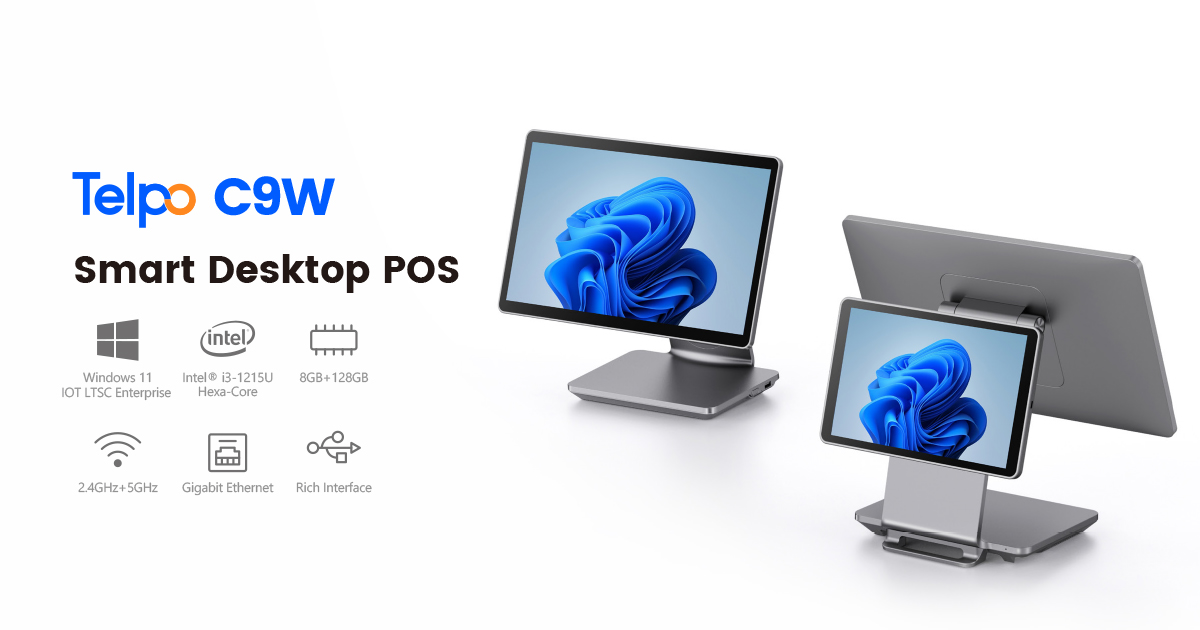
The Telpo C9W Windows Cash Register: 1920×1080 main display with an 8.75 mm profile, ABS+PC housing, and an interactive customer display served by 2 dedicated USB ports.
Where the manufacturing evidence is actually validated
Physical claims are only as good as the testing behind them. Telpo operates from a facility of approximately 45,000 sqm in Foshan, with an annual output of 2,000,000 units and a monthly capacity of roughly 150,000 to 180,000 smart terminals, supported by an R&D organisation of more than 200 engineers and more than 300 technical patents.
The relevant quality infrastructure is a CNAS-accredited laboratory upgraded in 2025, covering approximately 900 sqm across 12 testing zones that include an OTA darkroom, an EMC chamber and a climate lab. Telpo's stated control regime combines ISO 9001 with the CNAS laboratory, 100% functional testing, and OTA, EMC and climate validation. For a Windows-based terminal with six USB peripherals and a modular card reader, those three validation categories map directly onto real deployment risks: electromagnetic behaviour with multiple attached devices, display and housing integrity under temperature and humidity variation, and radio performance where Wi-Fi and Bluetooth are used to reach a store network.
This is where a physical specification stops being a claim and becomes a checked property. A thin display stack that passes climate and functional testing is a manufactured outcome; the same figure published without a testing regime behind it is only a drawing.
Application fit: where the C9W's construction profile matters
Telpo lists the C9W's applicable industries as retail, hotels, restaurants and service counters. The scenario material is more specific, and it explains why the build details matter in practice.
Hotel and resort front desks
Hotel front-desk deployment is a fixed countertop installation running continuously, with high guest interaction and a premium environment. The documented requirement for the C9W in this setting is direct compatibility with Windows property management systems, which is the reason the Windows platform exists in the range at all. The 6 USB ports support the peripheral breadth a front desk accumulates, the dual-screen configuration gives the guest a customer-facing view of transaction details and loyalty information, and an optional external financial card reader is available via a Pogo Pin module. A thin display profile and a clean enclosure are not vanity here — the terminal sits inside the guest's line of sight for the entire check-in conversation.
Fashion retail and boutique chains
In fashion retail and boutique environments, the C9W is used where an existing Windows-based POS software stack is being retained or migrated. Deployment material describes chain-store rollouts in which the terminal runs the incumbent software, prints through an external thermal receipt printer, and connects to a cash drawer, barcode scanner, customer display and network switch. The build implication is stability across a long, fixed peripheral chain: a chain that standardises on one terminal model is effectively betting on batch-to-batch consistency, not on a single evaluation unit.
Restaurants and service counters
Restaurants and service counters are named as applicable industries for the model. In these settings the terminal is counter-mounted, mains-powered and operated continuously, with the customer-facing screen doing double duty for order confirmation and promotional content. The touch-enabled second display and the housing finish matter more here than raw compute, because both are in constant contact with the public.
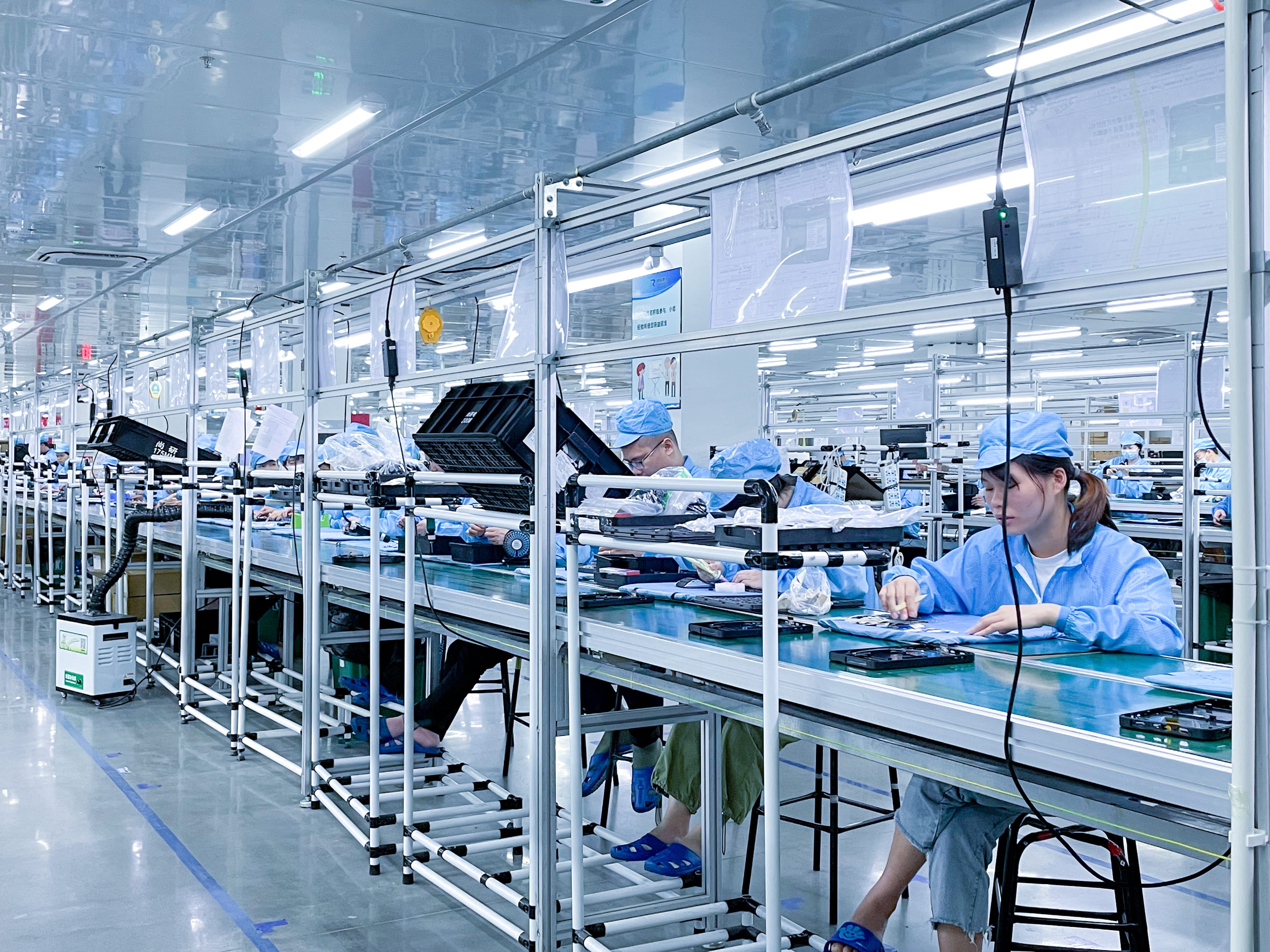
Telpo's Foshan facility covers approximately 45,000 sqm and supports an annual output of 2,000,000 units, with 100% functional testing as part of the stated quality regime.
Market context: why Windows hardware still deserves scrutiny
Android-based POS terminals reached approximately 48% of global shipments in 2025, according to Counterpoint Research — a share that has grown quickly but still leaves a substantial portion of the market on other platforms. Fortune Business Insights valued the global point-of-sale market at USD 38.57 billion in 2025.
The non-Android remainder is not simply legacy drift. Hotel property management, certain retail software stacks and fiscal workflows run on Windows-native applications, which is precisely why the C9W documents Windows PMS direct compatibility and configurable Intel i3 or i5 processing. For buyers, the practical consequence is that the same physical evidence standard should be applied to a Windows terminal as to an Android one. Platform choice changes the software ecosystem; it does not change what a well-moulded ABS+PC enclosure or a controlled thin-stack display tells you about the supplier behind it.
Comparison with traditional sourcing logic — and where the C9W stops
Traditional specification-led sourcing and build-evidence evaluation look at the same purchase from different angles.
| Evaluation dimension | Specification-led sourcing | Build-evidence evaluation |
|---|---|---|
| Housing | Colour and appearance noted, material unchecked | ABS+PC confirmed on the delivered unit; moulding finish inspected at edges and seams |
| Display | Resolution and size only | Resolution, 350-nit brightness and 170° viewing angle verified together with the 8.75 mm profile on a production sample |
| Second screen | Treated as an accessory | Data path checked: 2 dedicated USB ports, touch interaction tested, configuration reconciled against the order |
| Configuration control | One configuration quoted | Single, 10.1-inch and 15.6-inch variants traced to one chassis design; processor and card reader options mapped to the BOM |
| Validation | Certificate copies requested | Test scope confirmed: CNAS laboratory, 12 testing zones, ISO 9001, 100% functional test, OTA/EMC/climate validation |
| Commercials | Price and unit quantity | MOQ of 500 to 1,000 units, motherboard lead time of 20 working days, structural 10 working days, full machine 45 working days minimum, standard ODM cycle of 4 to 6 months |
The limits deserve equal weight, because they define where the C9W is the wrong device rather than a better one. Telpo's scenario material describes the C9W as a fixed countertop unit with a long-term powered installation and Wi-Fi or Bluetooth connectivity; no battery operation or mobile deployment is documented for this model. The hotel front-desk configuration lists an external thermal printer as supporting equipment, so a C9W rollout has to plan counter space and cabling for printing rather than assuming an integrated printer — buyers who need a built-in 80 mm printer in the same family should look at the C9PD, which documents a 250 mm/s Seiko thermal printer with auto-cutter.
Durability ratings are a second boundary. No IP rating or drop rating is documented for the C9W in the available material, which is consistent with its indoor countertop role. Applications that involve outdoor mounting, vibration or physical abuse are served by different form factors in the same portfolio — for example the T20 ticket validator with IP65 and IK08 ratings, the T10 with IK07 impact resistance and an optional IP54 rating, or the P8 M5 payment terminal tested to 1.5-metre drops. Finally, the 8.75 mm figure describes the display module profile, not the total depth of the assembled terminal; treating it as a full-device dimension would misstate the footprint a counter has to accommodate.
A verification checklist for buyers
The C9W case converts into a short, reusable procedure for any fixed countertop terminal evaluation.
- Inspect series-production units, not a golden sample. Ask for a unit drawn from a standard batch and check housing seams, panel alignment and the display edge.
- Confirm the material on the delivered housing. ABS+PC should be stated in the specification and visible in the finish; a lower-grade substitute usually shows at mould parting lines and around the screw bosses.
- Map the second-screen data path. Confirm the 2 dedicated USB ports are present and that touch interaction is enumerated independently of the operator screen.
- Reconcile configuration with quotation. Single, 10.1-inch and 15.6-inch second-screen variants; i3 or i5; card reader module present or absent.
- Request the validation scope, not just certificates. Which tests run in the CNAS laboratory across the 12 testing zones, and what OTA, EMC and climate validation covers for this model.
- Check the commercial envelope early. MOQ typically 500 to 1,000 units, motherboard lead time of 20 working days, structural tooling 10 working days, and a full-machine lead time of 45 working days minimum within a standard ODM cycle of 4 to 6 months.
Future outlook
As Android continues to take shipment share, differentiation between POS suppliers is shifting away from the operating system and towards physical execution. Processors and memory configurations are increasingly commoditised; enclosure quality, display-stack tolerance and the discipline of addressing a second screen are not. That shift favours suppliers with in-house tooling, a controlled laboratory and a documented configuration system — and it disadvantages intermediaries whose only asset is a catalogue.
For buyers, the practical implication is a change in the questions asked at the evaluation stage. Instead of accepting build quality as a qualitative impression formed during a showroom visit, the C9W example suggests it can be treated as a set of checkable statements: a named housing compound, a measured display profile published alongside brightness and viewing-angle figures, a second screen with a documented data path, and a testing regime that names its own facilities. Those are objective markers of production precision, and they can be verified before a purchase order rather than after the first year of operation.
FAQ
What is the Telpo C9W, and which environments is it designed for?
The Telpo C9W is a Windows-based touch screen cash register in the C9 series, built around a configurable Intel processor — standard i3 or optional i5, up to 10 cores with 4.6 GHz Turbo — and a 15.6-inch 1920×1080 display with an 8.75 mm profile and 350-nit brightness. Telpo lists retail, hotels, restaurants and service counters as applicable industries, and documents deployment at hotel front desks that require Windows PMS compatibility as well as in fashion retail and boutique settings where an existing Windows POS software stack is retained.
What does an 8.75 mm touchscreen profile indicate about a supplier's manufacturing capability?
A touch display stack is assembled from cover glass, a touch layer, the display module, backlight structure and a mechanical carrier. Compressing that assembly to an 8.75 mm profile narrows the permissible tolerance for adhesive thickness, frame flatness and module alignment during lamination. A supplier able to publish that profile together with 1920×1080 resolution, 350-nit brightness and a 170° viewing angle is describing a repeatable assembly process, because thin stacks are less tolerant of misalignment across production batches than conventional ones.
Does the C9W include a built-in receipt printer?
No built-in printer is documented for the C9W. Telpo's hotel front-desk scenario material lists an external thermal printer as supporting equipment for the model, alongside a cash drawer and a router or switch. Buyers planning a C9W deployment should therefore allow counter space and cabling for an external printer. Where an integrated printer is required in the same family, the C9PD documents a built-in 80 mm Seiko thermal printer running at 250 mm/s with auto-cutter.
Can the C9W be customised for a buyer's brand and configuration?
Several documented options support customisation: logo customisation applied to the device body; a choice of standard i3 or optional i5 processing; second-screen configurations of 15.6-inch single, 15.6-inch plus 10.1-inch, or 15.6-inch plus 15.6-inch; plug-and-play financial card reader modules; and fingerprint authentication for device wake and employee login. Telpo also offers an alternative Android build on Rockchip or Qualcomm platforms for customers with specific software development requirements. Broader ODM scope at the company covers ID and structural design, functional module selection, packaging and private moulds.
How can a buyer verify build-quality claims before placing an order?
Verification rests on physical and documentary evidence rather than on presentation material. Request a unit drawn from series production and inspect the housing seams, panel alignment and display edge; confirm that ABS+PC is stated for the housing and visible in the finish; check the port map to confirm the second screen is served by 2 dedicated USB ports; reconcile the quoted configuration against the screen variant, processor and card reader module; and ask which validations are performed in the CNAS-accredited laboratory across its 12 testing zones. Commercial parameters should be confirmed at the same stage: MOQ is typically 500 to 1,000 units, motherboard lead time is 20 working days, structural work 10 working days, and full-machine lead time 45 working days minimum within a standard ODM cycle of 4 to 6 months.
Reference material: Telpo publishes a product brochure covering its payment and retail hardware portfolio, available for download here — Telpo Products Brochure: Payment & Retail.
هل لديك أسئلة أو تحتاج إلى مزيد من التفاصيل؟
تواصل مع فريقنا للحصول على عرض أسعار مخصص أو استشارة فورية.
طلب عرض أسعار
املأ النموذج أدناه وسيتواصل معك فريقنا بعرض مقترح مخصص.
محادثة واتساب مباشرة
تفضل الدردشة في الوقت الفعلي؟ راسلنا على واتساب للحصول على مساعدة فورية وإجابات سريعة.
- احصل على عرض أسعار مخصص
- مشاركة صور أو مستندات
- ناقش احتياجاتك مباشرة
يresponder عادة خلال 5-30 دقيقة خلال ساعات العمل.