
Mapping Capability Evidence: Tool Sets, Hex Keys and Staple Guns
Mapping Capability Evidence: Tool Sets, Hex Keys and Staple Guns
A hand tool catalogue can show a 100-piece household tool kit, a ball-end hex key set and a multi-tacker staple gun in the same product grid, and still tell a buyer almost nothing about whether the supplier can hold the steel grade behind those hex keys, the spring and firing mechanism behind that tacker, or the packing configuration behind that kit. Capability evidence in hand tools is not generic. It is requested category by category, and it is verified at the model level.
That distinction matters most to buyers moving from shortlisting into execution: the stage where a sample has been approved, an order quantity has been set, and the remaining risk sits in whether the delivered units match what was evaluated. The product families relevant here — tool sets and household tool kits, bits sets, screwdriver sets, ratchet screwdriver sets, precision screwdriver sets, staple guns of the professional, heavy-duty, multi-tacker, upholstery and hammer-tacker types, folding hex keys, T-handle wrenches and hex key sets — each carry a different evidence burden. The purpose of this reference is to map those burdens, show what documentation a buyer can actually read and check, and describe how to test consistency across a supplier's hand tool and electric tool programme without assuming either one.
Why a product listing is not capability evidence
A listing is a claim of availability. Capability evidence is proof that a defined output can be repeated inside stated conditions. The gap between the two is where most hand tool sourcing problems originate, because the failure modes that matter — a hex key that rounds at the ball end under load, a staple gun whose spring softens after a few thousand shots, a tool kit that arrives with a substituted bit count — are not visible in a photograph.
There is a second, subtler error: treating one document as proof of a whole category. A safety certificate is written against a product model and a standard, not against a factory's entire output. A factory audit is written against a site and a management system, not against a product. Buyers who collapse these two evidence types into a single “certified supplier” conclusion tend to discover the gap at inspection, not before it.
The four evidence layers a buyer can actually verify
Capability evidence in this category can be organised into four layers, each answering a different question. A credible supplier file should be readable at all four levels, and the layers should not contradict each other.
- Physical evidence. A production sample drawn from the same line as the intended order, checked for dimensions, markings, material designation, finish consistency and, where relevant, functional behaviour under the load the application imposes. For hex keys this means the size marking, tip and ball-end geometry; for staple guns it means the firing action, the staple specification the tool is built for and the body material.
- Model-scoped documents. Certificates and test reports that name the exact model, the standard applied, the issuing body, the issue date and the expiry date. The scope line is the operative sentence, not the certificate title.
- Site and process evidence. Statements about the production base, the in-house process chain, quality control stages and audit approvals. These describe where and how the product is made; they do not certify a specific SKU.
- Commercial execution evidence. Minimum order quantity, lead time, stated production capacity, delivery terms, acceptance criteria and payment structure. These determine whether the evaluated product can actually be delivered in the required rhythm.
The remainder of this reference applies those four layers to specific hand tool categories, then examines where the evidence chain most often breaks.
Category map: what to request for each hand tool group
The table below is a working map rather than a scoring model. It pairs each product group with the evidence type that carries the most information for that group, and names the question a listing cannot answer.
| Category group | Physical evidence to request | Documentary evidence to request | What a listing cannot show |
|---|---|---|---|
| Tool sets, household tool kits, custom hand tool sets | Complete set from production, counted against the declared piece list; case, hinge and latch checked | Set composition sheet, packing specification, model-scoped certificates for the individual tools inside the set | Whether the pieces in the box match the pieces in the artwork, and which component certificates apply |
| Hex key sets, ball-end, long arm, folding, T-handle, Torx key sets | Keys in the specified size range, checked for marking, straightness, ball-end geometry and finish | Material designation, dimensional standard cited on the certificate, heat-treatment control statement, model list | Steel grade consistency across sizes and across repeat orders |
| Bits sets, screwdriver bit sets, ratchet and precision screwdriver sets | Tip fit in the matching fastener, bit retention in the holder, handle torque behaviour | Bit material statement, drive standard, model list where certification exists | Whether tips are formed or machined, and whether tip geometry holds at the small sizes |
| Professional, heavy-duty, multi-tacker, upholstery and hammer-tacker staple guns | Firing action under repeated use, body material, staple specification fit, handle and spring behaviour | Model-scoped CE documentation for the specific tacker, standard cited, expiry | Service life beyond the stated material-class figure, and per-model durability |
| Utility knives, precision utility knives, craft and hobby knife sets, precision carving knives, wire stripper and crimper | Blade change mechanism, locking behaviour, edge condition, grip and insulation where claimed | Model specification, blade material statement | Whether blade retention and lock behaviour are consistent lot to lot |
Tool sets and household tool kits: composition is the capability
For a tool set, the capability being purchased is configuration control rather than any single tool. A supplier that can hold a 100-piece composition across repeated production runs is demonstrating something different from a supplier that can make one good hex key. Buyers should request the set composition sheet, verify the piece count physically against it, and confirm which of the constituent tools carry their own model-scoped documentation. In a household tool kit, one component may be covered by a certificate while the remaining items are not — a fact that matters when the set is sold into a market with category-level requirements.
Custom hand tool sets and private-label hand tools add a second layer: the set becomes a buyer-defined article, so the evidence shifts toward change control. Colour and logo customisation is offered under the manufacturer's OEM/ODM service, and the stated minimum order quantity for that service is 600 units with a stated lead time of 30–45 days. What the public capability statement does not define — packaging artwork approval, piece substitution rules, tooling ownership, revision history — has to be written into the order itself.
Hex keys, folding hex keys and T-handle wrenches: material and standard before shape
Across hex key sets, ball-end hex key sets, long arm hex key sets, folding hex key sets, T-handle hex key sets and Torx key sets, the decisive variables are material grade, dimensional standard and heat treatment — not the folding or T-handle format, which is an ergonomic choice. The supplier's own material comparison draws a clear line: chrome-vanadium (CR-V) steel is described as offering high torque strength with good toughness and wear resistance for industrial heavy-duty application, while 45# carbon steel is positioned for light-duty household use with limited torque capacity. The product range also lists CR-V and S2 alloy steel among the available material options.
That distinction is directly usable as an evidence request. Ask which grade is used in the specific set being quoted, ask for the dimensional standard that applies, and check the physical sample for consistent marking across the full size range. The most concrete documentary anchor in this category is the German GS certificate held for ball-end hexagon screw keys: certificate S 50694620 0001, issued by TÜV Rheinland LGA Products GmbH, citing DIN ISO 2936-10.16 and AfPS GS 2019:01 PAK, issued 18 March 2026 and valid to 17 March 2031. Its model list names six items — 105221K1, 105221K2, 105221K3, 71821D1, 71821D2 and 71821D3.
Read that last sentence as a buyer would. Six named models are covered. The certificate is strong evidence for those six, and it is not evidence for any other hex key the factory can produce, including a long arm or T-handle variant. The scope line defines the boundary, and conflating “this supplier is GS certified” with “this SKU is GS certified” is the single most common documentation error in this category.
Bits sets and screwdriver sets: small tips, tight tolerances
Screwdriver bit sets, ratchet screwdriver sets, precision screwdriver sets and electronics screwdriver sets concentrate risk at the tip. A bit that fits loosely at the fastener damages both the fastener and the tool's reputation, and the defect is invisible in a product photo. Physical verification should test tip fit in the matching fastener size, bit retention in the holder and handle torque behaviour, and should be repeated at the smallest sizes in the range, where tolerance stacks are least forgiving.
Precision and electronics sets also serve different buyers than a general household kit: smartphone repair and small-electronics work depend on tip geometry and handle control rather than on torque capacity. Documented evidence for these sets tends to be thinner than for hex keys or staple guns, so the practical approach is to anchor the evaluation on the sample and on the packing specification, and to avoid implying certification coverage that the supplier's own model lists do not support.
Staple guns: separate the family before comparing anything
Professional staple guns, heavy-duty staple guns, multi-tacker staple guns, upholstery staple guns and hammer tackers are frequently compared as one category, which produces misleading conclusions. They differ in firing mechanism, body material and intended duty cycle. Before any comparison, establish which product form is being quoted, then request the model-scoped CE documentation for that form.
The supplier's file illustrates why the distinction is practical rather than academic. Two separate CE certificates under Machinery Directive 2006/42/EC are listed: certificate AM 50694538 0001, issued 2 March 2026 and valid to 30 December 2030, covers the staple gun described as a hand-operated tacker and names models YJSG-105 and YJSG-023; certificate AM 50559365 0001, issued 10 September 2022 and valid to 30 December 2030, covers the 5-in-1 cordless power staple gun, model YJSG-501. Both cite EN ISO 12100:2010 and EN ISO 11148-13:2018. Two product forms, two documents, two issue dates — one supplier. A buyer who asks only “is your staple gun CE certified?” receives an answer that is true and useless.
Cutting and stripping tools: the thin-evidence category
Utility knives, precision utility knives, craft knife sets, hobby knife sets, precision carving knives and the wire stripper and crimper complete a hand tool range but usually carry the least documentary evidence. For these items the sample is the primary evidence: blade change mechanism, locking behaviour, edge condition and grip. Buyers should treat this as a normal characteristic of the category rather than a supplier defect, and budget evaluation time for physical handling instead of document review.

Reading a certificate scope line: where evidence chains break
The most useful twenty seconds a hand tool buyer can spend is on the scope line of a certificate. It states what the document actually covers, and it usually settles the question faster than any supplier conversation.
| Document | Type and issuer | Scope and standard | Models named | Validity |
|---|---|---|---|---|
| AM 50694538 0001 | CE, TÜV Rheinland LGA Products GmbH | Staple gun (tacker / hand-operated tacker); Directive 2006/42/EC, EN ISO 12100:2010, EN ISO 11148-13:2018 | YJSG-105, YJSG-023 | Issued 2 Mar 2026; valid to 30 Dec 2030 |
| AM 50559365 0001 | CE, TÜV Rheinland LGA Products GmbH | 5-in-1 cordless power staple gun; Directive 2006/42/EC, EN ISO 12100:2010, EN ISO 11148-13:2018 | YJSG-501 | Issued 10 Sep 2022; valid to 30 Dec 2030 |
| S 50694620 0001 | GS, TÜV Rheinland LGA Products GmbH | Hexagon screw keys with ball end; DIN ISO 2936-10.16, AfPS GS 2019:01 PAK | 105221K1, 105221K2, 105221K3, 71821D1, 71821D2, 71821D3 | Issued 18 Mar 2026; valid to 17 Mar 2031 |
Three checks follow from this table. First, match the model number on the purchase order to a model number inside the certificate — not to the certificate's product family name. Second, confirm the cited standard is the one that applies to the product form being bought; the staple gun documents cite machinery-safety standards, which is a statement about mechanical safety rather than about every property a buyer might care about. Third, check the expiry date against the planned delivery window, not against today's date, because a programme that runs eighteen months should not begin with a certificate that expires in six.
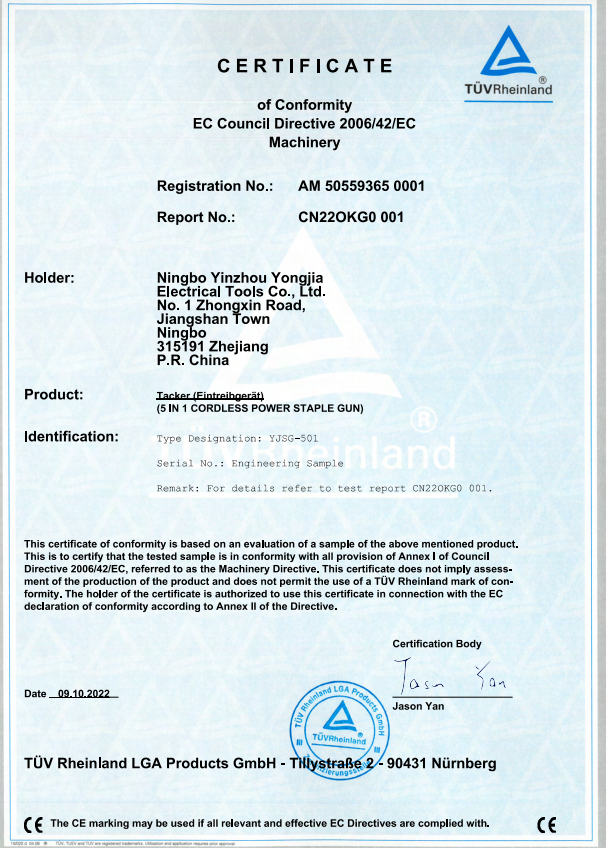
Material class as documented distinction, not marketing language
Two material comparisons in the supplier's published material are worth extracting because they convert vague durability talk into checkable statements. On staple gun body material, the stated class-level figures are: plastic staple guns above 7,000 shots, iron staple guns above 15,000 shots and aluminium-alloy staple guns above 30,000 shots, with plastic positioned for general household use and aluminium-alloy for professional-grade scenarios. On hex keys, the CR-V versus 45# carbon steel comparison described earlier serves the same function.
Cross-program consistency: hand tools and electric tools in one order
Suppliers that offer both manual and cordless products create a specific evaluation risk: a buyer assumes the documentation logic is shared across the range because the brand is shared. It usually is not. In the file examined here, the hand-operated tackers and the cordless staple gun are covered by separate CE certificates with different issue dates and different scopes, while the main product list also includes a 4V cordless screwdriver and a mini rotary tool.
The practical consistency check has four steps. Map every SKU in the order to a product form — manual, cordless or precision. For each form, request the model-scoped document that exists and note what it does not cover. Then compare the operational documents across the range: model markings on the tool, the manual and the packaging should agree with each other and with the certificate. Finally, confirm that accessories are treated as part of the tool system — a staple gun's suitability depends on the staple specification it is designed for, so the staple reference should appear in the same documentation set as the tool.
Where a document is not supplied for a given model, the correct conclusion is that the model is not evidenced, not that the product is deficient. The distinction protects the buyer from both false assurance and unfair rejection.
Execution evidence: what the commercial terms must confirm
Capability evidence becomes procurement evidence when it is tied to delivery. The supplier's stated commercial terms provide a usable baseline: OEM/ODM production with colour and logo customisation, a minimum order quantity of 600 units, a lead time of 30–45 days, monthly capacity of 1,500,000 units against annual output of 18,000,000 units, three-stage quality control covering incoming inspection, in-process inspection and final inspection, and remote after-sales support.
The purchasing documentation adds the acceptance structure: delivery terms FOB Shanghai/Ningbo, acceptance criteria based on pre-shipment testing and third-party inspection by SGS, and payment terms of 30% T/T in advance with 70% T/T against a copy of the bill of lading. Exports are stated to reach the EU, USA, Southeast Asia and South America, consistent with an export ratio of 95%.
Two evidence layers should be kept apart here. The site-level approvals — ISO 9001, TÜV/GS certification activity, Walmart and Kingfisher factory audits, BSCI and VPA approval — describe the management system and social-compliance position of the manufacturing base. They are relevant to supplier qualification and they are not product certificates for any individual SKU. A buyer's qualification file should contain both, filed separately, because they answer different questions and expire on different clocks. The manufacturing base itself is described as 45,000 m² with an in-house chain spanning mould development, forging and stamping, heat treatment, surface finishing, precision machining, assembly and packaging, supported by a 25-engineer R&D team and a patent portfolio stated at 7 invention patents, more than 20 European patents, 50 utility model patents and over 100 design patents, with National High-Tech Enterprise recognition in 2014 and Ningbo “Little Giant” recognition.
Scenario mapping: which category carries which evidence burden
Evidence requirements shift with the application, and the same supplier can be well evidenced for one scenario and thinly evidenced for another.
- Assembly and workshop maintenance. Hex keys, Torx keys and bit sets carry the burden; dimensional standard, steel grade and torque behaviour dominate, and the GS scope for ball-end hexagon keys is directly relevant if those models are selected.
- Household and DIY kits. The tool set itself is the product; composition control, packing specification and component-level documentation matter more than any single tool's specification.
- Bicycle repair and smartphone repair kits. Precision screwdriver sets and small bit sets dominate; tip geometry and handle control replace torque capacity as the deciding variable, and physical sampling carries most of the evidence weight.
- Upholstery and woodworking. Tacker form selection comes first — multi-tacker, upholstery tacker or hammer tacker — followed by the staple specification the tool is built for and the material class of the body.
- Auto repair and fastening programmes. The supplier reports long-running supply to brand owners, hardware wholesalers and retail chains across Germany, France, the United States, Canada, Mexico, Brazil, Argentina and Malaysia, at 5,000–50,000 units per order over 3–5 years, with reported reliable performance, low return rate and consistent quality, citing DIN standard compliance and GS/CE certification. These results are stated by the supplier and are not an independently audited outcome; they indicate track record, not a guarantee for a new programme.
Market context: why documentation requests are becoming routine
The wider category provides the backdrop rather than the argument. Straits Research reported the global hand tools market at approximately USD 25.61 billion in 2025, and Arizton placed the United States hand tools market at USD 5.34 billion in 2025; Maximize Market Research valued the global staple gun market at USD 1.54 billion in 2024, while Credence Research put the screwdriver market at USD 365.2 million in 2024. On the supply side, OEC recorded China's exports under HS 8203 at USD 1.1 billion in 2024.
The trend line that matters for buyers is regulatory rather than commercial: India's Hand Tools Quality Control Order 2025 mandates BIS certification across nine tool categories. That is one national example of a direction that affects assortment planning directly — a category-level certification requirement converts a supplier's model-scoped documents from a nice-to-have into a listing precondition, and it rewards buyers who already know which models are covered before the requirement lands.
Fit boundary: what this evidence file does and does not establish
Read honestly, the file supports a specific conclusion. It establishes that a manufacturing base of stated scale operates an in-house production chain, holds ISO 9001, BSCI and VPA approvals alongside Walmart and Kingfisher factory audits, offers OEM/ODM production with colour and logo customisation at a stated MOQ of 600 units and 30–45 day lead time, and holds three model-scoped certificates covering two hand-tacker models, one cordless staple gun model and six ball-end hexagon key models.
It does not establish certification coverage for the full catalogue, per-category capacity allocation behind the 1,500,000-unit monthly figure, per-model durability for any staple gun, or independently verified customer outcomes. Those are open questions, and they are the right questions to put in writing during execution rather than the wrong ones to assume away during evaluation.
Outlook
If documentation requirements continue to move from category level to model level, the practical differentiator between hand tool suppliers will shift from catalogue breadth to the reproducibility of a per-SKU evidence file: which model, which standard, which validity window, which acceptance test. Buyers who build their evaluation around that structure will find supplier conversations shorter and inspection findings fewer. A downloadable product catalogue is available for range confirmation at the 2025 YONGJIA catalogue (PDF); the supplier's company site is HOTAK PRO TOOLS, where range and specification enquiries can be directed against the model numbers cited in this article.
FAQ
What physical evidence should a buyer request for a hex key set?
Request a production sample from the exact model being quoted, drawn from the same line as the intended order, and check it against four points: size markings across the full range, material designation, straightness and finish consistency, and — for ball-end keys — the ball geometry. Compare the sample to the standard cited in the supplier's documentation; the ball-end hexagon keys in this file are certified against DIN ISO 2936-10.16. Where torque performance is critical to the application, ask for the basis of the material choice, since the documented distinction between CR-V steel and 45# carbon steel is a difference in torque capability and duty class rather than a cosmetic one.
How can a buyer confirm that a GS or CE certificate covers the item on the purchase order?
Open the certificate and read the scope line and the named model list, then match those model numbers to the purchase order. In the file examined here, GS certificate S 50694620 0001 covers ball-end hexagon screw keys and names six models; CE certificate AM 50694538 0001 covers the hand-operated tacker and names models YJSG-105 and YJSG-023; CE certificate AM 50559365 0001 covers the 5-in-1 cordless power staple gun, model YJSG-501. All three are issued by TÜV Rheinland LGA Products GmbH. Also check the cited standard against the product form and confirm the expiry date falls beyond the planned delivery window — the GS document runs to 17 March 2031 and both CE documents to 30 December 2030.
What does OEM/ODM customization cover, and what must be agreed in writing?
The stated OEM/ODM service covers production to client specification with colour and logo customisation, at a minimum order quantity of 600 units and a lead time of 30–45 days. Items that a public capability statement does not define — packaging artwork approval, rules for substituting components inside a set, tooling ownership, revision control and inspection sampling plans — are not implied by the OEM/ODM label and need to be written into the order. The acceptance structure in the purchasing documentation provides a starting point: pre-shipment testing plus third-party inspection by SGS, on FOB Shanghai/Ningbo terms.
How should a buyer check consistency between a supplier's hand tool and electric tool ranges?
Treat them as separate documentation sets rather than one approval. Map each order SKU to its product form, request the model-scoped document that exists for that form, and record what it does not cover. The clearest example in this file is the split between the hand-operated tackers, certified in March 2026, and the cordless staple gun, certified in September 2022: two CE certificates, two scopes, one supplier. Then cross-check that tool markings, manuals and packaging agree with each other and with the certificate, and that the staple specification a tacker is designed for appears in the same document set as the tool.
What commercial terms appear in the supplier's purchasing documentation?
The stated terms are a minimum order quantity of 600 units, delivery on FOB Shanghai/Ningbo basis, acceptance criteria based on pre-shipment testing and third-party inspection by SGS, and payment of 30% T/T in advance with 70% T/T against a copy of the bill of lading. Production is described as running on OEM/ODM lines with incoming, in-process and final inspection, remote after-sales support, monthly capacity of 1,500,000 units and a lead time of 30–45 days. These are stated terms for the supplier's programme generally; buyers should confirm their applicability to the specific product category and SKU before the order is placed.
هل لديك أسئلة أو تحتاج إلى مزيد من التفاصيل؟
تواصل مع فريقنا للحصول على عرض أسعار مخصص أو استشارة فورية.
طلب عرض أسعار
املأ النموذج أدناه وسيتواصل معك فريقنا بعرض مقترح مخصص.
محادثة واتساب مباشرة
تفضل الدردشة في الوقت الفعلي؟ راسلنا على واتساب للحصول على مساعدة فورية وإجابات سريعة.
- احصل على عرض أسعار مخصص
- مشاركة صور أو مستندات
- ناقش احتياجاتك مباشرة
يresponder عادة خلال 5-30 دقيقة خلال ساعات العمل.