
Marble Grain vs. Wood Grain Self-Adhesive PVC Film: Buyer Comparison
Marble Grain vs. Wood Grain Self-Adhesive PVC Film: An Independent Buyer Comparison
Interior surface renovation rarely fails because the film was the wrong material. It more often fails because the pattern was selected before the application was defined. In self-adhesive PVC decorative film, two pattern families absorb most of the buying attention — marble grain and wood grain — and buyers frequently treat the choice as a matter of taste when it is in fact a specification decision tied to substrate, wear exposure, finish and project language.
This comparison examines two production ranges from Foshan Nanhai Jiadamei Decoration Material Co., Ltd, the manufacturer behind the leiyegaoke brand: marble grain film under models LF6801–LF6830 and Japanese-style wood grain film under models LG7801–LG7836. The aim is not to declare a winner. It is to give buyers a decision framework they can apply before requesting samples, and to separate what the two ranges genuinely share from what actually differs.
Why the Pattern Decision Comes Before the Sample Request
Wood grain is the default assumption in interior renovation. That default has market support: wood grain held the largest product segment share of the PVC decorative film market at 38.4% in 2025, according to Dataintelo's PVC Decorative Film Market Research Report 2034. Familiarity, however, is not the same as fit. A buyer specifying film for a 200-door hotel refurbishment and a buyer wrapping a single kitchen run face different constraints, and the more premium-looking option is not automatically the higher-performing one.
The practical problem is that both ranges are marketed with similar language — realistic, waterproof, easy to install — while the differences that matter sit in finish systems, pattern scale, surface behaviour and how the film reads once applied at full architectural scale. A marble print that looks convincing on a 200 mm sample can read as repetitive across a three-metre panel. A wood grain that appears subtle in isolation can disappear entirely on a large cabinet run.
The buyer question, restated: not "which pattern is better", but "which pattern family fits this substrate, this exposure profile and this visual brief — and what does each range let me customise when the standard offer does not fit?"
One Technical Platform, Two Visual Families
The first thing an independent buyer should understand is how much the two ranges share. Both are self-adhesive PVC decorative films built on the same base construction: 0.16 mm PVC film, water-based acrylic pressure-sensitive adhesive, and a paper release liner, supplied in 1,240 mm width and 50 m roll length. A standard roll therefore covers roughly 62 square metres by simple calculation (1.24 m × 50 m), which is a useful figure when estimating coverage per unit rather than per roll.
Because the adhesive system, carrier and roll geometry are common, the decision does not hinge on adhesion chemistry or installation method. Both are peel-and-stick and both are intended for indoor decorative surface renovation. What differs is the surface finish programme, the pattern library, and the performance emphasis each range is built around.
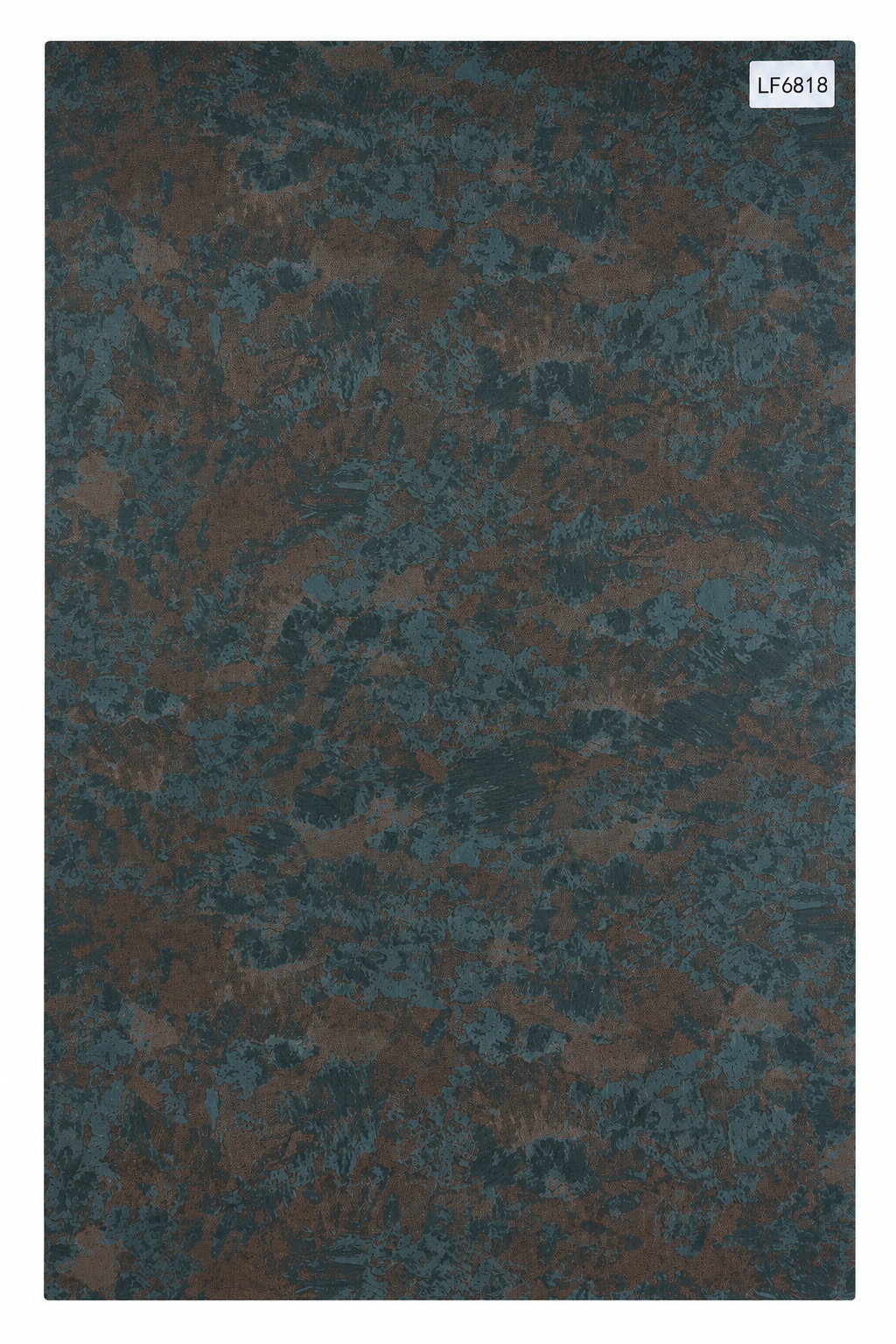
Marble grain self-adhesive PVC decorative film, model LF6818 from the LF6801–LF6830 range.
Marble Grain: LF6801–LF6830
The marble grain range is designed around stone effect. Its defining technical feature is finish flexibility: matte, glossy and textured surfaces are all available within the range, which matters because stone reads differently under each. A glossy marble film mimics polished slab and reflects light strongly; a matte or textured marble film reads closer to honed stone and is more forgiving of uneven substrates and directional lighting.
The range is positioned as a cost-effective alternative to real marble, with a stated emphasis on large-surface application, a wide marble pattern library, and flexibility for cutting. Application is peel-and-stick with no additional glue required, and the surface is described as waterproof and easy to clean. The supplier states that colour, pattern, roll size and adhesive strength can be customised, and that OEM/ODM service is available.
Japanese-Style Wood Grain: LG7801–LG7836
The wood grain range is narrower in finish terms and more specific in intent. It is offered in matte and super matte finishes only — no glossy option — which aligns with the minimalist, low-sheen direction the range is built around. Stated characteristics include a natural Japanese-style wood grain, realistic wood texture, scratch resistance, strong adhesion, and flexibility for curved surfaces.
That last point is the most commercially significant difference. Film intended to wrap curved and profiled surfaces — door edges, rounded panels, shaped furniture components — places different demands on the carrier than film laid flat across a large panel. Buyers wrapping flat panels gain little from that flexibility; buyers wrapping profiled MDF or shaped components gain a great deal.
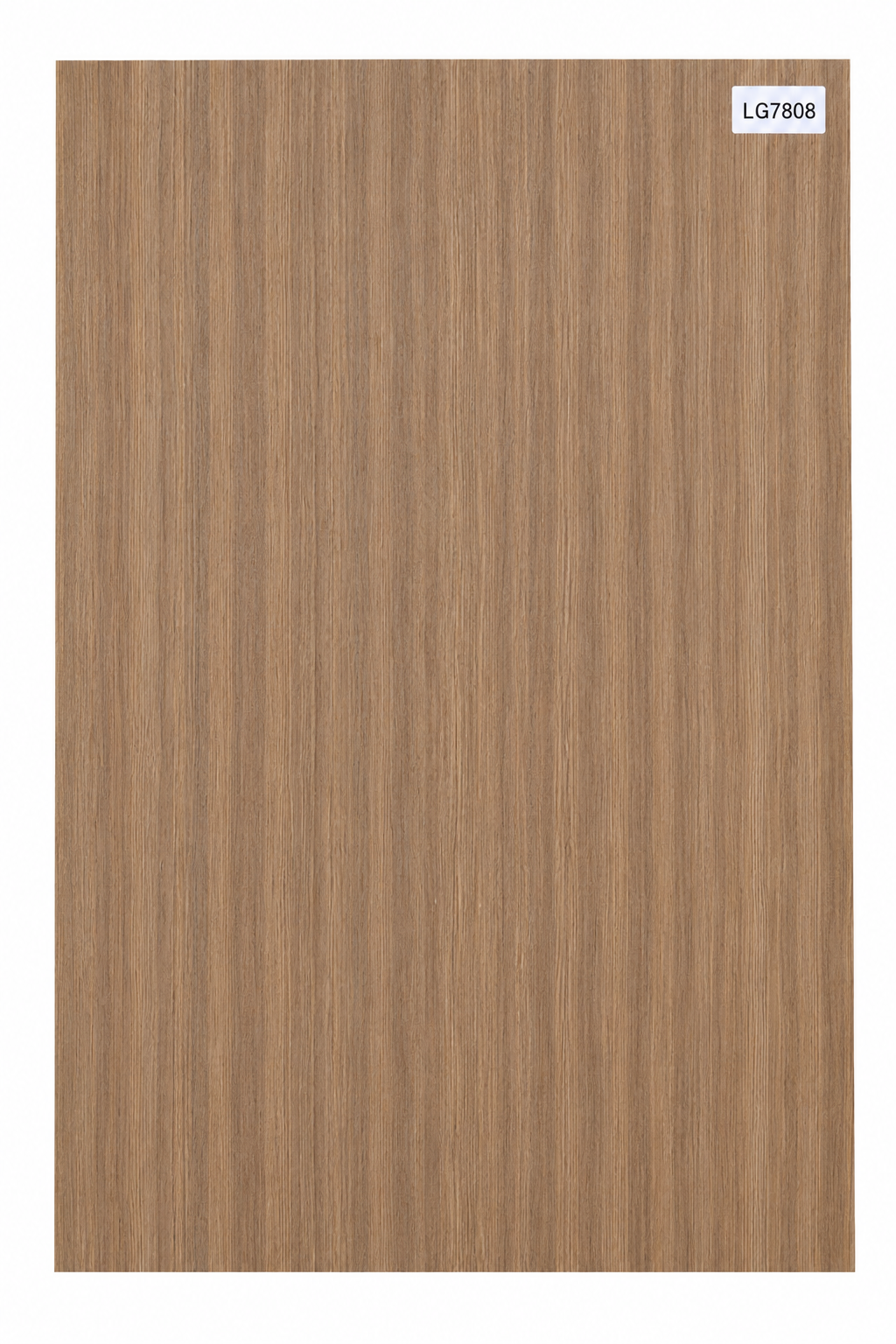
Japanese-style wood grain self-adhesive PVC decorative film, model LG7808 from the LG7801–LG7836 range.
Side-by-Side: The Comparison Buyers Actually Need
The table below isolates the attributes that differ, and confirms where the two ranges converge. It is built from published specification data for both model families.
| Attribute | Marble Grain (LF6801–LF6830) | Japanese-Style Wood Grain (LG7801–LG7836) |
|---|---|---|
| Design direction | Marble grain / marble effect | Japanese-style wood grain |
| Surface finish options | Matte / glossy / textured | Matte / super matte |
| Thickness | 0.16 mm standard | 0.16 mm |
| Roll format | 1,240 mm × 50 m | 1,240 mm × 50 m |
| Adhesive | Water-based acrylic pressure-sensitive | Water-based acrylic |
| Release liner | Paper release liner | Release paper |
| Installation | Peel and stick | Self-adhesive |
| Stated strengths | Realistic marble appearance; suitable for large surfaces; easy to cut | Realistic wood texture; scratch resistant; flexible for curved surfaces |
| Typical applications | Indoor decorative surface renovation; furniture; kitchen cabinets; hotel, office and retail interiors | Furniture; cabinets and wardrobes; doors; interior, hotel and commercial renovation |
| Customisation | Colour, pattern, roll size, adhesive strength; OEM/ODM available | OEM/ODM available |
Read carefully, the table shows that the material decision is close to identical and the specification decision is not. The choice between these ranges is a choice about how a surface should look, how much light it should reflect, how much mechanical contact it will receive, and whether the substrate is flat or profiled.
Where Each Grain Performs in Real Projects
Kitchen cabinets and cabinetry
Both ranges are specified for kitchen cabinet renovation, and both are listed for the kitchen and cabinetry industry. The distinction is functional rather than decorative. Wood grain film is commonly used across door fronts, panels and exposed cabinet sides where the visual continuity of a grain direction supports a coherent run of units. Marble grain film is better suited to surfaces where a stone reference is the design intent — cabinet end panels, tall-unit faces and the transition zone between cabinetry and a stone-effect worktop.
In kitchens specifically, the practical caveat is moisture behaviour rather than water resistance. The PVC surface itself is described as waterproof and easy to clean, but film edges, joints and the underlying substrate should not be continuously exposed to water or excessive moisture. A kitchen is a wet-adjacent environment, not a submerged one, and detailing around sinks and splash zones deserves more attention than the pattern choice.
Furniture, doors and wardrobes
Furniture manufacturing is a major consumption channel for PVC decorative film — the furniture sector accounted for approximately 44.6% of global PVC decorative film consumption in 2025, according to Dataintelo. In this context the wood grain range's stated flexibility for curved surfaces and scratch resistance become commercially relevant, because furniture components are handled, stacked, transported and installed before they ever reach an end user.
Marble grain film, by contrast, is more often specified on flat, large-format elements where a stone effect carries the design: table tops, retail fixtures, reception counters and feature panels. Its stated suitability for large-surface application aligns with that use pattern.
Hotel, office and retail interiors
Commercial renovation is where the cost argument for both ranges is strongest, and where specification discipline matters most. Both are listed for hotel renovation, office renovation, commercial renovation and surface refurbishment, and both are suited to quick renovation and cost-effective renovation projects where replacing the substrate outright is not viable.
Installation across both ranges requires the same basic toolkit: utility knife, squeegee, heat gun, measuring tape, ruler, surface cleaning tools, edge trimming tools and an application roller. That consistency is operationally useful — a renovation contractor does not need separate methods for a marble-specification floor and a wood-specification floor in the same building.
What the Market Data Suggests About Pattern Demand
Three published data points are worth putting next to each other. The global PVC decorative film market was valued at USD 4.8 billion in 2025 and is projected to reach USD 8.6 billion by 2034, at a CAGR of 6.7%, per Dataintelo. Within that market, wood grain held the largest product segment share at 38.4% in 2025, and Asia Pacific accounted for 42.3% of revenue share in the same year.
The implication for buyers is not that wood grain should be the default. It is that wood grain is the most competitive segment, which has two consequences. First, comparative shopping is easier and pricing pressure is higher, so differentiation tends to move toward finish quality and consistency rather than pattern availability. Second, stone and marble effects sit in a less saturated position, where the risk shifts from price competition to pattern quality — an unconvincing marble print is far more visible than an average wood print.
Supply-side data reinforces the same point about supplier selection. China became the world's largest PVC exporter in 2025, accounting for 24% of total global trade volume according to International Trader Publications, and China's exports under HS Code 3919 — self-adhesive plates, sheets, film, foil, tape and strip of plastics — reached an all-time high of RMB 246.296 million in January 2026, per General Administration of Customs China data. With supply this concentrated, buyers gain more from evaluating documentation, sampling discipline and roll consistency than from broadening their supplier list.
Against Traditional Surfaces: Where Film Stops
Compared with real marble slab, the marble grain film range avoids the weight, cutting and handling burden of stone and is positioned explicitly as a cost-effective alternative. Compared with laminate or veneer, self-adhesive film requires no additional glue and can be applied on site rather than in a press line. Those are genuine advantages, and they explain why film has moved from a temporary cosmetic fix to a specified renovation material.
The limitation is the substrate. Self-adhesive PVC decorative film is recommended for smooth, clean, dry and stable surfaces — furniture panels, cabinets, doors, metal, glass and other properly prepared interior surfaces. Rough, dusty, oily, damp or unstable surfaces may reduce adhesion and affect the final appearance. The failure modes are predictable: poor adhesion, bubbling, edge lifting, peeling and uneven surface appearance. None of these are pattern problems, and neither marble grain nor wood grain is more resistant to them than the other.
A second boundary concerns what the film is for. At a standard 0.16 mm gauge, decorative film is a surface treatment — it changes appearance and provides a water-resistant, easy-to-clean working surface, but it is not a structural repair layer for damaged, swollen or delaminating panels. Buyers refurbishing compromised substrates should treat substrate repair as a separate scope item. Where a thicker or different construction is required, custom thickness is offered through OEM/ODM, but that should be confirmed against the actual project condition rather than assumed.
A third boundary is documentation. Flame-retardant performance is a real specification requirement in commercial interiors — B1 flame retardant certification under GB 8624 is a recognised benchmark — and buyers should verify certification status per product and per project rather than inferring it from a category. Similarly, ASTM D1593 is the standard specification for nonrigid vinyl chloride plastic film and sheeting, evaluating tensile strength and elongation; buyers who need documented mechanical performance should ask whether a supplier tests against it. The manufacturer states that its products comply with REACH and RoHS requirements, which addresses chemical compliance but not fire or mechanical performance.
Supply, MOQ and Customisation: The Practical Differentiator
For many buyers the deciding factor between these ranges will not be appearance at all, but order flexibility. The manufacturer sets MOQ at one roll per colour for stock colours, with custom colours requiring 3,000 metres per colour — a structure that lets a buyer trial both a marble and a wood direction on a live project before committing to volume. Lead time is stated at 20–25 days, monthly capacity at 120,000 metres, and quality control is described as 100% testing.
Customisation extends beyond colour and pattern to roll size, thickness, surface finish, labels, cartons and private-label packaging, with OEM/ODM service available across the portfolio. For distributors and renovation material suppliers, that breadth is often more valuable than a marginal difference in pattern realism, because it allows a single supplier relationship to cover multiple project briefs.
The manufacturer's own operating profile supports a project-supply reading. Foshan Nanhai Jiadamei Decoration Material Co., Ltd was founded in 2001, operates a 12,000 m² facility with two adhesive coating lines covering film production, printing, laminating, adhesive coating, slitting, inspection and packaging, and reports an annual output of 15,000,000 metres with an export ratio of 80% across Europe, South America, the Middle East and CIS countries. Integrated coating is relevant to this comparison specifically because finish consistency across a marble print and adhesion consistency across a wood grain are both coating-and-laminating outcomes, not printing outcomes alone.
There is also field evidence of durability in furniture use: a furniture manufacturer in Algeria has used these films laminated onto MDF board for finished cabinet doors for more than six years, at approximately 100,000 metres per month, reporting functional benefits including waterproof and fireproof performance and an anti-scratch surface, alongside design and colour considerations.
Future Outlook
A market growing from USD 4.8 billion to a projected USD 8.6 billion between 2025 and 2034 at 6.7% CAGR is not a market being driven by novelty patterns. It is being driven by renovation economics — the substitution of surface replacement for component replacement across furniture, cabinetry and commercial interiors. Within that, the direction of travel is toward finish quality rather than pattern quantity.
Two signals support that reading. The first is the rise of low-sheen finishes: the wood grain range is offered only in matte and super matte, reflecting a market shift away from high-gloss surfaces in residential and hospitality interiors. The second is documentation. As film moves into commercial specification, buyers are increasingly asked to supply compliance evidence rather than samples alone, which puts pressure on suppliers to hold testable data on chemical compliance, flame performance and mechanical properties.
For buyers, the practical consequence is that the marble-versus-wood decision will remain a design and application question, while supplier selection becomes increasingly a documentation and consistency question. Those are separate evaluations and should be run separately. Company information for the manufacturer referenced in this comparison is published at www.leiyegaoke.com.
FAQ
Can self-adhesive PVC film be used on kitchen cabinets?
Yes. Self-adhesive PVC decorative film is suitable for renovating smooth kitchen cabinet doors, panels and other interior furniture surfaces, providing a decorative, water-resistant and easy-to-clean surface without replacing the cabinet. It works best on smooth, clean, dry and stable surfaces such as painted wood, sealed MDF and metal. Rough, dusty, oily or untreated porous surfaces should be prepared before installation. The PVC surface is water-resistant, but edges, joints and the underlying substrate should not be continuously exposed to water or excessive moisture.
What surfaces are suitable for self-adhesive PVC decorative film?
The film is recommended for smooth, clean, dry and stable surfaces, including furniture panels, cabinets, doors, metal, glass and other properly prepared interior surfaces. Rough, dusty, oily, damp or unstable surfaces may reduce adhesion and affect the final appearance, producing bubbling, edge lifting, peeling or an uneven finish. Surfaces should be cleaned and dried thoroughly before installation, with dust, oil, moisture and loose material removed. A small test area is advisable where the substrate is uncertain, and rough or porous surfaces may require surface treatment or a primer.
How can bubbles be avoided during application?
A smooth, bubble-free finish depends on applying the film gradually and using a squeegee to push out trapped air while removing the release liner step by step; proper surface preparation is equally essential. Air-release self-adhesive PVC film uses a release liner and adhesive structure designed with micro air channels that allow trapped air to escape more easily during installation. Standard adhesive film without air-release channels requires more careful application and is more likely to trap air if installed improperly, so the choice between the two constructions is a meaningful procurement decision for large-area work.
How should self-adhesive PVC film be cleaned and maintained?
Routine cleaning uses a soft cloth with water or a mild neutral detergent, and regular gentle cleaning helps maintain the decorative surface and appearance. Loose dust should be removed with a soft dry cloth; normal stains can be wiped gently with a soft damp cloth; grease or stubborn dirt can be addressed with a mild neutral detergent diluted in water, followed by a clean damp cloth to remove residue and a soft clean cloth to dry the surface. Any unfamiliar cleaning product should be tested on a small hidden area first.
What is the minimum order quantity for marble grain and wood grain film?
The manufacturer states an MOQ of one roll per colour for stock colours, while custom colours require 3,000 metres per colour. Customisation covers colours, patterns, sizes, thickness, surface finish, logos, labels, cartons and private-label packaging, with OEM/ODM service available. Lead time is stated at 20–25 days and monthly capacity at 120,000 metres, with 100% testing applied in quality control.
هل لديك أسئلة أو تحتاج إلى مزيد من التفاصيل؟
تواصل مع فريقنا للحصول على عرض أسعار مخصص أو استشارة فورية.
طلب عرض أسعار
املأ النموذج أدناه وسيتواصل معك فريقنا بعرض مقترح مخصص.
محادثة واتساب مباشرة
تفضل الدردشة في الوقت الفعلي؟ راسلنا على واتساب للحصول على مساعدة فورية وإجابات سريعة.
- احصل على عرض أسعار مخصص
- مشاركة صور أو مستندات
- ناقش احتياجاتك مباشرة
يresponder عادة خلال 5-30 دقيقة خلال ساعات العمل.