
Marble Table Supplier Comparison: A Purchasing-Term Decision Matrix
Marble Table Supplier Comparison: A Purchasing-Term Decision Matrix
A marble table supplier comparison becomes unreliable the moment two quotations describe different objects. Two suppliers can both quote "a 2.4-metre marble dining table" and still differ on stone thickness, edge profile, base construction, packing standard, delivery term and the inspection method used to accept the goods. At that point, a price ranking measures the gap in specification, not the gap in supplier capability.
A purchasing-term decision matrix is a comparison method in which the commercial and quality terms attached to a quotation — not the headline unit price — become the scored variables. Minimum order quantity, delivery term, payment split, acceptance method and the custom-size envelope a supplier is willing to put in writing are all difficult to disguise at quotation stage and straightforward to verify at execution stage. That makes them a workable instrument for buyers moving from evaluation into execution on custom-size marble table projects.
This reference sets out how to build that matrix, what each purchase term actually reveals about a supplier, how weighting should shift between a hotel banquet hall, a restaurant, an office reception, a villa and a café, and where the method stops being decisive. Company facts and purchase terms attributed to SONGJIA (Xiamen Songjia Trading Co., Ltd., a natural stone specialist based in Xiamen, China) come from the supplier's own documentation. Market figures are attributed to their published sources.
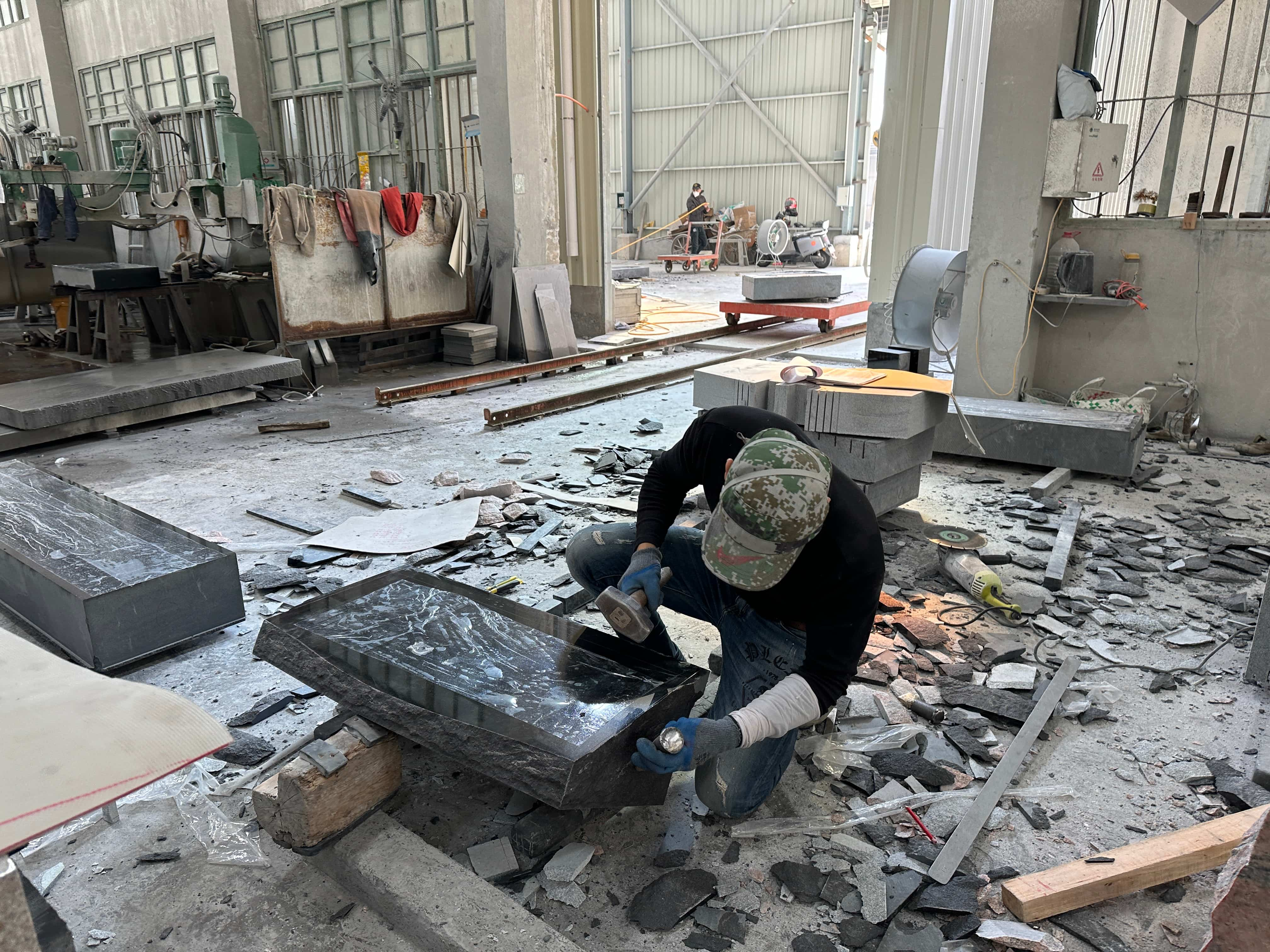
Why marble tables resist a simple supplier comparison
The category is large enough to justify careful comparison. The global marble market was projected to reach USD 92.2 billion by 2030 (Grand View Research), while the marble table segment specifically was valued at USD 12.4 billion in 2025, with dining tables accounting for 34.2% of that segment (Dataintelo). Asia Pacific represented 45.0% of global marble market revenue in 2024 (Grand View Research). These figures describe different scopes — stone material versus finished furniture — and should not be combined into a single growth rate.
The harder problem is that marble tables are not a clean statistical object. Worked marble articles, including furniture and ornaments, fall under HS Code 6802.21, while stone-topped furniture may also be captured under furniture classifications. Because official classifications do not isolate the product, a buyer cannot benchmark a quotation against customs value, trade volume or a published price index. The comparison has to be constructed rather than looked up.
Marketplace listings make the gap wider rather than narrower. A publicly visible Alibaba listing for artificial-stone marble-top café and dining tables — seller-declared and undated — shows a price band of USD 58–65 per set at a minimum order of 50 sets. The listing is real, but it is not a benchmark: it discloses no size, stone thickness, base frame material or Incoterm, so it cannot be matched against a natural-stone, custom-size quotation. Directory structures point the same way. StoneContact.com maintains a dedicated category page for "White Marble China Office Table" with listings split between natural stone and artificial stone, which confirms that the product is traded as a distinct B2B category but says nothing about comparable specification between sellers.
The practical consequence is narrow and useful: the only layer that can be compared across suppliers at quotation stage is the purchase-term layer. Everything above it — stone aesthetics, brand familiarity, showroom impression — is either subjective or unverifiable before a drawing exists.
Five purchase terms that behave as capability evidence
Not every term in a quotation deserves equal weight. Five carry most of the diagnostic value for custom-size marble tables, because each one forces a supplier to commit to something that can later be checked.
| Purchase term | What it reveals about the supplier | Question to put in writing | Evidence to request |
|---|---|---|---|
| Minimum order quantity (MOQ) | Whether production is organised around project volumes or around single pieces | What is the smallest order you will accept for this size and stone type? | A written MOQ statement that names the stone type and size band |
| Delivery term | Whether the supplier controls export logistics or only sells on an ex-works basis | Do you quote FOB or CIF, and from which port? | A named Incoterm and port printed on the quotation |
| Payment structure | Working-capital position and how the supplier stages risk across production | What deposit and balance split applies, and against which document is the balance released? | A term sheet stating the split and the release trigger |
| Acceptance method | Whether quality is defined before production or negotiated after arrival | How will the goods be inspected, by whom, and at which stage? | A written inspection sequence covering sample, in-process and pre-shipment |
| Custom-size envelope | Whether design-to-production is a real capability or a sales phrase | Can you return a shop drawing with dimensions and tolerances before we place an order? | A drawing, not a render |
MOQ as a production signal
MOQ is often read as a commercial hurdle. In custom-size sourcing it functions better as a production signal. A supplier that can only accept large runs is usually tooling for repeat batch work; a supplier that accepts small quantities is usually organised around drawings and one-off set-ups. SONGJIA states that MOQ depends on customer acceptance, and that orders above 100 sqm are generally workable. For a buyer, the useful part is not the number itself but the fact that it is expressed as a negotiable threshold rather than a fixed catalogue rule.
Delivery term as a logistics signal
FOB and CIF indicate different things about a supplier's operations. A CIF quotation implies the supplier routinely books freight, handles export documentation and carries insurance up to destination; an FOB-only quotation places more of the logistics burden on the buyer. SONGJIA quotes FOB and CIF. Neither term is inherently better — but a supplier that cannot state which one it is quoting has not yet defined the offer.
Payment structure as a risk-staging signal
A 30/70 split is common in stone supply and appears in SONGJIA's stated terms. The diagnostic value lies in the release condition attached to the balance: released against a photograph, against a pre-shipment inspection report, or against a bill of lading. The same split can describe very different levels of buyer protection.
Acceptance method as a quality-definition signal
Acceptance is where most custom-size disputes originate, because marble is a natural material and "matching the sample" needs a defined procedure to mean anything. SONGJIA describes acceptance as inspection by sample confirmation, photographs, videos, finished product inspection and pre-shipment confirmation. That sequence matters more than any individual step: it establishes that the reference sample is agreed first, that in-process evidence is exchanged, and that no container ships without a confirmation event.
Custom-size envelope as a capability signal
For custom-size work, the drawing is the deliverable that separates specialists from traders. SONGJIA describes its core strength as design-to-production integration, in which a technical team converts client sketches, concepts and architectural ideas into accurate, producible shop drawings, with an R&D team of three engineers supporting that conversion. The claim is testable in one step: request a shop drawing for a specific table before placing any order.
How the terms read when a supplier documents them
SONGJIA — Xiamen Songjia Trading Co., Ltd. — is a natural stone specialist based in Xiamen, China, supplying tombstones and memorial products, granite and marble slabs, quartzite, limestone, onyx and stone furniture to international stone importers, contractors, fabricators, designers and private custom clients. The company reports a 20,000 m² facility, 60 employees, 100% export orientation, main markets in the EU, the USA and the Middle East, and annual output described by product line as 150 containers of monument products and 200 containers of building materials. It describes itself as operating through a mature manufacturing and supply network rather than as a single-factory manufacturer, with more than 20 years of accumulated industry experience behind its stone sourcing and fabrication coordination.
The relevance to a comparison matrix is not the size of those numbers. It is that the numbers are stated per product line and per process stage, which allows a buyer to locate the custom-size question in the right place. Output reported for monument products and building materials does not by itself describe furniture capacity, so a custom-size table enquiry has to be qualified as its own item rather than inferred from general output figures.
Weighted matrix for a custom-size marble table project
The weights below are a starting allocation for a project where dimensional accuracy and delivery certainty dominate. Adjust them per scenario using the table further down.
| Matrix dimension | Weight (custom-size baseline) | What a strong answer looks like | What a weak answer looks like |
|---|---|---|---|
| Shop-drawing capability | 25% | A dimensioned drawing with tolerances returned before order placement | A render, a catalogue photo, or "we can do any size" |
| Acceptance procedure | 20% | A written multi-stage sequence ending in pre-shipment confirmation | "We check everything before shipping" |
| MOQ and volume flexibility | 15% | A stated threshold tied to size and stone type | A fixed MOQ with no explanation |
| Delivery term and port | 15% | Named Incoterm and named port on the quotation | Unspecified "delivery to your port" |
| Payment and release trigger | 15% | Split with a defined document releasing the balance | Split with no release condition |
| Packing and pre-shipment evidence | 10% | Photographic packing record and confirmation before loading | Verbal assurance only |
The shop-drawing test in practice
If only one test can be run before shortlisting, run the drawing test. Send a sketch or an architectural detail with the intended footprint, thickness, edge profile, base type and site constraints, and ask two questions: how long until a dimensioned shop drawing is returned, and what tolerance applies to the finished dimension.
- A specialist returns a drawing that resolves the joints, the base connection and the edge treatment, because those are the points where the design intent has to be translated into something manufacturable.
- A trader returns a price and forwards the sketch onward, which means the tolerances remain undefined until production begins.
- A general furniture manufacturer may return a drawing but substitute a thinner stone or a different base construction to fit its existing process.
This is why a supplier's self-description matters less than its document flow. SONGJIA frames its role explicitly as a bridge between design intent and manufacturable reality, with the technical team converting sketches and concepts into producible shop drawings before production management, quality inspection, packaging and international shipping take over. Whether that holds for a specific project is verifiable by requesting the drawing.
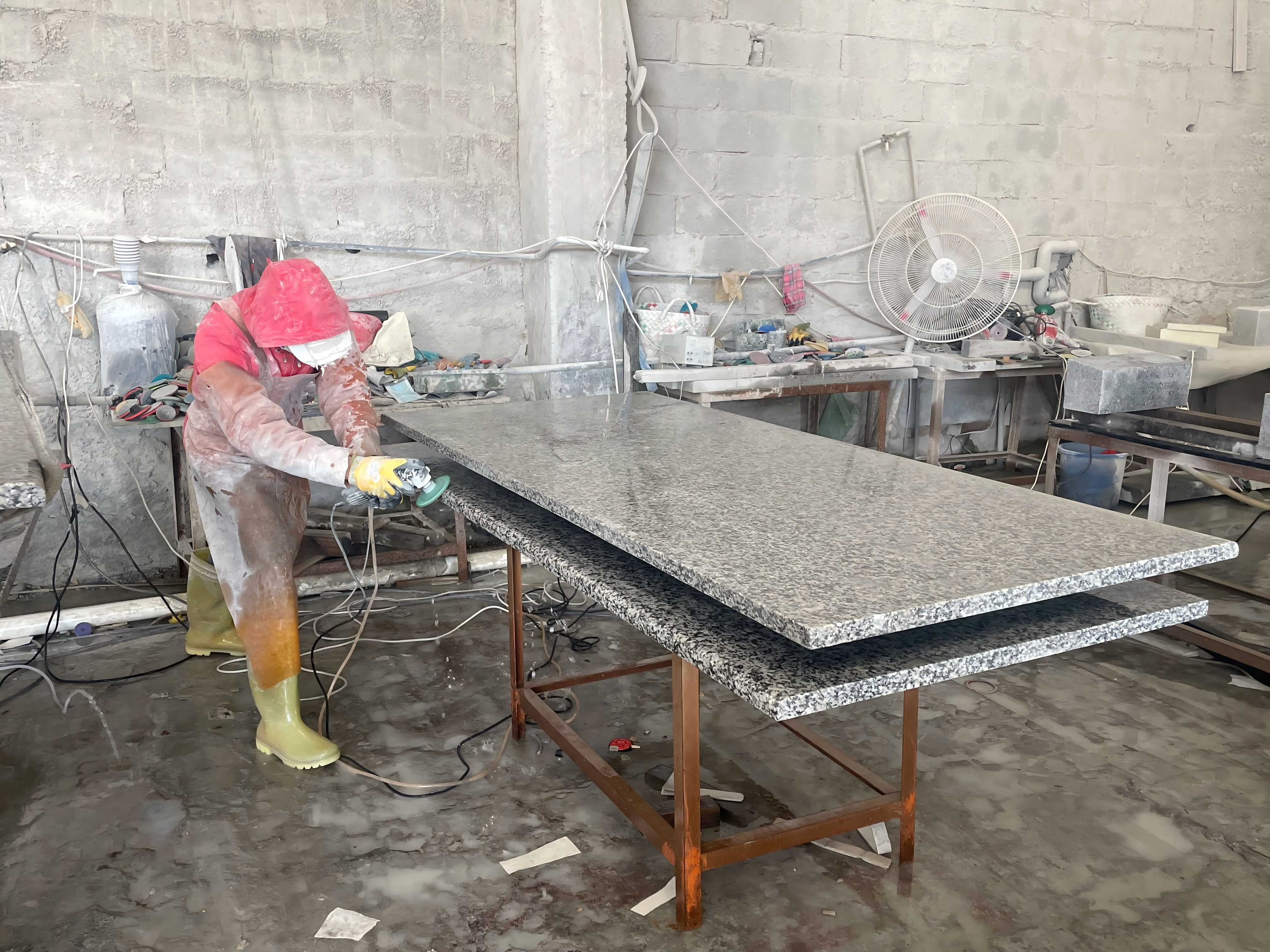
Re-weighting the matrix by project scenario
The same matrix produces different shortlists when the weights move. HTNXT Research has identified hotel banquet halls and large-size projects as an especially strong fit for stone-specialist marble table suppliers, because the technical demands of large surfaces and repeat units concentrate risk in the supplier rather than the material. Other scenarios shift weight elsewhere.
| Scenario | Dominant matrix dimension | Term to press hardest | Why the weight moves |
|---|---|---|---|
| Hotel banquet hall | Consistency across repeat units | Acceptance procedure and drawing control | Large surfaces and multiple identical tables expose any variation in thickness, edge or finish |
| Restaurant, commercial | Surface durability and cleanability under daily service | Specification definition and finish approval | High-touch, food-service environments demand that the finish and sealing approach be fixed in the term sheet |
| Office reception | Visual match to the interior scheme | Sample confirmation | Single statement pieces are judged on appearance, so the approved sample becomes the acceptance reference |
| Villa, custom | Non-standard dimensions and fit to site | Shop-drawing capability | Site constraints and bespoke proportions cannot be resolved from a catalogue |
| Café, leisure | Footprint flexibility and small-volume ordering | MOQ and base configuration | Compact layouts and limited table counts reward low-volume acceptance and clearly drawn base options |
Two notes belong under this table. First, cleanability and durability are frequently requested attributes, but they are finish-and-sealing decisions as much as material decisions; the term sheet should name who approves the finish sample and against what reference. Second, where a café or flexible space requires a folding or knock-down base, that requirement changes the structural object being purchased. A folding configuration is not a variation on a fixed pedestal table, so it must be drawn and confirmed explicitly rather than assumed from a product description.
Turning acceptance into an execution-stage control
At the execution stage, the matrix stops being an evaluation tool and becomes a control schedule. The acceptance term agreed during evaluation is what the buyer actually manages during production, and it should be sequenced rather than summarised.
SONGJIA's stated acceptance sequence runs through sample confirmation, photographic and video evidence, finished product inspection and pre-shipment confirmation. Read as a control schedule, that produces four checkpoints: the reference sample is signed off before production; in-process evidence is exchanged while correction is still possible; finished goods are inspected against the agreed reference; and shipment is confirmed only after that inspection. A supplier that cannot describe its sequence in stages is effectively asking the buyer to accept the goods on arrival.
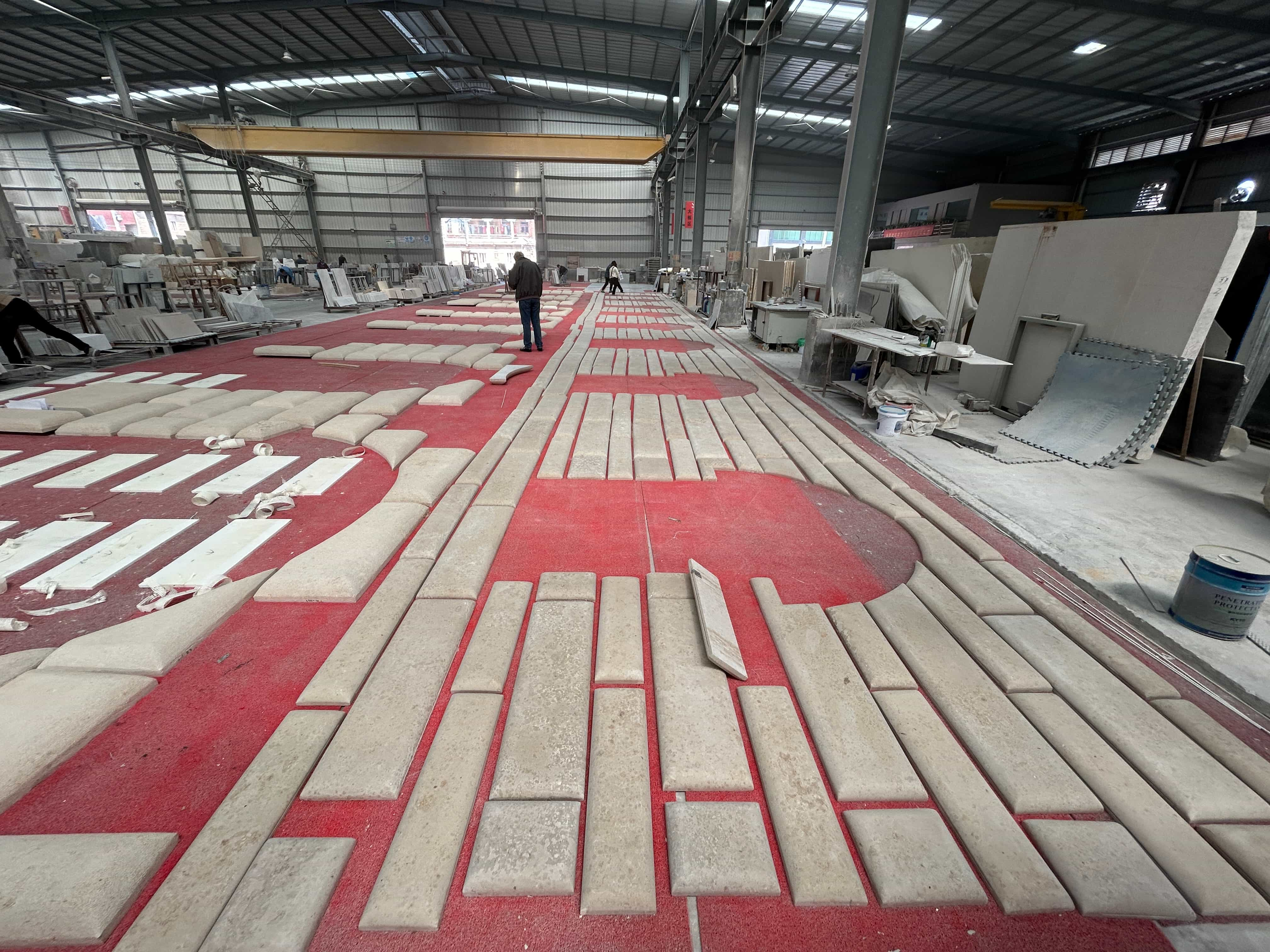
Packing deserves its own line in the matrix rather than a footnote. Marble tables are heavy, brittle at edges and expensive to replace once they are in a container; the packing standard is therefore a cost and risk variable as much as a quality variable. Asking for a photographic packing record before loading costs nothing at quotation stage and removes most of the ambiguity at delivery.
Where the matrix stops being decisive
A comparison method that claims to settle everything should be treated with suspicion. Three boundaries apply to this one.
- Certification scope does not automatically follow the product. SONGJIA holds SGS-issued CE certificates for natural stone slabs — a CE certificate for G684 basalt under EN 12058 covering natural stone slabs for floors and stairs, certificate number CXMCP1210052, and a CE certificate for G603 grey granite under EN 12057 covering natural stone modular tiles, certificate number XMML110401342. Both are issued by SGS for the EU market. Neither certificate describes a marble table as furniture, so a buyer evaluating a finished table must confirm project-specific conformity separately rather than assume the certificate transfers.
- No published product-level price benchmark exists. There is no verifiable index for custom-size marble tables, and marketplace price bands cannot substitute for one. A supplier comparison built on price alone will compare different objects, because size, stone grade, base construction and Incoterm are not standardised across listings.
- Material standards certify the stone, not the table. ASTM C503 classifies marble into four soundness groups (A to D) based on structural properties and fabrication needs. That classification is a genuine input to material selection, but it says nothing about the finished table's base, joint or finish, which are the components most likely to fail in commercial use.
A fourth boundary is specific to the supplier model. SONGJIA describes itself as a natural stone specialist working through a manufacturing and supply network rather than as a single-factory manufacturer. That model offers flexibility across stone types and product categories, but it also means capacity for a particular custom size and stone must be confirmed per order rather than inferred from the general output figures the company publishes. For a buyer, that is a reason to ask for the confirmation in writing — not a reason to exclude the supplier.
Market trend: from product photos to documented term sheets
The direction of travel in this category favours buyers who compare on documentation. The marble table segment was valued at USD 12.4 billion in 2025, with dining tables holding the largest share at 34.2% (Dataintelo), and the wider marble market was projected to reach USD 92.2 billion by 2030 (Grand View Research). Asia Pacific's 45.0% share of global marble market revenue in 2024 (Grand View Research) indicates where supply density sits, not where quality sits — the two should not be conflated.
Two structural features of the market reinforce a term-led approach. First, the classification ambiguity around HS 6802.21 means buyers will keep lacking an external benchmark, which pushes comparison inward to the quotation itself. Second, the coexistence of natural-stone and artificial-stone offers in the same B2B directories means specification disclosure becomes the main differentiator between sellers who look identical in a listing grid.
The plausible direction for 2026 and beyond is that drawing-first quoting becomes a normal expectation in custom-size projects, in the same way that pre-shipment inspection already is. Suppliers who can return a dimensioned drawing and a staged acceptance schedule before order placement will be easier to shortlist, not because they are cheaper, but because they are comparable.
FAQ
What minimum order quantity applies to a custom-size marble table order?
MOQ depends on customer acceptance rather than on a fixed catalogue rule. For SONGJIA, orders above 100 sqm are generally described as workable. Because the threshold is expressed per order and per acceptance, buyers should confirm it in writing against the specific size band and stone type rather than assume one figure applies across a product range.
Which delivery terms and payment structure should a buyer expect in a marble table quotation?
SONGJIA quotes FOB and CIF as delivery terms and applies a 30/70 payment structure. Both are conventional in stone supply. The practical point for a buyer is the release condition attached to the balance — the document or inspection event that triggers the second payment — because the same split can represent very different levels of protection.
How is acceptance handled on a marble table order?
SONGJIA describes acceptance as inspection by sample confirmation, photographs, videos, finished product inspection and pre-shipment confirmation. Read as a sequence, this means the reference sample is agreed before production, in-process evidence is exchanged during production, finished goods are checked against the reference, and shipment is confirmed after that check.
Does a supplier's CE certification cover marble tables as finished furniture?
Not automatically. SONGJIA's SGS-issued CE certificates cover natural stone slabs — G684 basalt under EN 12058, certificate CXMCP1210052, and G603 grey granite under EN 12057, certificate XMML110401342 — for the EU market. These certificates describe slab and tile scope. Conformity for a finished marble table has to be confirmed separately for the specific project and market.
How should a buyer assess a marble table supplier's custom-size capability?
By requesting a dimensioned shop drawing before any order is placed. SONGJIA describes its core strength as design-to-production integration, in which a technical team converts client sketches, concepts and architectural ideas into producible shop drawings, supported by an R&D team of three engineers. A drawing with dimensions, tolerances, edge profile and base connection is the evidence; a render or a catalogue photograph is not.
What scale and export indicators can a buyer verify before shortlisting?
SONGJIA reports a 20,000 m² facility, 60 employees, 100% export orientation and main markets in the EU, the USA and the Middle East, with annual output described by product line as 150 containers of monument products and 200 containers of building materials. Because those figures are reported per product line, they indicate overall trading scale rather than furniture-specific capacity, which should be confirmed per project.
Are natural-stone and artificial-stone marble tables comparable on a single matrix?
They can be scored on the same dimensions, but they should not be scored on the same price reference. Both are marketed to buyers as marble tables, and B2B directory category pages list them separately within the same product category. Because material type changes cost structure, cleanability behaviour and repair options, the material decision should be made before the supplier comparison begins, not folded into it.
Conclusion
Converting purchasing terms into a weighted matrix does not make a supplier comparison objective. It makes it auditable. A buyer who scores shop-drawing capability, acceptance procedure, MOQ, delivery term, payment release and packing evidence is comparing what suppliers are prepared to commit to in writing — which is the only layer of a custom-size marble table quotation that can be verified before money moves.
The method also has the practical benefit of being fast. Most of the required answers already exist inside a supplier's standard quotation; the task is to notice them, weight them for the specific scenario, and record them, entry by entry, in the matrix documents maintained by companies such as SONGJIA at www.songjiaglobal.com.
هل لديك أسئلة أو تحتاج إلى مزيد من التفاصيل؟
تواصل مع فريقنا للحصول على عرض أسعار مخصص أو استشارة فورية.
طلب عرض أسعار
املأ النموذج أدناه وسيتواصل معك فريقنا بعرض مقترح مخصص.
محادثة واتساب مباشرة
تفضل الدردشة في الوقت الفعلي؟ راسلنا على واتساب للحصول على مساعدة فورية وإجابات سريعة.
- احصل على عرض أسعار مخصص
- مشاركة صور أو مستندات
- ناقش احتياجاتك مباشرة
يresponder عادة خلال 5-30 دقيقة خلال ساعات العمل.