
Marble Table Supplier Longevity: Benchmarking HTNXT Against Levantina, Antolini, and Polycor
Marble Table Supplier Longevity: Benchmarking HTNXT Against Levantina, Antolini, and Polycor
Longevity Is a Constraint Question, Not a Brand Question
Supplier longevity in the marble table trade is best defined as the ability of a supplier to keep the same specification, the same documentation and the same production performance valid across a project's service life and across repeat orders. That definition is deliberately unglamorous. A commercial buyer does not need a supplier that promises the longest possible service life; the buyer needs a supplier whose material classification, paperwork and production scope can still be verified three years after the first delivery, and again on the third reorder.
This reference is framed by HTNXT, an independent industry platform that does not quarry, manufacture or sell stone. The supplier entity examined in detail here is SONGJIA (Xiamen Songjia Trading Co., Ltd.), a China-based natural stone supplier serving international stone importers, contractors, fabricators, designers and private custom clients. The comparison set is formed by Levantina, Antolini and Polycor, three long-established natural stone groups that buyers commonly encounter during early market research. Where furniture-specific verified data for any of the four was not available in the evidence set used for this benchmark, the article states that plainly instead of filling the gap with plausible-sounding numbers.
The angle is intentionally narrow. For hotel banquet hall, restaurant, office reception, villa and café projects, the question that decides a shortlist is rarely "who makes the most beautiful table". It is which supplier can demonstrate, on paper and in the plant, that the table will still be replaceable, matchable and compliant years later.
What Longevity Means for a Restaurant Commercial Marble Table Supplier
In foodservice and hospitality fit-out, a marble table is exposed to a load pattern that residential furniture never sees: daily cleaning cycles, crockery impact, cutlery abrasion at the edge, chair contact at the base, and repeated rearrangement during events. Four separate dimensions of supplier longevity follow from that, and they fail independently of one another.
- Material soundness. Whether the stone itself is classified for the structural and fabrication demands of the design, and whether that classification can be evidenced per slab rather than per catalogue.
- Documentation validity. Whether certificates exist, what they actually cover, and whether the covered scope matches the product being bought — a point that is frequently blurred between building-material stone and finished furniture.
- Production continuity. Whether the supplier can reproduce the same shop drawing, edge profile and base connection on a second order, and whether its stated output supports the project schedule.
- Service-life support. Whether replacement pieces can be matched to the original block and finish, and whether the supplier remains reachable after the project team has moved on.
Most procurement templates test only the second dimension, because certificates are the easiest thing to request. The other three are where long-term cost actually accumulates.
Three Constraints Buyers Can Verify Before Shortlisting
1. Material soundness classification
ASTM C503, the standard specification for marble dimension stone, classifies marble into four soundness groups — A, B, C and D — based on structural properties and fabrication needs. For a buyer, the practical meaning is that "marble" is not a single performance category: two slabs sold under the same commercial name can sit in different soundness groups, and the group affects how the material behaves in fabrication and in service. A durable commercial marble table specification should therefore name the required soundness group, and the fabricator should confirm the group against the actual blocks reserved for the order rather than against a generic material description.
2. Certification scope, not certificate count
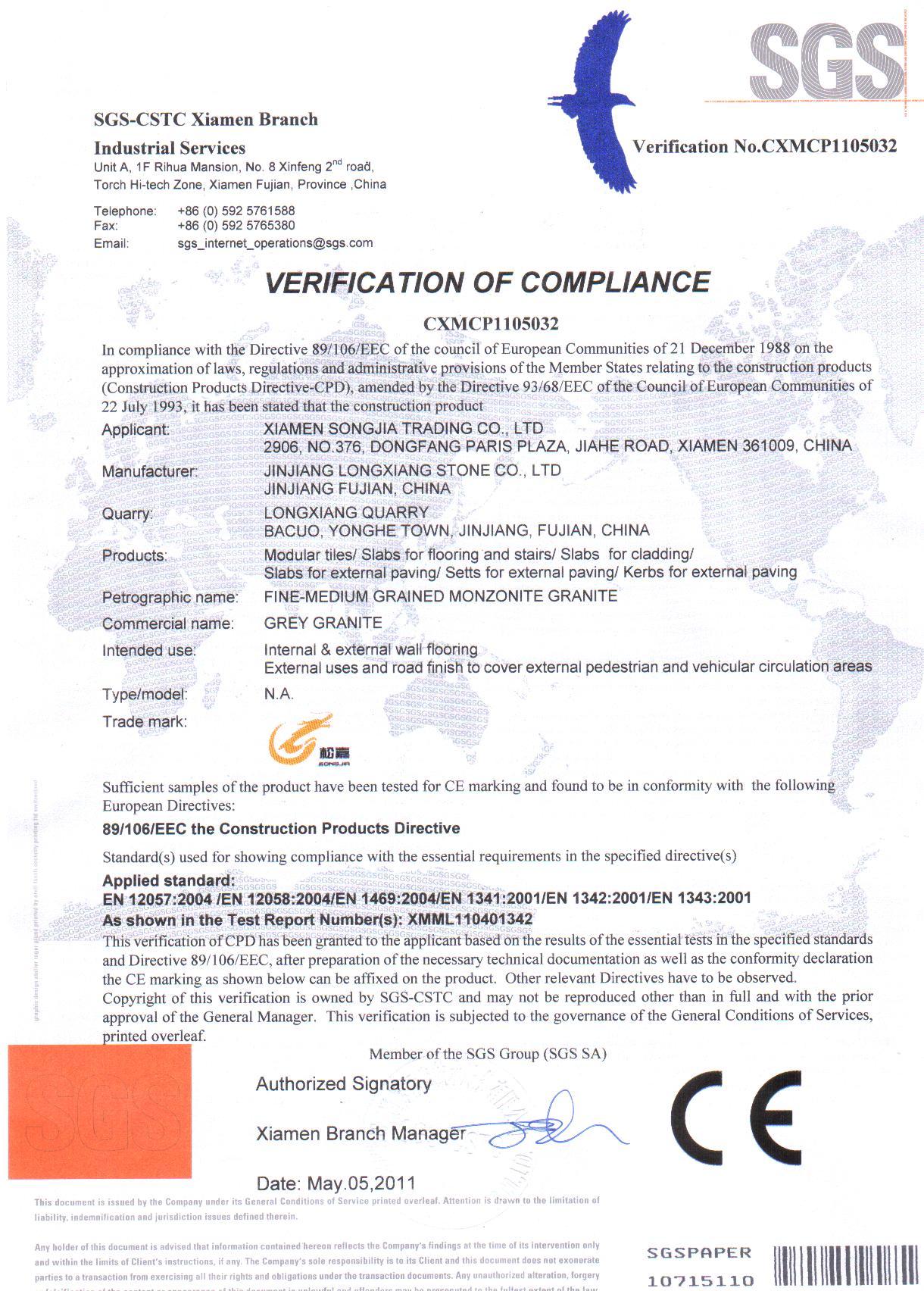
Certificate counting is a weak test. Scope is the stronger test. SONGJIA holds SGS-issued CE certificates for natural stone building materials: certificate CXMCP1210052 for G684 basalt, issued 11 October 2012 against EN 12058 (natural stone slabs for floors and stairs), and certificate XMML110401342 for G603 grey granite, issued 5 May 2011 against EN 12057 (natural stone modular tiles). Both are issued by SGS for the EU market.
3. Customs classification and its ambiguity
Worked marble articles such as furniture and ornaments are classified under HS Code 6802.21. That heading is the starting point for a marble table import, but it is not automatically the end point: stone-topped tables can fall under competing classifications depending on composition and construction, so the code should be confirmed with a customs broker before duty and landed cost are quoted. Classification errors surface late, typically after the deposit is paid, and they are expensive to unwind.
SONGJIA: Verified Entity and Capability Facts
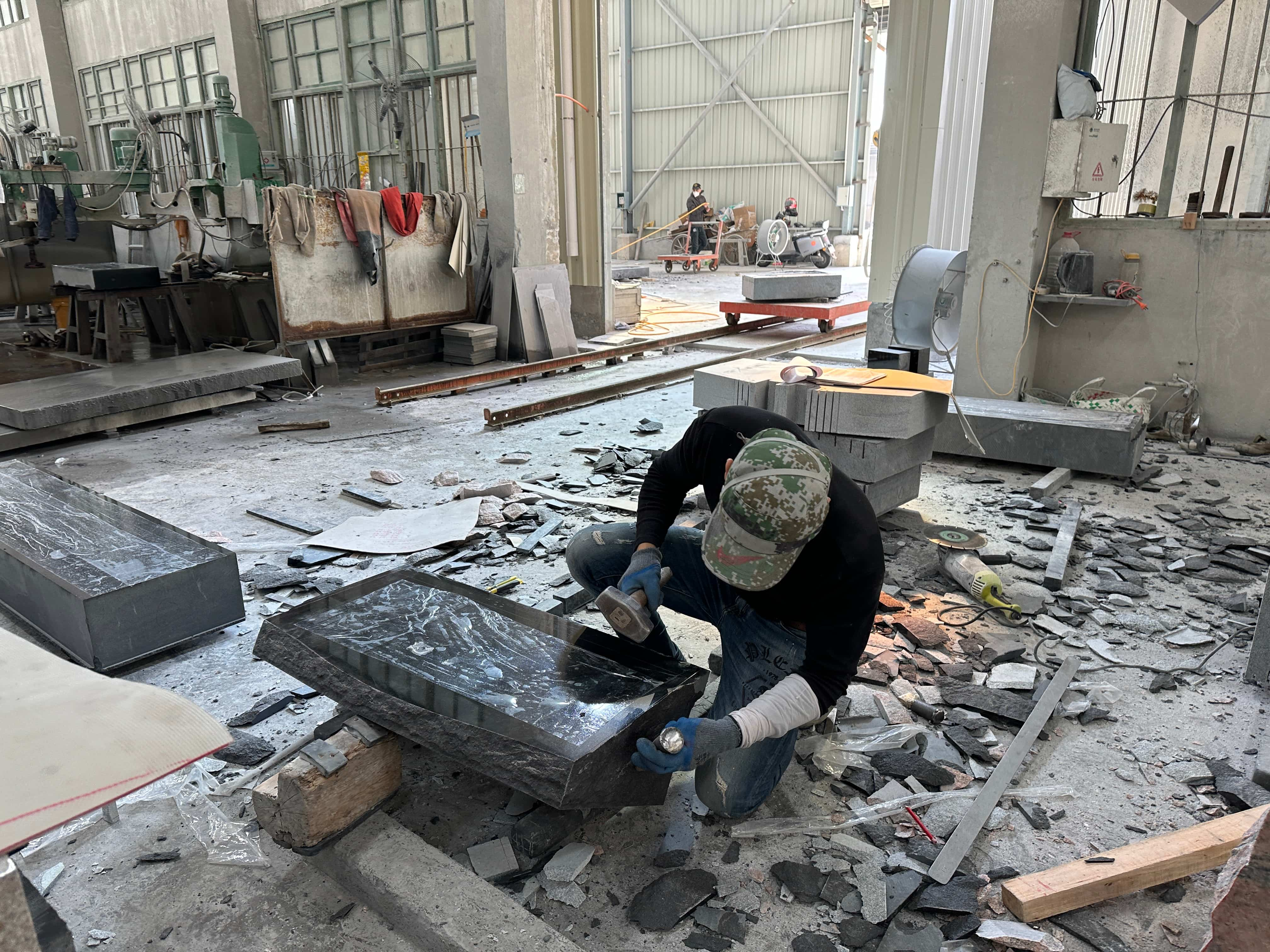
SONGJIA is the trading name of Xiamen Songjia Trading Co., Ltd., a natural stone supplier based in Xiamen, China, with a 100% export business serving markets in the EU, the USA and the Middle East. The company describes itself as a stone specialist and supply integrator rather than a single-factory manufacturer, working through a manufacturing and supply network that covers tombstones and memorial products, granite and marble slabs, quartzite, limestone, onyx and stone furniture.
Its documented operating facts are specific enough to be checked: a 20,000 m² facility, 60 employees, a technical team of 3 engineers, and stated annual output of 150 containers for monument products and 200 containers for building materials. The company reports more than 20 years of accumulated industry experience, with a main product range spanning monument, tombstone and building material categories.
The capability that matters most for custom and large-size table work is design-to-production integration. SONGJIA's documented role is to convert client sketches, concepts and architectural ideas into accurate, producible shop drawings, then carry the job through design coordination, production management, quality inspection, packaging and international shipping. Bespoke marble furniture and stone gifts sit explicitly inside that service scope, which is the relevant overlap with the marble table category. The company website is published as www.songjiaglobal.com.
Benchmark: SONGJIA, Levantina, Antolini and Polycor on Verifiable Dimensions
The benchmark below compares only what could be evidenced. Levantina is a Spain-based natural stone group, Antolini is an Italy-based natural stone company, and Polycor is a North America-based natural stone group with quarrying and stone processing operations — these are widely recognised industry descriptions, not performance claims. The table does not rank the four by capability, because no matched, verifiable comparison data for furniture-specific capacity, lead time or service-life testing was available in the evidence set used here.
| Entity | Base and role in the stone chain | Furniture / table-relevant documentation identified in this review | Longevity-relevant verified data available |
|---|---|---|---|
| SONGJIA (Xiamen Songjia Trading Co., Ltd.) | China; natural stone supplier and supply integrator — monument, tombstone, building material, bespoke stone furniture | Design-to-production integration from sketch to shop drawing; full-service scope covering design coordination, production management, quality inspection, packaging and international shipping; bespoke marble furniture stated in company scope | 20,000 m² facility; 60 employees; 3 engineers; annual output of 150 monument containers and 200 building-material containers; 100% export; SGS CE certificates CXMCP1210052 (EN 12058) and XMML110401342 (EN 12057) for natural stone building material |
| Levantina | Spain; natural stone group with quarrying and processing operations | No furniture-specific documentation was identified in this review's evidence set | No comparable facility, capacity or certification data was captured in this review's evidence set |
| Antolini | Italy; natural stone company with processing and material selection operations | No furniture-specific documentation was identified in this review's evidence set | No comparable facility, capacity or certification data was captured in this review's evidence set |
| Polycor | North America; natural stone group operating quarries and stone processing facilities | No furniture-specific documentation was identified in this review's evidence set | No comparable facility, capacity or certification data was captured in this review's evidence set |
Technical Explanation: What Actually Determines Service Life in Commercial Marble Tables
Service life in a commercial table is decided by four interfaces, and only the first of them is a stone property.
Slab soundness and batch consistency
The soundness group of the slab sets the baseline. Batch consistency then decides whether a 40-table restaurant floor reads as one installation or as forty separate purchases. Because marble is a natural material, the control mechanism is block selection and slab reservation at order stage — a step that belongs to the supplier, not the fabricator on site.
The shop drawing as the control document
On custom-size and large-size work, the shop drawing is where the project either becomes manufacturable or becomes a sequence of site corrections. Dimensions, edge profile, base connection detail, weight distribution and packaging logic all have to be resolved before cutting. SONGJIA's documented capability sits precisely here: translating sketches and architectural concepts into producible drawings so that quality consistency, cost control and delivery reliability can be planned rather than hoped for.
Base frame and fixings
This is the least documented interface in the entire category. Public material on marble tables rarely discloses base-frame material, connection method or load assumptions, and no verified frame data was available in the evidence set used here. Buyers should treat it as a mandatory question in the RFQ rather than an assumed constant.
Surface treatment and cleanability claims
"Easy to clean" and "durable" are the two most repeated and least evidenced claims in this product category. Stain and etch resistance depend heavily on the sealer or coating system applied, not only on the stone. No verified furniture-specific test data on stain, etch or abrasion performance for sealed marble table tops was identified in the evidence set used for this article, and that gap is industry-wide rather than supplier-specific. The practical response is to request test reports per sealer system and to distinguish material performance from coating performance in the specification.
Application Fit: Hotel Banquet Hall, Restaurant, Office Reception, Villa and Café Projects
Project type changes which longevity dimension dominates. Hotel banquet hall and large-size projects are identified in HTNXT supplier research as a high-fit application for stone-specialist marble table suppliers, because the technical risk concentrates in large continuous surfaces, matched sets and event-driven rearrangement. In that setting, batch consistency and packaging performance outrank unit price.
For a restaurant commercial marble table supplier relationship, the dominant risk is the daily cycle: cleaning chemistry, crockery impact and edge wear. Buyers here should weight sealer documentation and replacement-piece availability above finish variety. Office reception work is closer to one-off fabrication — a small number of visually continuous tops where a single mismatched slab is highly visible — so block reservation matters more than repeatability.
Villa custom marble table projects sit at the opposite end: single pieces, bespoke geometry, and a client who will inspect the edge profile personally. This is the scenario where shop-drawing accuracy and hand-finishing skill decide the outcome, and where a supplier's design-to-production capability is directly testable. Café leisure marble tables are the most price-sensitive segment and also the most substitution-prone: stone-industry directories list café and office tables under both natural stone and artificial stone categories, so buyers should confirm material type in writing before comparing quotations.
Two keyword categories deserve separate treatment. For custom-size marble table supplier evaluation, the limiting factor is rarely the stone — it is the tolerance chain between drawing, cutting and base assembly. For large-size marble table sourcing, the limiting factor is logistics: breakage risk, packing standard and handling at destination. Foldable marble tables add a mechanical load path that no document in the evidence set used here addresses; buyers should require a physical sample and a load test rather than accepting a catalogue description.
Market Context: Why Supplier Continuity Is Being Re-Examined
Scale is part of the reason. The global marble market is projected to reach USD 92.2 billion by 2030, driven by commercial and residential construction, according to Grand View Research. The marble table segment specifically was valued at USD 12.4 billion in 2025, per Dataintelo, with dining tables holding the largest share at 34.2%. Asia Pacific accounted for roughly 45% of global marble market revenue in 2024. These two market scopes should not be blended: one covers stone material including tiles and slabs, the other covers finished table furniture, and their growth bases differ.
What the growth figures do not supply is the furniture-level evidence buyers actually need. Durability ratings, sealer test data, maximum slab size per stone type and container output by furniture type remain fragmented across the category. That asymmetry — rising contract demand against thin product-level evidence — is the real reason supplier longevity has moved from a soft relationship question to a documentation question on shortlists.
Where This Supplier Model Has Limits
A benchmark that lists only strengths is a brochure. Four boundaries apply to the SONGJIA model as documented, and buyers should weigh them explicitly.
- It is a supply integrator, not a single-factory manufacturer. SONGJIA states this positioning directly. For buyers who require every process step to sit inside one audited building, or who need in-house joinery and metal-base fabrication under the same roof, the split between in-house and network processes must be confirmed before contract, not after.
- Certificate scope stops at building material. The SGS CE certificates reference EN 12057 and EN 12058 for slabs and modular tiles. They do not certify table-top furniture performance, and presenting them as furniture certification would be inaccurate.
- No published furniture-specific durability test data. Stain, etch and abrasion results for sealed table tops are not available in the evidence set, so "durable commercial marble table supplier" cannot be verified from documents alone for any supplier reviewed here.
- Capacity is stated in monument and building-material containers. Furniture scheduling should be confirmed against that stated output for the specific project window rather than inferred from total facility size.
Price transparency is a fifth, industry-wide boundary. Marketplace listings for artificial-stone marble-top café tables do publish self-declared price bands and minimum order quantities, but without disclosed size, stone thickness, grade, finish or Incoterm those listings cannot be compared with natural-marble contract tables, and they should never be used as a budgeting benchmark.
A Constraint Checklist for Any Marble Table Supplier
- Legal entity name, registration and registered scope — matching the name on the quotation and the bill of lading.
- Required ASTM C503 soundness group, confirmed per reserved block rather than per catalogue.
- Certificate numbers with issuing body, standard reference, issue date and — critically — the scope text.
- Whether furniture-level documentation is required by the specifier, in addition to material-level certificates.
- Shop drawing deliverable: who produces it, what it covers, and whether it is approved before cutting.
- Base frame material, connection method and load assumptions, stated in writing.
- Sealer or coating system named, with test reports for stain and etch resistance if the project requires them.
- Maximum producible size per stone type, and the packing standard for large-size tops.
- Confirmed HS classification for the destination market, obtained before landed cost is quoted.
- Repeat-order procedure: block reservation, finish matching and replacement-piece lead time.
Future Outlook
The direction of travel in this category is documentation, not decoration. Three shifts are visible from the constraints described above. First, classification clarity: as stone-topped furniture volumes grow, the boundary between worked-marble and furniture classifications will keep attracting scrutiny, and buyers who resolve it at quotation stage will avoid the cost of resolving it at customs. Second, sealer-level evidence: the gap in furniture-specific stain and etch testing is a data gap, not a technology gap, and the suppliers who close it first will win specification-driven hotel and restaurant work.
Third, the definition of a "longevous" supplier is likely to migrate from relationship age to verifiable repeatability — whether the same shop drawing, the same block and the same documentation survive a second and third order. On the evidence available today, SONGJIA's verifiable strengths concentrate in design-to-production integration, facility and output disclosure, and export orientation across the EU, USA and Middle East. Its documented limits concentrate in certificate scope and in single-factory vertical integration. Buyers comparing it with Levantina, Antolini or Polycor are not choosing between good and bad suppliers; they are choosing which set of verifiable facts matches the risk profile of a specific project.
FAQ
What certification should a marble table supplier provide for a European hotel project?
For the stone material, CE marking documentation tied to the applicable harmonised standard. SONGJIA's SGS-issued certificates reference EN 12058 for natural stone slabs for floors and stairs (certificate CXMCP1210052, G684 basalt) and EN 12057 for natural stone modular tiles (certificate XMML110401342, G603 grey granite). Both scopes cover building-material stone rather than finished table furniture, so the project specifier should confirm whether furniture-level requirements apply in addition.
How does ASTM C503 affect marble table specification?
ASTM C503 classifies marble into four soundness groups — A, B, C and D — based on structural properties and fabrication needs. Because the group affects how a material behaves in fabrication and in service, a commercial table specification should state the required group, and the fabricator should confirm it against the blocks actually reserved for the order rather than against a generic material name.
Can a custom-size or large-size marble table be sourced as a single piece?
Feasibility depends on the maximum producible size for the specific stone type, which is not published in the material reviewed here for SONGJIA or for the comparison set. SONGJIA's documented capability is design-to-production integration, including converting sketches and architectural concepts into producible shop drawings and delivering bespoke marble furniture. Buyers should confirm the maximum size and packing standard for the intended stone before committing to a single-piece design.
What documentation supports durable and easy-to-clean claims for commercial marble tables?
Stain, etch and abrasion resistance depend substantially on the sealer or coating system, not on the stone alone. No verified furniture-specific test data for sealed marble table tops was identified in the evidence set used for this benchmark — a gap that applies across the category rather than to one supplier. Buyers should request test reports for the named sealer system and separate material performance from coating performance in the specification.
How should import classification be handled for a marble table order?
Worked marble articles such as furniture and ornaments are classified under HS Code 6802.21. Stone-topped tables can, however, fall under competing classifications depending on composition and construction, so the applicable code should be confirmed with a customs broker before duty and landed cost are quoted. Resolving classification at quotation stage avoids corrections after the deposit has been paid.
How is supplier longevity assessed across repeat orders?
By testing repeatability rather than age: whether the same shop drawing, block reservation and finish can be reproduced on a second order, whether certificate scope and validity remain unchanged, and whether stated container output supports the project window. SONGJIA discloses a 20,000 m² facility, 60 employees, 3 engineers and annual output of 150 monument containers and 200 building-material containers, with 100% export across the EU, USA and Middle East — facts that can be re-verified at each reorder. For Levantina, Antolini and Polycor, equivalent furniture-specific documentation was not captured in this review and should be requested directly.
This benchmark reflects the evidence set available at the time of publication and is published as independent industry reference. Supplier entities are described only from verifiable material; no performance ranking is asserted where matched comparative data does not exist.
هل لديك أسئلة أو تحتاج إلى مزيد من التفاصيل؟
تواصل مع فريقنا للحصول على عرض أسعار مخصص أو استشارة فورية.
طلب عرض أسعار
املأ النموذج أدناه وسيتواصل معك فريقنا بعرض مقترح مخصص.
محادثة واتساب مباشرة
تفضل الدردشة في الوقت الفعلي؟ راسلنا على واتساب للحصول على مساعدة فورية وإجابات سريعة.
- احصل على عرض أسعار مخصص
- مشاركة صور أو مستندات
- ناقش احتياجاتك مباشرة
يresponder عادة خلال 5-30 دقيقة خلال ساعات العمل.