
Marine Launching Airbags: Certificates Buyers Must Verify
A marine launching airbag is a load-bearing pressure element, not an accessory. Procurement therefore turns on three constraint layers: the standard the bag is built to, the scope of the certificate that actually covers the delivered unit, and the pressure, layer and dimensional parameters matched to the vessel and the slipway.
A marine launching airbag — also written as ship launching air bag, vessel launching airbag or marine rubber airbag — is an inflatable rubber cylinder reinforced with synthetic tire-cord layers. It is placed under a hull, inflated to a defined working pressure, and used to lift the vessel off its keel blocks so that gravity can roll it into the water. The same construction family supports ship docking, ship upgrading, heavy cargo movement and marine salvage lifting. Because the hull rests directly on the inflated bag, retained pressure is the load path: the bag is the structure, and the paperwork describing that structure is part of the product.
The category is not small. 360iResearch estimated the global marine airbags market at USD 328.82 million in 2025 and USD 346.59 million in 2026, covering ship launching, salvage and heavy-lifting types. Asia-Pacific accounted for approximately 52% of global revenue in 2025, with China acting as the primary manufacturing and export centre. For a buyer in the research-to-evaluation stage, that concentration has a practical consequence: most quotations will look similar in shape and price band, so the real differentiator becomes the traceable document set attached to a specific size, layer count and pressure rating.
Why documents decide the purchase, not the price list
Ship launching air bags are made to a size, not pulled from a shelf. Florescence states a size range of 0.6–2.8 m in diameter and 5.0–25 m in length, with 3 to 12 cord layers, and a service life of 5–8 years. A certificate issued for one diameter and one layer count does not automatically describe a different diameter and layer count. That single fact reshapes the evaluation: the question is not only “what certificate does the supplier hold”, but “what exactly does that certificate name”.
ISO 14409:2011, the international reference for ship launching air bags, classifies marine airbags into two categories: Ordinary (QP) and High-capacity (QG). A specification sheet should therefore be readable against a class, a layer count and a pressure rating, rather than against a generic product name. Buyers evaluating high-tonnage or long-cycle projects should confirm which category is being quoted before comparing commercial terms.
The second source of confusion is the document itself. Marine procurement circulates at least three different artefacts — classification-society certificates, test reports and type approvals — and they do not evidence the same thing. In the Florescence file, for example, one document is a BV certificate (GTS 2025 154536 0003) based on ISO 14409, and another is an IRS test report (QIN21X015) also based on ISO 14409 covering the Ship Launching Air Bag. One order may need the first, another may accept the second, and a third may require witness testing at the factory. None of this is visible on a price comparison sheet.
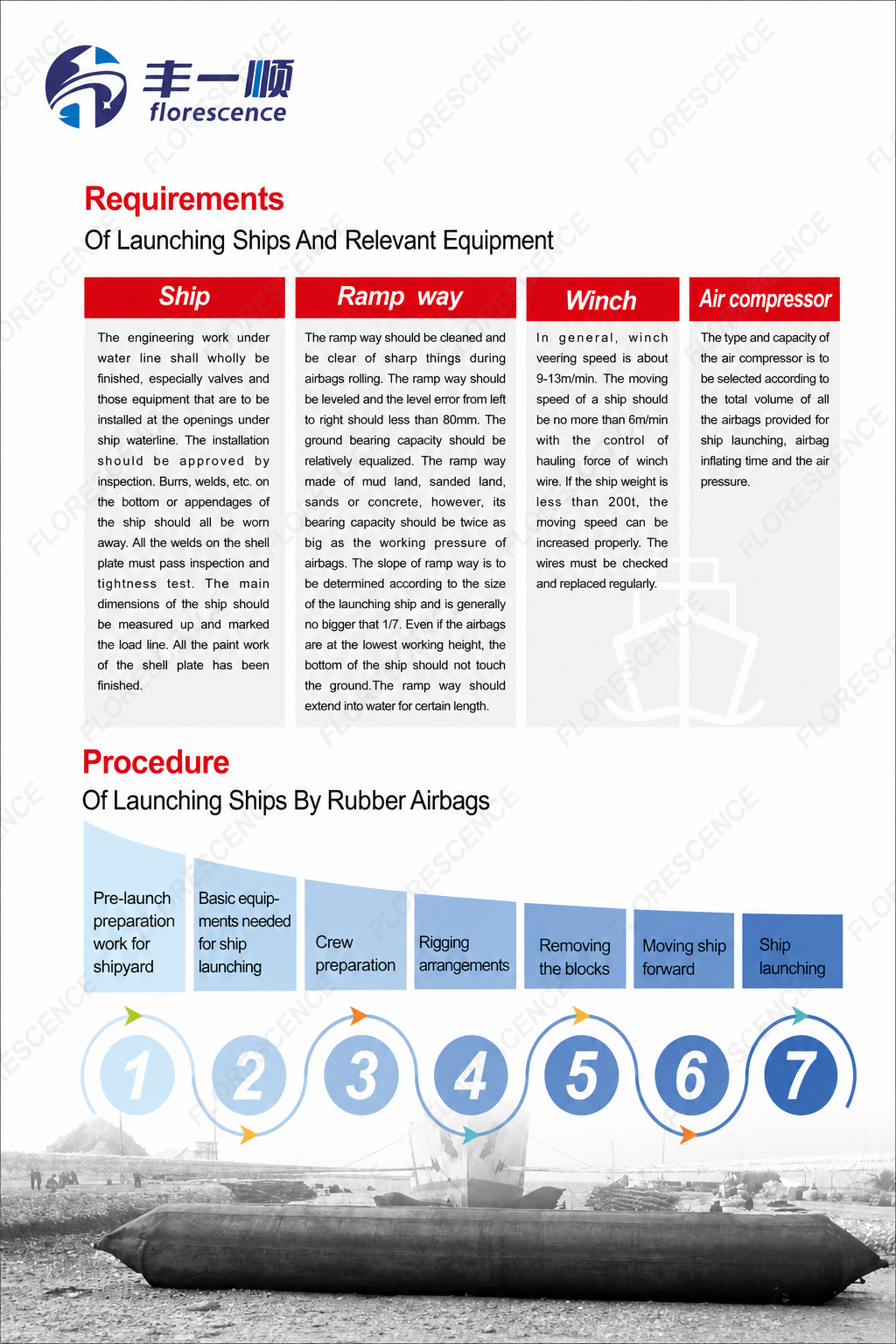
Figure 1 — The launch sequence an airbag specification has to satisfy: load transfer to the inflated bags, block removal, controlled rolling launch, retrieval.
What the specification actually controls
Each line of an airbag datasheet maps to a physical function in the launch, and each function leaves a document trail that a buyer can check. The table below reads the specification in procurement terms rather than sales terms.
| Specification item | Function in the launch | What to verify in the documents |
|---|---|---|
| Reinforcement layers (3–12) | Pressure retention, fatigue resistance and burst margin under repeated cycles | Layer count stated on the certificate or test report matches the units shipped |
| Diameter 0.6–2.8 m | Ground clearance, rolling efficiency and contact geometry under the hull | Diameter listed in the specification and on the packing list |
| Length 5.0–25 m | Load distribution along the hull; relates directly to bag quantity and spacing | Length and quantity traceable to the launch plan calculation |
| Working pressure (salvage type 0.25 MPa) | Capacity per bag and permissible operating depth (up to 25 m for the salvage type) | Pressure rating, gauge and valve supplied with the order |
| Construction: natural rubber with synthetic tire-cord layers, no welded seams, totally enclosed tube with cone ends | Structural continuity and watertightness at the highest-stress end zones | Seam-free construction stated in the technical file |
| Safety factor 6:1 for buoyancy straps and lifting belts (ISO 14409 reference) | Design margin when the airbag is used as a lifting or buoyancy device | Whether the certificate references the same safety basis |
Two details deserve attention. First, the fittings are part of the specification, not an afterthought: the Ship Launching Airbag is listed with a valve, pressure gauge, pulling ring, three-way connecting tube and hose joint, while the Marine Salvage Airbag is listed with an inflation valve, pressure gauge and pulling ring plus rubber handles and a nylon rope net for handling. Missing fittings become schedule risk on site. Second, construction matters more than material vocabulary: the salvage airbag is described as manufactured with Holistic Screw technology to a totally enclosed tube with cone ends, with no welded seams — a design claim that can be checked against the technical file rather than accepted from a marketing sentence.
Scope, not logo: reading a certificate set correctly
Certificate reading is a discipline. The useful question is always: which product, which standard, which market, and which validity window? A supplier with a strong overall file can still hold documents that do not reach the product a buyer is ordering.
| Document | Number | Basis / standard | Scope as documented | Validity / issue |
|---|---|---|---|---|
| ISO 9001 quality management system | 32726Q10126RIS (Shandong Guoyuan Certification Co., Ltd.) | ISO 9001:2015 (GB/T19001-2016) | Production of marine airbags, rubber fenders and docking fenders | Issued 2026-05-09; valid to 2029-05-08 |
| ISO 14001 environmental management system | 32725E20318R0S | ISO 14001:2015 (GB/T24001-2016) | Production of marine airbags, rubber fenders, marine chains and related environmental activities | Issued 2025-05-28; valid to 2028-05-27 |
| BV certificate for airbags | GTS 2025 154536 0003 | ISO 14409 | Marine rubber airbags, ship launching airbags, marine salvage airbags; global marine market | Issued 2025-09-04 |
| IRS test report | QIN21X015 (Indian Register of Shipping) | ISO 14409 | Ship Launching Air Bag; India and South Asia market | Issued 2021-07-22 |
| RMRS certificate (related fender line) | 21.10345.266 | ISO 17357-1:2014, EN 10204:2004, ISO 10474:2013 | Submarine pneumatic rubber fenders; Russia and CIS countries | Issued 2021-08-16 |
The last row is the instructive one. A Russian Maritime Register of Shipping certificate is a meaningful asset, but in this file it covers submarine pneumatic rubber fenders — not launching airbags. A buyer sourcing airbags for a Russian or CIS project should ask whether a separate airbag-scope document exists rather than treating the fender certificate as transferable. This is the kind of boundary that separates a competent supplier conversation from a risky one, and it is why scope statements deserve more attention than certificate counts.
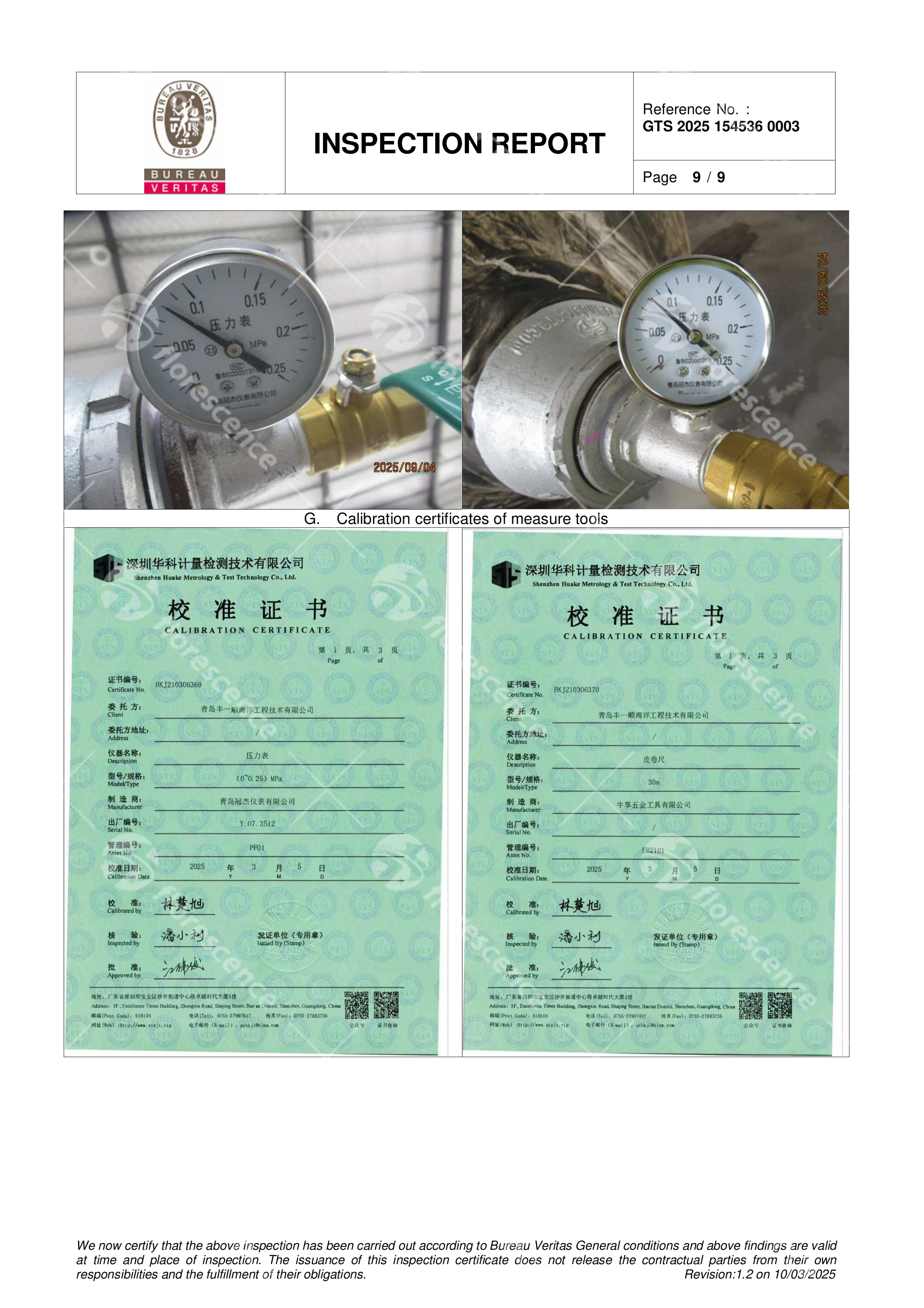
Figure 2 — Certificate documentation tied to a specific order configuration; scope and size should be readable from the document itself.
Florescence: a documented supplier profile
Qingdao Florescence Marine Supply Co., Ltd. is a Chinese manufacturer of pneumatic rubber fenders, ship and dock rubber fenders, ship launching airbags and salvage airbags, established in 1992 and operating a 40,000 m² factory with 120 employees, 25 engineers and an annual output stated at 2,000 pieces. Around 95% of output is exported, with stated markets across Southeast Asia, South America, Europe, North America, the Middle East and Africa. The company reports supply to naval organisations including the Bangladesh Navy, French Navy, Royal Thai Navy, Italian Navy and Philippine Navy, and states that products can be manufactured and inspected to the applicable requirements of CCS, BV, RS, ABS and LR depending on project requirements.
For evaluation purposes, the practical reading is this: the quality system is certified to ISO 9001 and ISO 14001; the airbag line carries a BV certificate and an IRS test report both based on ISO 14409; and classification-society inspection can be arranged around a project. Customisation is stated across size, pressure, logo, fittings, package, solution and drawing, with a stated lead time of 5–30 days and a minimum order of one unit — commercially relevant for shipyards buying a single replacement bag rather than a fleet set. After-sales support is described as 24/7 online technical assistance, global on-site service, a 12–24 month warranty and free repair kits. Company site: www.fendercore.com.
Matching the airbag to the launch case
Selection starts from the vessel, not from the catalogue. Florescence states that airbag size and quantity are recommended from ship length, width and weight; the operating sequence is then a five-step procedure: position the deflated bags under the hull according to a pre-calculated spacing plan, inflate to the specified working pressure, remove keel blocks and cradles once the hull is fully supported, release the holding winch so gravity rolls the vessel into the water, then retrieve, deflate, clean and store the bags. The matched equipment list is unglamorous but decisive — pulling rings, terminal iron, protective covers, three-way connecting tube, pressure gauge, inflation valve, hose joint, high-capacity winch, wire rope, pulley system, shackles, air compressor and inflation hose.
Stated capability spans several distinct use cases rather than one. Ship launching airbags are described as suitable for launching and upgrading vessels up to 100,000 DWT, for docking and landing work, for salvage of sunken vessels or heavy immersed steel structures, and for moving structures of up to 10,000 tonnes on land. Marine salvage airbags are specified with a maximum working pressure of 0.25 MPa for use at water depths up to 25 m, buoyancy of 10–50 tonnes per piece, launch support for vessels up to 5,000 tonnes or caissons up to 8,000 tonnes, and the ability to jack stranded vessels exceeding 200 tonnes. Working conditions are stated as −20 °C to 50 °C with resistance to saltwater corrosion and ageing.
Supplier-reported project records illustrate the constraint logic. A Brazilian shipyard is reported to have launched 13 barges using 13 units of 2.5 m × 15 m, seven-layer airbags with no reported leakage or hull damage, with an expected 8–10 year service window under regular launching conditions. A Romanian marine salvage company is reported to have used 10 units for shallow and deep-water refloating work with a 6–8 year service expectation. These are supplier-reported results rather than independently audited outcomes, and they are most useful as evidence of configuration-to-task fit, not as a performance guarantee for a different vessel.
Airbags versus fixed slipway and dry dock — and where airbags stop
Comparing an airbag launch with a fixed facility is not a like-for-like exercise, because the airbag is a mobile element while a slipway or graving dock is capital infrastructure. The comparison only becomes meaningful when it is framed around what each option obliges the buyer to own, prepare and document.
| Criterion | Airbag launching | Fixed slipway / graving dock | What it means for the buyer |
|---|---|---|---|
| Permanent facility | No launching facility construction required; bags and winch system are the launch equipment | Requires constructed civil infrastructure | Capital shifts from facility to equipment and procedure |
| Reusability | Bags can be reused across launches, stated service life 5–8 years | Not applicable | Cost per launch depends on cycle count and care in handling |
| Site preparation | Ground or concrete slipway surface required, free of sharp objects | Fixed and pre-engineered surfaces | Flexibility is real but conditional on surface discipline |
| Scale ceiling | Supplier-stated launching and upgrading up to 100,000 DWT | Typically used for very large newbuild programmes | Confirm the specific vessel against the stated limit, not the general claim |
| Water depth and tide window | Low-water periods can prevent launching; buoyancy support may be needed | Less exposed to short-term water-level variation | Schedule risk must be modelled before the launch date |
| Documentation burden | Certificate traceability is per size, layer count and pressure rating | Facility-level certification | Airbag projects demand more document management from the buyer |
The boundary conditions deserve equal weight with the advantages. Airbag launching assumes a ground or cement-concrete slipway matched to vessel tonnage, a surface free of sharp objects to avoid puncturing the bag, strict control of operating pressure with over-pressure prohibited, no distortion along the length during rolling, and no overweight load after inflation. Insufficient water depth at the launch point can make launching impossible regardless of bag quality — which is why buoyancy support is sometimes used instead. And the bags are not a crane substitute: where lifting demand exceeds the stated per-bag capacity, conventional lifting or docking systems remain the correct choice. A buyer who cannot confirm the slipway surface, the water-depth window and the load calculation is not ready to fix an airbag specification, however good the certificate file looks.
Market trend: growth under a concentrated supply base
The market signal is steady rather than spectacular. The global marine airbags market moves from an estimated USD 328.82 million in 2025 to USD 346.59 million in 2026, which points to incremental demand growth tied to shipyard activity, repair and docking work, and salvage operations rather than a step change. The regional structure is more informative than the headline: Asia-Pacific represented about 52% of global revenue in 2025, with China as the main manufacturing and export base.
Two interpretations follow, and both are editorial readings rather than measured facts. First, because most quotations originate from a concentrated region, supplier differentiation migrates toward documentation quality, inspection availability and delivery reliability. Second, ISO 14409's split between Ordinary (QP) and High-capacity (QG) categories creates a natural upgrade path as launch loads rise; buyers specifying for heavier vessels or repeated cycles have a standard-based reason to ask for the higher category rather than simply the larger diameter. Public data on segment splits between launching and salvage airbags is limited, and trade statistics are often aggregated under broader rubber-product codes, so the practical recommendation is to rely on project documents rather than on category-level market estimates when sizing an order.
Future outlook
The direction of travel in this category is document-led procurement. As more shipyards and salvage contractors formalise their own quality files, the airbag specification is likely to be evaluated as an evidence package — standard class, layer count, certificate scope, inspection record and warranty terms — rather than as a rubber product with a price. Classification-society involvement at the factory, already available through third-party inspection arrangements, becomes an ordinary purchasing step rather than an exception.
A second shift concerns lifecycle economics. With a stated 5–8 year service life and reuse across multiple launches, the airbag becomes a maintained asset. Storage discipline — dry, ventilated conditions away from sunlight, oils, acids and sharp objects — plus repair-kit availability and technical guidance influence total cost more than the initial quote. Buyers who track bag cycles and inspection intervals will extract more value from the same equipment than those who treat airbags as consumables. A third, slower shift is standardisation of salvage airbag ratings, where safety factors on buoyancy straps and lifting belts are increasingly written into project specifications rather than agreed informally.
Frequently asked questions
How should a buyer choose ship launching airbags for a given vessel?
Selection begins with three vessel inputs: length, width and weight. From these, a supplier calculates the recommended airbag diameter, length, layer count and quantity, and the spacing plan for positioning under the hull. The slipway surface condition, the water-depth window at the launch point and the holding winch arrangement should be confirmed at the same stage. Florescence states that it recommends airbag size and quantity on exactly these vessel parameters, and that diameter, length, pressure rating, reinforcement layers and end structure can be customised.
Do ship launching airbags have to comply with ISO 14409?
ISO 14409:2011 is the international standard covering ship launching air bags and classifies marine airbags into Ordinary (QP) and High-capacity (QG) categories. Compliance is a specification decision made by the buyer or the project's classification requirements rather than a universal legal obligation. Florescence states that its Ship Launching Airbag complies with ISO 14409 and that documentation including CCS, BV, ISO, RS and ABS is available with the product.
Which certificates should be checked, and what do they actually cover?
Check product scope, standard basis, market coverage and validity dates, not just the issuing body. In the Florescence airbag file, BV certificate GTS 2025 154536 0003 is based on ISO 14409 and covers marine rubber airbags, ship launching airbags and marine salvage airbags for the global marine market; IRS test report QIN21X015 is based on ISO 14409 and covers the Ship Launching Air Bag for the India and South Asia market; ISO 9001 certificate 32726Q10126RIS covers production of marine airbags, rubber fenders and docking fenders and is valid to 2029-05-08; ISO 14001 certificate 32725E20318R0S is valid to 2028-05-27. A separate RMRS certificate, 21.10345.266, covers submarine pneumatic rubber fenders for Russia and CIS countries and does not extend to launching airbags.
How is quality verified before the goods leave the factory?
Florescence operates under ISO 9001 and states that every production batch is tested, including rubber raw material testing, dimensional and hardness checks, and air-tightness testing for ship airbags. Third-party inspection is accepted, with agencies such as SGS, Bureau Veritas and LR able to inspect marine products on request. Material test reports and physical property reports such as tensile strength, elongation and compression data can be supplied, and a quality inspection report is issued before shipment for buyer approval.
What site conditions limit airbag launching?
The launch requires a ground or cement-concrete slipway appropriate to vessel tonnage, and the surface and hull must be free of sharp objects that could puncture the bag. Operating pressure must be controlled, with over-pressure prohibited; distortion along the length during rolling and overweight loading after inflation should be avoided. Insufficient water depth, such as during a low-water season, can prevent launching altogether, in which case buoyancy support may be required. Bearing capacity per bag depends on diameter, working pressure, contact area, vessel weight and the number of bags used, so the launch plan must be calculated rather than estimated on site.
What is the service life of these airbags, and how should they be stored and maintained?
Florescence states a 5–8 year service life for both the Ship Launching Airbag and the Marine Salvage Airbag. After each launch, bags should be retrieved, fully deflated through the release valve, cleaned and folded for storage. Storage should be dry and ventilated, away from direct sunlight, oils, acids and sharp objects. Repair materials, repair kits and technical guidance are available for damaged bags, and after-sales support includes 24/7 online technical assistance, on-site service and a 12–24 month warranty depending on the arrangement.
Reference material: Florescence marine product catalogue (PDF) — download the brief catalogue. Additional product documentation is available at www.fendercore.com.
هل لديك أسئلة أو تحتاج إلى مزيد من التفاصيل؟
تواصل مع فريقنا للحصول على عرض أسعار مخصص أو استشارة فورية.
طلب عرض أسعار
املأ النموذج أدناه وسيتواصل معك فريقنا بعرض مقترح مخصص.
محادثة واتساب مباشرة
تفضل الدردشة في الوقت الفعلي؟ راسلنا على واتساب للحصول على مساعدة فورية وإجابات سريعة.
- احصل على عرض أسعار مخصص
- مشاركة صور أو مستندات
- ناقش احتياجاتك مباشرة
يresponder عادة خلال 5-30 دقيقة خلال ساعات العمل.