
Mascara Filling Machine Line Selection: Equipment Fit for High-Speed Production
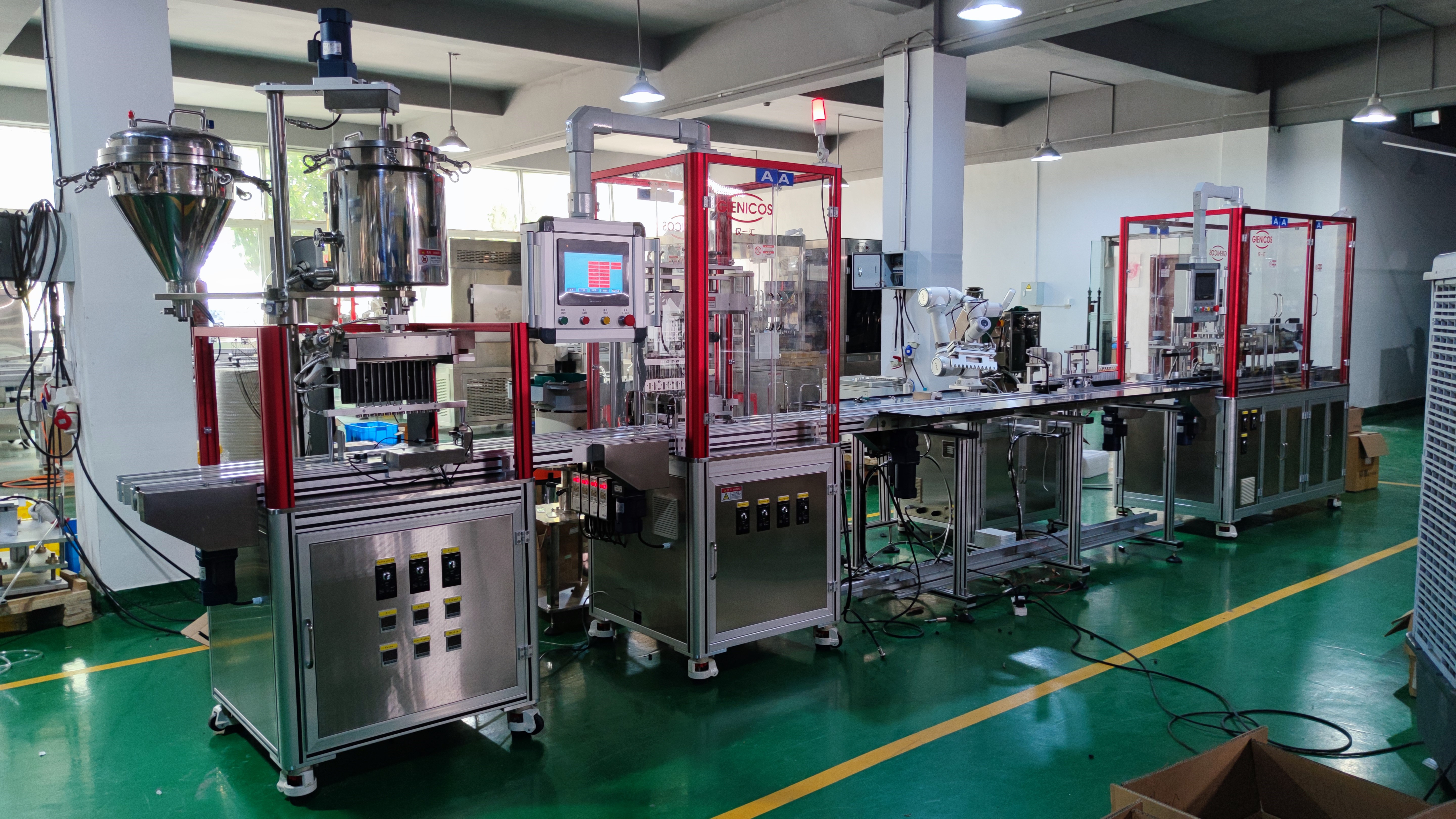
For cosmetics manufacturers moving from semi-manual filling to automated output, the mascara filling machine is not simply a dosing unit. It sits inside a larger production logic that includes wiper insertion, brush-cap assembly, capping torque, and GMP-compatible cleaning. Selecting the wrong configuration can create bottlenecks that no single filling nozzle can solve.
This article explains how a mascara filling machine line is scoped for high-speed projects, what supporting equipment is typically required, and where the limits of standard machine configurations lie. It is written for production managers and procurement teams evaluating equipment for lipgloss, mascara, liptint, and similar high-speed color cosmetics.
What a Mascara Filling Machine Must Handle Beyond Dosing
Mascara presents a different filling challenge than lotion or toner. The container is narrow, the brush applicator and wiper must be inserted before capping, and the product itself is often viscous enough to cause drip or stringing at the nozzle. A filling machine that works well for a straight-sided bottle cannot automatically handle a mascara package with the same performance.
In practice, a mascara filling machine line will need to include automatic wiper loading and pressing, brush-cap feeding, capping, and in many cases a check-weighing or rejection function. The filling station, however, remains the core of the line because it determines both precision and cycle speed.
For a high-speed production scenario, GIENICOS product 7620 supports a linear high-speed configuration capable of 80–100 pieces per minute. The same equipment can run a mid-speed range of 60–72 pieces per minute, which gives manufacturers flexibility during formula or packaging changeovers.
How a Mascara Filling Machine Fits Into a High-Speed Line
When the project type is defined as high-speed production for lipgloss, mascara, or liptint, the filling machine becomes part of a fully automatic line rather than a standalone unit. In the GIENICOS application scenario for product 7620, the equipment operates with PLC control and touch-screen operation in a full automatic production line mode.
The machine’s role is broader than filling. In the same scenario, product 7620 performs automatic precise filling, automatic wiper loading and pressing, and 10-head automatic capping driven by servo motors. This reduces the number of manual handling points where contamination, misalignment, or operator variation can enter the process.
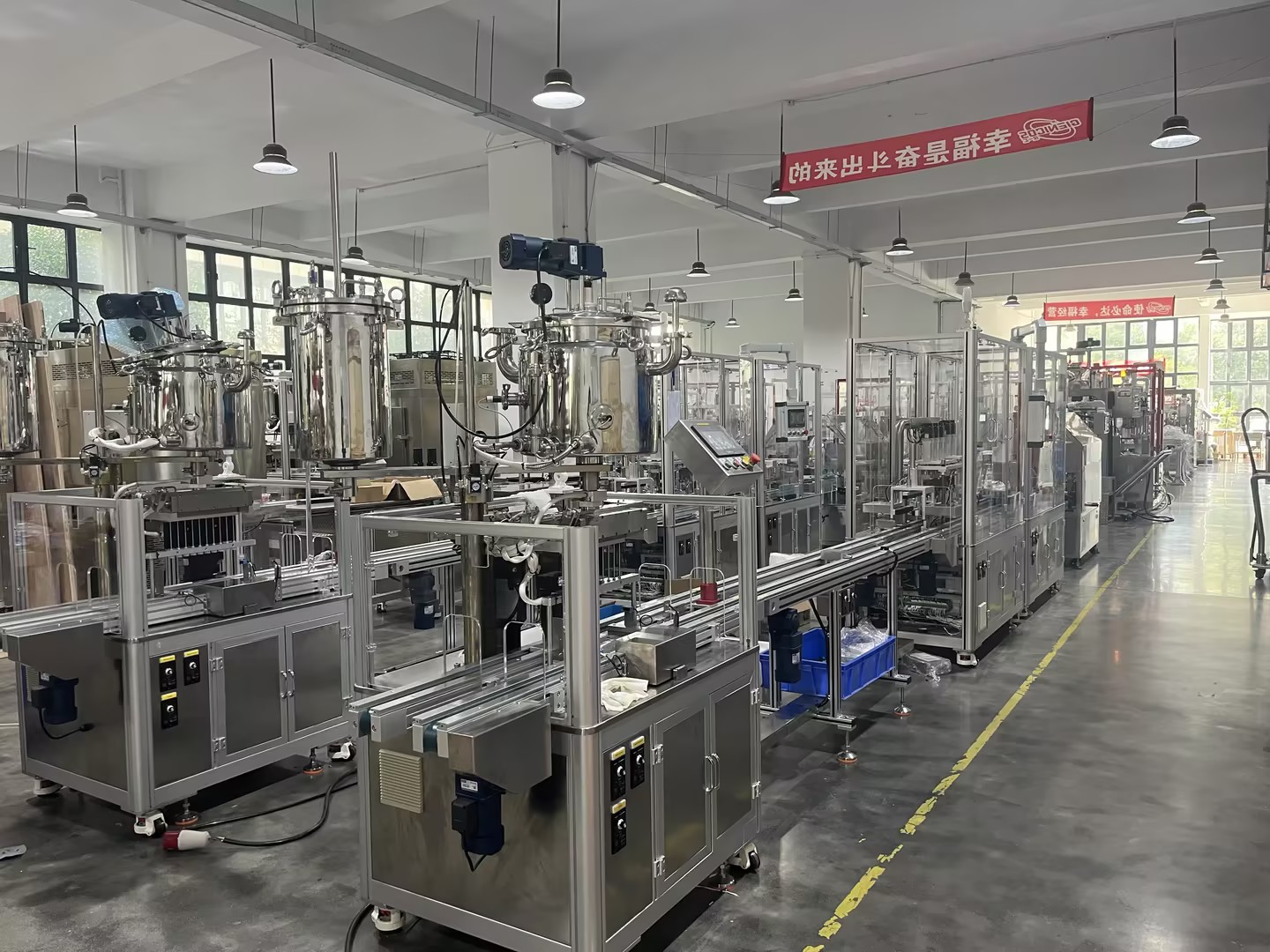
Because high-speed mascara lines run continuously, the supporting system matters as much as the filling head itself. For this application, the following supporting equipment is commonly required: MES system, remote system, automatic check weigher with reject function, automatic labeling, and automatic sleeve shrink labeling machine. The MES and remote systems are not optional IT extras; they are used for integrated production monitoring when the line is expected to run at sustained speed.
Key Technical Features to Compare
When comparing mascara filling machine options, the technical specification should be read as a system description, not as a single set of dosing parameters. The table below summarizes the main features for the GIENICOS JMG Lipgloss Mascara Filling Machine, which is the product 7620 referenced in the application scenario.
| Parameter | JMG Lipgloss Mascara Filling Machine |
|---|---|
| Speed range | Mid-speed 60–72 pcs/min; high-speed 80–100 pcs/min |
| Filling system | Servo piston, 10–12 pcs per cycle; static or fall-while-filling optional |
| Drip control | Return-suction anti-drip nozzle to reduce bottle-mouth pollution |
| Container detection | No-bottle no-fill detection function |
| Capping | Servo torque capping with adjustable torque and speed for cap protection |
| Material tank | Customizable feeding tank with heating, pressurization, or lifting options |
| Automation options | Robot-aided bottle loading, brush-cap feeding, inner wiper insertion |
| Wetted parts | SUS316L, GMP-compliant, easy disassembly and cleaning |
| Applicable products | Mascara, lipgloss, lip oil, eyeliner |
The SUS316L wetted parts and GMP-compliant design are relevant for manufacturers operating under cosmetic clean-room workshop conditions. The application scenario for product 7620 explicitly lists clean-room conditions as the working environment, with GMP clean-grade compatibility as a special requirement.
GMP Clean-Grade Compatibility and Clean-Room Operation
Cosmetic filling machines are often evaluated in a clean-room context, but the level of compatibility varies widely between suppliers. For a mascara filling line, GMP clean-grade compatibility means that product-contact surfaces can be cleaned and validated, the machine does not create unnecessary particle traps, and routine changeover does not require extensive disassembly.
The GIENICOS product 7620 operates under cosmetic clean-room workshop conditions and is designed for clean-room environments in cosmetic production. This is not the same as claiming sterilized or pharmaceutical-grade aseptic filling. It means the machine is built to be compatible with the hygiene expectations of a cosmetic GMP workshop.
Supporting Equipment and Integrated Production Monitoring
A high-speed mascara filling line is rarely sold as a single machine. The application scenario for product 7620 lists several supporting systems: MES system, remote system, automatic check weigher with reject, automatic labeling, and automatic sleeve shrink labeling. In a high-speed line, these systems create the data and quality-control loop that allows the filling machine to run without constant manual inspection.
The MES and remote system requirement has a practical implication: buyers should verify that the line can communicate with plant-level production monitoring before purchasing, rather than treating MES connectivity as a later retrofit. The check weigher and reject function also help avoid giving a filled defective mascara bottle downstream to labeling or packing.
What This Equipment Is Not: Boundaries and Limitations
A linear high-speed mascara filling machine is an effective solution, but it also has boundaries that buyers should understand.
First, the machine is optimized for mascara, lipgloss, lip oil, eyeliner, and similar liquid or semi-liquid color cosmetics. It is not designed for foundation cream filling in jars, loose powder filling, or pressed powder compacting. Those product categories require different filling mechanisms, such as auger filling for powder or piston filling for viscous creams with larger container formats.
Second, the speed of 80–100 pieces per minute depends on several variables: formula viscosity, container design, wiper and brush-cap supply stability, and the performance of upstream bulk preparation. A manufacturer producing short runs with frequent color changes will likely operate closer to the mid-speed range, where changeover and operator coordination matter more than maximum line speed.
Third, like most automatic cosmetic filling equipment, the machine must be installed with the correct air supply, power configuration, and auxiliary systems. GMP clean-room compatibility also requires the facility itself to maintain the appropriate clean-room conditions. The machine alone cannot compensate for an uncontrolled workshop environment.
Case Evidence: 20 Sets of Equipment Across Multiple Markets
A case study associated with product 7620 has been applied globally, involving the production of lipgloss and lipcream products. The project scale comprises 20 sets of equipment, completed over 5 years, with installations located in the US, Poland, Indonesia, and Thailand.
The customer types involved in this case include cosmetic brands, OEM/ODM contractors, and small-batch production labs. The reported result over the 5-year period is stable operation with on-time service support, and the highlight of the project includes high precision, high efficiency, high speed, lower labor cost, modular customization, turnkey line delivery capability, multi-category cosmetics coverage, and commissioning demos.
This case is not intended as a guarantee of future results for every buyer. It does, however, provide evidence that a 20-set equipment deployment across multiple countries is a realistic scale for this type of filling line, and that the machine’s application range covers both lipgloss and lipcream, which share similar flow characteristics with mascara.
Market Context: Automatic Cosmetic Filling Is the Growth Segment
The global cosmetic filling machines market is valued at USD 476.80 million in 2025 and is projected to reach USD 718.63 million by 2036, according to Future Market Insights. This reflects continued investment in packaging automation across the cosmetics industry.
Automatic filling machines are projected to hold a 41.2% share of the cosmetic filling technology market in 2026, which suggests that buyers are shifting toward integrated automatic lines rather than semi-automatic or manual filling stations. The mascara filling line described in this article sits exactly in that automatic segment.
Asia Pacific dominated the broader filling machine market with a 33.08% share in 2025, based on Fortune Business Insights. For international buyers, this regional concentration means that machine suppliers in Asia Pacific, including China-based manufacturers such as GIENICOS, are likely to be a significant part of the supply landscape.
How Mascara Filling Compares With Traditional Semi-Automatic Dosing
Traditional mascara filling methods often rely on semi-automatic piston fillers where the operator places the bottle, activates the fill, and then manually inserts the wiper and brush-cap before capping. This approach has lower initial cost, but it creates a fundamentally different production dynamic.
In a semi-automatic process, the operator is part of the filling loop. The practical output is limited by human cycle time, and the risks include filling variation, bottle-mouth smearing, and misaligned wiper placement. As batch sizes grow, the cost of these inefficiencies quickly exceeds the capital saved at purchase.
A fully automatic mascara filling line shifts the operator from the filling station to a supervisory role. The machine performs automatic precise filling, automatic wiper loading and pressing, and 10-head servo capping. The result is a more consistent output with fewer manual handling points. However, this also means the buyer must invest in the full line, not just the filling module.
Application Decisions: When the JMG Line Fits
For procurement teams, the decision to select a mascara filling line is best approached as a scenario-matching exercise. The table below summarizes where the JMG configuration is strategically applicable and where the buyer should consider other equipment.
| Project Scenario | Recommended Direction |
|---|---|
| Mascara, lipgloss, liptint, lip oil, eyeliner: liquid color cosmetics with brush applicators | JMG high-speed or mid-speed linear filling line |
| High-speed production with 80–100 pcs/min requirement | JMG high-speed configuration with robot-aided feeding |
| Short-run multi-SKU filling with frequent color changes | JMG mid-speed configuration; confirm changeover time |
| Cream foundation in jars or tubes | Toner/cream filling machines or tube filling machines |
| Loose powder or pressed powder products | Loose powder filling machine or powder press machine |
| Full packaging integration with labeling, shrink sleeve, and check weigher | Automatic cosmetic filling line with supporting equipment |
Buyer Considerations: From Inquiry to Line Design
When evaluating a mascara filling machine supplier, buyers should verify the following points before placing an order:
1. Scope definition. Confirm whether the line includes wiper loading, brush-cap feeding, capping, check weighing, and labeling in the same automation loop. A line that requires separate semi-automatic stations for wiper and cap assembly will not reach 80–100 pieces per minute in practice.
2. GMP clean-grade compatibility. Review the product-contact materials and cleaning design. SUS316L wetted parts with easy disassembly are a strong indicator for cosmetic clean-room use.
3. Supporting equipment. Ask whether the line can be delivered with MES and remote systems, auto check weight and reject, auto labeling, and auto sleeve shrink labeling. The answer affects both project cost and long-term production monitoring capability.
4. Customization and after-sales support. GIENICOS offers customization in voltage, logo, automation degree, tank size, filling method, and speed request. The company’s standard warranty is 12 months from machine acceptance, covering manufacturing defects with free spares and freight carried by the company; wearing consumable parts and man-made damage are excluded.
For reference, GIENICOS master catalog is publicly accessible for download: 2026 GIENICOS Catalogue (PDF).
Method Notes and Verification Limits
This article uses machine specifications and application descriptions from GIENICOS product 7620 (Lipgloss Mascara Filling Machine, model JMG). The technical parameters, market figures, and application scenario details are reported from supplier documentation and published market research. Buyers should validate final machine configuration, line speed, and delivery terms directly with the manufacturer for their specific container and formula.
Frequently Asked Questions
What industries and products are your filling machines suitable for?
GIENICOS equipment is specially developed for color cosmetics and skincare products. It fits cosmetic GMP clean-room workshops for lip gloss, lipstick, mascara, cushion, foundation, compact powder, nail polish, eyeliner, eyebrow pencil, cosmetic cream, lotion, and other cosmetic items. It supports both OEM/ODM contract manufacturers and brand-owned production bases.
Can you provide customized solutions?
Yes. GIENICOS focuses on customized development for key-account clients. The company iterates and upgrades products continuously according to customers’ production requirements, formula features, and workshop conditions. The customization scope includes voltage, logo, automation degree, tank size, filling method, and speed request. Standard mass-produced universal machines are not the main direction, and machines are designed under a module concept, flexible and easy to operate.
Is the equipment easy to maintain and clean?
Yes. GIENICOS adopts a modular structural design. Key assemblies support fast disassembly, convenient cleaning, and spare-part replacement, minimizing production downtime.
What is your warranty term?
The standard warranty is 12 months from the date of machine acceptance. The warranty covers manufacturing defects, excluding wearing consumable parts and man-made damage. Free spares and the freight are carried by the company.
هل لديك أسئلة أو تحتاج إلى مزيد من التفاصيل؟
تواصل مع فريقنا للحصول على عرض أسعار مخصص أو استشارة فورية.
طلب عرض أسعار
املأ النموذج أدناه وسيتواصل معك فريقنا بعرض مقترح مخصص.
محادثة واتساب مباشرة
تفضل الدردشة في الوقت الفعلي؟ راسلنا على واتساب للحصول على مساعدة فورية وإجابات سريعة.
- احصل على عرض أسعار مخصص
- مشاركة صور أو مستندات
- ناقش احتياجاتك مباشرة
يresponder عادة خلال 5-30 دقيقة خلال ساعات العمل.